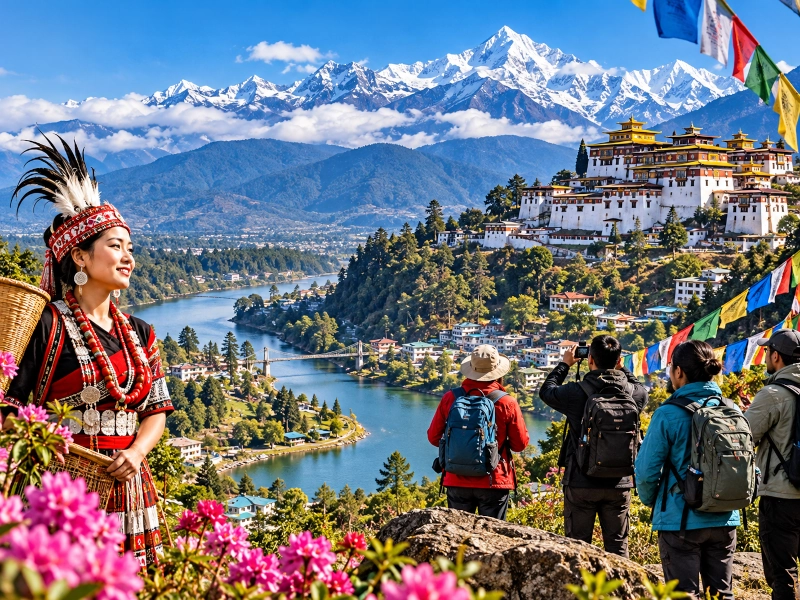
India’s northeastern region has recorded substantial growth in domestic tourism, with tourist visits reaching approximately 1.51 crore in 2025, compared with 95.65 lakh in 2019. The increase of nearly 58% highlights the growing importance of the Northeast in India’s tourism economy and the opportunities emerging from improvements in regional connectivity, tourism infrastructure and destination promotion.
The Ministry of Tourism announced the figures on October 29, 2026, during the inauguration of the 14th International Tourism Mart in Tawang, Arunachal Pradesh. The three-day event, organised in collaboration with the Arunachal Pradesh government and other northeastern states, brings together tourism businesses, international buyers, domestic operators and government representatives to promote the region’s diverse tourism attractions.
Union Minister for Tourism and Culture Gajendra Singh Shekhawat highlighted the increasing interest in northeastern destinations and emphasised the importance of translating the region’s natural and cultural resources into sustainable economic opportunities. The event is intended to strengthen cooperation between tourism stakeholders, encourage investment and improve the visibility of destinations that remain relatively unfamiliar to many domestic and international travellers.
The reported growth reflects the expanding appeal of northeastern India as a destination for cultural tourism, wildlife exploration, spiritual experiences, adventure activities and community-based travel. However, the government figures represent tourist visits rather than unique individual travellers, and they relate to the completed calendar year 2025 rather than tourism activity during October 2026.
Domestic Tourism in Northeast India Increases by Nearly 58%
The rise in domestic tourist visits between 2019 and 2025 represents an important development for a region where geographical conditions and infrastructure limitations have historically presented challenges to tourism expansion. According to the Ministry of Tourism, visits to the eight northeastern states increased from 95.65 lakh in 2019 to approximately 1.51 crore in 2025, reflecting growth of nearly 58% over the period.
The statistics cover Arunachal Pradesh, Assam, Manipur, Meghalaya, Mizoram, Nagaland, Sikkim and Tripura. Together, these states contain some of India’s most distinctive landscapes and cultural environments, including Himalayan mountain ranges, extensive river systems, tropical forests, wetlands, traditional villages and historical religious sites.
The increase in visitor numbers indicates growing domestic interest in exploring the region beyond conventional tourism destinations. Improvements in connectivity, greater awareness of regional attractions and the expansion of tourism-related services may have contributed to this development, although the ministry has not attributed the entire increase to any single initiative.
Tourism growth also creates opportunities for local enterprises involved in accommodation, transportation, food services, handicrafts and cultural experiences. The economic benefits can be particularly important in rural and geographically isolated communities where alternative employment opportunities may be limited.
Nevertheless, the long-term value of tourism expansion will depend on whether infrastructure development, environmental protection and community participation keep pace with growing visitor demand.
Assam Leads Northeast Tourism with More Than 90 Lakh Domestic Visits
Official state-wise tourism statistics released by the Ministry of Tourism in August 2026 provide additional insight into the distribution of visitors across the northeastern region. Assam recorded approximately 90.56 lakh domestic tourist visits during 2025, accounting for the largest share of the region’s tourism activity.
Assam’s tourism sector benefits from its combination of wildlife destinations, religious sites, cultural attractions, river-based experiences and established urban infrastructure. Kaziranga National Park, the Kamakhya Temple in Guwahati, Majuli and the Brahmaputra River are among the state’s prominent attractions.
Meghalaya recorded approximately 18.48 lakh domestic tourist visits during the same period. The state’s waterfalls, caves, forest landscapes, traditional villages and distinctive cultural heritage continue to attract travellers interested in nature and community-oriented tourism experiences.
Sikkim registered approximately 16.55 lakh domestic tourist visits, supported by its Himalayan landscapes, Buddhist monasteries, mountain tourism infrastructure and established destinations such as Gangtok and surrounding high-altitude regions.
Arunachal Pradesh recorded approximately 9.13 lakh domestic tourist visits, while Mizoram registered around 8.28 lakh. Tripura recorded approximately 6.81 lakh visits, followed by Nagaland with approximately 1.27 lakh and Manipur with around 25,000.
These differences demonstrate that tourism development across the Northeast remains uneven, with some states attracting significantly greater numbers of visitors than others. The figures highlight the importance of destination-specific strategies that recognise differences in accessibility, infrastructure, tourism products and local conditions.
International Tourism Mart Returns to Tawang After 13 Years
The 14th International Tourism Mart commenced in Tawang on October 29, 2026, marking the event’s return to the Arunachal Pradesh destination after 13 years. Tawang previously hosted the second edition of the International Tourism Mart in 2013, making its selection for the 2026 event a significant development for the state’s tourism promotion efforts.
The three-day programme is being organised at Hotel Vivanta in Tawang from October 29 to 31, with participation from domestic and international tourism stakeholders. The event provides a platform for promoting northeastern destinations, developing commercial partnerships and encouraging greater cooperation between tourism businesses and government agencies.
According to the Ministry of Tourism, the 2026 edition has attracted 43 international buyers representing 22 countries, marking the highest international buyer participation recorded at an International Tourism Mart. The event also includes 42 domestic buyers from 16 states and Union Territories and 81 sellers representing tourism-related businesses and services.
The participation of international buyers provides opportunities for travel operators and tourism enterprises from the Northeast to establish commercial relationships with overseas markets. Such interactions can help introduce lesser-known destinations to international travel networks and support the development of specialised tourism packages.
The programme includes structured business-to-business meetings, destination presentations, cultural performances and discussions concerning sustainable tourism development. These activities are intended to connect local tourism enterprises with potential commercial partners while highlighting the region’s natural and cultural attractions.
Tawang Highlights Arunachal Pradesh’s Himalayan Tourism Potential
The selection of Tawang as the venue places particular emphasis on Arunachal Pradesh’s potential as a destination for Himalayan tourism, cultural exploration and spiritual travel. Located in the eastern Himalayas, Tawang is known for its mountainous landscapes, Buddhist heritage and distinctive cultural traditions.
Tawang Monastery is among the region’s most prominent religious and historical landmarks. The monastery attracts visitors interested in Buddhist culture, traditional architecture and the religious heritage of the Himalayan region.
The surrounding landscape also contains high-altitude lakes, waterfalls, mountain passes and memorials associated with India’s military history. These attractions provide opportunities for tourism experiences combining natural scenery, cultural heritage and historical exploration.
The International Tourism Mart programme includes planned technical visits to Tawang Monastery, Jaswant Garh War Memorial, Jang Waterfall, Tawang War Memorial, Urgelling Gompa, Buddha Park and Pankang Teng Tso Lake. These visits are intended to familiarise tourism operators and international delegates with the destination’s attractions and potential visitor experiences.
The development of tourism in high-altitude regions requires careful planning because mountain environments can be vulnerable to landslides, extreme weather, waste-management problems and infrastructure pressures. Sustainable tourism development must therefore consider environmental protection, transport safety and the capacity of destinations to accommodate increasing visitor numbers.
Government Sanctions Major Tourism Infrastructure Investments
The Ministry of Tourism has outlined substantial infrastructure investments intended to support tourism development across northeastern India. These investments cover destination development, pilgrimage infrastructure, visitor amenities and projects intended to improve the overall tourism experience.
According to the October 29 announcement, 16 projects worth approximately ₹1,309 crore have been sanctioned under Swadesh Darshan 1.0. The programme supports the development of tourism infrastructure and facilities associated with identified destinations and tourism circuits.
Another 17 projects worth approximately ₹564 crore have been sanctioned under Swadesh Darshan 2.0, which places greater emphasis on sustainable, responsible and destination-oriented tourism development. The revised approach seeks to strengthen individual destinations while considering their environmental, social and economic requirements.
The government has also sanctioned nine projects worth approximately ₹139 crore under the Challenge Based Destination Development initiative. These projects are intended to support destination improvements and strengthen the competitiveness of selected tourism locations.
Under the Special Assistance to States for Capital Investment framework, nine additional projects worth approximately ₹790 crore have been sanctioned. The programme supports capital expenditure by state governments, including infrastructure projects relevant to tourism development.
The Pilgrimage Rejuvenation and Spiritual Heritage Augmentation Drive has also supported nine projects worth approximately ₹258 crore across the region. These investments are intended to improve facilities at important religious and heritage destinations.
The sanctioned projects demonstrate the scale of government investment being directed towards the Northeast’s tourism infrastructure. However, project sanctions should not be confused with completed construction or actual expenditure, as implementation timelines and progress may vary between individual projects.
Improved Air Connectivity Supports Regional Tourism
Transport connectivity remains a major consideration for tourism development in northeastern India because of the region’s mountainous geography, dispersed settlements and challenging terrain. Improved air services can reduce travel times and make destinations more accessible to visitors travelling from other parts of India.
The Ministry of Tourism has reported support for ten tourism routes in the Northeast under the Regional Connectivity Scheme–UDAN. The initiative seeks to improve air connectivity by encouraging regional aviation services and supporting routes that may otherwise face commercial difficulties.
Better air connectivity can help tourism operators develop travel itineraries connecting major cities with smaller destinations. It can also support local businesses by improving access for visitors, investors and tourism service providers.
For states such as Arunachal Pradesh, Mizoram, Nagaland and Sikkim, transport infrastructure is especially important because geographical conditions can make road journeys lengthy and difficult.
However, the successful development of tourism connectivity depends on more than the introduction of air routes. Reliable flight operations, airport infrastructure, road networks and transport services are necessary to ensure that travellers can reach destinations beyond major transport hubs.
The expansion of connectivity must therefore be accompanied by improvements in supporting infrastructure and services.
North East Bazaar Promotes Traditional Handicrafts and Cultural Heritage
The inauguration of the North East Bazaar formed an important part of the International Tourism Mart’s opening programme. The exhibition showcases traditional handicrafts, handlooms and cultural products associated with the eight northeastern states.
The region possesses diverse artistic traditions involving weaving, textile production, bamboo and cane craftsmanship, traditional jewellery and other forms of locally developed craftsmanship. These activities are closely associated with the cultural identities and livelihoods of communities across the Northeast.
Tourism can create additional markets for such products by connecting visitors directly with artisans and local enterprises. The expansion of cultural tourism may also encourage greater appreciation of traditional skills and support their transmission between generations.
The Ministry of Tourism has emphasised the importance of ensuring that local communities participate in tourism development and benefit from the economic opportunities it creates.
Cultural performances organised during the International Tourism Mart provide another opportunity to showcase the region’s diverse traditions. Such activities help introduce visitors and tourism businesses to the cultural experiences available across northeastern destinations.
The promotion of traditional crafts and cultural tourism also demonstrates how tourism development can contribute to economic activity beyond conventional accommodation and transport services.
Sustainable Tourism Becomes a Priority for the Northeast
Northeastern India contains some of the country’s most ecologically sensitive landscapes, including tropical forests, mountain ecosystems, wetlands and protected wildlife habitats. The region’s natural resources are central to its tourism appeal, making environmental conservation an essential component of long-term destination development.
The Ministry of Tourism has identified sustainable tourism as an important priority for the region. The approach seeks to encourage tourism growth while protecting natural habitats, cultural heritage and the interests of local communities.
Community-based tourism can provide opportunities for residents to participate directly in tourism activities through homestays, local guiding services, traditional food experiences and cultural programmes. Such models can help distribute tourism-related income among smaller enterprises and rural households.
Nature-based tourism also offers opportunities for wildlife observation, trekking, river-based activities and exploration of forest landscapes. However, these activities require appropriate management to reduce disturbance to wildlife and sensitive ecosystems.
The expansion of visitor infrastructure can create environmental pressures involving waste generation, water consumption, habitat disturbance and changes in land use. Mountain destinations may face additional challenges associated with landslides, flooding and seasonal weather conditions.
Effective tourism planning must therefore consider environmental carrying capacity, infrastructure requirements and the long-term protection of the landscapes that attract visitors.
Digital Initiatives Aim to Improve Tourism Accessibility
The Ministry of Tourism is also promoting digital technologies to improve destination visibility and strengthen access to tourism information and services. During the inaugural programme, Union Minister of State for Tourism Suresh Gopi highlighted the potential of technology to support tourism businesses and promote lesser-known destinations.
Government initiatives such as Dekho Apna Desh 2.0 and the National Digital Tourism Stack are intended to improve the digital accessibility of tourism information and support technology-enabled tourism services.
Digital platforms can help visitors discover destinations, obtain travel information and connect with accommodation providers, transport operators and other tourism businesses.
For smaller enterprises in remote areas, improved digital visibility may create opportunities to reach customers beyond traditional commercial networks. Online access can be particularly useful for homestay operators, local guides and community-based tourism organisations.
However, the effectiveness of digital tourism initiatives depends on reliable internet connectivity, digital literacy and the ability of local businesses to participate in online platforms.
The development of digital infrastructure must therefore be accompanied by practical support for enterprises seeking to use these technologies.
Tourism Growth Creates Opportunities for Local Economies
The increase in domestic tourist visits to northeastern India highlights the sector’s potential to contribute to regional economic development. Tourism generates demand across multiple industries, including accommodation, transportation, food services, handicrafts, entertainment and specialised visitor experiences.
As destinations attract more visitors, these activities can create opportunities for local entrepreneurs and small businesses. Rural communities may benefit through homestays, guided tours, cultural programmes and the sale of locally produced goods.
Tourism can also generate employment for young people in hospitality management, transport services, food preparation, destination management and related activities.
For communities located in geographically isolated regions, tourism-related income may provide an additional source of livelihood alongside agriculture and traditional economic activities.
However, higher visitor numbers do not automatically guarantee proportional increases in local income. The distribution of tourism benefits depends on business ownership, employment conditions, local procurement and the ability of communities to participate in commercial opportunities.
Policies supporting entrepreneurship, workforce training and sustainable destination management can help strengthen the sector’s contribution to local economies.
Northeast States Seek Greater Cooperation in Tourism Development
The International Tourism Mart programme includes a regional meeting of tourism ministers from the northeastern states scheduled for October 30, 2026. The meeting is intended to examine opportunities for strengthening cooperation, improving tourist facilitation and developing coordinated approaches to tourism promotion.
Greater collaboration between the eight states could support the development of tourism circuits connecting destinations across state boundaries. Such arrangements may allow travellers to experience several cultural and natural attractions during a single journey.
Regional coordination can also help address shared challenges involving transport connectivity, tourism infrastructure, destination management and marketing.
For example, coordinated tourism promotion could connect wildlife destinations in Assam with cultural attractions in Nagaland, Himalayan experiences in Arunachal Pradesh and Sikkim, and nature-based tourism in Meghalaya and Mizoram.
Such approaches could encourage longer visitor stays and help distribute tourism-related economic activity across a wider geographical area.
The October 29 government announcement confirms that the regional meeting is scheduled as part of the International Tourism Mart. Any specific decisions or agreements arising from the meeting would require separate official confirmation.
Northeast India’s Tourism Growth Highlights Expanding National Interest
The increase in domestic tourist visits from 95.65 lakh in 2019 to approximately 1.51 crore in 2025 represents a noteworthy development for northeastern India’s tourism sector. The figures indicate growing interest in the region’s natural landscapes, cultural traditions, wildlife destinations and historical heritage.
The inauguration of the 14th International Tourism Mart in Tawang provides an opportunity to strengthen this momentum through commercial partnerships, improved destination promotion and greater engagement with international tourism markets.
The participation of buyers from 22 countries highlights the potential for expanding the Northeast’s visibility among overseas travellers. At the same time, government investments in tourism infrastructure and regional connectivity are intended to support the development of destinations across the eight states.
The long-term success of the sector will depend on balancing visitor growth with environmental conservation, cultural preservation and economic opportunities for local communities. Tourism development must also account for the geographical and ecological conditions that make the region distinctive.
With its combination of Himalayan landscapes, biodiversity-rich forests, traditional communities and cultural heritage, northeastern India has the potential to expand its contribution to India’s tourism economy while developing a sustainable and inclusive model of regional tourism.
The figures released by the Ministry of Tourism on October 29, 2026, provide an important measure of the sector’s growth and underscore the opportunities associated with developing tourism across one of India’s most geographically and culturally diverse regions.
References
Ministry of Tourism, Government of India. “14th International Tourism Mart Inaugurated in Tawang, Arunachal Pradesh.” Press Information Bureau, October 29, 2026. The official announcement confirms the increase in domestic tourist visits from 95.65 lakh in 2019 to approximately 1.51 crore in 2025, international and domestic buyer participation, and tourism infrastructure investments across northeastern India.
Official Source: https://www.pib.gov.in/PressReleseDetailm.aspx?PRID=2330273&lang=1®=1
Ministry of Tourism, Government of India. “Tawang to Host 14th International Tourism Mart from 29–31 October 2026.” Press Information Bureau, October 28, 2026. The announcement provides details of the event, participating tourism stakeholders, business meetings, cultural activities and planned technical visits to destinations in Tawang.
Official Source: https://www.pib.gov.in/PressReleasePage.aspx?PRID=2329288&lang=2®=48
Ministry of Tourism, Government of India. “Development of Tourism in the North-Eastern Region.” Press Information Bureau, August 10, 2026. The official parliamentary response provides state-wise domestic and foreign tourist visit statistics for the eight northeastern states during 2025 and available tourism data for January–June 2026.
Official Source: https://www.pib.gov.in/PressReleasePage.aspx?PRID=2297053&lang=2®=48
Ministry of Tourism, Government of India. “Ministry of Tourism Concludes the 13th International Tourism Mart in Gangtok, Showcasing the Rich Tourism Potential of the North Eastern Region.” Press Information Bureau, November 16, 2025. The announcement provides background on the previous edition of the International Tourism Mart and the government’s efforts to promote sustainable tourism across northeastern India.
Official Source: https://www.pib.gov.in/PressReleasePage.aspx?PRID=2191108&lang=1®=3
You may also like
-
India’s Pharmaceutical Exports Rise 4.9% to $16.14 Billion as European and Asian Markets Expand
-
Pratt & Whitney Signs Over $40 Million in Aerospace Supply Agreements with Indian Manufacturers
-
India Emerges as Global Leader in Green Hydrogen Offtake Commitments Exceeding 5.55 Lakh Tonnes Annually
-
India Post and UTI Mutual Fund Expand Partnership to Provide Doorstep KYC Verification Across India
-
Ambemohar Rice of Maharashtra: The Mango-Blossom Fragrant Heritage Grain of the Sahyadri Hills
