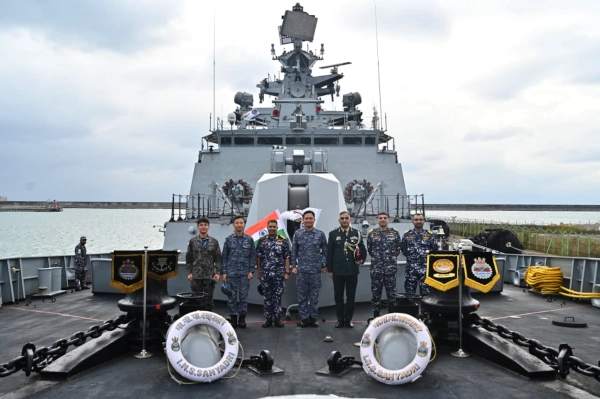
The Indian Navy’s indigenously designed and built guided-missile stealth frigate INS Sahyadri arrived at Busan Naval Harbour in the Republic of Korea on 26 October 2026 to participate in a bilateral maritime exercise with the Republic of Korea Navy. The deployment marks another step in strengthening operational cooperation, maritime security and naval interoperability between India and South Korea in the Indo-Pacific region.
The Ministry of Defence announced the ship’s arrival on 28 October 2026, highlighting the growing defence engagement between the two countries. The bilateral exercise will bring together INS Sahyadri and the South Korean destroyer ROKS Munmu the Great for coordinated maritime activities designed to improve professional cooperation and operational understanding.
The deployment also reflects the Indian Navy’s continuing efforts to strengthen maritime partnerships with friendly countries through regular exercises, port visits and professional exchanges.
Indian and South Korean Navies Begin Bilateral Engagement
INS Sahyadri received a warm welcome from the Republic of Korea Navy upon its arrival at Busan, reflecting the established defence relationship between the two countries.
The bilateral engagement comprises harbour and sea phases, providing personnel from both navies with opportunities to exchange operational knowledge, familiarise themselves with different naval procedures and strengthen professional relationships.
During the harbour phase, Indian and South Korean naval personnel will participate in professional interactions, cross-deck visits, training activities and sporting events. These exchanges are intended to promote mutual understanding of operational practices while encouraging the sharing of experience between sailors and officers.
The Commanding Officer of INS Sahyadri is also scheduled to meet senior Republic of Korea Navy officials as part of the bilateral engagement.
Such interactions contribute to developing professional familiarity between naval forces, which is important for conducting coordinated maritime operations and responding effectively to shared security challenges.
INS Sahyadri and ROKS Munmu the Great to Conduct Maritime Activities
Following the harbour phase, INS Sahyadri will participate in coordinated activities at sea alongside ROKS Munmu the Great, a guided-missile destroyer of the Republic of Korea Navy.
The sea phase will provide an operational environment for strengthening communication, coordination and interoperability between the two warships.
Bilateral naval exercises help participating forces understand each other’s procedures, improve coordination during maritime operations and develop familiarity with different naval platforms.
The Indian Ministry of Defence has not disclosed the specific tactical serials planned for the exercise. However, the announced maritime activities are intended to consolidate operational cooperation and strengthen professional ties between the participating naval forces.
The exercise is particularly relevant because India and South Korea are important maritime economies with significant interests in maintaining secure and uninterrupted international sea routes.
INS Sahyadri Demonstrates India’s Indigenous Naval Capabilities
INS Sahyadri is a Shivalik-class guided-missile stealth frigate of the Indian Navy, developed under Project 17 as part of India’s indigenous warship construction programme.
Built by Mazagon Dock Shipbuilders Limited in Mumbai, the frigate represents an important stage in India’s development of domestically constructed frontline surface combatants incorporating stealth-oriented design features and integrated combat systems.
The Shivalik-class frigates were designed for multidimensional naval operations, combining anti-surface, anti-air and anti-submarine warfare capabilities.
INS Sahyadri is equipped with advanced sensors, missile systems and naval aviation facilities that enable it to undertake a variety of operational assignments, including fleet deployments, maritime surveillance and international naval exercises.
Its participation in the bilateral exercise also provides an opportunity to demonstrate the operational capabilities of Indian-built warships during engagements with technologically advanced foreign navies.
The deployment reflects India’s progress in indigenous naval design, construction and integration of complex maritime combat platforms.
Strengthening India-South Korea Defence Cooperation
India and the Republic of Korea maintain a Special Strategic Partnership encompassing defence cooperation, economic relations, technology, manufacturing and maritime security.
Naval engagement has become an important component of this relationship as both countries recognise the strategic significance of the Indo-Pacific and the need to safeguard international maritime trade.
South Korea possesses advanced shipbuilding and maritime technology capabilities, while India continues to expand its indigenous shipbuilding infrastructure and naval modernisation programmes.
Regular interactions between their naval forces can help strengthen operational familiarity while creating opportunities for wider defence and maritime cooperation.
The bilateral exercise at Busan represents a practical demonstration of this engagement, bringing together naval platforms and personnel for professional exchanges and coordinated operations.
Advancing Maritime Security in the Indo-Pacific
The Indo-Pacific contains some of the world’s busiest shipping routes, connecting major manufacturing centres, energy suppliers and international consumer markets.
Maintaining maritime stability across these waters is important for economic security and uninterrupted international trade.
For India, naval cooperation with countries such as South Korea supports broader efforts to develop maritime partnerships across East and Southeast Asia.
The Indian Navy regularly participates in bilateral and multilateral exercises with friendly foreign navies to strengthen interoperability, improve operational understanding and contribute to regional maritime security.
The deployment of INS Sahyadri to Busan demonstrates India’s continuing commitment to these objectives while reinforcing the importance of defence cooperation within the India-Republic of Korea Special Strategic Partnership.
Through professional exchanges and coordinated maritime activities, both navies aim to deepen their operational relationship and contribute to peace, stability and security across the Indo-Pacific.
You may also like
-
India and South Korea Explore Joint Defence Technology Development and Industrial Cooperation
-
India and Mexico Launch Preferential Trade Agreement Negotiations to Expand Bilateral Trade and Investment
-
India Strengthens Indo-Pacific Defence Partnerships with US, Japan and Singapore at ADMM-Plus
-
India and Russia Explore Deeper Cooperation in Trade, Science and Technology During Parliamentary Talks
-
India Advances Tracked Artillery Procurement, Creating Opportunities for Domestic Defence Manufacturers
