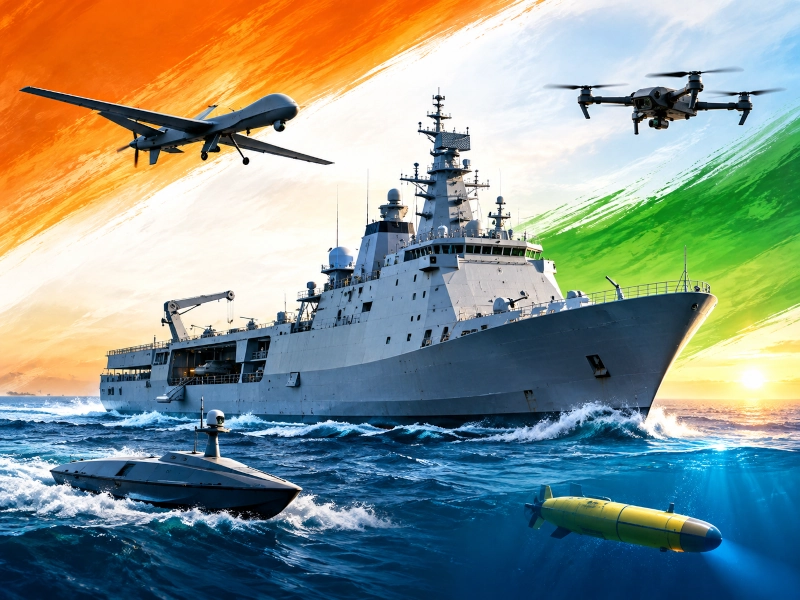
The Indian Navy has inducted INS Samarthak, an indigenously designed and constructed multi-purpose warship capable of serving as a mothership for unmanned and autonomous naval systems. Built by Larsen & Toubro at its Kattupalli shipyard near Chennai, the vessel represents an important development in India’s efforts to strengthen indigenous naval shipbuilding, expand maritime technological capabilities and prepare for the increasing role of autonomous systems in modern naval operations.
Commissioned into the Indian Navy on 16 October 2026 at Naval Base Karwar in Karnataka, INS Samarthak is the first of two Multi-Purpose Vessels being constructed under the programme. The ship has been designed to undertake a wide range of operational and developmental responsibilities, including maritime surveillance, offshore patrolling, weapons and sensor trials, unmanned-system operations, humanitarian assistance and disaster relief.
One of its most significant capabilities is its intended role as a support platform for unmanned aerial, surface and underwater systems. Rather than functioning exclusively as a conventional patrol vessel, INS Samarthak provides the Indian Navy with a versatile platform designed to accommodate emerging technologies and support their evaluation under operational maritime conditions.
According to the Ministry of Defence, the ship incorporates more than 75% indigenous content and is the first major warship constructed by an Indian private shipyard to enter service with the Indian Navy. Its commissioning reflects the expanding role of domestic industry in the design, engineering and construction of advanced naval platforms.
A New Platform for Unmanned Naval Operations
The concept of using a warship as a mothership for unmanned systems represents an important development in modern naval warfare. Such vessels provide a base from which unmanned platforms can be deployed, controlled, supported and recovered during maritime operations.
Unlike traditional naval vessels designed primarily around onboard weapons and crewed systems, a mothership can extend its operational capabilities through smaller autonomous or remotely operated platforms. These systems may be employed for reconnaissance, surveillance, underwater inspection, environmental monitoring, mine countermeasures and other specialised maritime activities.
The Ministry of Defence has officially identified unmanned and autonomous system mothership operations as one of INS Samarthak’s intended functions. This capability gives the Indian Navy a platform for evaluating how different unmanned technologies can be integrated into future maritime missions.
Unmanned aerial vehicles can extend surveillance coverage beyond the immediate vicinity of a ship, while unmanned surface vessels can conduct missions in areas where deploying larger crewed vessels may be unnecessary or operationally undesirable. Autonomous underwater vehicles can perform underwater surveys, inspections and other tasks requiring specialised sensors and navigation systems.
The integration of such technologies could enable naval forces to gather information across larger maritime areas while reducing the need to expose personnel to certain hazardous operating environments.
For INS Samarthak, the mothership role is particularly significant because the vessel has been designed as a multi-purpose platform rather than a dedicated drone carrier. Its adaptable configuration provides opportunities for evaluating different unmanned technologies as the Indian Navy’s operational requirements evolve.
However, the Navy has not publicly confirmed that every category of unmanned system has already been deployed operationally from the vessel. Its designated mothership role should therefore be understood as an officially established design capability, with specific operational deployments requiring separate confirmation.
Supporting Unmanned Surface and Underwater Vehicles
The increasing use of unmanned surface vessels and autonomous underwater vehicles is transforming the way navies approach several maritime missions.
Unmanned surface vessels are capable of operating on the water without personnel physically present onboard. Depending on their configuration, these platforms can undertake surveillance, hydrographic surveys, reconnaissance and other specialised tasks.
Autonomous underwater vehicles operate below the sea surface and can be equipped with sonar, imaging equipment and scientific instruments for mapping or inspecting underwater environments.
These technologies are particularly relevant to mine countermeasure operations, where identifying and investigating potentially dangerous underwater objects can expose crewed vessels and personnel to significant risks.
A mothership capable of supporting underwater robotic systems can provide a means of deploying specialised platforms while maintaining the larger support vessel at a safer distance from suspected hazards.
INS Samarthak’s intended role in supporting unmanned platforms could therefore contribute to future Indian Navy efforts to integrate robotic systems into mine detection, underwater reconnaissance and maritime surveillance.
Specialist naval reporting has identified the ship’s stern-mounted crane, flight deck and dynamic positioning capabilities as features suited to the handling and operation of unmanned systems.
The precise range of unmanned vehicles that INS Samarthak will routinely operate has not yet been publicly established. Nevertheless, the vessel provides a useful foundation for evaluating how autonomous maritime systems can be integrated with larger naval platforms.
Dynamic Positioning Technology for Precision Maritime Operations
An important technological feature of INS Samarthak is its advanced Dynamic Positioning System, which enables the vessel to maintain a controlled position during complex maritime manoeuvres.
Dynamic positioning systems use information from positioning sensors, environmental monitoring equipment and vessel-control systems to manage propulsion and maintain a ship’s position or heading.
Such capabilities are valuable during operations requiring precise control, particularly when a vessel must remain relatively stationary despite the effects of wind, waves and currents.
For a ship supporting the deployment and recovery of unmanned maritime systems, maintaining a stable position can improve the safety and efficiency of handling operations.
Dynamic positioning can also support equipment trials, underwater operations and other specialised missions that require accurate vessel positioning.
Larsen & Toubro has confirmed that INS Samarthak incorporates a state-of-the-art Dynamic Positioning System designed to support precision control during complex marine manoeuvres.
The technology adds to the vessel’s versatility and makes it suitable for specialised naval tasks that extend beyond conventional maritime patrol operations.
A Floating Test Platform for Indigenous Weapons and Sensors
Beyond unmanned-system operations, INS Samarthak has been designed to support the testing and evaluation of advanced naval weapons, sensors and other equipment.
The Ministry of Defence describes the vessel as a versatile trials and evaluation platform intended to strengthen the Indian Navy’s ability to test emerging technologies developed by domestic research institutions and defence manufacturers.
Such testing platforms play an important role in defence technology development because new equipment must be evaluated under realistic environmental and operational conditions before it can be considered for broader deployment.
Naval systems face demanding requirements involving seawater exposure, vibration, vessel movement, electromagnetic interference and changing weather conditions. Testing equipment aboard an operational vessel allows engineers and naval personnel to assess performance under conditions that cannot always be fully reproduced in laboratories.
INS Samarthak can support the evaluation of technologies such as naval sensors, surveillance equipment, weapons-related systems and unmanned maritime platforms.
The vessel’s intended role as a target deployment and trials platform also provides opportunities to support testing activities involving naval equipment and operational procedures.
For Indian defence research organisations and private manufacturers, access to specialised maritime trials infrastructure is important for translating technology development into operationally suitable products.
INS Samarthak could therefore contribute to India’s indigenous naval technology ecosystem by providing a platform for the evaluation, refinement and integration of advanced systems.
Expanding the Indian Navy’s Mine Countermeasure Capabilities
Mine countermeasure operations represent another area in which unmanned maritime technologies are becoming increasingly important.
Naval mines can threaten military vessels, commercial shipping and access to strategically important maritime routes. Detecting, classifying and neutralising these threats requires specialised equipment and careful operational procedures.
Traditionally, mine countermeasure operations have relied heavily on dedicated vessels and crewed equipment. Advances in autonomous underwater vehicles and remotely operated surface platforms are creating opportunities to perform certain detection and inspection tasks without placing personnel directly inside hazardous areas.
INS Samarthak’s mothership configuration could allow the Indian Navy to evaluate the deployment of unmanned platforms suited to mine countermeasure missions.
Such systems may use sonar and other sensors to examine underwater environments, identify suspicious objects and provide information for further investigation.
Specialist naval reporting has identified mine countermeasures as one of the potential applications of the Samarthak-class vessels, particularly through the operation of unmanned surface and underwater vehicles.
The ship has not been officially described as a dedicated mine countermeasure vessel, and its commissioning should not be interpreted as confirmation that a complete operational mine-hunting capability has already been established.
Nevertheless, its adaptable design provides an opportunity for the Navy to develop and evaluate technologies relevant to future mine countermeasure requirements.
Larsen & Toubro Demonstrates Indigenous Warship Construction Capabilities
INS Samarthak is also an important achievement for India’s private defence manufacturing industry.
The vessel was conceptualised, engineered and constructed by Larsen & Toubro through its Warship Design Centre and Kattupalli shipbuilding facilities in Tamil Nadu.
According to L&T, the ship was designed and built entirely through its in-house shipbuilding capabilities, demonstrating the company’s ability to undertake complex naval engineering projects.
The vessel incorporates more than 75% indigenous content and uses modular construction and pre-outfitting techniques intended to improve shipbuilding efficiency.
Modular construction involves assembling major sections of a vessel separately before integrating them into the completed ship. This approach can improve construction coordination and allow equipment installation to proceed during earlier stages of production.
The Ministry of Defence has highlighted INS Samarthak as the first major warship built by an Indian private shipyard to enter service with the Indian Navy.
The achievement is significant because India’s naval shipbuilding sector has traditionally been dominated by public-sector shipyards. The successful delivery and commissioning of INS Samarthak demonstrates the growing capabilities of private industry in complex military ship construction.
Larsen & Toubro delivered the vessel to the Indian Navy on 27 August 2026, before its formal commissioning on 16 October.
The company’s Kattupalli facility is also constructing the second vessel in the Multi-Purpose Vessel programme, alongside other naval shipbuilding projects.
Strengthening Make in India and Atmanirbhar Bharat
The indigenous development of INS Samarthak is closely aligned with India’s Make in India and Atmanirbhar Bharat initiatives, which seek to strengthen domestic defence manufacturing and reduce dependence on imported military equipment.
Modern naval shipbuilding requires an extensive industrial ecosystem involving steel production, propulsion engineering, electrical equipment, automation systems, communication technologies, sensors and specialised manufacturing services.
The construction of advanced naval vessels within India creates opportunities for domestic companies to develop expertise across these interconnected industries.
INS Samarthak’s high indigenous-content percentage reflects the participation of Indian manufacturers and engineering enterprises in producing equipment and components for the vessel.
The project also illustrates the importance of collaboration between the Indian Navy and private industry in developing sophisticated military platforms.
By expanding the number of domestic organisations capable of designing and constructing naval vessels, India can strengthen competition, manufacturing capacity and technological development within its defence industrial ecosystem.
The ship’s role as a platform for indigenous weapons and sensor trials adds another dimension to this objective. It can support the evaluation of technologies developed by Indian research organisations, defence manufacturers and emerging companies working on advanced maritime systems.
This combination of indigenous shipbuilding and support for future technology development makes INS Samarthak relevant to India’s broader efforts to establish a more self-reliant defence industry.
Supporting Maritime Surveillance and Humanitarian Operations
Although its potential role in unmanned naval operations has attracted attention, INS Samarthak has been designed to perform several additional responsibilities.
The Ministry of Defence has confirmed that the vessel can undertake maritime surveillance, reconnaissance, offshore patrolling and low-intensity maritime operations.
These functions are relevant to India’s extensive maritime responsibilities, including the protection of strategic sea routes, monitoring of maritime activity and maintenance of security across areas of national interest.
The vessel is also intended to support humanitarian assistance and disaster relief operations.
During natural disasters and maritime emergencies, naval ships can provide transportation, logistical assistance, emergency supplies and support to affected communities.
INS Samarthak has additionally been designed with the potential for conversion into a limited hospital ship, providing flexibility to support medical assistance when required.
The Ministry of Defence has also identified firefighting and salvage-related operations among the vessel’s intended roles.
These capabilities make the ship a versatile support platform capable of contributing to both military and non-combat maritime activities.
Its multi-purpose design reflects the Indian Navy’s requirement for vessels that can adapt to different operational conditions without being restricted to a single specialised mission.
Preparing the Indian Navy for Autonomous Maritime Technologies
The development of INS Samarthak comes at a time when naval forces around the world are examining how autonomous systems can complement conventional warships.
Unmanned platforms offer opportunities to extend surveillance coverage, conduct specialised underwater operations and undertake missions that may be difficult or hazardous for crewed vessels.
Their growing capabilities are also creating new requirements for communications, command-and-control systems, autonomous navigation and integration with larger naval platforms.
The use of motherships provides one approach to supporting these technologies by allowing smaller unmanned systems to operate with logistical and technical assistance from a larger vessel.
INS Samarthak’s flexible design creates opportunities for the Indian Navy to test these concepts while continuing to perform conventional maritime responsibilities.
The vessel may also help Indian research institutions and defence manufacturers evaluate new technologies involving unmanned surface vehicles, underwater robotics and advanced maritime sensors.
As these technologies mature, the ability to integrate different systems into naval operations will become increasingly important.
The commissioning of INS Samarthak therefore represents an investment not only in present operational requirements but also in the infrastructure needed to evaluate future naval capabilities.
A New Chapter in India’s Indigenous Naval Development
INS Samarthak combines indigenous shipbuilding, advanced engineering and operational versatility within a single naval platform.
Its commissioning marks the successful induction of the first vessel in a new class of multi-purpose ships designed to support the Indian Navy’s evolving requirements.
The vessel’s designated role as a mothership for unmanned and autonomous systems is particularly significant because it provides a foundation for testing and integrating technologies that could influence future maritime operations.
Its additional capabilities in weapons trials, sensor evaluation, maritime surveillance and humanitarian assistance make it a valuable platform for both operational and developmental activities.
Equally important is the contribution of Larsen & Toubro and India’s domestic defence manufacturing ecosystem to the ship’s development and construction.
With more than 75% indigenous content, INS Samarthak demonstrates the growing ability of Indian industry to undertake complex naval shipbuilding projects and support technologically advanced defence programmes.
While the specific unmanned platforms that will operate from the vessel remain to be publicly confirmed, its intended capabilities establish an important foundation for India’s future autonomous maritime operations.
INS Samarthak thus represents a significant step towards an Indian Navy equipped not only with indigenously built warships but also with the infrastructure required to develop, test and integrate emerging naval technologies.
References
1. Ministry of Defence, Government of India — Press Information Bureau
Title: Indian Navy Set to Commission Indigenous Multi Purpose Warship Samarthak
Published: 13 October 2026
The official announcement identifies the ship’s intended roles, including unmanned and autonomous system mothership operations, maritime surveillance, weapons trials, humanitarian assistance and other naval tasks.
Official source:
https://www.pib.gov.in/PressReleaseIframePage.aspx?PRID=2322795
2. Ministry of Defence, Government of India — Press Information Bureau
Title: Indian Navy Commissions INS Samarthak, the First Indigenous Multi-Purpose Vessel
Published: 16 October 2026
The announcement confirms the commissioning, indigenous construction, domestic-content percentage and technological capabilities of the vessel.
Official source:
https://www.pib.gov.in/PressReleasePage.aspx?PRID=2324581
3. Ministry of Defence, Government of India — Press Information Bureau
Title: Delivery of Samarthak — The First Indigenous Multi-Purpose Vessel of Indian Navy
Published: 27 August 2026
The release confirms delivery of the vessel by Larsen & Toubro and provides background on its design and intended operational roles.
Official source:
https://www.pib.gov.in/PressReleasePage.aspx?PRID=2303919
4. Larsen & Toubro — Official Corporate Announcement
Title: L&T Delivers Multi-Purpose Vessel INS Samarthak to Indian Navy
Published: 1 September 2026
The announcement provides details of indigenous design and construction, the ship’s dynamic positioning capabilities and the company’s naval shipbuilding programme.
Official source:
https://www.larsentoubro.com/pressreleases/2026/2026-09-01-lt-delivers-multi-purpose-vessel-ins-samarthak-to-indian-navy
5. Naval News — Technical Analysis
Title: Mothership, MCM, Trials Platform: Indian Navy Inducts First Multi-Purpose Vessel
Published: 17 October 2026
The report examines the ship’s design and its potential applications in unmanned maritime operations and mine countermeasures.
Reference:https://www.navalnews.com/naval-news/2026/10/indian-navy-first-multi-purpose-vessel-ins-samarthak/
You may also like
-
Indian Air Force Reportedly Evaluates Shield AI’s V-BAT Drones as JSW Defence Expands Indigenous Manufacturing
-
Indian Defence Firm Tonbo Imaging Secures European EO/IR Seeker Export Order with €13 Million Potential
-
Japan Explores Indian Missile Testing Facilities for Long-Range Anti-Ship Weapons and Attack Drones
-
L&T and BAE Systems Begin Production of BvS10 Sindhu All-Terrain Vehicles for Indian Army at Hazira
-
HAL Expands Aerospace Component Procurement, Strengthening Make in India Manufacturing Ecosystem
