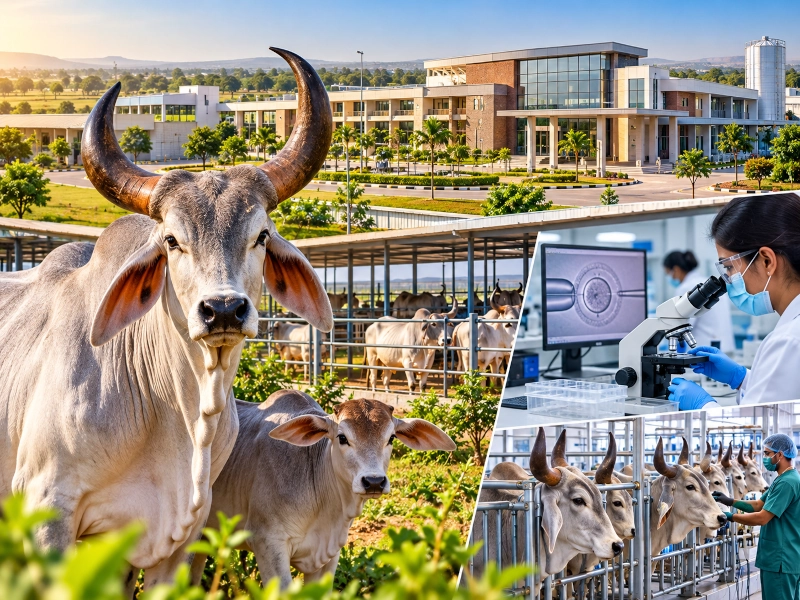
India is strengthening its indigenous cattle breeding and livestock research infrastructure through the establishment of the Bharat Bovine Breeding and Research Centre (BBBRC) at Bhildi in Gujarat’s Banaskantha district. Developed by Banas Dairy at an estimated investment of ₹325 crore, the centre is designed to integrate modern reproductive biotechnology with scientific breeding programmes to improve cattle productivity while conserving valuable indigenous genetic resources.
Prime Minister Narendra Modi is scheduled to dedicate the facility to the nation on October 30, 2026, during his visit to Gujarat. The Prime Minister’s Office announced the programme on October 29, highlighting the centre’s role in advancing bovine genetics, improving reproductive efficiency and strengthening India’s dairy industry. Spread across approximately 127 acres, the facility has been developed as a specialised research and breeding centre equipped with modern laboratory infrastructure and advanced reproductive technologies.
A major focus of the project will be the improvement of the indigenous Kankrej cattle breed. According to the government, the application of modern breeding techniques at the centre is expected to accelerate genetic improvement by approximately 10–20 times compared with conventional approaches. The projected improvement reflects the potential of assisted reproductive technologies to increase the multiplication of desirable genetic characteristics among cattle populations.
New Research Centre Focuses on Indigenous Kankrej Cattle
The Bharat Bovine Breeding and Research Centre has been established with a particular emphasis on the conservation and genetic improvement of Kankrej cattle, an indigenous Indian breed associated with northern Gujarat and adjoining parts of Rajasthan. The breed is recognised for its distinctive physical characteristics, adaptability to local environmental conditions and traditional importance in both dairy farming and agricultural activities.
Kankrej cattle are generally characterised by their strong body structure, prominent horns and ability to tolerate the relatively hot and dry climatic conditions found in their native regions. These characteristics have contributed to their continued importance in livestock systems where environmental adaptability, working capacity and milk production are significant considerations.
The new research centre seeks to improve economically important characteristics of the breed through systematic genetic selection and reproductive technologies while preserving the adaptations that make Kankrej cattle suitable for local farming conditions. Such an approach is particularly relevant to the conservation of indigenous livestock because genetic improvement programmes must balance productivity with reproductive health, environmental resilience and long-term genetic diversity.
The establishment of a specialised facility dedicated to Kankrej cattle also provides an opportunity to develop a more comprehensive understanding of the breed’s reproductive characteristics, genetic variation and potential for productivity improvement. Research conducted at the centre could contribute to breeding strategies that are better suited to the needs of dairy farmers operating under different agricultural and climatic conditions.
Advanced Reproductive Technologies to Accelerate Genetic Improvement
One of the most important features of the Bharat Bovine Breeding and Research Centre is its planned use of advanced reproductive technologies, including embryo transfer technology and in vitro fertilisation. These techniques allow scientists and livestock breeding specialists to multiply desirable genetic material more efficiently than would generally be possible through conventional breeding alone.
Embryo transfer technology involves collecting embryos from genetically selected donor animals and transferring them into suitable recipient animals. This enables valuable breeding females to contribute a greater number of offspring to genetic improvement programmes without requiring them to carry every pregnancy themselves. When combined with systematic genetic evaluation, the technique can support the multiplication of animals possessing desirable characteristics such as improved milk production, reproductive efficiency and environmental adaptability.
In vitro fertilisation involves collecting suitable eggs and fertilising them under controlled laboratory conditions before transferring the resulting embryos into recipient animals. The procedure can provide additional flexibility in breeding programmes, particularly when scientists are attempting to improve the reproductive contribution of genetically valuable animals.
The Prime Minister’s scheduled visit to the facility includes an inspection of its Embryo Transfer Technology–In Vitro Fertilisation laboratory, indicating the importance of assisted reproductive biotechnology to the centre’s planned operations. These technologies are expected to support more efficient cattle breeding and contribute to the development of improved genetic resources for India’s dairy industry.
However, the successful application of reproductive biotechnology requires careful genetic selection, veterinary supervision, laboratory expertise and appropriate animal management. The benefits of these technologies depend not only on the number of embryos produced but also on reproductive success, offspring health and the performance of animals under practical farming conditions.
Government Expects Genetic Improvement to Accelerate by 10–20 Times
According to the Prime Minister’s Office, the new research centre is expected to accelerate bovine genetic improvement by approximately 10–20 times through the application of advanced breeding technologies. This projection highlights the potential of modern reproductive science to overcome some of the limitations associated with conventional cattle breeding.
Traditional livestock breeding programmes often require several generations before significant genetic improvements become established within a population. The relatively long reproductive cycle of cattle means that measurable progress can take considerable time, particularly when breeding programmes depend exclusively on natural reproduction or conventional artificial insemination.
Advanced reproductive technologies can improve the efficiency of genetic multiplication by allowing selected animals to contribute more offspring over a shorter period. These techniques can also support the development of breeding programmes that place greater emphasis on scientifically evaluated genetic characteristics rather than relying solely on external appearance or historical productivity records.
The availability of specialised laboratory infrastructure at Bhildi could enable researchers to undertake more systematic reproductive studies and establish breeding strategies tailored to the characteristics of indigenous cattle. The resulting information may contribute to improved selection procedures and more efficient use of valuable breeding animals.
The government’s stated 10–20-times improvement remains a projected outcome rather than a result already demonstrated by the new facility. The actual rate of genetic progress will depend on the breeding methods employed, the accuracy of genetic evaluations, reproductive efficiency, animal health and the successful performance of future generations.
₹325 Crore Investment Expands Livestock Research Infrastructure
The Bharat Bovine Breeding and Research Centre represents a substantial investment in livestock research and agricultural biotechnology. Developed by Banas Dairy at a reported cost of approximately ₹324.77 crore, the facility occupies 127 acres at Bhildi in Banaskantha district and is intended to provide a specialised institutional foundation for advanced cattle breeding programmes.
The project has received support through government and institutional financing arrangements associated with livestock development. Information released by the Gujarat government indicates that approximately ₹38.83 crore was sanctioned under the Rashtriya Gokul Mission, including support connected with the development of breeding infrastructure and the acquisition of donor animals.
The National Dairy Development Board is providing technical support to the project, while additional financial assistance has been associated with the Animal Husbandry Infrastructure Development Fund and NABARD-linked financing arrangements. The involvement of these institutions reflects the collaborative approach required to establish specialised livestock research facilities that depend on substantial capital investment, scientific expertise and long-term operational support.
The development of such infrastructure is particularly important for modern livestock breeding because advanced reproductive technologies require controlled laboratory environments, specialised equipment, trained personnel and comprehensive veterinary systems. The establishment of the centre could therefore contribute to strengthening the technical capabilities available to India’s organised dairy sector.
Banaskantha’s Dairy Economy Provides an Important Foundation
Banaskantha district is among Gujarat’s important dairy-producing regions, with livestock farming playing a significant role in the livelihoods of rural households. The district is closely associated with Banas Dairy, formally known as the Banaskantha District Cooperative Milk Producers’ Union Limited, which has developed an extensive cooperative network supporting milk procurement, processing and marketing.
Dairy farming provides an important source of supplementary and, in some cases, primary income for agricultural households. Cattle productivity, reproductive efficiency, animal health and access to veterinary services can therefore influence the economic sustainability of rural dairy operations.
The location of the Bharat Bovine Breeding and Research Centre in Banaskantha creates an opportunity to connect advanced livestock research with an established dairy cooperative ecosystem. Scientific breeding programmes developed at the facility could eventually support farmers through improved genetic resources, technical guidance and the wider adoption of reproductive technologies.
The presence of an extensive cooperative network may also help facilitate the dissemination of research findings and livestock management practices. However, the benefits of advanced genetic improvement programmes will depend on their accessibility to dairy farmers, particularly small and marginal producers who may face financial and logistical constraints.
Integrating research with practical animal husbandry services will therefore be important for ensuring that the investment contributes to improvements in rural livelihoods rather than remaining confined to specialised laboratory activities.
Indigenous Cattle Breeds Remain Important to Sustainable Dairy Farming
India possesses a diverse range of indigenous cattle breeds that have evolved under different geographical, climatic and agricultural conditions. These breeds represent valuable genetic resources because many possess characteristics suited to particular farming environments, including heat tolerance, resilience under local management conditions and adaptation to traditional livestock systems.
The genetic diversity found among indigenous cattle populations is important for maintaining long-term breeding options. As livestock production systems face changing environmental conditions and increasing demands for productivity, the preservation of locally adapted genetic characteristics can contribute to the resilience of agricultural systems.
Scientific breeding programmes can help identify animals possessing desirable traits while supporting the conservation of breed-specific characteristics. For Kankrej cattle, this may involve improving milk production and reproductive efficiency while maintaining adaptability to local climatic conditions.
At the same time, breeding programmes must avoid excessive emphasis on a limited number of production characteristics. Maintaining genetic diversity and preventing inbreeding are essential for protecting reproductive health and ensuring the sustainability of improved livestock populations.
The research undertaken at the Bhildi centre could contribute to these objectives by combining genetic evaluation with assisted reproductive technologies and structured breeding management.
Centre Supports Objectives of Rashtriya Gokul Mission
The establishment of the Bharat Bovine Breeding and Research Centre is consistent with the objectives of the Rashtriya Gokul Mission, which seeks to support the development and conservation of indigenous bovine breeds while improving livestock productivity through scientific interventions.
The mission promotes improved breeding infrastructure, artificial insemination services, reproductive technologies and the development of high-quality genetic resources. It also seeks to strengthen institutional capabilities involved in livestock breeding and make improved breeding services more accessible to farmers.
The Bhildi facility provides a specialised platform for advancing these objectives through research focused on indigenous cattle genetics and assisted reproduction. Its emphasis on Kankrej cattle reflects the importance of developing breeding strategies suited to the characteristics of individual breeds rather than applying uniform approaches across diverse livestock populations.
The availability of modern reproductive laboratories could also support collaboration between dairy cooperatives, veterinary institutions and agricultural researchers. Such cooperation is necessary for translating scientific advances into practical improvements in cattle breeding and farm-level productivity.
Reproductive Biotechnology Could Support India’s Wider Dairy Industry
The technologies being introduced at the Bharat Bovine Breeding and Research Centre have potential applications beyond the immediate improvement of Kankrej cattle. Assisted reproductive techniques are increasingly important in modern livestock breeding because they enable more efficient multiplication of selected genetic material and can complement conventional artificial insemination programmes.
The scientific expertise developed through embryo transfer and in vitro fertilisation could contribute to wider breeding initiatives involving other indigenous and economically important cattle breeds. Such applications would require appropriate programme design, veterinary oversight and consideration of the reproductive characteristics of the animals involved.
For the dairy industry, improvements in livestock genetics may contribute to higher productivity, better reproductive performance and more efficient herd development. These benefits can support farmers when combined with adequate animal nutrition, disease prevention, veterinary services and sound farm management practices.
Genetic improvement alone does not guarantee increased milk production or higher farm income. The health and productivity of dairy animals are influenced by several interacting factors, including feed quality, environmental conditions, disease exposure and the availability of trained veterinary personnel.
The long-term value of the centre will therefore depend partly on its ability to integrate advanced research with practical livestock management systems.
Banas Dairy Plans Bio-CNG Facilities to Utilise Cattle Waste
The Prime Minister’s October 30 programme in Gujarat also includes the planned foundation-stone laying for two Bio-CNG plants being developed by Banas Dairy at Tharad and Radhanpur. These projects represent a complementary approach to strengthening the dairy economy by converting livestock waste into useful energy resources.
According to the Prime Minister’s Office, the proposed Tharad plant will have the capacity to process approximately 75 metric tonnes of cattle dung daily, while the Radhanpur facility will be designed to process approximately 100 metric tonnes per day. Together, the two plants will have a planned processing capacity of 175 metric tonnes of cattle dung daily.
The projects are intended to use biomethanation technologies to convert organic livestock waste into biogas, which can subsequently be purified and upgraded into compressed biogas. The resulting fuel can support renewable energy applications and contribute to more organised waste management within dairy-producing regions.
The processing of cattle dung through anaerobic digestion can also generate digestate, which may have agricultural applications when appropriately treated and managed. Such systems can create opportunities to connect dairy farming, renewable energy production and organic nutrient recycling.
These developments illustrate the potential for integrating livestock-based economic activities with sustainable energy technologies. However, the October 30 programme concerns the laying of foundation stones for the proposed plants, and their commercial commissioning has not been established by the advance government announcement.
Advanced Livestock Research Could Strengthen Rural Livelihoods
The long-term importance of cattle breeding research extends beyond laboratory innovation because improvements in animal productivity can influence the economic conditions of farming households. In many parts of rural India, dairy farming provides regular income that complements seasonal agricultural earnings.
Improved breeding practices may help farmers develop healthier and more productive herds, particularly when genetic selection is supported by adequate nutrition and veterinary care. Better reproductive performance can also contribute to more efficient livestock management by reducing certain losses associated with unsuccessful breeding.
For indigenous cattle breeds, scientific improvement offers the possibility of combining locally adapted characteristics with enhanced productivity. This approach may be particularly relevant in regions where environmental conditions make livestock management challenging.
The Bharat Bovine Breeding and Research Centre could contribute to these objectives by developing scientific knowledge and reproductive technologies that support long-term improvements in cattle breeding.
Ensuring that the resulting benefits reach farmers will require effective coordination between researchers, dairy cooperatives, veterinary service providers and agricultural extension systems.
Gujarat’s New Bovine Research Centre Marks an Important Development in Animal Husbandry
The establishment of the Bharat Bovine Breeding and Research Centre at Bhildi represents a significant investment in India’s livestock research and breeding infrastructure. With its 127-acre campus, advanced reproductive laboratories and focus on the indigenous Kankrej cattle breed, the facility is intended to strengthen the application of modern biotechnology in animal husbandry.
The government’s expectation that the centre could accelerate genetic improvement by 10–20 times highlights the potential of assisted reproductive technologies to support more efficient breeding programmes. At the same time, the scientific and economic benefits of these technologies will depend on their successful implementation, long-term evaluation and accessibility to livestock farmers.
The collaboration between Banas Dairy, government institutions and technical organisations demonstrates the importance of connecting agricultural research with established rural production systems. By locating the facility within one of Gujarat’s major dairy-producing regions, the project creates opportunities to integrate scientific breeding with the practical requirements of the dairy economy.
As the centre advances its research and breeding programmes, its contribution will be measured by improvements in genetic quality, animal health, reproductive performance and the ability of farmers to access the resulting technologies.
The planned dedication of the facility on October 30, 2026, marks an important step in India’s efforts to conserve indigenous cattle genetics, strengthen dairy productivity and expand the use of advanced scientific technologies in livestock development.
References
Prime Minister’s Office, Government of India. “PM to Visit Gujarat on 30–31 October.” Press Information Bureau, October 29, 2026. The official announcement provides details of the Bharat Bovine Breeding and Research Centre at Bhildi, its 127-acre campus, its focus on Kankrej cattle and the projected acceleration of genetic improvement through advanced reproductive technologies.
Official Source: https://www.pib.gov.in/PressReleseDetailm.aspx?PRID=2329999&lang=1®=1
Prime Minister of India, Government of India. “PM to Visit Gujarat on 30–31 October.” October 29, 2026. The announcement outlines the dedication of the bovine research centre and the proposed Bio-CNG projects being developed by Banas Dairy.
Official Source: https://www.pmindia.gov.in/en/news_updates/pm-to-visit-gujarat-on-30-31-october-4/
Government of Gujarat. Project information released on October 29, 2026, concerning the Bharat Bovine Breeding and Research Centre, its estimated investment of ₹324.77 crore, institutional funding arrangements and technical support from the National Dairy Development Board.
Supporting Source: https://news.webindia123.com/news/articles/india/20261029/4513151.html
The Times of India. “PM to Inaugurate Bovine Research Centre on Oct 30.” October 26, 2026. Reporting on the facility’s infrastructure, reproductive biotechnology capabilities and planned inauguration.
Source: https://timesofindia.indiatimes.com/city/rajkot/pm-to-inaugurate-bovine-research-centre-on-oct-30/articleshow/135196922.cms
You may also like
-
ISRO Set to Launch NVS-03 Navigation Satellite with Indigenous Atomic Clock to Strengthen India’s NavIC System
-
IIT Guwahati Scientists Reveal How Plants Adapt Their Water Transport Systems During Drought
-
Indian Scientists Discover New Electric Ray Species in Arabian Sea, Revealing Hidden Deep-Ocean Biodiversity
-
ISRO Plans Four Operational Launch Pads by 2029 to Expand India’s Space Capabilities
-
Indian Scientists Discover How Rapidly Spinning Black Holes Produce High-Frequency X-Ray Oscillations
