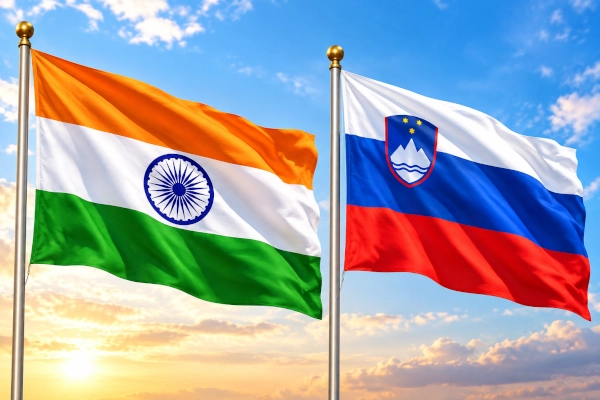
India and Slovenia have identified manufacturing, energy, digital technology, connectivity and defence as areas for deeper cooperation as the two countries prepare for the commercial opportunities expected from the India-European Union Free Trade Agreement. External Affairs Minister S. Jaishankar discussed the expanding relationship with Slovenian Foreign Minister Tone Kajzer during their meeting on the sidelines of the 81st United Nations General Assembly in New York.
The talks placed bilateral economic engagement within a significantly larger India-EU framework. Negotiations on the India-EU Free Trade Agreement were concluded in January 2026, creating the basis for substantially greater market access once the agreement completes the necessary legal and institutional procedures and enters into force.
India-Slovenia Talks Focus on the Next Phase of Economic Cooperation
Jaishankar said the two sides discussed emerging trade and investment opportunities as India and the European Union move towards the actualisation of the FTA. Their discussions covered energy, manufacturing, digital technologies, connectivity, defence and cooperation in multilateral institutions.
The breadth of the agenda indicates that India and Slovenia are looking beyond conventional merchandise trade. Industrial partnerships, technology-intensive manufacturing and connectivity are becoming increasingly important as Indian companies expand their presence in European markets and European companies examine opportunities arising from India’s manufacturing growth.
Kajzer also indicated Slovenia’s interest in strengthening strategic, political, economic and investment cooperation with India. The Slovenian side is working towards a visit to India accompanied by a sector-focused economic delegation, which could give businesses from both countries an opportunity to identify specific projects and commercial partnerships.
India-EU FTA Creates a Much Larger Economic Framework
India and the European Union concluded negotiations for their Free Trade Agreement on 27 January 2026. The agreement covers a combined market of approximately two billion people with an estimated economic output of around US$24 trillion.
Merchandise trade between India and the European Union stood at approximately US$136.54 billion in 2024–25, while bilateral services trade reached about US$83.10 billion in 2024. The scale of this relationship means that implementation of the FTA could influence manufacturing decisions, investment flows and supply-chain strategies across individual EU member states, including Slovenia.
India secured preferential access covering 97 per cent of EU tariff lines and 99.5 per cent of its export value under the negotiated agreement. A large part of India’s labour-intensive export basket is expected to receive immediate duty-free access once the agreement enters into force.
Manufacturing Could Become a Stronger Bilateral Link
Manufacturing was explicitly discussed during the India-Slovenia meeting and offers several potential areas for expanding commercial cooperation.
Slovenia has a diversified industrial economy with capabilities spanning automotive components, electrical equipment, machinery, pharmaceuticals, advanced materials and specialised engineering. India, meanwhile, is expanding domestic manufacturing across automobiles, electronics, defence, renewable energy, machinery and advanced industrial sectors.
The India-EU FTA could make it easier for companies on both sides to integrate production networks. Indian manufacturers gaining improved access to European markets may find Slovenia useful as a manufacturing and logistics partner within Central Europe, while Slovenian companies could use India as a production and sourcing base serving both the domestic market and other Asian economies.
Engineering Goods Stand to Gain From the India-EU Agreement
Engineering products are among the major sectors expected to benefit from the FTA. India currently exports approximately US$16.6 billion worth of engineering goods to the European Union, while the EU represents an engineering-goods import market valued at roughly US$2 trillion.
Preferential access under the agreement is expected to reduce tariffs that currently reach as high as 22 per cent on certain engineering products. This could improve opportunities for Indian manufacturers supplying machinery, industrial components, electrical equipment and specialised manufactured products.
For India-Slovenia relations, this creates scope for cooperation involving not only finished products but also components, production technology, industrial automation and participation in European manufacturing supply chains.
Energy Cooperation Gains Greater Importance
Energy was another area discussed by the two foreign ministers. India and Europe are simultaneously investing heavily in renewable energy, grid modernisation, energy storage and lower-carbon industrial technologies.
Slovenia’s position within the European energy system and its industrial expertise could support partnerships involving clean-energy equipment, power-system technologies and energy-efficient manufacturing. India’s rapidly expanding electricity and renewable-energy markets, meanwhile, provide opportunities for European technology companies seeking larger-scale deployment.
The broader India-EU relationship also includes cooperation on clean energy and climate technologies, giving bilateral India-Slovenia initiatives a wider institutional framework within which they can develop.
Digital Cooperation Moves Alongside Trade
Digital technology has become an increasingly important element of India’s economic diplomacy with Europe. The India-Slovenia meeting included digital cooperation alongside traditional sectors such as manufacturing and energy.
India has developed large-scale digital public infrastructure and a rapidly expanding digital-services industry, while European countries possess strengths in industrial digitalisation, cybersecurity, advanced engineering and specialised software.
Future cooperation could therefore extend across digital services, industrial automation, cybersecurity, data-driven manufacturing and technology partnerships between companies and research institutions.
The India-EU FTA itself contains substantial commitments covering digitally delivered services, giving Indian technology and professional-services companies greater certainty when operating in European markets.
Connectivity Could Link India More Closely With Central Europe
Connectivity also featured in the bilateral discussions. Slovenia’s geographic position between Central Europe, the Adriatic and the Balkans gives it potential importance in logistics and trade routes linking European markets.
The Port of Koper provides Slovenia with maritime access to the Adriatic and serves markets across Central and Eastern Europe. Greater India-Europe merchandise flows following implementation of the FTA could increase the commercial importance of ports, rail corridors and logistics networks capable of connecting Indian exporters with inland European markets.
Connectivity cooperation consequently has implications extending beyond transport infrastructure. Efficient shipping, ports, customs processes and digital logistics systems can directly determine whether tariff reductions under a trade agreement translate into commercially competitive supply chains.
Defence Enters the Bilateral Economic Conversation
Defence was also included among the areas discussed by Jaishankar and Kajzer. India’s defence industry has expanded rapidly in recent years as the government seeks greater domestic production, technological collaboration and exports.
For smaller European industrial economies, India’s growing defence-manufacturing ecosystem can create opportunities involving components, electronics, specialised engineering and joint industrial projects rather than relationships based solely on finished-platform purchases.
Any substantial India-Slovenia defence cooperation would require specific agreements and industrial projects to emerge, but its inclusion in the ministerial discussion demonstrates that security and defence technology are becoming part of the broader bilateral agenda.
Slovenia Could Gain Importance as India Expands Across Europe
India’s commercial relationship with Europe has historically been concentrated in the continent’s largest economies. The completion of the India-EU FTA negotiations creates an opportunity for New Delhi to broaden its engagement with smaller and medium-sized EU member states whose industrial strengths can complement Indian manufacturing.
Slovenia offers an interesting combination of industrial capability, European Union market access and geographic connectivity. Its relatively compact economy also creates room for targeted partnerships in specialised sectors rather than relying primarily on high-volume trade.
The proposed sector-focused Slovenian business delegation to India could become an important next step by moving discussions from broad diplomatic priorities towards company-level partnerships and investment opportunities.
From an EU-Wide Agreement to Bilateral Opportunities
The India-EU FTA establishes a common framework, but many of its eventual commercial gains will depend on individual relationships between Indian companies and businesses in the 27 EU member states.
The India-Slovenia meeting illustrates this next stage. Instead of treating the FTA purely as a negotiation between New Delhi and Brussels, India is increasingly examining how the agreement can generate concrete opportunities with individual European economies.
Manufacturing, energy, digital technologies, connectivity and defence provide a broad foundation for such cooperation. The next phase will depend on converting ministerial discussions into investments, industrial partnerships, technology exchanges and stronger movement of goods and services between India and Slovenia.
References
External Affairs Minister Dr. S. Jaishankar — Official statement following meeting with Slovenian Foreign Minister Tone Kajzer on the sidelines of the 81st UN General Assembly, September 2026.
Government of Slovenia / Ministry of Foreign and European Affairs — Statements by Foreign Minister Tone Kajzer on strengthening strategic, political, economic and investment cooperation with India, September 2026.
Press Information Bureau, Ministry of Commerce & Industry — “India and European Union Trade Agreement,” 27 January 2026.
https://www.pib.gov.in/PressReleasePage.aspx?PRID=2219146
Ministry of Commerce & Industry, Government of India — India-European Union Free Trade Agreement factsheet, January 2026.
Ministry of External Affairs, Government of India — India-European Union Joint Statement following the 16th India-EU Summit, 27 January 2026.
You may also like
-
India and Russia Hold Seventh Strategic Security Dialogue on Pakistan and Afghanistan
-
Indian Coast Guard and Korea Coast Guard Strengthen Maritime Cooperation at 14th High-Level Meeting in Incheon
-
Indian Navy Completes Historic First Command of Combined Task Force 154, Training Personnel from 39 Nations
-
India and Brunei Strengthen Trade and Economic Cooperation
-
India Leads BIMSTEC Security Cooperation as Seven Nations Adopt Delhi Declaration
