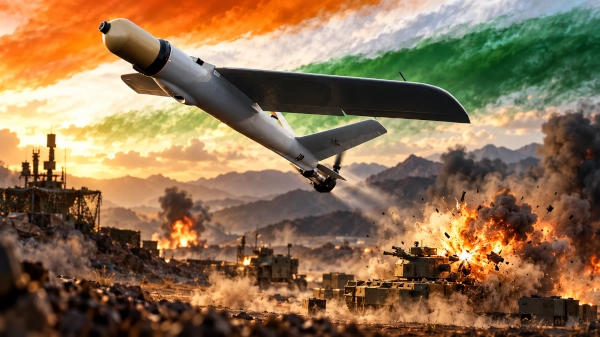
Poland’s WB Group is expanding its defence-industrial presence in India, with local manufacturing, component sourcing and collaboration with Indian companies forming the centre of its strategy. The European defence technology group already operates in the country through WB Electronics India Pvt. Ltd. in New Delhi and has aligned its Indian operations with the Make in India and Atmanirbhar Bharat programmes.
The company’s current India plans include pursuing manufacturing opportunities in the Uttar Pradesh Defence Industrial Corridor and developing a local production capability for the Warmate Tube-Launched family of unmanned systems. The initiative is part of a wider effort to establish an Indian industrial base for WB Group technologies rather than relying solely on equipment manufactured in Poland and imported into the country.
The Warmate production proposal itself is not entirely new. WB Group publicly stated during Aero India 2025 that its Indian subsidiary was making investments connected with the Uttar Pradesh Defence Industrial Corridor, while reports from the event said an agreement had been reached with an Indian partner to pursue a production line for the Tube-Launched system. The latest disclosures indicate that the company continues to advance that localisation strategy rather than having abandoned the plan.
WB Electronics India Becomes the Centre of the India Strategy
WB Electronics India is responsible for the Polish group’s operations in the country and operates from New Delhi. The company describes its Indian portfolio as covering unmanned reconnaissance platforms, strike systems, battlefield-management technologies, military communications, fire-control systems, cybersecurity and equipment modernisation.
WB Group has explicitly stated that its Indian operations are intended to support indigenisation and technological self-reliance. The company has said it wants to become a long-term partner to the Indian military and security services rather than functioning simply as an overseas supplier.
This approach is particularly important in the Indian defence market, where procurement policy increasingly favours domestic manufacturing, Indian content, local supply chains and technologies that can be supported within the country over their operational lives.
Warmate Tube-Launched System at the Centre of Local Manufacturing Plans
One of the most significant elements of WB Group’s strategy is the proposed Indian manufacturing line for the Warmate Tube-Launched system.
The Tube-Launched architecture allows unmanned aircraft from the Warmate family to be stored and launched from compact reusable containers. The launchers can be deployed by dismounted personnel or integrated with land and surface platforms, allowing the system to be incorporated into vehicles and other mobile combat systems.
The family includes both reconnaissance and strike configurations. WB Group’s Warmate TL-R, for example, is a reusable reconnaissance aircraft equipped with day and night observation sensors. After completing its mission, the system returns by parachute, while its launch container can be reused.
Strike versions of the Warmate family provide precision engagement capability using loitering munitions. The broader system architecture allows reconnaissance assets, communications equipment and effectors to operate together rather than functioning as isolated platforms.
Uttar Pradesh Defence Corridor Could Host Production
WB Electronics India has already publicly indicated its interest in establishing a presence in India’s defence industrial corridors. During Aero India 2025, WB Group said its Indian subsidiary was making investments associated with the Uttar Pradesh Defence Industrial Corridor as part of its broader localisation programme.
WB Electronics India subsequently publicised an on-ground visit to a defence-corridor site, describing the visit as part of the company’s next phase of progress and connecting the initiative directly with Atmanirbhar Bharat and Make in India.
A Warmate production line in Uttar Pradesh would therefore represent the industrial implementation of a localisation strategy that the company has been signalling for more than a year. The final location, manufacturing structure, investment value and production capacity have not yet been publicly detailed.
The identity and role of the Indian manufacturing partner also require further formal disclosure before the eventual structure of the programme can be assessed completely.
Local Components Could Replace Imported Subsystems
An important part of WB Group’s Indianisation strategy concerns the components inside its systems rather than simply final assembly.
The company has indicated that it is examining which foreign-sourced components can be replaced with products manufactured in India while maintaining the necessary performance and reliability standards. This creates potential opportunities for Indian electronics manufacturers, precision-engineering firms, communications suppliers and specialised defence MSMEs.
Such localisation can be more significant than assembling imported kits because it gradually transfers a larger portion of the supply chain into the domestic industrial ecosystem. Local component sourcing also reduces dependence on international supply routes for maintenance, repairs and production expansion.
WB Group retains control of the overall architecture of its systems, which the company says provides flexibility to redesign platforms and incorporate local components when operational requirements justify changes.
FlyEye Brings a Reconnaissance Layer
The company’s India strategy extends beyond Warmate.
The FlyEye mini unmanned aerial system is one of WB Group’s principal reconnaissance platforms and has been developed for battlefield observation, surveillance and target acquisition. It carries an electro-optical observation system incorporating visible-light and infrared sensors and can provide reconnaissance information to other battlefield systems.
FlyEye has also been designed to function in environments where satellite navigation is disrupted or unavailable, an increasingly important consideration as electronic warfare becomes commonplace on modern battlefields.
The system can operate alongside Warmate within WB Group’s wider reconnaissance-strike architecture. A reconnaissance UAV can locate and identify a target before passing the information through the command network to a precision-strike platform.
This sensor-to-shooter concept is increasingly important to modern military operations because the effectiveness of a munition depends heavily on how rapidly reliable targeting information can move between reconnaissance assets, commanders and weapon systems.
TOPAZ Connects Sensors, Commanders and Weapons
Another major component of the Polish company’s portfolio is the TOPAZ Integrated Combat Management System.
TOPAZ is designed to connect battlefield information with command decisions and weapon systems, particularly artillery and other precision-fire capabilities. It allows data collected from reconnaissance platforms to be shared with commanders and firing units through a common digital architecture.
WB Group has developed its unmanned systems around this networked concept rather than treating drones as independent aircraft. FlyEye reconnaissance systems, Warmate effectors, artillery and command posts can therefore operate within a wider information environment.
The Warmate TL-R has already been integrated with TOPAZ for artillery reconnaissance. WB Group states that the system can detect and identify battlefield targets, provide precise coordinates and assist in assessing the effects of subsequent strikes.
Such integration is relevant to India as the Armed Forces increasingly pursue network-centric operations in which sensors, command systems and weapons exchange information digitally across the battlefield.
FONET Adds the Communications Layer
WB Group is also promoting its FONET digital communications system as part of the wider Indian opportunity.
FONET provides internal voice and data communications aboard military vehicles and can link crew members, radios and mission systems within the platform. The technology has been integrated into numerous armoured and military vehicles internationally.
Communications systems such as FONET become particularly important when unmanned systems, artillery, command posts and reconnaissance sensors must operate as part of the same tactical network.
The combination of FONET, TOPAZ, FlyEye and Warmate illustrates WB Group’s broader strategy. Rather than offering only individual drones or loitering munitions, the company is attempting to provide interconnected reconnaissance, command, communications and precision-strike capabilities.
Poland Has Ordered Warmate on a Much Larger Scale
The Warmate family is no longer a small experimental programme in Poland.
In 2025, Poland’s Armament Agency concluded a framework agreement with WB Electronics covering nearly 1,000 Warmate sets, corresponding to almost 10,000 loitering munitions over the planned procurement period.
The programme expanded further in 2026 when Poland placed major orders covering Warmate, FlyEye and the larger Gladius reconnaissance-strike system. WB Group described the agreements as the largest procurement of unmanned reconnaissance-strike systems undertaken by Poland and among the largest of their kind in Europe.
This production experience provides the company with an established industrial base from which to pursue international localisation programmes.
For India, however, the central issue will be how much of that manufacturing capability can ultimately be recreated domestically and how much Indian industry will participate in electronics, airframes, launch equipment, communications systems, software and other subsystems.
India Could Become More Than an Export Market
WB Group’s statements indicate that India is being treated as a potential manufacturing and technology base rather than solely as a destination for Polish defence exports.
A production line in the Uttar Pradesh Defence Industrial Corridor could eventually allow systems to be manufactured, integrated, maintained and upgraded within India while creating a domestic supplier network around the programme.
The extent of localisation will ultimately depend on contracts, Indian military requirements, industrial partnerships and the availability of components that can meet defence performance standards. No Indian procurement order for a locally produced Warmate TL system has yet been publicly confirmed as part of the latest localisation announcement.
The development is nevertheless notable because WB Group already possesses an Indian subsidiary, has publicly committed itself to indigenisation, has visited Indian defence-corridor locations and has identified the Tube-Launched Warmate family as a candidate for Indian production.
If these plans progress into serial manufacturing, the result would add another foreign-origin unmanned-systems developer to India’s increasingly diverse defence manufacturing ecosystem while creating opportunities for Indian companies to participate in the electronics and subsystem supply chain.
The larger significance lies in the direction of the partnership. WB Group is no longer presenting India merely as a market for complete systems manufactured abroad. Its stated approach increasingly centres on adapting those systems to Indian requirements, sourcing components locally and developing production capacity inside the country.
References
WB Group — WB India, official company profile detailing WB Electronics India, its New Delhi operations, defence portfolio and commitment to Make in India and Atmanirbhar Bharat.
Official WB India page
WB Group — WARMATE TL-R Unmanned Reconnaissance System, official technical description of the Tube-Launched architecture, reusable reconnaissance configuration and TOPAZ integration.
Official Warmate TL-R page
WB Group — Official company material on FLYEYE, WARMATE, TOPAZ and FONET and the Group’s unmanned and network-centric battlefield systems.
WB Group UAV portfolio
WB Group — 10,000 Warmates for Poland, 15 May 2025, detailing the Polish Armed Forces framework agreement for nearly 1,000 Warmate sets.
Official WB Group release
WB Group — GLADIUS, FLYEYE and WARMATE – The Largest Unmanned Systems Contracts Ever Signed, 1 June 2026.
Official WB Group release
WB Group — Official Aero India 2025 statement by WB India CEO Ashish Sharma on investments connected with the Uttar Pradesh Defence Industrial Corridor and expansion of the company’s Make in India presence.
StratNews Global — Poland’s WB Group Steps Up India Defence Push, 24 September 2026, reporting the company’s renewed localisation plans, Indian component sourcing and proposed Warmate TL production line.
You may also like
-
HAL’s Indigenous Light Utility Helicopter Nears Final Certification, First 12 Deliveries Targeted for FY 2027–28
-
Tata Advanced Systems Reportedly Considering LAMV 4×4 Production in Morocco
-
Indian Navy Initiates Communication Systems Upgrade for Kamorta-Class Anti-Submarine Warfare Corvettes
-
TDB Backs Panacea Medical Technologies to Develop Indigenous 32-Slice CT Scanner in Karnataka
-
India Reportedly Offers Mine-Protected Vehicles to Kenya to Strengthen Defence Cooperation
