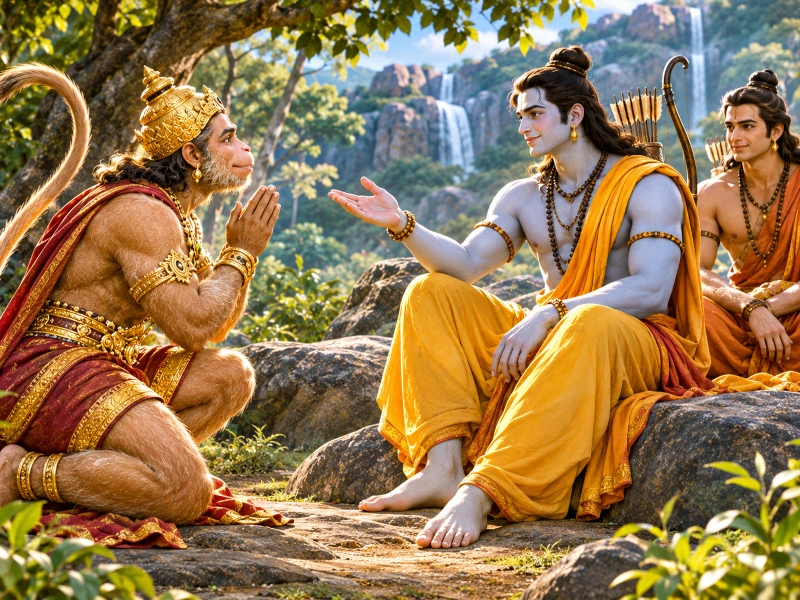
The coronation of Sugrīva, described in the Kiṣkindhā Kāṇḍa of the Vālmīki Rāmāyaṇa, provides an important example of political restoration, legitimate succession and the responsibilities arising from a strategic alliance. Following Vāli’s death, Rāma supported Sugrīva’s return to the throne of Kiṣkindhā but declined to enter the city himself, remaining faithful to the conditions of his exile. At the same time, he advised that Aṅgada, the son of the deceased Vāli, should be appointed crown prince, creating an arrangement that combined the restoration of Sugrīva’s authority with recognition of the previous ruler’s lineage.
The episode extends beyond the ceremonial transfer of royal power. It illustrates the political challenges that arise when a ruler is restored through external assistance, particularly the need to establish legitimacy, maintain continuity and fulfil commitments to the ally who made that restoration possible. The events recorded in Kiṣkindhā Kāṇḍa, Sarga 26, and their aftermath demonstrate that the success of a political alliance depends not only upon achieving an immediate objective but also upon the conduct of the restored government.
The Political Crisis That Divided Kiṣkindhā
The conflict between Sugrīva and Vāli originated in a dispute between brothers that eventually divided the political leadership of Kiṣkindhā. Sugrīva had been driven from the kingdom and deprived of his wife, Rumā, while Vāli retained control of the throne. Unable to confront his brother successfully, Sugrīva sought refuge near Ṛṣyamūka mountain, where he lived with a small group of loyal companions.
Sugrīva’s meeting with Rāma created an opportunity to resolve this political crisis. The two established an alliance based on reciprocal assistance: Rāma would help Sugrīva recover his kingdom, while Sugrīva would mobilise his resources to locate Sītā and support her rescue. Their agreement transformed Sugrīva’s struggle from an isolated conflict into an undertaking supported by a powerful ally.
Following Vāli’s death, the immediate obstacle to Sugrīva’s restoration had been removed. However, the kingdom still required a recognised ruler, a functioning administration and a succession arrangement capable of preventing further conflict. The death of a powerful sovereign could create uncertainty among ministers, military commanders and members of the royal family, particularly when the former ruler’s son remained an important political figure.
The coronation therefore represented a necessary stage in the restoration of political order. Without an accepted transfer of authority, Sugrīva’s recovery of power could have remained vulnerable to internal divisions, weakening both Kiṣkindhā and its newly established alliance with Rāma.
Hanumān Requests Rāma’s Participation in the Coronation
In Kiṣkindhā Kāṇḍa, Sarga 26, Hanumān approaches Rāma after the funeral rites for Vāli have been completed. He acknowledges Rāma’s role in restoring Sugrīva’s ancestral kingdom and requests his permission for the coronation ceremonies to proceed.
Hanumān’s intervention is significant because it recognises the political relationship between the restored ruler and the ally responsible for his recovery. Sugrīva’s supporters understood that Rāma’s assistance had altered the balance of power in Kiṣkindhā and made the restoration possible.
The request also demonstrates Hanumān’s continuing role as an intermediary. Having previously facilitated the original alliance, he now helps manage the transition from military intervention to political restoration. His responsibility is no longer limited to establishing contact between two leaders; it includes ensuring that their relationship is maintained during a critical change of government.
The vānara ministers approach Rāma respectfully, recognising his contribution and seeking his approval for the next stage of events. Their conduct places the coronation within a broader diplomatic context, where an ally’s support carries political significance even though the restored kingdom retains its own ruler and institutions.
Rāma Declines to Enter Kiṣkindhā
Rāma responds to Hanumān’s request by explaining that he cannot enter a city or village during the fourteen years of exile undertaken in accordance with his father’s instructions.
The Sanskrit passage states:
चतुर्दश समाः सौम्य ग्रामं वा यदि वा पुरम्।
न प्रवेक्ष्यामि हनुमन् पितुर्निर्देशपालकः॥
Kiṣkindhā Kāṇḍa, 4.26.9–10
Rāma declares that, as one who honours his father’s command, he will not enter a village or city during the prescribed period. He therefore instructs that Sugrīva should return to Kiṣkindhā and be installed as king according to the appropriate rites.
The decision is important because Rāma separates his commitment to the alliance from his personal participation in the ceremony. He does not abandon Sugrīva or withdraw political support, but neither does he compromise the obligations governing his own conduct.
This distinction demonstrates a principle of leadership in which political expediency does not automatically override established commitments. Although Rāma’s presence at the coronation would have been an expression of friendship, he chooses to support the restoration through advice and authorisation while maintaining the conditions of his exile.
His decision also preserves a clear separation between the authority of the restored ruler and the position of his external ally. Sugrīva is to govern Kiṣkindhā, while Rāma continues his forest exile and awaits the assistance promised under their agreement.
The Appointment of Aṅgada: Political Continuity Through Succession
One of the most significant elements of the episode is Rāma’s recommendation concerning Aṅgada, the son of Vāli. Rather than allowing the succession to depend entirely upon Sugrīva’s personal authority, Rāma advises that Aṅgada should be appointed crown prince.
The relevant passage states:
इममप्यङ्गदं वीरं यौवराज्येऽभिषेचय।
ज्येष्ठस्य हि सुतो ज्येष्ठः सदृशो विक्रमेण च॥
Kiṣkindhā Kāṇḍa, 4.26.12–13
Rāma advises Sugrīva to install the courageous Aṅgada as heir apparent, recognising his position as the son of Sugrīva’s elder brother and acknowledging his strength and suitability for royal responsibility.
The recommendation reveals an important element of political judgment. Vāli’s death had resolved the immediate conflict between the brothers, but his family remained part of Kiṣkindhā’s royal order. Excluding Aṅgada entirely could have weakened continuity within the dynasty and created another potential source of disagreement.
By recognising Aṅgada’s position, the new arrangement accommodated both branches of the royal family. Sugrīva received the authority necessary to govern, while Aṅgada retained a recognised place in the kingdom’s future succession.
The appointment can therefore be understood as a stabilising political measure. The epic presents it as an act consistent with royal duty and the qualifications of Aṅgada, while a modern analysis can also recognise its potential significance in reducing dynastic uncertainty.
Sugrīva’s Coronation and the Restoration of Royal Authority
After receiving Rāma’s instructions, Sugrīva enters Kiṣkindhā accompanied by the vānaras. The city welcomes its restored ruler, and preparations are made for the coronation according to the established ceremonial traditions.
The account describes the gathering of materials required for the consecration, including auspicious substances, water and royal ornaments. The ministers and leading vānaras participate in the ceremonies, formally recognising Sugrīva as king.
The coronation represents the public establishment of authority following the earlier conflict. Sugrīva is no longer merely a dispossessed claimant supported by a group of loyal companions. He becomes the recognised ruler responsible for the administration, security and political obligations of Kiṣkindhā.
The ceremonies also establish the continuity of the kingdom’s institutions. Political authority is transferred through recognised practices rather than remaining dependent solely upon the military outcome that made the restoration possible.
Sugrīva subsequently embraces Aṅgada and installs him as crown prince, fulfilling Rāma’s recommendation. This decision completes the political arrangement by establishing both the reigning sovereign and the designated successor.
Rāma’s Role as an Ally Rather Than a Conqueror
An important feature of Sugrīva’s restoration is that Rāma does not attempt to assume control over Kiṣkindhā. Although his intervention had been decisive in removing Vāli, he does not seek possession of the kingdom or demand authority over its administration.
Instead, he supports Sugrīva’s accession and advises him on the succession. The kingdom remains under its own royal leadership, while the alliance continues through the commitments established between the two rulers.
This distinction is essential to understanding the diplomatic character of the episode. Rāma’s objective was not territorial expansion but the restoration of a partner who had agreed to provide assistance in locating Sītā.
The arrangement also recognises that the strength of an alliance depends upon the effectiveness of each partner’s political institutions. A stable Kiṣkindhā, governed by an accepted ruler and supported by its military commanders, would be better positioned to fulfil the obligations arising from the agreement.
The episode consequently presents a model of cooperation in which assistance is directed towards restoring a partner’s governing capacity rather than replacing that partner’s authority with external control.
The Monsoon and the Responsibilities of a Restored Government
Following the coronation, Rāma instructs Sugrīva to remain in Kiṣkindhā during the rainy season. The onset of the monsoon makes immediate military operations difficult, and the leaders agree that the search for Sītā will proceed when conditions become more favourable.
Rāma and Lakṣmaṇa remain in the mountain region rather than entering Kiṣkindhā. Sugrīva returns to royal life, where he must assume the responsibilities of government and prepare the resources promised under the alliance.
The arrangement demonstrates that political and military commitments must account for practical conditions. Seasonal weather, the readiness of forces and the organisation of supplies can affect the timing of operations, even when the strategic objectives remain unchanged.
However, the period following Sugrīva’s restoration also introduces a challenge. Once the immediate crisis of recovering his kingdom has passed, Sugrīva becomes absorbed in royal comforts and delays the fulfilment of his promise to Rāma.
The resulting tension reveals a recurring problem in political alliances: one partner may achieve its immediate objective before the other has received the agreed assistance. The strength of the partnership is then tested by the willingness of the first partner to honour its remaining obligations.
Hanumān Reminds Sugrīva of His Commitments
In Kiṣkindhā Kāṇḍa, Sarga 29, Hanumān advises Sugrīva to fulfil the promises made to Rāma. He reminds the king of the assistance through which he recovered his position and emphasises the importance of acting without unnecessary delay.
The intervention demonstrates that a ruler’s obligations do not disappear upon accession to power. Political restoration creates responsibilities towards subjects, institutions and allies, particularly when those allies have undertaken substantial risks to provide assistance.
Hanumān’s counsel is important because he recognises the danger of allowing personal satisfaction to weaken a strategic relationship. Sugrīva’s recovery of his kingdom had been a major achievement, but the original agreement required him to contribute actively to Rāma’s search for Sītā.
The episode also reveals the value of advisers capable of speaking candidly to political leaders. Hanumān does not treat Sugrīva’s accession as the conclusion of the alliance. He understands that the continued legitimacy and credibility of the restored ruler are connected with responsible conduct.
Sugrīva eventually begins mobilising the vānara forces, restoring the practical cooperation necessary to pursue the alliance’s remaining objective.
Tārā’s Intervention and the Preservation of the Alliance
The delay nevertheless creates tension between the two sides, leading Lakṣmaṇa to travel to Kiṣkindhā. Angered by Sugrīva’s apparent neglect of his promise, Lakṣmaṇa approaches the kingdom in a confrontational mood.
The situation threatens to damage a partnership that had already produced important political results. Sugrīva’s government possesses the resources required for the search, but the relationship with Rāma has become strained by the failure to communicate and act promptly.
Tārā intervenes to calm Lakṣmaṇa and prevent the disagreement from escalating. Her role demonstrates that political stability and alliance management require more than the decisions of the principal rulers. Capable advisers and intermediaries can preserve relationships when anger, misunderstanding or delayed commitments threaten cooperation.
The episode also shows that restored political authority carries a responsibility to maintain confidence among external partners. A government that owes its recovery to an alliance must demonstrate that it can honour agreements and manage disagreements without allowing them to undermine larger strategic objectives.
Political Legitimacy and the Responsibilities of Kingship
The coronation of Sugrīva illustrates several connected dimensions of political legitimacy. The new ruler possesses a claim arising from his position within the royal family, receives recognition through traditional coronation ceremonies and obtains the support of ministers and leading vānaras.
The appointment of Aṅgada adds an element of dynastic continuity, while Rāma’s decision to remain outside the city demonstrates his respect for the obligations governing his own conduct. Together, these features create a political arrangement in which the restored authority of Sugrīva is accompanied by recognition of institutional and ethical responsibilities.
The narrative also distinguishes the acquisition of power from the successful exercise of power. Recovering a kingdom establishes the opportunity to govern, but responsible government requires continued attention to commitments, public duties and the advice of trusted ministers.
Sugrīva’s subsequent delay in assisting Rāma reinforces this distinction. Political success can create complacency, and alliances established during adversity may become vulnerable when circumstances improve for one participant.
The Rāmāyaṇa therefore presents the coronation not merely as the conclusion of a political struggle but as the beginning of a new phase of responsibility.
Modern-Day Parallel: Political Stabilisation and the Responsibilities of Strategic Partnerships
Sugrīva’s coronation offers a useful parallel to contemporary international relations, particularly situations in which governments receive external assistance during periods of political instability or security crisis. Modern strategic partnerships frequently involve support for institutional capacity, defence preparedness and the restoration of administrative effectiveness, but lasting cooperation depends upon the ability of the supported government to exercise legitimate authority and fulfil agreed commitments. The recognition of Aṅgada as crown prince provides an instructive comparison with the importance of political inclusion and continuity during transitions of power, while Rāma’s refusal to assume direct control over Kiṣkindhā illustrates the distinction between supporting an ally and exercising authority over its institutions. India’s contemporary partnerships in defence capacity-building, development assistance and regional security similarly involve cooperation with sovereign governments whose responsibilities remain distinct from those of their partners. The central lesson is that political assistance achieves its broader purpose when it strengthens stable institutions, respects the partner’s authority and results in reciprocal cooperation sustained beyond the immediate crisis.
Modern-Day Parallel: India’s G20 Diplomacy and the Power of Persuasive Communication
A compelling modern parallel to Hanumān’s diplomatic skills emerged during India’s G20 Presidency in 2023, when Indian negotiators successfully secured unanimous agreement on the New Delhi Leaders’ Declaration despite significant differences among member countries over the Russia–Ukraine conflict. The negotiations required exceptional diplomatic judgment, as representatives from nations holding sharply divergent positions had to agree upon language acceptable to all participants without abandoning their respective concerns. Led by India’s G20 Sherpa Amitabh Kant, with key contributions from diplomats Eenam Gambhir and K. Nagaraj Naidu, the negotiating process involved extensive consultations, repeated revisions and approximately 200 hours of discussions on the most contentious geopolitical provisions. The resulting declaration, adopted on September 9, 2023, demonstrated how carefully chosen words, disciplined engagement and an understanding of different perspectives can transform disagreement into consensus. This diplomatic achievement offers an instructive comparison with Hanumān’s first meeting with Rāma, where the envoy’s clarity of expression, mastery of language and measured communication immediately established confidence. In both instances, the decisive instrument was not coercion but the ability to communicate effectively, recognise the concerns of others and create the conditions for cooperation. The enduring lesson is that diplomatic language, when supported by knowledge, patience and sound judgment, can become an instrument of strategic influence.
Conclusion: Restoring Power Is Only the Beginning of Responsible Leadership
The coronation of Sugrīva demonstrates how political restoration can be accompanied by measures intended to preserve continuity, legitimacy and strategic cooperation. Rāma’s decision to support Sugrīva’s accession without entering Kiṣkindhā reflects his commitment to the conditions of his exile, while his recommendation that Aṅgada become crown prince recognises the importance of succession within a divided royal family.
The establishment of Sugrīva as king creates the political conditions necessary for fulfilling the alliance with Rāma. However, the subsequent delay in organising the search for Sītā reveals that restored authority must be accompanied by continued attention to obligations and the counsel of responsible advisers.
The episode’s enduring significance lies in its treatment of political power as a responsibility extending beyond personal victory. Legitimate leadership requires the preservation of institutional continuity, the recognition of appropriate succession and the fulfilment of commitments to those whose cooperation made political restoration possible.
References
1. Vālmīki Rāmāyaṇa — Kiṣkindhā Kāṇḍa, Sarga 25
Vāli’s funeral rites and the events immediately preceding Sugrīva’s coronation.
https://sanskritdocuments.org/sites/valmikiramayan/kish/sarga25/kishkindharoman25.htm
2. Vālmīki Rāmāyaṇa — Kiṣkindhā Kāṇḍa, Sarga 26
Rāma’s instructions, Sugrīva’s coronation and Aṅgada’s appointment as crown prince.
https://sanskritdocuments.org/sites/valmikiramayan/kish/sarga26/kishkindharoman26.htm
3. Vālmīki Rāmāyaṇa — Kiṣkindhā Kāṇḍa, Sarga 27
Rāma’s residence in the mountain region following Sugrīva’s restoration.
https://sanskritdocuments.org/sites/valmikiramayan/kish/sarga27/kishkindharoman27.htm
4. Vālmīki Rāmāyaṇa — Kiṣkindhā Kāṇḍa, Sarga 29
Hanumān’s counsel concerning Sugrīva’s responsibilities towards Rāma.
https://sanskritdocuments.org/sites/valmikiramayan/kish/sarga29/kishkindharoman29.htm
5. Vālmīki Rāmāyaṇa — Kiṣkindhā Kāṇḍa, Sargas 33–35
Tārā’s intervention and the diplomatic resolution of the confrontation involving Lakṣmaṇa.
https://sanskritdocuments.org/sites/valmikiramayan/kish/sarga33/kishkindharoman33.htm
https://sanskritdocuments.org/sites/valmikiramayan/kish/sarga35/kishkindharoman35.htm
You may also like
-
The Battle Against Raktabīja: Battlefield Proliferation, Tactical Adaptation and Kālī’s Decisive Countermeasure
-
The Rāma–Sugrīva Alliance: How Mutual Interests Created a Strategic Partnership
-
India Hosts First BIMSTEC Maritime Security Exercise in Andaman and Nicobar Islands, Strengthening Bay of Bengal Cooperation
-
UNESCO Recognises Mahabharata, Arthashastra and Rajatarangini Manuscripts, Taking India’s Asia-Pacific Heritage
-
India and Guatemala Explore Expanded Trade and Investment Cooperation Across Key Industrial Sectors
