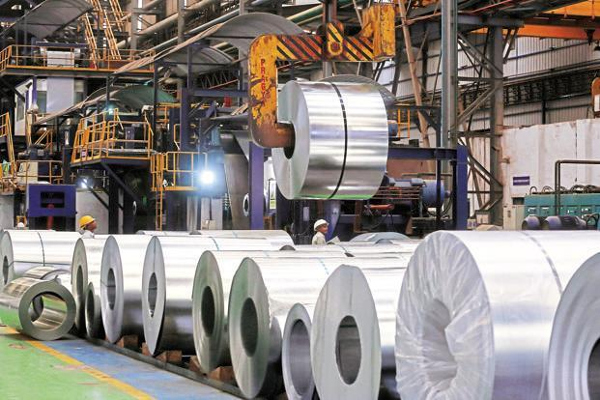
India’s finished-steel consumption rose 7.4 per cent year-on-year to 70.5 million tonnes during April–August 2026, reflecting sustained demand from infrastructure, construction, engineering, automobiles, capital goods and other manufacturing sectors. The latest provisional data from the Ministry of Steel also show that crude-steel production, finished-steel output and exports all increased during the first five months of the financial year, although India continued to remain a net importer of finished steel by volume.
Crude-steel production reached 71 million tonnes during April–August 2026, compared with 69 million tonnes in the corresponding period a year earlier, representing growth of 2.8 per cent. Finished-steel production increased 4.1 per cent to 68.3 million tonnes, while hot-metal production rose 2.9 per cent to 40.4 million tonnes. The figures indicate that domestic steelmaking activity continued to expand, even as consumption grew at a faster pace than production.
Domestic Steel Consumption Reaches 70.5 Million Tonnes
Finished-steel consumption increased from 65.7 million tonnes in April–August 2025 to 70.5 million tonnes during the same five-month period of 2026. In August alone, domestic consumption reached 14.6 million tonnes, compared with 13.8 million tonnes in August 2025, representing year-on-year growth of 5.8 per cent.
The strength in consumption reflects the broad role steel plays across the Indian economy. Demand is generated by highways, railways, housing, urban infrastructure, energy projects, automobiles, industrial machinery and a wide range of engineering applications. Sustained growth in steel consumption therefore provides an important indication of the level of underlying investment and manufacturing activity in the economy.
Crude-Steel and Finished-Steel Production Continue to Rise
India produced 71 million tonnes of crude steel during April–August 2026, while finished-steel production reached 68.3 million tonnes. August production was particularly strong, with crude-steel output rising 4.6 per cent year-on-year to 14.8 million tonnes. Hot-metal output during the month reached 8.4 million tonnes, while sponge-iron production stood at 5.1 million tonnes.
India’s annual crude-steel capacity stood at about 222.9 million tonnes during the period reviewed by the Ministry. The seven largest steel producers collectively accounted for 39.8 million tonnes of crude-steel output during April–August, while other producers contributed 31.2 million tonnes. The major producers include Steel Authority of India Limited, Rashtriya Ispat Nigam Limited, NMDC Steel Limited, Tata Steel Group, ArcelorMittal Nippon Steel India, Jindal Steel and JSW Group.
Public-sector companies accounted for 15.7 per cent of crude-steel production and 13.5 per cent of finished-steel production during the period. The figures underline the dominant role of private producers in India’s current steel expansion while public-sector companies continue to retain an important presence in strategically significant segments and large integrated plants.
Alloy-Steel Production Records Sharp Growth
One of the strongest areas of growth during April–August 2026 was alloy steel. Production increased 30.9 per cent year-on-year to around 4.80 million tonnes, compared with 3.67 million tonnes during the corresponding period of 2025. Consumption also increased sharply, rising 24.5 per cent to approximately 5.12 million tonnes.
Alloy steels are required in applications where conventional carbon steel cannot provide sufficient strength, hardness, resistance to wear or specialised mechanical properties. They are widely used in automobiles, defence equipment, railways, power generation, industrial machinery and advanced engineering products. The sharp increase in both production and consumption therefore reflects growth in higher-value segments of Indian manufacturing.
Exports of alloy steel also registered a strong increase. India exported around 178,700 tonnes during April–August 2026, compared with 63,300 tonnes a year earlier, representing growth of more than 180 per cent. August exports alone reached 56,500 tonnes, almost four times the volume recorded during the same month in 2025.
Finished-Steel Exports Rise by More Than One-Third
India exported approximately 2.99 million tonnes of finished steel during April–August 2026, up 34.1 per cent from around 2.23 million tonnes during the same period a year earlier. The value of these exports increased 32 per cent to around ₹23,647 crore.
Vietnam emerged as the largest destination for Indian finished-steel exports, accounting for 13.9 per cent of total volume, while the United Arab Emirates accounted for 13 per cent. Italy, Belgium and Nepal were also among the leading destinations for Indian steel during the period.
Hot-rolled coil and strip formed the largest export category, representing 39.2 per cent of total finished-steel export volumes. Pipes, bars and rods, galvanised products and plates also accounted for significant shares of overseas shipments.
India Remains a Net Importer of Finished Steel
Despite the strong increase in exports, India remained a net importer of finished steel during April–August 2026. Imports reached approximately 3.49 million tonnes, compared with 2.69 million tonnes during the corresponding period of 2025, an increase of 29.5 per cent.
The value of finished-steel imports increased even faster, rising 38.3 per cent to around ₹36,194 crore. China remained India’s largest source of imported finished steel, supplying approximately 1.11 million tonnes and accounting for 31.8 per cent of total imports. South Korea accounted for 29.8 per cent, while Japan contributed another 14.2 per cent.
Together, these three countries supplied more than three-quarters of India’s finished-steel imports. The pattern shows that even as domestic production continues to expand, Indian buyers still depend on overseas suppliers for certain grades, specifications and specialised steel products.
Hot-Rolled Products Dominate Both Imports and Exports
Hot-rolled coil and strip occupied a significant position on both sides of India’s steel trade. The country imported around 1.28 million tonnes of HR coil and strip during April–August, accounting for 36.6 per cent of finished-steel imports, while exports of the same broad category reached nearly 1.17 million tonnes.
The simultaneous movement of large volumes in both directions reflects the complexity of the steel market. Imports and exports are influenced not only by total domestic capacity but also by product grades, technical specifications, pricing, delivery schedules and the requirements of different downstream industries.
India’s growing steel economy is therefore becoming increasingly differentiated, with some categories supported strongly by domestic production while others continue to rely on imported material.
Stainless-Steel Imports Double as Domestic Consumption Rises
The stainless-steel segment showed a different pattern. Domestic stainless-steel production declined 11.7 per cent during April–August to around 1.62 million tonnes, while consumption increased 12.3 per cent to approximately 2.08 million tonnes.
Imports consequently increased sharply to around 642,900 tonnes, more than double the volume recorded a year earlier. Stainless-steel exports declined 24.4 per cent to 213,700 tonnes during the same period.
The widening gap between domestic production and consumption helped drive stronger imports into India. Stainless steel is used extensively in construction, consumer products, transport, process industries and specialised engineering, making its demand increasingly linked with broader industrial and urban development.
Steel Prices Rise During September
The Ministry’s review also showed a noticeable increase in domestic steel prices during September. Average TMT bar prices across Delhi, Mumbai, Kolkata and Chennai increased to ₹65,298 per tonne, representing a 12.6 per cent rise from August and a 21 per cent increase compared with a year earlier.
Hot-rolled coil prices increased to ₹76,085 per tonne, while cold-rolled coil reached ₹84,972 per tonne. Galvanised sheet prices rose to ₹94,148 per tonne. These figures include GST and represent average prices across the four metropolitan markets tracked by the Ministry.
Raw-material prices showed a mixed pattern during the same period. NMDC’s iron-ore lump price increased 2.9 per cent to ₹5,400 per tonne, while fines remained unchanged at ₹4,500 per tonne. HMS-II scrap prices increased 9.6 per cent to ₹43,810 per tonne, adding another cost variable for steelmakers dependent on scrap-based production.
SAIL Records Strong August Sales and Production
Steel Authority of India Limited reported stronger operational performance during August 2026. Sales rose 13 per cent year-on-year to 1.87 million tonnes, while crude-steel production increased 8 per cent to 1.68 million tonnes.
SAIL’s supplies to Indian Railways reached 1.23 lakh tonnes during the month, including 1.12 lakh tonnes of long rails. Cumulative sales during April–August increased 5.6 per cent to 7.71 million tonnes.
The performance reflects continued demand from infrastructure and railways, where long-product and rail requirements remain an important source of business for the public-sector steel producer.
NMDC Advances Iron-Ore Logistics Infrastructure
NMDC also recorded an important infrastructure milestone with the first successful pumping of iron-ore slurry through its 135-kilometre pipeline connecting the Bailadila-Bacheli mining complex with the Nagarnar pellet facility.
The pipeline is intended to provide a more efficient method of moving iron ore compared with conventional road and rail transport. Such infrastructure can reduce logistics costs, improve reliability and lower the environmental impact associated with large-scale movement of raw materials.
Improved ore transportation will become increasingly important as India expands domestic steelmaking capacity and seeks greater efficiency across the mining-to-steel value chain.
Green-Steel Certification Begins to Expand
The expansion of India’s steel industry is increasingly being accompanied by efforts to reduce carbon intensity. By September 2026, green-steel certificates had been issued to 99 individual steel producers under the Ministry of Steel’s certification framework.
Certified products include TMT bars, hot-rolled and cold-rolled coils, plates, wire rods and pipes. The framework is intended to encourage producers to measure and progressively reduce emissions associated with steel production.
This transition is becoming more important as international buyers place greater emphasis on embedded carbon, while export markets increasingly introduce environmental standards affecting steel and other energy-intensive products.
Strong Demand Continues to Drive India’s Steel Expansion
The April–August 2026 data show a steel sector expanding across several dimensions at the same time. Domestic finished-steel consumption rose faster than production, finished-steel exports increased by more than one-third, alloy-steel output recorded particularly strong growth and public and private producers continued to expand capacity and logistics infrastructure.
At the same time, the increase in imports shows that rapid growth in domestic demand is creating opportunities as well as challenges for Indian producers. The future competitiveness of the sector will depend increasingly on the ability to manufacture a wider range of specialised grades, improve logistics, control production costs and reduce carbon intensity.
With steel consumption already at 70.5 million tonnes in just the first five months of the financial year, India’s steel market continues to reflect the scale of infrastructure investment, industrial expansion and manufacturing activity taking place across the wider economy.
References
Press Information Bureau, Ministry of Steel — “Steel Demand in India Remains Strong During April–August 2026,” 24 September 2026.
https://www.pib.gov.in/PressReleasePage.aspx?PRID=2314464
Ministry of Steel, Government of India — Joint Plant Committee provisional steel-sector statistics, August 2026.
https://steel.gov.in/
Press Information Bureau, Ministry of Steel — SAIL operational performance update, September 2026.
https://www.pib.gov.in/
National Mineral Development Corporation — Official updates on Bailadila–Nagarnar slurry pipeline development.
https://www.nmdc.co.in/
You may also like
-
Koraput Kalajeera Rice: Odisha’s Fragrant ‘Prince of Rice’ Preserved by Generations of Tribal Farmers
-
Mormugao Port Becomes India’s First Major Port to Secure Private 5G Network Authorisation
-
PM Modi Inaugurates ₹3,350 Crore Development Projects in Ladakh
-
AXISCADES Expands Global Technology Footprint with US Acquisition Plan and Swiss Company Takeover
-
Skyroot Aerospace Secures Two Satellite Launch Contracts from US Space Company Reflect Orbital
