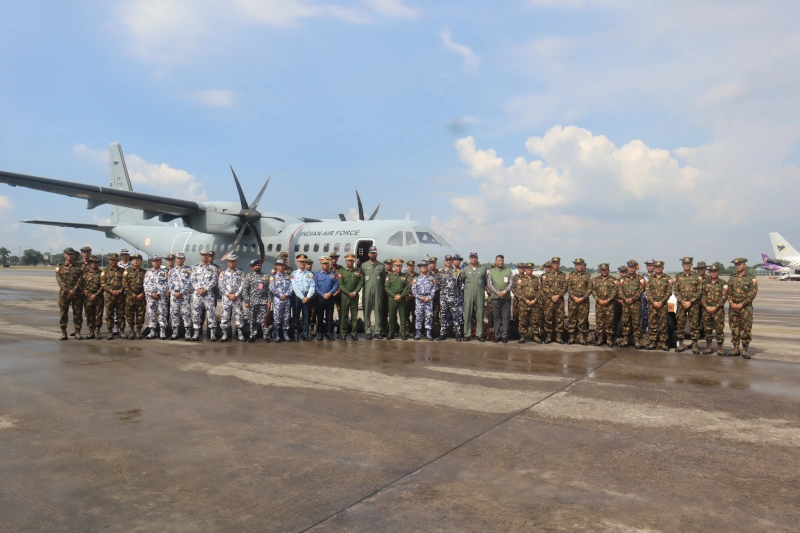
India and Myanmar have commenced their first bilateral tri-services Humanitarian Assistance and Disaster Relief (HADR) exercise, Rahat Mitra, in Chennai, marking a significant step towards strengthening regional disaster response capabilities and defence cooperation between the two neighbouring countries. The exercise began on November 5 and brings together more than 300 military personnel from the Army, Navy and Air Force components of both nations to improve coordination, operational preparedness and interoperability during humanitarian emergencies.
Conducted under the aegis of the Indian Navy, the inaugural exercise is centred on the theme Together for Humanity, Stronger through Partnership. The initiative reflects the shared commitment of India and Myanmar to developing coordinated responses to natural disasters, improving cooperation among their armed forces and strengthening institutional relationships through joint training and professional exchanges.
Strengthening Joint Disaster Response Capabilities
Exercise Rahat Mitra provides a dedicated platform for the defence forces of India and Myanmar to exchange operational experience and develop a common understanding of humanitarian assistance and disaster relief procedures. By bringing together personnel from all three military services, the exercise seeks to strengthen the coordination required for complex relief operations involving multiple agencies, specialised equipment and different operational environments.
Humanitarian assistance and disaster relief operations frequently require the simultaneous deployment of land, maritime and air capabilities. Ground forces undertake rescue operations, establish temporary infrastructure and assist affected communities, while naval and air assets support transportation, evacuation, logistical movement and access to areas where conventional infrastructure has been disrupted. Effective coordination among these capabilities is essential for delivering timely assistance during large-scale emergencies.
The joint exercise is designed to strengthen this integrated approach by enabling participating personnel to exchange practical knowledge and improve their familiarity with each other’s procedures. Such cooperation contributes to greater operational compatibility between the two armed forces, particularly during emergencies requiring rapid mobilisation and coordinated humanitarian action.
Indian Armed Forces Demonstrate Integrated Relief Operations
As part of the exercise, Indian Army personnel, working alongside the Indian Navy and Indian Air Force, demonstrated humanitarian assistance capabilities involving flood relief and engineering support. These activities included rescue operations, dewatering procedures and bridge-laying demonstrations intended to illustrate how military resources can assist communities affected by flooding and damaged infrastructure.
The demonstrations highlighted the role of specialised Flood Relief Columns and Engineer Task Forces in responding to emergencies where access routes, essential services and transportation networks have been disrupted. Restoring connectivity is often a critical requirement during disaster relief operations because damaged roads and bridges can prevent emergency personnel, medical supplies and essential assistance from reaching affected populations.
The participation of personnel from all three services also illustrated the importance of integrated military planning in humanitarian operations. By combining engineering capabilities, transportation resources and rescue expertise, armed forces can support civilian disaster management agencies in reaching affected communities and restoring essential infrastructure.
Professional interactions during the exercise provided additional opportunities for Indian and Myanmar personnel to exchange experiences, discuss operational procedures and strengthen their understanding of disaster response requirements. These exchanges contribute to building institutional familiarity and improving coordination during future humanitarian emergencies.
India-Myanmar Cooperation in Regional Disaster Management
India and Myanmar share geographical proximity and face several common challenges arising from natural disasters, including cyclones, flooding, earthquakes and extreme weather events. Their location along the Bay of Bengal and adjoining regions makes cooperation in disaster preparedness and emergency response an important component of their bilateral relationship.
Both countries have experienced the consequences of major natural disasters, reinforcing the importance of rapid humanitarian assistance, reliable communication and coordinated relief operations. Joint military exercises provide opportunities to improve practical cooperation in these areas while strengthening the ability of participating forces to operate together when humanitarian assistance is required.
The involvement of more than 300 personnel in Rahat Mitra demonstrates the emphasis placed on developing operational relationships through direct engagement. In addition to improving technical coordination, such exercises help establish professional contacts and mutual confidence among military personnel responsible for planning and executing humanitarian operations.
The exercise also strengthens the humanitarian dimension of bilateral defence cooperation by establishing a dedicated framework for joint disaster response activities. This approach complements existing military engagements between India and Myanmar and expands cooperation into an area directly connected with civilian safety and regional resilience.
Supporting India’s Neighbourhood First Policy and MAHASAGAR Vision
Exercise Rahat Mitra reflects India’s commitment to its Neighbourhood First policy, which places importance on strengthening cooperation and constructive engagement with neighbouring countries. Humanitarian assistance and disaster relief form an important component of this approach, allowing India to employ its military capabilities and institutional experience in support of regional partners during emergencies.
The exercise also aligns with India’s MAHASAGAR vision, or Mutual and Holistic Advancement for Security and Growth Across Regions. The framework emphasises cooperative approaches to regional security, development and shared challenges, including the protection of maritime interests and strengthening partnerships across the wider Indian Ocean region.
Within this framework, disaster response cooperation represents a practical area where regional countries can develop stronger institutional linkages and contribute to collective security. Natural disasters frequently affect multiple countries and require coordination involving military organisations, civilian authorities and humanitarian agencies. Improving the ability of neighbouring armed forces to cooperate can therefore contribute to a more effective regional response mechanism.
India’s participation in such exercises also reflects the growing importance of humanitarian operations within the responsibilities of modern armed forces. Military organisations possess specialised logistics, engineering, transportation and communication capabilities that can support civilian administrations during major emergencies, making disaster response preparedness an important aspect of regional defence cooperation.
Expanding Bilateral Defence Engagement
The inaugural Rahat Mitra exercise follows continuing defence engagement between India and Myanmar, including military-level discussions focused on training, professional exchanges and institutional cooperation. The two countries recently conducted their eighth Army-to-Army Staff Talks in Naypyidaw, where discussions addressed opportunities for strengthening joint training, capacity building and bilateral military cooperation.
During those interactions, the Indian delegation also handed over training simulators to the Myanmar Army, supporting ongoing efforts to develop professional military capabilities and strengthen institutional engagement. The subsequent conduct of Rahat Mitra adds a humanitarian assistance component to these bilateral exchanges, providing participating personnel with opportunities to translate professional cooperation into practical operational activities.
The exercise’s tri-services format is particularly significant because it brings together capabilities from different military branches within a common humanitarian framework. This integrated approach supports the development of coordinated procedures and strengthens preparedness for situations requiring multiple types of military assistance.
Building a Stronger Foundation for Humanitarian Cooperation
The commencement of Exercise Rahat Mitra marks an important development in India-Myanmar defence relations by establishing a dedicated bilateral platform for humanitarian assistance and disaster relief training. Its emphasis on operational coordination, professional exchanges and integrated military capabilities reflects the importance both countries attach to improving preparedness for natural disasters and humanitarian emergencies.
For India, the exercise reinforces the contribution of its armed forces to regional humanitarian cooperation while advancing its broader objectives of strengthening partnerships with neighbouring countries. For Myanmar, participation provides opportunities for exchanging operational experience and developing closer working relationships with Indian military personnel across the three services.
By combining practical disaster response demonstrations with institutional engagement, Rahat Mitra creates a foundation for continued cooperation in humanitarian operations. The inaugural exercise represents a constructive step towards strengthening regional disaster preparedness, enhancing bilateral defence coordination and advancing the shared objective of providing timely assistance to communities affected by natural disasters.
You may also like
-
India and Rwanda Explore Solar Energy Cooperation in Irrigation, Cold Storage and Agricultural Processing
-
Airbus Confirms Extended Flight Testing of India’s First Made-in-India C-295 Aircraft
-
BITS Hyderabad Startup Beijan Develops Indigenous GPS-Independent Drone Navigation Technology for Indian Army
-
AVNL Showcases Upgraded T-72 Ajeya Tank with 1,000 HP Engine
-
CFF Fluid Control and Germany’s TKMS Partner for Anti-Submarine Warfare Manufacturing
