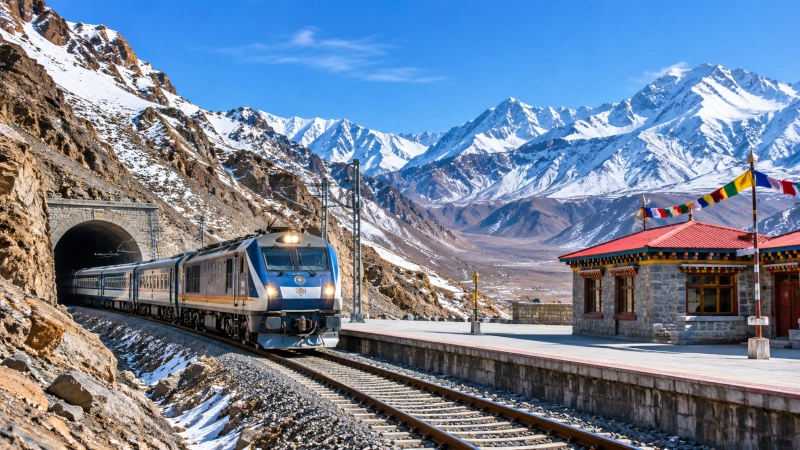
India is advancing plans for an ambitious railway corridor connecting Himachal Pradesh with Ladakh, with the proposed ₹1.31 lakh crore Bilaspur–Manali–Leh railway line potentially featuring the world’s highest railway station at an altitude exceeding 5,200 metres. The 489-kilometre strategic railway project, identified by the Ministry of Defence as an important infrastructure requirement, is intended to establish a direct rail connection to Leh while strengthening transportation, economic development and defence logistics across the Himalayan region.
According to the Ministry of Railways, the survey for the proposed railway corridor has been completed and its Detailed Project Report (DPR) prepared. The alignment includes approximately 270 kilometres of tunnels, reflecting the exceptional engineering requirements of constructing railway infrastructure through the mountainous terrain of Himachal Pradesh and Ladakh. The project remains at the planning and approval stage, with its estimated investment and proposed route providing the foundation for further government consideration.
Proposed Railway Station Could Establish a New World Record
One of the most remarkable features of the proposed railway corridor is a high-altitude station planned near the Tanglang La mountain pass in Ladakh. Recent reports indicate that the station could be located approximately 5,256 metres, or 17,244 feet, above sea level, potentially making it the highest railway station in the world.
If constructed at this elevation, the proposed Indian station would surpass China’s Tanggula railway station on the Qinghai–Tibet Railway, which stands at approximately 5,068 metres above sea level. The Indian station would exceed that elevation by around 188 metres, establishing a new benchmark in high-altitude railway engineering.
The Tanglang La region presents extraordinary geographical and climatic challenges, including extreme cold, reduced atmospheric oxygen, rugged mountain formations and difficult construction conditions. Developing railway infrastructure at such elevations requires specialised engineering approaches to track stability, tunnel construction, passenger safety and the reliable operation of railway equipment under demanding environmental conditions.
The proposed station’s elevation has been reported by media organisations covering the project in November 2026. While the Ministry of Railways has officially confirmed the corridor’s alignment, length and estimated cost, the precise elevation and final design of the record-setting station have not been independently established through the available official project documentation.
489-Kilometre Railway Corridor Connecting Himachal Pradesh and Ladakh
The Bilaspur–Manali–Leh railway project is designed to establish a broad-gauge railway connection between Himachal Pradesh and the Union Territory of Ladakh. According to the Ministry of Railways, the proposed alignment will pass through Beri, Sundernagar, Mandi, Manali, Sissu, Darcha, Keylong, Sarchu, Pang, Rumtse, Upshi and Kharu before terminating at Leh.
The planned railway would connect several important settlements across the Himalayan region, improving access to areas that presently depend heavily on road transportation. The corridor would traverse mountainous terrain and high-altitude valleys, requiring extensive tunnelling and specialised infrastructure to establish a reliable railway alignment.
The project also represents an important extension of India’s railway connectivity ambitions towards its northern frontier. A railway connection to Leh would create an additional transportation route for passengers, commercial goods, construction materials and essential supplies, complementing the existing road and air transport networks serving Ladakh.
Improved railway connectivity could also support economic development in the districts and settlements along the proposed route. Better access to transportation infrastructure would create opportunities for tourism, trade, local enterprise and the movement of agricultural and commercial products between remote Himalayan communities and larger markets.
270 Kilometres of Tunnels Present Major Engineering Challenge
The engineering scale of the Bilaspur–Manali–Leh railway is particularly significant because approximately 270 kilometres of its 489-kilometre alignment would pass through tunnels. This represents more than half of the proposed railway corridor and illustrates the complexity of establishing a railway connection through the Himalayan mountain system.
According to the Ministry of Railways, the route passes through difficult terrain characterised by complex geological formations and numerous engineering challenges. Constructing tunnels through these mountains would require detailed geological investigations, specialised excavation techniques, structural reinforcement and sophisticated systems for drainage, ventilation and operational safety.
High-altitude railway construction also presents challenges associated with snow accumulation, freezing temperatures, unstable slopes and limited seasonal access to construction locations. These conditions can influence the selection of construction methods, the transportation of machinery and materials, and the design of infrastructure intended to remain operational in severe Himalayan weather.
The extensive tunnelling requirements are central to the project’s estimated cost of ₹1.31 lakh crore. The scale of underground construction reflects the need to negotiate steep mountain gradients and difficult terrain while developing an alignment suitable for railway operations.
The proposed corridor would represent a major undertaking for India’s railway engineering and construction industries. Its development would require expertise across tunnelling, geotechnical engineering, bridge construction, railway systems integration and high-altitude infrastructure design, creating opportunities for Indian engineering organisations and specialised construction companies.
Strategic Railway Connectivity to India’s Northern Frontier
The Bilaspur–Manali–Leh railway has particular strategic importance because Ladakh occupies a critical geographical position along India’s northern frontier. The Ministry of Railways has confirmed that the proposed railway line has been identified as a strategic project by the Ministry of Defence, reflecting its significance for national security and transportation connectivity.
Ladakh currently depends primarily on road and air transportation for the movement of people, essential commodities and military supplies. Road connectivity through the Himalayan mountain passes can be affected by heavy snowfall, landslides and adverse weather, creating operational and logistical challenges during certain periods of the year.
A railway corridor connecting the region with the national rail network could provide an additional high-capacity transportation option for moving personnel, equipment and essential supplies. Railway transportation is particularly valuable for bulk logistics because it can accommodate substantial quantities of cargo while reducing dependence on long-distance road movement.
The proposed connection could also support the transportation requirements of military formations deployed in Ladakh by improving access to an additional strategic logistics corridor. The movement of construction materials, engineering equipment, fuel and other supplies could benefit from railway connectivity once the necessary infrastructure is established.
The project therefore carries significance beyond passenger transportation, contributing to India’s broader efforts to strengthen infrastructure and logistical preparedness in strategically important border regions.
Supporting Economic Development and Tourism in the Himalayas
In addition to its strategic role, the proposed Bilaspur–Leh railway has considerable potential to improve economic connectivity across Himachal Pradesh and Ladakh. The alignment would link established tourism centres such as Manali with remote settlements and high-altitude destinations, creating new opportunities for regional economic activity.
Ladakh attracts visitors for its distinctive landscapes, Buddhist monasteries, cultural heritage and mountain tourism experiences. Improved railway connectivity could make the region more accessible to domestic travellers while providing an additional transport option for tourism-related businesses and service providers.
The proposed route could also improve access to markets for communities located along the railway corridor. Reliable transportation connections can facilitate the movement of agricultural produce, handicrafts, commercial goods and essential commodities, supporting local enterprises and strengthening economic relationships between remote settlements and larger urban centres.
Railway infrastructure development would also generate demand for construction materials, engineering services, transportation equipment and specialised technical expertise. The project’s scale could provide opportunities for domestic industries involved in railway construction, tunnel engineering, electrical systems and infrastructure manufacturing.
By improving connectivity across geographically isolated regions, the proposed railway could contribute to more balanced regional development and support the long-term economic integration of Himalayan communities with the national transportation network.
Indian Railways Completes Survey and Detailed Project Report
The Bilaspur–Manali–Leh railway proposal has been under consideration for several years as part of India’s efforts to extend railway connectivity into strategically important Himalayan regions. On June 27, 2017, the Ministry of Railways formally launched the final location survey for the proposed broad-gauge railway line, recognising its potential contributions to national security, economic development and tourism.
The Ministry subsequently undertook the technical studies required for preparing the Detailed Project Report. In an official announcement issued on December 12, 2025, Union Railway Minister Ashwini Vaishnaw confirmed that the proposed corridor would extend approximately 489 kilometres, including 270 kilometres of tunnels, with an anticipated project cost of ₹1,31,000 crore.
The Ministry reiterated these details on March 13, 2026, confirming that the survey had been completed and the DPR prepared. It also identified the proposed railway alignment through key towns and settlements in Himachal Pradesh and Ladakh, providing further clarity on the geographical scope of the project.
The completion of the DPR represents an important planning milestone because it establishes the technical framework, anticipated investment requirements and proposed alignment for government appraisal. The project must subsequently undergo the required consultations and approvals involving relevant authorities, including the Ministry of Finance, Ministry of Defence and other stakeholders, before construction can be sanctioned.
The Ministry of Railways has not announced a confirmed construction commencement date or completion deadline for the entire corridor. The project therefore remains a major strategic infrastructure proposal supported by detailed planning rather than an approved railway line already under construction.
A Major Step Towards High-Altitude Railway Connectivity
The proposed Bilaspur–Manali–Leh railway represents one of India’s most ambitious plans for extending railway connectivity into the Himalayan region. With a projected investment of ₹1.31 lakh crore, approximately 270 kilometres of tunnels and a potential record-breaking railway station near Tanglang La, the corridor combines major engineering challenges with important strategic and developmental objectives.
The project reflects India’s continuing emphasis on strengthening transportation infrastructure in remote and strategically important regions. Railway connectivity to Ladakh would complement existing road and air networks, improve access to essential supplies and create new opportunities for economic activity across the northern Himalayas.
The completion of the survey and preparation of the Detailed Project Report provide an established technical foundation for further consideration of the corridor. As the proposal progresses through the required government appraisal and approval processes, it represents a significant opportunity to extend India’s railway network into one of the world’s most challenging geographical environments while strengthening connectivity to its northern frontier.
You may also like
-
Indian Companies’ Overseas Investments Surge 41% to ₹16.71 Lakh Crore, UAE Emerges as Major Destination
-
India Crosses 65 Lakh Rooftop Solar Installations Under PM Surya Ghar Yojana
-
Indian Startup Aina Unveils AI Smart Ring with Context-Aware Controls
-
Russian BRICS Researchers Highlight India’s Responsible Business Roadmap and Employment Development Model
-
India’s Startup Revolution Enters a New Era as Growing Number of Companies Achieve Profitability
