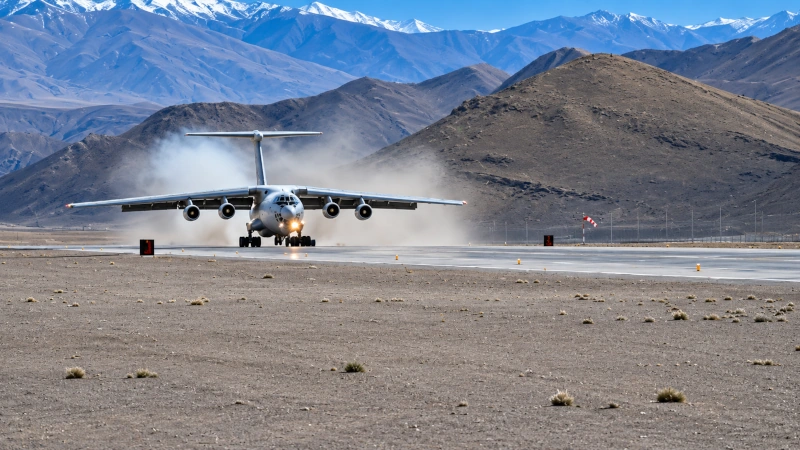
The Indian Air Force (IAF) has achieved a significant milestone in military aviation after an IL-76MD heavy-lift transport aircraft successfully landed at Nyoma Airfield in eastern Ladakh, situated at an altitude of 13,629 feet above sea level. Announced on 7 November 2026, the achievement marks the highest-altitude landing ever accomplished by an IL-76MD aircraft anywhere in the world, demonstrating the Indian Air Force’s ability to operate large military transport aircraft under exceptionally demanding Himalayan conditions.
Announcing the achievement, the Indian Air Force described the landing as a demonstration of the aircraft’s enduring operational capabilities and the exceptional skill, precision and professionalism of its crew. The successful operation represents an important advancement in India’s strategic airlift capabilities, particularly in eastern Ladakh, where mountainous terrain, extreme weather and limited surface connectivity present substantial logistical challenges.
Nyoma Airfield: A Strategic Gateway to Eastern Ladakh
Located in eastern Ladakh near the Line of Actual Control (LAC) with China, Nyoma occupies a strategically important position in India’s northern defence infrastructure. The airfield is situated approximately 25–40 kilometres from the LAC, depending on the sector and reference point, making it one of India’s most strategically positioned military aviation facilities in the region.
Nyoma previously functioned primarily as an Advanced Landing Ground capable of accommodating smaller transport aircraft and helicopters. Its subsequent development into a more capable military airfield has expanded the Indian Air Force’s options for operating larger aircraft in the region. The ability to accommodate heavy transport aircraft strengthens the infrastructure available for moving military personnel, equipment and essential supplies into eastern Ladakh.
The development of Nyoma forms part of India’s broader efforts to strengthen connectivity and military infrastructure across its Himalayan frontier. Alongside established airbases at Leh and Thoise, the facility contributes to a more extensive aviation network supporting operational readiness, logistics and military mobility in Ladakh.
IL-76MD Gajraj: India’s Heavy-Lift Military Transport Aircraft
The IL-76MD, popularly known as Gajraj in Indian Air Force service, is a four-engine, Russian-origin heavy military transport aircraft designed to carry substantial quantities of cargo, troops and military equipment over long distances. Inducted into the Indian Air Force in 1985, the aircraft has remained an important component of India’s strategic airlift fleet for more than four decades.
With a payload capability of approximately 40 tonnes, depending on operating conditions, the IL-76MD can transport military vehicles, equipment, personnel and logistical supplies. Its large cargo compartment and rear loading ramp enable the movement of substantial military loads that would otherwise require multiple flights by smaller transport aircraft.
The aircraft has supported Indian military operations, humanitarian assistance missions and disaster relief activities over several decades. Its ability to operate from airfields in demanding environments has made it particularly useful for transporting essential supplies to geographically isolated regions.
The successful landing at Nyoma demonstrates that the aircraft continues to possess valuable operational capabilities despite its long service history. It also highlights the importance of experienced aircrew, effective maintenance and careful mission planning in extending the operational usefulness of established military aviation platforms.
Why Landing a Heavy Transport Aircraft at 13,629 Feet Is Technically Challenging
Operating a heavy military transport aircraft at elevations exceeding 13,000 feet presents significant aerodynamic and engineering challenges. At such altitudes, reduced atmospheric pressure results in lower air density, directly affecting aircraft performance during take-off, approach and landing.
Lower air density reduces the lift generated by aircraft wings at a given true airspeed and decreases the thrust available from jet engines. Consequently, aircraft operating at high-altitude airfields generally require higher true airspeeds and greater runway distances than they would under comparable conditions at sea level.
For a large aircraft such as the IL-76MD, these factors make runway length, aircraft weight, wind conditions, engine performance and braking capability especially important. The surrounding mountainous terrain introduces further operational considerations, requiring careful assessment of approach paths, navigation, weather conditions and emergency procedures.
The Indian Air Force’s successful landing demonstrates the ability of its aircrew to manage these demanding conditions through precise aircraft handling and operational planning. It also provides an important practical demonstration of Nyoma Airfield’s capability to receive heavy military transport aircraft.
Strengthening India’s Military Logistics Along the Northern Frontier
Military operations in the Himalayan region depend heavily on reliable logistical support. Mountainous terrain, extreme winter temperatures, high-altitude passes and seasonal disruptions can complicate the movement of personnel, equipment and essential supplies by road.
Strategic transport aircraft help overcome these limitations by enabling the rapid movement of substantial military cargo over long distances. Their availability reduces dependence on extended surface transportation routes and provides military commanders with additional flexibility when responding to operational requirements.
The ability of an IL-76MD to land at Nyoma is particularly significant because the airfield is located close to strategically important areas of eastern Ladakh. Direct access by heavy transport aircraft creates additional opportunities to improve logistical responsiveness and support military deployments across the region.
The landing also strengthens the broader concept of integrated military mobility, in which air transport capabilities complement roads, bridges, forward logistics facilities and other infrastructure developed to sustain operations in difficult terrain.
Although the landing establishes the aircraft’s ability to operate at Nyoma, the cargo capacity available on individual missions will depend on altitude, temperature, runway conditions and other operational considerations.
Expanding India’s High-Altitude Aviation Capabilities
India has steadily expanded its experience in conducting military aviation operations in the Himalayan region. The Indian Air Force has long operated transport aircraft and helicopters in Ladakh, including missions to remote locations where air transport provides essential connectivity.
The successful IL-76MD landing at Nyoma represents an important addition to these capabilities because of the aircraft’s size and heavy-lift role. The achievement demonstrates how improved airfield infrastructure can enable existing military aircraft to undertake missions in locations that were previously beyond their regular operating requirements.
It also highlights the relationship between infrastructure development and military capability. Aircraft performance alone does not determine operational effectiveness; suitable runways, ground support facilities, navigation systems and trained personnel are equally important in enabling demanding missions.
As India’s high-altitude aviation infrastructure continues to expand, facilities such as Nyoma can contribute to improved logistical flexibility, faster movement of essential equipment and stronger connectivity between established military bases and forward operational areas.
A Significant Milestone for Indian Military Aviation
The landing of an Indian Air Force IL-76MD at 13,629 feet in Nyoma represents more than an aviation record. It demonstrates the convergence of experienced aircrew, established heavy-lift aircraft capabilities and improved military infrastructure in one of the world’s most demanding operational environments.
For India, the achievement reinforces the strategic importance of sustained investment in Himalayan connectivity and military aviation infrastructure. The ability to operate heavy transport aircraft at high-altitude airfields provides additional options for supporting troops, transporting equipment and maintaining operational readiness across the northern frontier.
By accomplishing the highest-altitude landing ever recorded for the IL-76MD, the Indian Air Force has demonstrated an important capability that strengthens India’s strategic airlift network and contributes to its long-term defence preparedness in the Himalayan region.
You may also like
-
India and Myanmar Launch First Tri-Services Disaster Relief Exercise ‘Rahat Mitra’ in Chennai
-
Airbus Confirms Extended Flight Testing of India’s First Made-in-India C-295 Aircraft
-
BITS Hyderabad Startup Beijan Develops Indigenous GPS-Independent Drone Navigation Technology for Indian Army
-
AVNL Showcases Upgraded T-72 Ajeya Tank with 1,000 HP Engine
-
CFF Fluid Control and Germany’s TKMS Partner for Anti-Submarine Warfare Manufacturing
