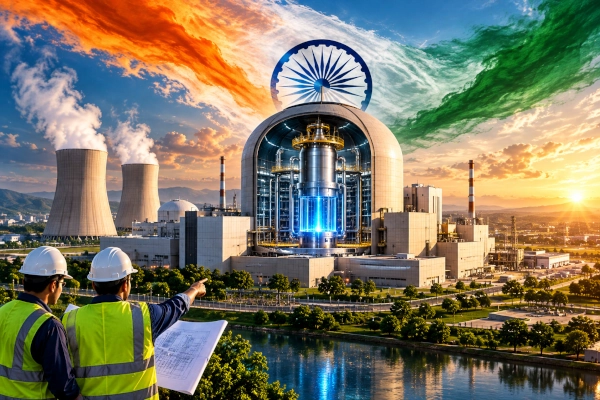
India’s ambitious programme to expand nuclear power generation to 100 GW by 2047 received renewed attention at the 20th Indian Chamber of Commerce (ICC) India Energy Summit in New Delhi, where industry leaders highlighted the potential of Bharat Small Reactors (BSRs) to provide reliable, low-carbon electricity to energy-intensive industries. The discussions focused on private-sector participation, indigenous manufacturing, regulatory reforms and the industrial infrastructure required to support a substantial expansion of nuclear power generation.
The summit, held under the theme The Energy Business: The Present, Diversification and the Future, brought together representatives from the energy industry to examine India’s changing electricity requirements and the technologies needed to support long-term energy security.
On the second day of the summit, discussions focused on the 220 MW Bharat Small Reactor programme, which builds upon India’s established Pressurised Heavy Water Reactor (PHWR) technology. The initiative aims to enable industries with large electricity requirements to participate in developing nuclear power facilities for captive consumption.
The discussions come as India implements its Nuclear Energy Mission, announced in the Union Budget 2025–26, and advances a new regulatory framework through the Sustainable Harnessing and Advancement of Nuclear Energy for Transforming India (SHANTI) Act, 2025.
The government’s nuclear expansion strategy combines conventional large reactors, Bharat Small Reactors and indigenous Small Modular Reactors (SMRs). Together, these technologies are expected to strengthen India’s electricity supply while supporting industrial growth and the transition towards lower-carbon energy.
Bharat Small Reactors Could Transform Industrial Power Supply
Bharat Small Reactors represent an important element of India’s plans to make nuclear electricity available to energy-intensive industries.
The programme focuses on 220 MW Pressurised Heavy Water Reactors, a technology that India has developed, manufactured and operated over several decades.
Unlike large nuclear power stations primarily developed to supply regional electricity grids, the Bharat Small Reactor initiative seeks to establish nuclear power facilities suited to the captive electricity requirements of industrial enterprises.
Industries such as aluminium, steel, cement, chemicals and large manufacturing complexes require dependable electricity supplies throughout the day. Interruptions in electricity availability can affect production schedules, equipment performance and operating costs.
Nuclear reactors can provide continuous electricity generation over extended operating periods, making them relevant to industries seeking stable energy supplies while reducing emissions associated with fossil-fuel-based generation.
At the ICC India Energy Summit, Kishor U. Agarwal, Director of Nuclear Strategy and Advisor at Vedanta Power, highlighted India’s extensive experience with 220 MW nuclear reactors.
Agarwal, who previously spent 36 years with Nuclear Power Corporation of India Limited (NPCIL), explained that the country’s established reactor technology provides a foundation for expanding nuclear power into industrial captive generation.
He estimated that India’s energy-intensive industries represent a potential captive electricity requirement of approximately 65–70 GW.
The proposed expansion would create opportunities for industrial companies to participate in nuclear power development while drawing upon India’s established engineering and operating experience.
NPCIL’s 220 MW Reactor Technology Provides the Industrial Foundation
India’s Bharat Small Reactor initiative builds upon the experience accumulated through its indigenous 220 MW Pressurised Heavy Water Reactor programme.
NPCIL has operated several reactors of this capacity across the country, developing expertise in reactor engineering, construction, fuel management, operation and maintenance.
The technology uses heavy water as a moderator and coolant and is designed to operate using natural uranium fuel. India’s experience with PHWR technology has contributed to the establishment of domestic manufacturing capabilities for specialised nuclear equipment.
During the summit, Agarwal emphasised that the established 220 MW reactor design offers advantages for industrial deployment because its engineering characteristics and operating requirements are well understood.
He noted that standardisation has helped resolve many engineering challenges associated with reactor construction and equipment procurement.
Standardised designs can reduce repeated engineering work, simplify manufacturing arrangements and improve consistency across projects. They also allow equipment suppliers to develop production capabilities around established technical specifications.
The government formally initiated the Bharat Small Reactor programme for industrial participation when NPCIL issued a Request for Proposals on December 31, 2024.
The official announcement invited Indian industries to participate in establishing 220 MW Bharat Small Reactors for captive electricity generation.
NPCIL described the initiative as an opportunity to provide reliable, low-carbon electricity to industries seeking to reduce their dependence on fossil fuels.
The programme therefore represents an effort to extend India’s established nuclear engineering capabilities into a broader industrial energy market.
Private Companies to Participate in Nuclear Power Development
Private-sector participation formed a central theme of the discussions at the ICC India Energy Summit.
Under the original Bharat Small Reactor framework introduced by NPCIL, Indian companies were invited to participate in financing and developing nuclear power facilities for captive electricity consumption.
The proposed arrangements envisaged industrial partners working with NPCIL, drawing upon the corporation’s nuclear engineering and operating expertise.
During the summit, Agarwal discussed a model in which private companies could jointly develop reactor projects with NPCIL while the public sector nuclear power enterprise would undertake plant operations.
Such arrangements would allow industrial enterprises to participate in nuclear electricity generation while benefiting from NPCIL’s accumulated experience in reactor technology and plant management.
India’s nuclear regulatory environment has subsequently undergone significant changes through the SHANTI Act, 2025.
The legislation establishes a wider framework under which eligible private entities may participate in developing, owning and operating nuclear facilities, subject to licensing, regulatory safety authorisation and other applicable requirements.
This represents a substantial change in the legal framework governing India’s nuclear power industry.
Private investment and industrial participation are expected to support capacity expansion by bringing additional financial resources, manufacturing capabilities and project development expertise into the sector.
The combination of established public sector nuclear expertise and private industrial resources could support the wider deployment of nuclear technologies across India’s expanding economy.
SHANTI Act Opens New Opportunities for India’s Nuclear Industry
The Sustainable Harnessing and Advancement of Nuclear Energy for Transforming India Act, 2025, represents a major legislative development in India’s nuclear energy sector.
The legislation received presidential assent in December 2025 and establishes a framework for wider participation by public and private sector organisations in nuclear energy activities.
According to the Department of Atomic Energy, the Act enables private companies and joint ventures to participate in building, owning and operating nuclear power facilities under licences issued by the Central Government and safety authorisations granted by the regulatory authority.
The legislation also provides for participation in nuclear technology research, equipment manufacturing and other peaceful applications of atomic energy.
At the same time, it preserves government control over specified sensitive nuclear activities and establishes responsibilities concerning nuclear safety, security, radioactive waste management and decommissioning.
An important component of the legislation concerns the Atomic Energy Regulatory Board (AERB), which receives statutory recognition to strengthen its independent regulatory functions.
The framework also addresses nuclear liability through provisions governing financial responsibility and compensation in the event of a nuclear incident.
For private industrial participants, the new legislation creates a legal foundation for investments in nuclear power facilities and associated manufacturing infrastructure.
The Department of Atomic Energy informed Parliament in July 2026 that the detailed rules under the SHANTI Act were being prepared. The legislation’s implementation framework remains important to the development of future private nuclear projects.
Domestic Manufacturing Expected to Play a Major Role in Reactor Expansion
India’s plans for a substantial increase in nuclear generating capacity will require corresponding expansion of the domestic manufacturing ecosystem.
Nuclear power stations depend upon specialised equipment, including reactor pressure vessels, steam generators, heat exchangers, coolant systems, turbines, electrical equipment and sophisticated instrumentation.
Manufacturing these components requires advanced metallurgy, precision engineering, welding technologies and rigorous quality assurance procedures.
During the summit, Agarwal highlighted the importance of strengthening India’s supply chain for specialised nuclear components.
He observed that India has already developed considerable domestic manufacturing capabilities through decades of reactor construction and operation.
According to Agarwal, only two specialised components associated with the established reactor technology continued to require imports, and he expected Indian suppliers to develop manufacturing capabilities for these items within the next one or two years.
The assessment reflects growing confidence within the industry regarding India’s ability to manufacture increasingly specialised nuclear equipment domestically.
An expanded programme of Bharat Small Reactors could provide additional opportunities for heavy engineering companies, specialised equipment manufacturers and industrial suppliers.
The standardisation of reactor designs would also help manufacturers plan investments in production facilities and develop the technical capabilities required for repeated equipment orders.
BARC Advances Indigenous Small Modular Reactor Technologies
Alongside the Bharat Small Reactor programme, the Bhabha Atomic Research Centre (BARC) is developing a separate family of indigenous Small Modular Reactors.
The Department of Atomic Energy has officially identified three principal reactor technologies under development.
These include the 220 MWe Bharat Small Modular Reactor, designated BSMR-200; the 55 MWe Small Modular Reactor, known as SMR-55; and a high-temperature gas-cooled reactor with a thermal capacity of up to 5 MW for hydrogen production.
The BSMR-200 is an indigenous Pressurised Water Reactor design, while the Bharat Small Reactor programme uses India’s established 220 MW Pressurised Heavy Water Reactor technology.
Although both programmes address smaller nuclear power applications, they represent different reactor designs and development approaches.
BARC’s indigenous SMR programme focuses on developing advanced reactor technologies that can be deployed at suitable industrial locations, retiring fossil-fuel-based power stations and remote areas.
The government has also identified opportunities to increase the capacity of the BSMR-200 to approximately 300 MWe based on experience gained from the initial design.
In August 2026, the Department of Atomic Energy informed Parliament that Indian industries were participating in the development of specialised materials and equipment for these reactors.
The government confirmed that advanced reactor vessel alloy technology and associated forging capabilities had been developed indigenously in cooperation with Indian manufacturers.
These advances strengthen India’s ability to design and manufacture critical components required for future nuclear power technologies.
₹20,000 Crore Nuclear Energy Mission Targets Five Indigenous SMRs by 2033
The Union Budget 2025–26 announced a Nuclear Energy Mission with an allocation of ₹20,000 crore for research, development and deployment of Small Modular Reactors.
The mission aims to develop and operationalise at least five indigenous SMRs by 2033.
The programme forms part of the government’s wider strategy to establish nuclear energy as a major contributor to India’s long-term electricity supply.
BARC is leading the development of indigenous reactor designs, working with domestic manufacturers and specialised engineering organisations.
According to the Department of Atomic Energy, the initial SMR projects will demonstrate the technologies and establish operating experience before wider commercial deployment.
These reactors are intended to complement India’s larger PHWR and light water reactor programmes rather than replace them.
Small Modular Reactors may offer advantages in applications where very large nuclear power stations are unsuitable because of electricity demand, site constraints or infrastructure requirements.
Their development also creates opportunities for modular construction techniques, specialised equipment manufacturing and standardised production.
India’s investments in SMR technologies therefore support both the expansion of electricity generation and the development of domestic nuclear engineering capabilities.
Regulatory Safety Requirements Remain Central to Nuclear Development
Nuclear power projects require extensive regulatory evaluation before construction and operation.
At the ICC India Energy Summit, Prasenjit Pal, Senior Advisor for Nuclear at Bajaj Energy and former Executive Director of NTPC Parmanu Urja Nigam Limited, highlighted the importance of selecting suitable locations and obtaining the necessary regulatory approvals.
Pal explained that nuclear site selection involves detailed assessments of geological conditions, seismic characteristics, water availability and the surrounding environment.
Project developers must also examine the proximity of industrial facilities, military installations and population centres to establish the suitability of a proposed location.
The Atomic Energy Regulatory Board oversees the nuclear safety requirements associated with plant siting, construction, commissioning and operation.
Regulatory reviews begin during the site-selection process and continue through subsequent project development stages.
These requirements are intended to ensure that nuclear power facilities are developed using appropriate engineering practices and maintain the necessary safety standards throughout their operational lives.
The SHANTI Act reinforces the importance of regulatory oversight as India’s nuclear industry expands to include additional public and private sector participants.
In June 2026, AERB organised a dedicated discussion meeting for prospective industry leaders to explain the responsibilities associated with nuclear safety, management systems and organisational safety culture.
The engagement reflected the regulator’s efforts to prepare industrial organisations for participation in India’s evolving nuclear energy framework.
Mahi Banswara Project Demonstrates the Scale of Nuclear Construction
The Mahi Banswara Rajasthan Atomic Power Project emerged as an important example during the summit discussions.
Located in Rajasthan’s Banswara district, the project is being implemented by Anushakti Vidhyut Nigam Limited (ASHVINI), a joint venture between NPCIL and NTPC.
The project comprises four indigenous 700 MW Pressurised Heavy Water Reactors, with a combined planned capacity of 2,800 MW.
Prime Minister Narendra Modi laid the foundation stone for the project on September 25, 2025.
According to NPCIL’s official announcement, the four-unit development involves an estimated investment of ₹42,000 crore and will be implemented in two phases.
During the summit, Pal highlighted the substantial construction resources required for large nuclear power projects.
He explained that a twin-unit 700 MW development could require approximately 15 lakh cubic metres of concrete and substantial annual water resources, demonstrating the engineering scale associated with nuclear infrastructure.
Such projects involve complex civil construction, specialised reactor equipment, extensive electrical systems and supporting infrastructure.
Pal also emphasised that detailed planning is essential to coordinate construction activities with regulatory inspections and technical approval processes.
According to his assessment, excavation activities at Mahi Banswara were progressing ahead of the planned schedule. He indicated that regulatory clearance for the first concrete pour was being targeted around the middle of 2027.
The project’s first unit was being targeted for initial criticality around 2032, reflecting the extended planning and construction periods associated with large nuclear installations.
The Ministry of Power’s official project assessment, published in February 2026, envisaged initial testing of the first 700 MW unit during FY 2032–33.
Nuclear Projects Create Opportunities for Local Infrastructure Development
Community engagement formed another important part of the discussions concerning nuclear project development.
Large nuclear power facilities require extensive land, supporting infrastructure, reliable water supplies and long-term engagement with neighbouring communities.
During the summit, Pal described community development initiatives associated with the Mahi Banswara project.
He highlighted improvements to local infrastructure, including roads, schools and solar-powered streetlighting, as examples of how major energy projects can contribute to development in surrounding areas.
Such initiatives can improve accessibility, public amenities and local economic opportunities while strengthening engagement between project developers and nearby communities.
Nuclear power projects also generate employment opportunities during construction, equipment installation, commissioning and subsequent operation.
Specialised manufacturing, civil engineering, transportation, maintenance and technical services create additional opportunities for local and regional businesses.
The Department of Atomic Energy has consistently emphasised the importance of public awareness programmes to improve understanding of nuclear power, address concerns and explain the safety arrangements associated with nuclear facilities.
As India expands nuclear generation into new locations, engagement with local communities will remain an important component of project planning.
Thermal Power Equipment Manufacturers Can Support Nuclear Expansion
India’s established heavy engineering and thermal power equipment manufacturing industries could play an important role in supporting nuclear capacity expansion.
During the summit, Pal highlighted the opportunities available to companies currently supplying equipment for conventional thermal power stations.
Although nuclear-specific components require specialised manufacturing qualifications and stringent regulatory compliance, many non-nuclear systems rely on engineering technologies already familiar to India’s power equipment industry.
These include turbines, generators, electrical distribution systems, cooling equipment, pumps, piping, control systems and auxiliary machinery.
Indian manufacturers with experience in conventional power projects can therefore participate in suitable portions of nuclear plant construction and equipment supply.
Companies such as Bharat Heavy Electricals Limited have already developed capabilities in nuclear power equipment and heavy engineering.
The expansion of India’s reactor programme could create further opportunities for equipment manufacturers to invest in specialised production facilities, materials technologies and quality-control systems.
Agarwal also highlighted the possibility of NPCIL strengthening its engineering support arrangements to assist private industrial participants.
Such institutional support could help companies understand the technical requirements associated with nuclear equipment manufacturing and project implementation.
India Plans Nuclear Power Expansion to 22 GW by 2031–32
India’s Nuclear Energy Mission establishes a long-term objective of achieving 100 GW of installed nuclear power capacity by 2047.
According to information presented by the Department of Atomic Energy to Parliament in July 2026, India’s installed nuclear power capacity stood at approximately 8.78 GW.
The government expects this capacity to increase to around 22 GW by 2031–32 through the progressive completion of projects under construction or implementation.
These projects include indigenous Pressurised Heavy Water Reactors and light water reactors being developed through international cooperation.
The Department of Atomic Energy has outlined a broader roadmap under which NPCIL would contribute approximately 54 GW of nuclear capacity by 2047 through existing and future projects.
The remaining 46 GW is expected to come from participation by other public sector enterprises, state governments, private companies and joint ventures using different reactor technologies and business models.
This approach demonstrates the importance of expanding India’s nuclear industry beyond its traditional institutional structure.
The introduction of Bharat Small Reactors and indigenous SMRs provides additional opportunities to diversify nuclear generating capacity and meet electricity requirements across different industrial and geographical settings.
Nuclear Power Could Help Decarbonise Energy-Intensive Industries
India’s industrial sector faces the challenge of increasing production while reducing the carbon intensity of energy consumption.
Industries such as steel, aluminium, chemicals and cement require large quantities of electricity, often accompanied by substantial thermal energy demand.
Fossil fuels continue to play an important role in meeting these requirements, particularly where continuous electricity generation is essential.
Nuclear power offers a low-carbon electricity source capable of operating over extended periods without depending on daily variations in sunlight or wind availability.
Bharat Small Reactors could provide industrial enterprises with dedicated electricity supplies while supporting broader efforts to reduce emissions.
The availability of reliable electricity also contributes to production stability and long-term energy planning.
The government has identified captive nuclear generation as a potential solution for hard-to-abate industries, particularly those seeking alternatives to conventional thermal power.
The initiative complements India’s investments in renewable energy, energy storage and green hydrogen by expanding the range of technologies available for industrial decarbonisation.
Nuclear power’s ability to provide continuous generation makes it particularly relevant to industrial operations requiring uninterrupted electricity supplies.
India’s Nuclear Manufacturing Ecosystem Enters a New Phase
The expansion of Bharat Small Reactors and indigenous SMRs is expected to create significant opportunities for India’s engineering and manufacturing industries.
Nuclear construction involves highly specialised equipment that must satisfy demanding material, mechanical and quality standards.
The development of domestic capabilities in pressure vessel manufacturing, precision forgings, advanced alloys and reactor control systems will be important to achieving the government’s capacity targets.
BARC’s work with Indian industries on advanced reactor vessel materials demonstrates progress towards reducing dependence on imported specialised technologies.
The country’s existing experience with PHWR construction also provides a foundation for expanding domestic participation in reactor manufacturing.
Private companies can contribute additional engineering capabilities, manufacturing investment and specialised technological expertise.
The SHANTI Act provides an enabling legal framework for this expansion, while the Nuclear Energy Mission supports long-term research and technology development.
Together, these initiatives are expected to strengthen India’s ability to design, manufacture, construct and maintain a wider range of nuclear power facilities.
Bharat Small Reactors Strengthen India’s Long-Term Energy Security
The discussions at the 20th ICC India Energy Summit highlighted the growing importance of smaller nuclear reactors in India’s evolving energy strategy.
The Bharat Small Reactor programme draws upon India’s established 220 MW PHWR technology to address the continuous electricity requirements of energy-intensive industries.
At the same time, BARC’s indigenous Small Modular Reactor programme is advancing new reactor designs intended for industrial, remote and specialised energy applications.
The SHANTI Act has introduced a wider framework for private participation, creating opportunities for industrial enterprises to contribute to nuclear power development and manufacturing.
India’s existing nuclear engineering experience, expanding domestic supply chain and substantial investment in advanced reactor research provide a foundation for achieving these objectives.
As the country works towards 100 GW of nuclear power capacity by 2047, cooperation among government institutions, public sector enterprises, private manufacturers and research organisations will play an increasingly important role.
The Bharat Small Reactor initiative represents an important step in this transition, combining proven Indian nuclear technology with new industrial participation to support reliable electricity generation, energy security and lower-carbon economic growth.
References
1. Nuclear Power Corporation of India Limited — Official Announcement
Date: December 31, 2024
Title: NPCIL Invites Proposals for Setting Up 220 MW Bharat Small Reactors for Captive Use
Details: Official introduction of private industry participation in the Bharat Small Reactor programme.
https://www.pib.gov.in/PressReleasePage.aspx?PRID=2089048
2. Department of Atomic Energy — Parliamentary Reply
Date: July 23, 2026
Title: Progress Under Nuclear Energy Mission
Details: 100 GW capacity target, nuclear expansion roadmap, private participation and indigenous reactor development.
https://www.pib.gov.in/PressReleasePage.aspx?PRID=2288294
3. Department of Atomic Energy — Parliamentary Reply
Date: August 5, 2026
Title: Deployment of Small Modular Reactors
Details: BARC’s development of BSMR-200, SMR-55 and high-temperature gas-cooled reactor technologies.
https://www.pib.gov.in/PressReleasePage.aspx?PRID=2294813
4. Department of Atomic Energy — Parliamentary Reply
Date: August 12, 2026
Title: Government’s Roadmap for a Self-Reliant and Globally Competitive Nuclear Energy Ecosystem
Details: Private-sector participation, indigenous manufacturing, advanced reactor technologies and India’s nuclear expansion strategy.
https://www.pib.gov.in/PressReleasePage.aspx?PRID=2298208
5. Department of Atomic Energy — Parliamentary Reply
Date: April 1, 2026
Title: Nuclear Energy Sector
Details: SHANTI Act provisions concerning private participation, nuclear safety authorisation and the legal framework for nuclear development.
https://www.pib.gov.in/PressReleasePage.aspx?PRID=2247971
6. Department of Atomic Energy — Parliamentary Reply
Date: July 23, 2026
Title: Private Sector Participation in Nuclear Energy
Details: SHANTI Act implementation, regulatory framework and licensing requirements.
https://www.pib.gov.in/PressReleasePage.aspx?PRID=2288299
7. Atomic Energy Regulatory Board — Official Announcement
Date: June 16, 2026
Title: Atomic Energy Regulatory Board Conducts One-Day Discussion Meet for Prospective Industry Leaders on Nuclear Safety
Details: Safety culture, regulatory responsibilities and preparation for private participation in nuclear power.
https://www.pib.gov.in/PressReleasePage.aspx?PRID=2273583
8. Nuclear Power Corporation of India Limited — Official Announcement
Date: September 26, 2025
Title: Prime Minister Lays Foundation Stone of Mahi Banswara Rajasthan Atomic Power Project
Details: Four 700 MW indigenous PHWR units, project investment and ASHVINI joint venture.
https://www.pib.gov.in/PressReleasePage.aspx?PRID=2171783
9. Ministry of Power — Parliamentary Reply
Date: February 5, 2026
Title: NTPC Plans Setting Up of Nuclear Power Projects
Details: Mahi Banswara project, NTPC’s nuclear expansion strategy and future capacity development.
https://www.pib.gov.in/PressReleasePage.aspx?PRID=2223660
10. Ministry of Finance — Union Budget 2025–26
Date: February 1, 2025
Title: Nuclear Energy Mission for Research and Development of Small Modular Reactors
Details: ₹20,000 crore allocation, indigenous SMR development and 100 GW nuclear capacity objective.
https://www.pib.gov.in/PressReleasePage.aspx?PRID=2098367
11. Indian Chamber of Commerce — 20th ICC India Energy Summit
Date: October 14–15, 2026
Theme: The Energy Business: The Present, Diversification and the Future
Details: Industry discussions on Bharat Small Reactors, private participation, domestic manufacturing, project development and regulatory requirements.
Official organisation website:
https://www.indianchamber.org/
You may also like
-
India’s Merchandise Exports Surge 23% to $44.40 Billion in September 2026
-
Segritech Develops AI-Powered Fruit Grading Machines to Improve Farmers’ Income and Reduce Post-Harvest Losses
-
OSTO Launches AI-Native Cybersecurity Platform for Indian Startups and SMEs
-
Cosmochute Develops Reusable Lunar Robotics Platform, Raises $1.5 Million to Advance Moon Exploration
-
BHEL Approves ₹500 Crore Expansion of Thermal and Nuclear Power Equipment Manufacturing at Haridwar
