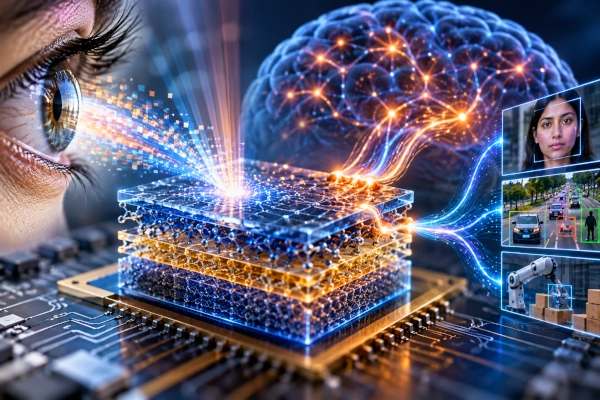
Researchers from the Indian Institute of Technology (IIT) Guwahati and IIT Kharagpur have developed an ultrathin, brain-inspired electronic device capable of detecting, storing and processing visual information while consuming significantly less energy than conventional technologies. The innovative device combines three essential functions of electronic vision within a single platform, offering a promising approach to developing energy-efficient artificial intelligence hardware, intelligent cameras and robotic vision systems.
Announced by IIT Guwahati on October 12, 2026, the research achieved a remarkable reduction in energy consumption during laboratory experiments. The newly developed device consumed approximately 500 times less energy than conventional MXene-based devices, while demonstrating the ability to retain visual information and respond more strongly to repeated light signals.
The research team also evaluated the technology in image-processing applications, achieving 90% accuracy in facial recognition and 85% accuracy in traffic-scene segmentation under the reported experimental conditions. The findings have been published in the international scientific journal Carbon, highlighting India’s growing research capabilities in neuromorphic electronics, advanced materials and low-power computing.
Indian Researchers Develop Electronic Device Inspired by the Human Brain
Modern electronic vision systems typically depend on separate components to capture images, store information and process visual data. A camera records the image, memory components retain the information, and a processor analyses the data to identify objects or interpret a scene. Although this arrangement supports sophisticated applications, repeatedly transferring information between different components consumes electrical energy and increases computational requirements.
The human brain processes visual information through a considerably different mechanism. Rather than treating perception, memory and learning as entirely separate operations, networks of neurons continuously exchange electrical signals through specialised connections known as synapses. These connections can change their responses based on previous activity, allowing the brain to recognise familiar objects and interpret visual information efficiently.
Researchers worldwide are investigating ways to reproduce selected characteristics of biological neural systems within electronic hardware. This field, known as neuromorphic computing, seeks to develop devices that combine information processing with memory and learning-like behaviour.
The research collaboration between IIT Guwahati and IIT Kharagpur has produced an artificial synaptic device that responds directly to light while retaining a measurable electrical response after illumination ends. By combining sensing and memory functions within the same material structure, the device offers an alternative to conventional electronic architectures that depend heavily on transferring information between separate components.
MXene and Organic Semiconductor Form the Core of the Technology
The new device uses an innovative combination of two advanced materials: MXene nanosheets and the organic semiconductor P3HT. Their complementary electronic properties allow the device to respond to light and retain information through a process involving the separation of electrical charges.
MXenes are a family of two-dimensional materials known for their electrical conductivity and other useful physical properties. Their extremely thin structures make them attractive for advanced electronic devices, sensors, energy storage systems and emerging computing technologies.
The researchers combined MXene nanosheets with P3HT, or poly(3-hexylthiophene), an organic semiconductor capable of generating electrical charge carriers when exposed to light. P3HT has attracted research interest in areas such as organic electronics, photodetectors and photovoltaic devices because of its ability to interact with light.
When light reaches the combined material system, electrical charges are generated and separated at the interface between the two materials. Some of these charges remain separated even after the light source is removed, producing a persistent electrical response.
This behaviour creates a memory-like effect because the device retains evidence of its previous exposure to light. The response resembles certain functional characteristics of biological synapses, where previous stimulation can influence subsequent electrical activity.
The combination of light sensitivity and persistent electrical response allows the device to perform functions associated with visual sensing and information retention within the same electronic structure.
Artificial Synapse Remembers Information After Light Is Switched Off
One of the most important achievements of the research is the development of an artificial synapse capable of maintaining an electrical response after the light responsible for generating it has disappeared.
In a conventional photodetector, the electrical response generally changes when illumination begins or ends. The device developed by the IIT researchers exhibits a more persistent response because of the behaviour of electrical charges at the interface between MXene and P3HT.
When researchers exposed the device to a brief light signal, it generated an electrical response that continued after the illumination stopped. This demonstrated that the material system could retain information about an earlier optical stimulus.
The researchers also observed that repeated exposure to light strengthened the electrical response. During their experiments, a second light signal produced a response 180% stronger than the first.
This behaviour resembles synaptic plasticity, a fundamental characteristic of biological neural systems in which the strength of a connection changes with stimulation and experience.
Professor P. K. Giri of IIT Guwahati’s Department of Physics, who led the research, explained that the device combines sensing, memory and information processing within a single platform. He compared the stronger response to repeated illumination with the way biological neurons can modify their behaviour through repeated stimulation.
The ability to retain and modify electrical responses is particularly relevant to neuromorphic computing because it provides a physical mechanism for reproducing selected learning-like functions in electronic devices.
Laboratory Experiments Demonstrate 500-Fold Reduction in Energy Consumption
The most striking finding of the research concerns the device’s low energy consumption.
According to IIT Guwahati, laboratory tests demonstrated that the newly developed artificial synapse consumed approximately 500 times less energy than conventional MXene-based devices used as the comparison.
The result highlights the potential advantages of combining sensing and memory functions within a single electronic structure.
Conventional visual processing systems frequently require the movement of large amounts of data between image sensors, memory units and processors. Every transfer involves electrical activity, and the cumulative energy requirement becomes substantial when systems continuously process high-resolution images or video streams.
Neuromorphic devices seek to reduce this burden by allowing selected information-processing functions to occur directly within the sensing hardware.
The IIT researchers’ device addresses this challenge by generating a light-dependent electrical response and retaining information without requiring an entirely separate memory element for the demonstrated function.
The reported energy reduction applies to the devices and experimental conditions evaluated by the research team. It establishes an encouraging result for the underlying technology rather than a universal 500-fold reduction in the energy consumption of complete cameras, computers or artificial intelligence systems.
Further engineering and system-level evaluation will determine how these advantages can be incorporated into larger electronic architectures.
Device Achieves 90% Accuracy in Facial Recognition Tests
The research team demonstrated the practical potential of the technology through experimental image-processing applications.
In facial recognition tests, the system achieved approximately 90% accuracy. Facial recognition involves analysing visual information to distinguish between different faces using identifiable patterns and features.
Such applications require electronic systems to extract relevant information from images and compare it with previously learned patterns. Neuromorphic hardware offers a possible way to support these functions with lower energy requirements.
The researchers also evaluated the technology in traffic-scene segmentation, achieving approximately 85% accuracy.
Traffic-scene segmentation involves identifying and separating different elements within road images, such as vehicles, roads, pedestrians and surrounding objects. It is an important component of machine vision systems used in intelligent transportation research and automated visual analysis.
The two demonstrations show that the developed device can support visual information-processing tasks beyond simply detecting light.
These experimental results also provide a foundation for investigating more sophisticated neuromorphic systems capable of recognising patterns and responding to changing visual environments.
Low-Cost Solution Processing Offers Manufacturing Advantages
Another important aspect of the research is the fabrication method used to develop the artificial synapse.
The researchers employed a low-cost solution-processing technique to combine the advanced materials and fabricate the device.
Solution processing involves depositing or assembling materials from liquid formulations rather than relying exclusively on complex vacuum-based fabrication methods. Depending on the materials and processing conditions, these techniques can offer advantages in manufacturing cost, material utilisation and compatibility with different substrates.
Organic semiconductors such as P3HT are particularly attractive for solution-based fabrication because suitable formulations can be processed into thin functional layers.
The use of MXene nanosheets also provides opportunities to explore thin-film electronic structures with specialised electrical properties.
Combining these materials through solution processing could support further research into scalable manufacturing approaches for neuromorphic sensors and other advanced electronic components.
The researchers’ approach is especially relevant to the development of emerging electronic technologies where material costs, fabrication complexity and energy efficiency influence the prospects for commercial adoption.
The present research demonstrates laboratory fabrication and functional performance. Its potential for large-scale manufacturing will depend on further evaluation of material stability, device consistency, production yields and long-term reliability.
Brain-Inspired Vision Technology Could Support Autonomous Robotics
Energy-efficient visual processing is increasingly important in robotics because autonomous machines depend on cameras and other sensors to understand their surroundings.
Mobile robots, industrial inspection systems and autonomous vehicles continuously collect information about objects, obstacles and environmental conditions. Processing these data streams can require considerable computing power, particularly when the system must respond rapidly.
A neuromorphic vision system capable of combining sensing and memory may reduce some of the computing requirements associated with conventional processing architectures.
The technology developed by IIT Guwahati and IIT Kharagpur offers a potential building block for such systems by allowing light-sensitive hardware to retain and modify responses to visual stimuli.
Future robotic applications could use similar devices to support object recognition, environmental monitoring and other visual processing functions.
The technology may also prove useful in compact robotic platforms where battery capacity, available space and heat dissipation impose restrictions on conventional computing hardware.
These possibilities are particularly relevant to industrial automation, autonomous inspection equipment and intelligent sensing systems that require continuous operation.
Intelligent Cameras and Traffic Monitoring Could Benefit from Neuromorphic Hardware
The researchers identified intelligent facial recognition, artificial vision, robotic vision and other smart computing applications as potential areas for the technology.
Modern surveillance and monitoring systems frequently depend on continuous video processing, which places demands on computing hardware and electricity consumption. Energy-efficient sensing technologies could help reduce these requirements while allowing more processing to take place closer to the camera.
Such an approach is commonly associated with edge computing, where information is analysed locally rather than being transmitted continuously to a remote computing facility.
Neuromorphic vision hardware could complement edge computing by reducing the amount of information that must move between sensors, memory components and processors.
Traffic-monitoring systems are another potential application because they require continuous analysis of changing road conditions. The successful laboratory demonstration of traffic-scene segmentation provides an early indication of the device’s relevance to this field.
Industrial machine vision could also benefit from improved energy efficiency. Automated inspection systems use cameras and image-processing equipment to identify defects, examine manufactured components and monitor production lines.
As the technology advances, combining image sensing with memory-like behaviour may support new generations of compact, energy-efficient visual processing devices.
Researchers from IIT Guwahati and IIT Kharagpur Collaborate on Advanced Electronics
The research was led by Professor P. K. Giri of the Department of Physics at IIT Guwahati, in collaboration with scientists and researchers from IIT Guwahati and IIT Kharagpur.
The research team included Sanjoy Sur Roy, Dr. Sanju Nandi, Debabrata Sahu, Garima Choudhary and Professor M. Meyyappan from IIT Guwahati, along with Saswata Goswami and Professor Chandra Sekhar Tiwary from IIT Kharagpur.
The collaboration brought together expertise in materials science, electronic device development and advanced computing technologies.
The findings were published in Carbon, an international scientific journal covering carbon-based materials, their properties and technological applications.
The research demonstrates how combining advanced materials with new electronic architectures can create devices that perform functions inspired by biological systems.
It also highlights the growing importance of interdisciplinary research, where developments in physics, chemistry, materials engineering and computing contribute to emerging technology platforms.
Indigenous Neuromorphic Hardware Research Strengthens India’s Deep-Tech Ecosystem
India’s research institutions are increasingly exploring technologies that address the energy requirements of advanced computing and artificial intelligence.
As AI applications expand into transportation, manufacturing, healthcare, robotics and consumer electronics, the demand for efficient computing hardware continues to grow.
Conventional semiconductor technologies remain essential to modern computing, but researchers are also investigating alternative architectures that can perform specialised tasks with lower energy consumption.
Neuromorphic computing represents one such approach because it seeks to reproduce selected information-processing characteristics of biological nervous systems.
The development of artificial synapses using advanced materials creates opportunities for research into intelligent sensors, in-memory computing and low-power electronic circuits.
For India, progress in these fields can contribute to the development of indigenous capabilities in advanced semiconductor materials, device fabrication and specialised electronic hardware.
The collaboration between IIT Guwahati and IIT Kharagpur demonstrates the role of Indian academic institutions in advancing foundational technologies that may eventually support industrial applications.
Indian Researchers Advance Energy-Efficient Artificial Intelligence Hardware
The brain-inspired visual processing device developed by IIT Guwahati and IIT Kharagpur represents a promising advance in neuromorphic electronics and energy-efficient sensing technologies.
By combining MXene nanosheets with the organic semiconductor P3HT, researchers have created an artificial synapse capable of detecting light, retaining an electrical response and demonstrating learning-like behaviour under repeated stimulation.
The device achieved a 500-fold reduction in energy consumption compared with conventional MXene-based devices under laboratory conditions, while its image-processing demonstrations recorded 90% accuracy in facial recognition and 85% accuracy in traffic-scene segmentation.
The use of a low-cost solution-processing technique adds another dimension to the research by providing a potential pathway for developing advanced electronic materials through relatively accessible fabrication methods.
The next stages of development will involve translating these laboratory capabilities into larger, reliable electronic systems that can operate under practical conditions.
With applications extending across robotics, intelligent cameras, industrial inspection and low-power artificial intelligence, the research contributes to India’s growing expertise in advanced electronic materials and brain-inspired computing.
The achievement also demonstrates how collaboration between Indian technological institutions can produce innovative hardware solutions that address one of the most important challenges in modern computing: processing increasingly complex information while using less energy.
References
- Indian Institute of Technology Guwahati. IIT Guwahati Researchers Create Brain-Inspired Device for Low-Energy Visual Processing. Official press release, October 12, 2026.https://iitg.ac.in/iitg_press_details?p=245%2Fiit-guwahati-researchers-create-brain-inspired-device-for-low-energy-visual-processing
- Sanjoy Sur Roy, Sanju Nandi, Debabrata Sahu, Garima Choudhary, M. Meyyappan, Saswata Goswami, Chandra Sekhar Tiwary and P. K. Giri. Research on MXene–P3HT artificial synapses for energy-efficient visual processing. Carbon, 2026. As identified in IIT Guwahati’s official research announcement.
- Indian Institute of Technology Guwahati. Research and Innovation — Official Research Announcements.https://www.iitg.ac.in/iitg_research_all
- The Times of India. IIT-G & IIT-KGP Develop Device That Mimics Brain’s Visual Memory. October 12, 2026.https://timesofindia.indiatimes.com/city/guwahati/iit-g-iit-kgp-develop-device-that-mimics-brains-visual-memory/articleshow/134900622.cms
- Indian Institute of Technology Kharagpur. Official institutional information on research in materials science, advanced electronics and interdisciplinary engineering.https://www.iitkgp.ac.in/
You may also like
-
Geological Survey of India to Establish Advanced Geophysical Research Laboratory in Hyderabad
-
Pune University Scientists Discover How Immune Cells Influence Ovarian Cancer Progression
-
India and EU Conclude Horizon Europe Negotiations, Opening New Opportunities for Scientific Research
-
IIT Guwahati Uses Drone Data from 36,000 Vehicles to Develop Indian Traffic Models
-
Wildlife Institute of India Study Reveals How Lightning Helps Andaman Mangrove Forests Regenerate
