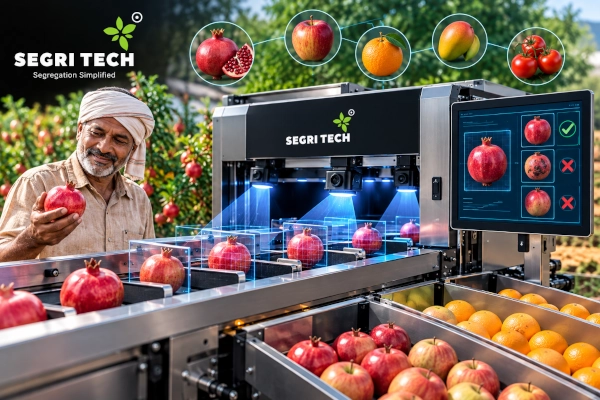
Hyderabad-based agritech startup Segritech is developing indigenous artificial intelligence-powered fruit grading machines that can identify defects, assess produce quality and automatically sort fruits into different commercial grades. Founded in 2022, the company combines computer vision, machine learning and agricultural automation to address one of India’s persistent agricultural challenges: the inconsistent grading and handling of fruits and vegetables after harvesting.
The startup has developed compact grading systems capable of processing approximately two to three tonnes of produce per hour, making automated quality inspection more accessible to farmer producer organisations, agricultural collection centres, traders and fruit exporters. Its technology uses specialised cameras and AI algorithms to examine individual fruits and identify differences in size, shape, colour and external defects.
In its latest development, reported by YourStory on October 13, 2026, Segritech was featured among India’s Tech30 startups for 2026. The report highlighted the company’s commercial deployments, the development of autonomous fruit-harvesting robots and its plans to expand the installation of AI-based grading machines across India’s agricultural supply chain.
Segritech’s technology has already been deployed for grading pomegranates and apples, while the company is conducting trials involving oranges. According to the startup, a deployment serving pomegranate growers in Gujarat’s Bhuj region helped participating farmers achieve approximately 30% higher price realisation through more accurate grading and segregation of produce.
Segritech Founded to Solve Problems in India’s Fruit Supply Chain
Segritech was founded in 2022 by Hetendra Singh, Sri Kusulu Devalla and Vijay Pratap Singh, who identified the need for affordable automation in agricultural sorting and grading.
The idea emerged from the founders’ earlier experience operating Tikkly.com, a business involved in supplying fresh fruits and vegetables to commercial customers. Their interactions with farmers, traders and agricultural markets exposed problems associated with manual sorting, inconsistent quality assessment and damage to produce during handling.
In conventional agricultural supply chains, workers frequently inspect fruits individually and separate them according to appearance, size and perceived quality. The process requires considerable labour and can produce inconsistent results because different workers may classify the same produce differently.
Such inconsistencies affect farmers, traders and exporters who depend on clearly defined quality standards. Poorly graded consignments may contain fruits with different levels of ripeness, damage or external defects, creating difficulties in storage, transportation and marketing.
Recognising these challenges, the founders shifted their focus towards developing automated grading machines designed specifically for Indian agricultural conditions.
Segritech began technology development in 2022, completed its minimum viable product in 2023 and launched its first commercial grading machine in 2024. The company subsequently moved into commercial deployment, strengthening its capabilities in hardware engineering, computer vision and agricultural robotics.
How Segritech’s AI Fruit Grading Technology Works
Segritech’s grading technology combines optical imaging, automated material handling and artificial intelligence to inspect fruits while they move through a processing machine.
The system uses high-speed cameras to capture images of individual fruits. These images provide information about surface characteristics, including colour, shape, visible damage and other external quality indicators.
The machines incorporate complementary metal-oxide-semiconductor (CMOS) camera technology and RGB imaging, with near-infrared and ultraviolet imaging capabilities forming part of the company’s optical inspection approach.
Computer vision algorithms analyse the captured images and identify features associated with different quality categories. Deep learning models help the system recognise external defects such as fungal marks, sunspots, scars and variations in fruit appearance.
The software then assigns a quality grade according to the parameters established for the particular crop. Automated sorting mechanisms separate the inspected produce into appropriate categories.
This process allows fruits to be graded according to measurable characteristics rather than relying entirely on visual inspection by workers.
Segritech’s machines also generate quality information that can support documentation, monitoring and improved traceability across the agricultural supply chain.
Minisort and Fastsort Machines Offer Different Processing Capacities
Segritech has developed two principal optical grading machines, known as Minisort and Fastsort, to serve agricultural operations with different processing requirements.
The Minisort is a compact AI-based grading machine designed for packhouses, agricultural markets, exporters and farmer cooperatives. According to the company’s published specifications, the system can process up to two tonnes of produce per hour.
It evaluates fruits using parameters such as size, shape, colour and external skin defects. The machine can separate produce into five or six grades, with the grading configuration adjustable according to customer requirements.
Its compact design is intended to make the equipment suitable for agricultural processing facilities where space and infrastructure may be limited.
The Fastsort is designed for higher-volume operations, with a reported processing capacity of approximately two to three tonnes per hour. It combines AI-based visual inspection with multiple grading parameters to support the sorting of large agricultural consignments.
According to the company’s founder, the machines can inspect approximately 10 to 12 fruits per second and achieve around 95% grading accuracy under the operating conditions described by Segritech.
The startup offers the Minisort at a reported price of ₹10 lakh plus GST, while the Fastsort is priced at approximately ₹20 lakh plus GST.
These machines are intended to provide an alternative to larger imported optical grading systems that may be financially or operationally unsuitable for regional agricultural markets and smaller collection centres.
AI-Based Grading Supports Multiple Fruits and Vegetables
One of Segritech’s important technological capabilities is its ability to grade different varieties of agricultural produce using a common machine architecture.
The company’s optical grading systems support crops including pomegranates, apples, oranges, mangoes, kiwis, avocados and tomatoes. The technology can also be adapted for potatoes and other agricultural commodities requiring quality-based segregation.
Different crops require different grading parameters. For example, pomegranates may be evaluated for skin blemishes, cracking, colour and size, while apples require inspection for surface damage, shape irregularities and variations in appearance.
Segritech addresses these differences through crop-specific software configurations and machine-learning models trained to recognise relevant quality characteristics.
The company has also developed an AI-powered inspection box for original equipment manufacturers and exporters requiring specialised quality assessment. The system combines optical imaging with automated analysis to evaluate agricultural products and generate information about their condition.
The ability to support different crops can improve equipment utilisation because agricultural processing centres frequently handle several varieties of produce across different harvesting seasons.
Gujarat Pomegranate Farmers Report 30% Improvement in Price Realisation
One of Segritech’s notable commercial deployments involves pomegranate growers in the Bhuj region of Gujarat.
According to the company, the installation serves approximately 80 to 100 farmers and has helped improve price realisation by around 30% through more precise grading of harvested pomegranates.
The reported improvement is associated with the machine’s ability to separate higher-quality fruits from produce containing defects or other characteristics that affect market value.
In agricultural markets, premium-quality fruits generally command higher prices when they meet buyer requirements for size, colour, appearance and consistency. However, when produce of different grades is mixed, buyers may offer prices that reflect the overall quality of the consignment rather than the value of its best fruits.
Automated grading allows farmers and traders to identify different quality categories before transporting produce to wholesale markets or distribution centres.
This approach can help growers market premium-grade fruits separately while directing other produce towards suitable domestic markets or processing applications.
It can also reduce unnecessary transportation and storage expenses by identifying damaged or unsuitable fruits earlier in the supply chain.
The 30% improvement reported by Segritech relates to its Gujarat deployment and should be understood as a project-specific outcome rather than a guaranteed increase in income for every farmer using automated grading technology.
Segritech Deploys Technology for Commercial Agricultural Customers
Segritech has moved beyond laboratory development and is supplying its grading technology to commercial customers.
According to the October 13, 2026 report, the startup has completed four deployments for paying customers, including an installation associated with Swiggy Instamart’s Bengaluru warehouse.
The company is currently using its machines commercially for grading pomegranates and apples. It is also conducting a paid pilot involving oranges as it expands the range of crops supported by its technology.
Segritech primarily serves business-to-business and business-to-government customers, including farmer producer organisations, agricultural aggregators, collection centres, exporters and retail distribution networks.
These customers require consistent quality assessment because they handle large quantities of perishable agricultural products that must meet different commercial specifications.
For fruit exporters, accurate grading is particularly important because overseas buyers frequently require uniform consignments meeting established appearance and quality standards.
The company is also exploring opportunities to supply automated grading systems through government-supported agricultural programmes.
Segritech has reported discussions with the Rajasthan Government concerning the possible introduction of automated grading technologies under an agricultural programme intended to benefit a large number of farmers.
Such initiatives could expand access to advanced post-harvest equipment through agricultural cooperatives, processing centres and other shared facilities.
Indigenous Manufacturing Supports Affordable Agricultural Automation
Segritech designs, fabricates and assembles its grading machines in Hyderabad, combining locally developed engineering systems with specialised electronic components.
The company undertakes structural fabrication, machine design, software development and system integration through its domestic operations.
Its optical grading technology uses selected imported components, including specialised cameras and actuators sourced from Japan and other international suppliers.
By developing the overall machine architecture and integrating the equipment domestically, Segritech is working to create agricultural automation solutions suited to Indian farming conditions.
The company’s products emphasise compact dimensions, modular construction and ease of installation, allowing them to operate in agricultural facilities that cannot accommodate large industrial sorting lines.
Another important consideration is maintenance and technical support. Agricultural processing facilities often operate far from major industrial centres, making dependable servicing and replacement components essential.
Segritech’s domestic manufacturing approach is intended to improve equipment accessibility while supporting the development of local engineering expertise in agricultural machinery, artificial intelligence and robotics.
Autonomous Fruit-Harvesting Robots Form the Next Stage of Development
Beyond post-harvest grading, Segritech is developing autonomous robotic systems capable of harvesting delicate fruits.
The company is particularly interested in robotic harvesting applications involving pomegranates, which require careful handling to avoid damage during picking and transportation.
The proposed harvesting robots will combine computer vision, tactile sensing and specialised robotic manipulation technologies.
Computer vision will help the machines identify fruits and determine suitable harvesting positions. Tactile sensors can provide information about contact forces, allowing robotic mechanisms to interact with delicate produce more carefully.
Robotic dexterity is especially important in fruit harvesting because the machine must reach the fruit, establish a secure grip and separate it from the plant without damaging the surrounding branches or harvested produce.
According to Segritech, its harvesting technology has reached Technology Readiness Level 5, indicating that components or systems have undergone validation in a relevant environment.
The company is working towards advancing the technology into field-testing applications.
Developing dependable autonomous harvesting systems could help address labour-intensive agricultural operations while expanding the role of intelligent robotics in Indian horticulture.
The company’s approach also creates opportunities to connect automated harvesting with optical grading and digital supply-chain management.
IIT Bombay, IIIT Hyderabad and VIT Support Segritech’s Technology Development
Segritech has received support from academic incubation and technology development ecosystems associated with IIT Bombay, IIIT Hyderabad and VIT Vellore.
The startup has raised approximately ₹80 lakh in seed funding to support engineering development, product commercialisation and team expansion.
Its early financial support included ₹10 lakh from the Avishkar programme associated with CIE-IIIT Hyderabad.
The company subsequently secured ₹70 lakh during 2024, including ₹45 lakh from the Technology Innovation Hub Foundation at IIT Bombay and ₹25 lakh from VIT Vellore’s technology business incubation ecosystem.
These investments supported the development of the company’s AI grading machines and its transition from prototypes to commercially deployed equipment.
Incubation support has also provided access to entrepreneurial mentoring, technological expertise and research networks associated with India’s engineering institutions.
The participation of university-linked innovation organisations highlights the role of academic incubation in supporting hardware startups developing technologies for agricultural and industrial applications.
NVIDIA Inception Programme Supports Segritech’s Physical AI Ambitions
Segritech has also announced its participation in the NVIDIA Inception programme, which supports technology startups developing applications involving artificial intelligence and advanced computing.
The company identifies physical AI as an important component of its long-term development strategy.
Physical AI involves integrating artificial intelligence with machines that can sense, interpret and interact with the physical environment.
Unlike software applications operating exclusively on digital information, physical AI systems must process real-world sensor data and convert decisions into mechanical actions.
Segritech’s optical grading machines already combine visual sensing, AI-based decision-making and automated sorting mechanisms.
Its proposed fruit-harvesting robots will extend these capabilities into more complex tasks involving autonomous movement and physical manipulation.
Participation in the NVIDIA startup ecosystem provides access to technological resources and expertise that can support the company’s continuing research and development activities.
Segritech Targets More Than 100 Machine Deployments
Following its initial commercial deployments, Segritech is preparing to expand the adoption of its optical grading technology.
The company has outlined plans to deploy more than 100 grading machines over the next 12 to 18 months, focusing on agricultural processing centres, farmer organisations and commercial supply-chain operators.
Expanding the installed base will allow the company to gather operational experience across different crops, climatic conditions and processing environments.
The resulting information can support improvements in machine reliability, grading accuracy and software performance.
Segritech is also developing technologies intended to improve the digitalisation of agricultural operations through real-time quality information and traceability.
Its longer-term objective is to establish an integrated agricultural automation platform connecting harvesting, inspection, sorting and other post-harvest operations.
The company is positioning its technology as a practical solution for decentralised agricultural processing, where grading can take place closer to farms rather than exclusively at large, centralised packing facilities.
AI-Powered Grading Can Strengthen India’s Agricultural Value Chains
India is one of the world’s major producers of fruits and vegetables, making efficient post-harvest handling an important component of agricultural development.
Farmers and agricultural traders face challenges associated with inconsistent grading, limited storage infrastructure, transportation costs and losses caused by damage or deterioration after harvesting.
Automated quality assessment can help address some of these problems by providing faster and more consistent segregation of agricultural produce.
When grading takes place near farms or collection centres, farmers can identify marketable produce early and make more informed decisions about transportation, storage and sales.
The technology also supports greater transparency in agricultural transactions because buyers and sellers can use measurable quality parameters to assess produce.
For farmer producer organisations and agricultural cooperatives, shared access to automated grading equipment can create opportunities to improve collective marketing and meet the requirements of institutional buyers.
Segritech’s development demonstrates how artificial intelligence and locally engineered machinery can contribute to the modernisation of agricultural operations while creating new opportunities for Indian technology manufacturers.
Segritech Advances India’s Agricultural Automation Industry
Segritech’s progress from an early-stage prototype in 2022 to commercially deployed AI-powered grading machines demonstrates the growing capabilities of India’s agritech startup ecosystem.
Its Minisort and Fastsort systems combine computer vision, machine learning and automated material handling to address challenges in agricultural quality assessment.
The company’s reported 30% improvement in price realisation for participating pomegranate farmers in Gujarat provides an example of how more precise grading can support agricultural marketing.
With four commercial deployments, institutional funding support and plans to install more than 100 machines, Segritech is preparing to expand its presence in India’s post-harvest processing industry.
Its continuing development of autonomous harvesting robots also represents a move towards more advanced agricultural robotics, where artificial intelligence is integrated directly with physical machines.
The startup’s recognition among the Tech30 companies of 2026 highlights growing interest in Indian enterprises applying advanced engineering to practical agricultural problems.
By combining indigenous machine development, artificial intelligence and agricultural processing expertise, Segritech is contributing to the development of a more technology-enabled horticultural supply chain. Its innovations offer opportunities to improve produce quality, strengthen agricultural marketing and help farmers obtain greater value from their harvests.
References
- Segritech. Official Company Website — AI-Powered Agricultural Automation and Grading Technologies.
https://www.segritech.com/ - Segritech. Optical AI Graders — Minisort and Fastsort. Official information on product features, grading parameters and processing capabilities.
https://www.segritech.com/products/quality-graders/ - Segritech. Segritech Minisort — Technical Specifications.
https://www.segritech.com/products/quality-graders/segritech-minisort/ - Segritech. About Us — Company History, Founders and Technology Development.
https://segritech.com/about/ - YourStory. Segritech Is Using AI to Grade Fruits and Improve Farmers’ Earnings. Rashmi Khotlande, October 13, 2026.
https://yourstory.com/2026/10/tech30-segritech-ai-grade-fruits-improve-farmers-earnings - Electronics For You. Segritech’s Compact and Portable Automated Machine Sorts Fruits and Vegetables at Farm Level. Nidhi Agarwal, September 1, 2026.
https://www.electronicsforu.com/electronics-startups/segritech - Segritech — Official LinkedIn. Company updates on the NVIDIA Inception programme, agricultural automation and deployment of AI-powered fruit grading equipment.
https://www.linkedin.com/company/segritech/
You may also like
-
Biocon Secures Global Patent Settlement with Genentech for Pebrilzo Biosimilar, Targets European Launch in 2027
-
India’s Pharmaceutical Market Grows 17.1% to ₹25,300 Crore in September 2026, Strongest Growth in Three Years
-
India’s Merchandise Exports Surge 23% to $44.40 Billion in September 2026
-
Bharat Small Reactors Take Centre Stage at ICC India Energy Summit as India Advances 100 GW Nuclear Power Mission
-
OSTO Launches AI-Native Cybersecurity Platform for Indian Startups and SMEs
