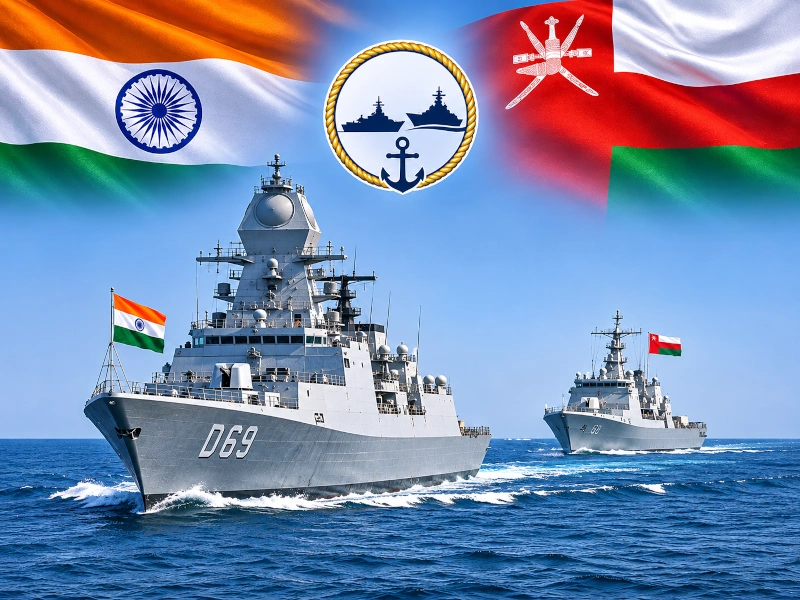
Indian Naval Ship INS Surat, one of India’s most advanced indigenously built guided-missile destroyers, arrived in Muscat, Oman, on 8 November 2026 to participate in the 15th edition of the bilateral maritime exercise Naseem Al Bahr. The exercise, conducted between the Indian Navy and the Royal Navy of Oman, will strengthen operational coordination, maritime interoperability and cooperation between the two countries in the strategically important western Indian Ocean.
According to the Ministry of Defence’s announcement on 9 November, the exercise will involve professional engagements during harbour and sea phases, followed by a Coordinated Patrol (CORPAT) involving the two navies. The deployment reflects the expanding maritime partnership between India and Oman and supports India’s MAHASAGAR vision of Mutual and Holistic Advancement for Security and Growth Across Regions.
Naseem Al Bahr 2026 to Strengthen Naval Interoperability
Exercise Naseem Al Bahr, meaning Sea Breeze, is a longstanding bilateral maritime engagement conducted by the Indian Navy and the Royal Navy of Oman. The exercise provides a platform for both navies to strengthen professional relationships, exchange operational experience and improve their ability to conduct coordinated maritime activities.
The 15th edition will feature harbour-based professional interactions, cross-deck visits, operational discussions and sporting engagements. These activities are designed to familiarise participating personnel with the operational procedures, equipment and working practices of their counterparts.
During the sea phase, personnel from both navies will have opportunities to strengthen coordination in a maritime operational environment. Such engagements contribute to improved communication, mutual understanding and the ability to conduct joint operations when required.
The exercise will be followed by a Coordinated Patrol, extending bilateral engagement beyond professional exchanges to practical cooperation at sea. Coordinated patrols help strengthen communication and operational familiarity between maritime forces operating in strategically important waters.
INS Surat: India’s Advanced Indigenous Guided-Missile Destroyer
The participation of INS Surat highlights India’s growing capabilities in indigenous warship design, construction and advanced naval technology.
Commissioned into the Indian Navy on 15 January 2025, INS Surat is the fourth and final warship constructed under Project 15B, also known as the Visakhapatnam-class guided-missile destroyer programme.
The warship was designed by the Indian Navy’s Warship Design Bureau and constructed by Mazagon Dock Shipbuilders Limited in Mumbai. It incorporates approximately 75% indigenous content, reflecting the increasing participation of Indian industries in the development of sophisticated naval combat platforms.
INS Surat has a displacement of approximately 7,400 tonnes and an overall length of 164 metres. Powered by four gas turbines in a Combined Gas and Gas propulsion configuration, the destroyer achieved speeds exceeding 30 knots during sea trials.
The vessel is equipped with advanced weapons and sensors, including surface-to-air missiles, anti-ship missiles and torpedoes. Its integrated combat systems and network-centric capabilities allow it to perform multiple operational roles, including air defence, surface warfare and maritime security missions.
The destroyer also incorporates advanced indigenous technological solutions intended to improve operational efficiency and situational awareness.
Its deployment to Oman demonstrates the Indian Navy’s ability to employ sophisticated domestically manufactured warships during international maritime exercises and operational engagements.
Three Decades of India–Oman Naval Cooperation
The India–Oman maritime partnership has developed steadily over more than three decades, supported by regular naval exercises, operational exchanges and high-level military engagement.
The first edition of Exercise Naseem Al Bahr was conducted in 1993, establishing a framework for sustained cooperation between the Indian Navy and the Royal Navy of Oman.
Since then, the exercise has evolved to include increasingly sophisticated maritime activities involving surface combatants, maritime patrol aircraft and other naval assets.
During the 13th edition, conducted off Oman in November 2022, Indian warships INS Trikand and INS Sumitra participated alongside Royal Navy of Oman vessels Al Shinas and Al Seeb.
The exercise included tactical maritime operations involving surface action, air defence, maritime surveillance and interdiction. Indian and Omani maritime patrol aircraft also participated, demonstrating cooperation across multiple operational domains.
The 14th edition, conducted off Goa from 13 to 18 October 2024, involved INS Trikand, an Indian Navy Dornier maritime patrol aircraft and the Omani naval vessel Al Seeb.
Activities included gunnery exercises, close-range anti-aircraft firing, tactical manoeuvres, replenishment-at-sea approaches and helicopter cross-deck operations.
These successive exercises have enabled both navies to strengthen interoperability while developing greater familiarity with each other’s operational procedures.
Oman’s Strategic Importance in the Western Indian Ocean
Oman occupies an important geographical position along the Arabian Sea and the Gulf of Oman, close to the approaches to the Strait of Hormuz.
The Strait of Hormuz is among the world’s most strategically significant maritime passages, connecting the Persian Gulf with the Gulf of Oman and the wider Indian Ocean. A substantial volume of international energy trade moves through this region, making maritime security particularly important for countries dependent on seaborne commerce.
For India, the western Indian Ocean is critical to energy security, commercial shipping and international trade. Sea routes connecting Indian ports with the Middle East, Africa and Europe pass through waters influenced by developments in this region.
Oman’s location and established maritime infrastructure make it an important partner for regional naval cooperation, maritime logistics and operational engagement.
Regular interactions between the Indian Navy and the Royal Navy of Oman contribute to mutual understanding of regional maritime conditions and reinforce cooperation in maintaining secure sea lanes.
Expanding Defence Cooperation Beyond Naval Exercises
India and Oman maintain a comprehensive defence relationship encompassing military training, operational cooperation, defence industry engagement and regular high-level consultations.
The 13th India–Oman Joint Military Cooperation Committee meeting, held in New Delhi on 24 November 2025, marked an important development in this partnership.
The meeting was co-chaired by India’s Defence Secretary Rajesh Kumar Singh and Dr Mohammed Bin Naseer Bin Ali Al Zaabi, Secretary-General of Oman’s Ministry of Defence.
Both countries reviewed existing defence cooperation and discussed opportunities to expand engagement in several areas, including joint development, technology sharing and defence production partnerships.
The discussions also addressed regional and international security developments, particularly those affecting the Indian Ocean.
The latest deployment of INS Surat builds upon this institutional cooperation by maintaining regular operational contact between the two navies.
Such engagements complement India’s broader defence diplomacy in West Asia and strengthen relationships with countries that play important roles in regional maritime security.
Supporting India’s MAHASAGAR Maritime Vision
The Ministry of Defence has linked INS Surat’s deployment to India’s MAHASAGAR vision, which emphasises Mutual and Holistic Advancement for Security and Growth Across Regions.
The initiative builds upon India’s established maritime engagement with countries across the Indian Ocean and promotes cooperative approaches to regional security, economic development and capacity building.
Bilateral naval exercises form an important component of this framework by enabling participating countries to strengthen operational relationships and develop shared approaches to maritime challenges.
Through professional exchanges, coordinated patrols and other maritime engagements, India seeks to expand cooperation with regional partners while supporting a stable maritime environment.
The deployment of an advanced indigenous destroyer such as INS Surat also demonstrates the connection between India’s expanding defence manufacturing capabilities and its international maritime partnerships.
Strengthening India’s Maritime Presence and Regional Partnerships
INS Surat’s participation in Naseem Al Bahr 2026 represents another important milestone in the longstanding relationship between the Indian Navy and the Royal Navy of Oman.
The exercise will allow both forces to deepen professional engagement, exchange operational experience and strengthen coordination during maritime activities. The subsequent coordinated patrol will further reinforce their ability to work together at sea.
The deployment also highlights India’s growing capacity to undertake sustained international naval engagements using sophisticated indigenously built combat platforms.
As India continues to expand its maritime partnerships across the Indian Ocean, regular exercises with countries such as Oman remain important instruments for strengthening regional cooperation, promoting maritime security and safeguarding the sea routes that support international trade and economic connectivity.
You may also like
-
India and EU Conclude Horizon Europe Negotiations, Opening New Opportunities for Scientific Research
-
Tārā’s Diplomacy: How Wise Counsel Prevented a Political Crisis Between Allies
-
Hanumān in Rāvaṇa’s Court: Courage, Strategic Messaging and the Responsibilities of an Envoy
-
India’s Railgun Programme: DRDO Advances Next-Generation Artillery Technology in Pune
-
Bharat Forge Receives Bulk Production Clearance for Indigenous ATAGS, Manufacturing to Begin in FY2026–27
