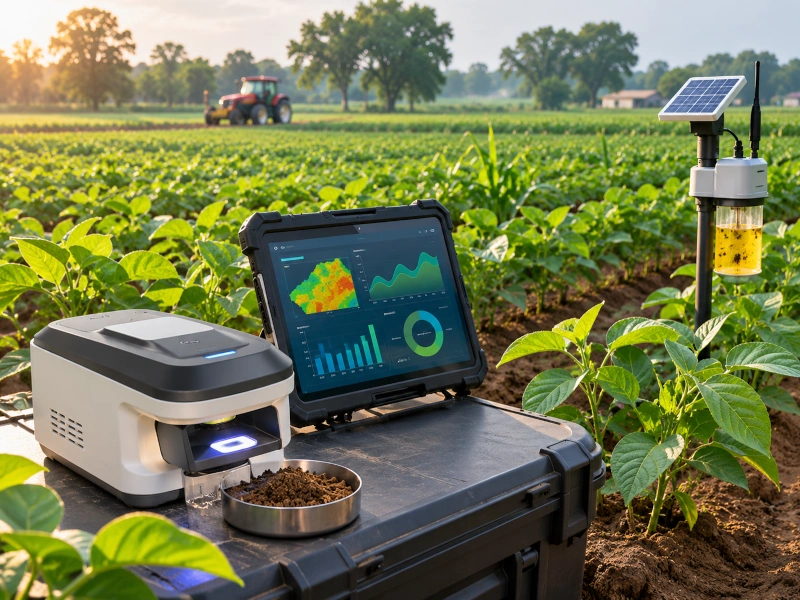
IIT Kanpur-incubated agritech startup ScaNxt Scientific Technologies has secured investment from Zerodha’s Rainmatter, the Small Industries Development Bank of India (SIDBI) and the Export-Import Bank of India (Exim Bank) to expand its indigenous agricultural technologies across India and international markets. Announced on 5 November 2026, the investment will support the company’s development of artificial intelligence-based soil diagnostics, intelligent pest detection, precision agricultural equipment and climate-resilient farming solutions.
The Noida-based company has developed a portfolio of technologies combining near-infrared spectroscopy, machine learning, Internet of Things (IoT) systems and agricultural engineering. Its flagship product, Bhu-Parikshak, enables rapid soil testing without chemical reagents, while its patented Detect technology and AgroLens platform support pest identification and crop advisory services. ScaNxt is also developing electric agricultural machinery and solar-powered crop-drying systems to address mechanisation and post-harvest requirements.
The company has registered nearly 90,000 farmers and serves more than 200 business customers across over 21 Indian states. The latest investment will enable it to strengthen research and development, improve its product portfolio, expand distribution partnerships and increase the availability of precision agricultural technologies for small and marginal farmers.
Bhu-Parikshak: Chemical-Free Soil Testing Using Near-Infrared Spectroscopy
One of ScaNxt’s principal innovations is Bhu-Parikshak, a portable soil diagnostic system designed to assess important soil characteristics using near-infrared spectroscopy and machine learning.
Conventional laboratory soil testing typically involves collecting samples and conducting chemical analyses to determine nutrient availability and other soil properties. Although laboratory testing provides important information for agricultural management, sample transportation, processing requirements and access to testing facilities can create practical difficulties for farmers in remote agricultural regions.
Bhu-Parikshak uses near-infrared light to analyse the spectral characteristics of soil samples. When light interacts with soil constituents, different materials produce distinct patterns of absorption and reflection. These spectral measurements can be processed using trained machine-learning models to estimate selected soil properties.
According to the company’s published product information, the system is designed to assess parameters including nitrogen, phosphorus, potassium, organic carbon, clay content and cation exchange capacity. The resulting information can be presented through a connected digital platform, allowing agricultural stakeholders to obtain soil assessments and crop-related recommendations.
The technology’s principal advantage is its ability to conduct rapid, reagent-free measurements using portable equipment. Unlike conventional chemical analysis, near-infrared spectroscopy does not require chemical reagents for each measurement, making it suitable for field-oriented diagnostic applications.
The system relies on calibration models that relate spectral measurements to soil characteristics. This approach offers opportunities to make soil-health information more accessible to farmers while supporting more informed decisions about nutrient management.
Artificial Intelligence Helps Farmers Identify Crop Pests Earlier
ScaNxt has also developed AI-powered pest-monitoring technologies intended to help farmers identify agricultural threats and make timely crop-protection decisions.
Its patented Detect technology and AgroLens platform combine digital sensing, artificial intelligence and crop advisory capabilities. The systems are designed to identify pest-related problems and provide actionable information that farmers can use when managing crops.
Pest infestations can result in substantial agricultural losses, particularly when problems remain undetected until visible damage has spread across a field. Conventional monitoring often depends on periodic manual inspection, agricultural experience and access to specialist advisory services.
Artificial intelligence can supplement these methods by examining field observations and identifying patterns associated with particular pests or crop conditions. When combined with suitable monitoring equipment, such systems can support earlier identification of problems and help farmers determine where intervention is necessary.
ScaNxt’s technologies are intended to bring this analytical capability closer to agricultural operations. Rather than relying exclusively on laboratory examinations or distant advisory centres, farmers and agricultural service providers can use digital tools to obtain field-level information and recommendations.
The company’s integration of pest identification with crop advisory services is particularly relevant to precision agriculture, where agricultural inputs are increasingly applied according to observed field conditions instead of uniform treatment schedules.
AgroLens Integrates Crop Monitoring with Digital Agricultural Advisory
AgroLens forms an important part of ScaNxt’s wider agricultural intelligence platform. The system is designed to bring together crop monitoring, pest detection and agricultural recommendations within a digital environment.
The platform’s objective is to convert agricultural observations into information that can support practical decisions. Soil characteristics, pest activity and crop conditions can influence fertiliser application, irrigation requirements and pest-control practices.
Digital advisory systems can help organise this information and make it available to farmers, agronomists and agricultural enterprises. Such platforms are particularly useful when agricultural operations involve multiple farms or geographically dispersed production areas.
By connecting field observations with digital analysis, ScaNxt is developing a technology ecosystem that extends beyond individual diagnostic instruments. Its approach seeks to integrate agricultural sensing, data interpretation and decision support into a coordinated system.
This combination of hardware and software is important because agricultural productivity depends on several interacting factors, including soil health, crop nutrition, pest pressure, weather conditions and the availability of suitable farm equipment.
Indigenous Electric Farm Mechanisation for Small Agricultural Holdings
ScaNxt’s technology portfolio also includes electric agricultural mechanisation designed to address the operational requirements of small and fragmented farms.
Conventional agricultural mechanisation frequently relies on diesel-powered tractors and specialised machinery. While these systems remain essential to modern farming, their purchase costs, fuel requirements and operating characteristics can create difficulties for smaller agricultural holdings.
Electric agricultural machinery offers an alternative for selected operations, particularly where compact equipment can provide sufficient power and operating endurance. Such systems can reduce direct fuel consumption and local exhaust emissions while potentially lowering some maintenance requirements.
ScaNxt is developing indigenous electric mechanisation technologies as part of its efforts to make advanced agricultural equipment more accessible. Its work includes compact electric farming equipment designed for smaller operational environments.
The company is also exploring the integration of intelligent sensing and digital systems into agricultural machinery. Such capabilities can support more precise operations and create opportunities for combining mechanisation with agricultural monitoring.
The development of domestic electric farming equipment is particularly relevant to India’s broader efforts to encourage indigenous manufacturing, improve agricultural productivity and expand clean-energy applications beyond conventional transportation.
Smart Solar Drying Technology for Post-Harvest Processing
Alongside soil diagnostics and mechanisation, ScaNxt is advancing smart solar drying solutions designed to support agricultural post-harvest management.
Drying is an important processing activity for numerous agricultural commodities, including spices, fruits, vegetables and medicinal plants. Traditional open-air drying methods can expose produce to dust, insects, moisture and changing weather conditions.
Solar drying systems use captured solar energy to create conditions suitable for removing moisture from agricultural products. Enclosed drying arrangements can provide greater protection from environmental contamination than open-air methods.
Smart monitoring and control technologies can further support drying operations by measuring relevant environmental conditions and assisting operators in managing the process.
ScaNxt’s interest in solar drying extends its technology portfolio beyond crop cultivation into post-harvest processing. The approach recognises that agricultural efficiency depends not only on improving production but also on protecting the quality of harvested produce.
For small farmers, producer organisations and agricultural processing enterprises, accessible drying technologies can support improved handling of perishable commodities and greater opportunities for value addition.
Rainmatter, SIDBI and Exim Bank Back Indigenous Agricultural Innovation
ScaNxt’s latest investment brings together private climate-technology capital and two important Indian development finance institutions.
Rainmatter, Zerodha’s investment arm, supports ventures developing technologies in areas including climate resilience, healthcare, financial technology and deep technology. Its participation reflects growing investor interest in agricultural companies that combine scientific research with practical hardware and engineering.
SIDBI plays an important role in financing and developing India’s micro, small and medium enterprise sector. Its participation provides institutional support for a company seeking to expand the manufacture and deployment of specialised agricultural technologies.
Exim Bank’s involvement is also significant because ScaNxt is pursuing opportunities beyond the Indian domestic market. The bank supports India’s international trade and investment activities, making its participation relevant to the company’s plans for international expansion.
The investment amount has not been publicly disclosed. According to IIT Kanpur’s official announcement, the new capital will be used to accelerate product development, strengthen research activities, expand channel partnerships and support the deployment of ScaNxt’s agricultural technologies.
The funding represents an important development for an enterprise working across several capital-intensive areas, including precision sensors, embedded electronics, artificial intelligence and agricultural machinery.
From IIT Kanpur Incubation to Commercial Agricultural Technology
ScaNxt Scientific Technologies emerged from the innovation and incubation ecosystem associated with the Indian Institute of Technology Kanpur. The company is led by founder and Chief Executive Officer Rajat Vardhan.
Its development has been supported by the institute’s technology incubation framework, which helps research-oriented enterprises transform engineering innovations into commercially relevant products.
IIT Kanpur’s Foundation for Innovation & Research in Science & Technology (FIRST) supports deep-technology startups across agriculture, healthcare, advanced manufacturing, clean energy and other sectors.
ScaNxt’s progress illustrates the role that academic institutions can play in connecting scientific research with practical industrial applications. Its technologies combine areas traditionally associated with laboratory research, such as spectroscopy and machine learning, with the requirements of agricultural production.
The company has moved beyond initial technology development to establish a growing commercial presence. With nearly 90,000 registered farmers and more than 200 business customers across over 21 states, it has developed a network through which its agricultural solutions can reach a wider range of users.
The company is also pursuing international opportunities, reflecting the potential relevance of affordable agricultural diagnostics and climate-smart equipment in other regions where smallholder farming remains economically important.
Making Precision Agriculture Accessible to Indian Farmers
Precision agriculture involves using information about soil, crops and field conditions to improve the timing and location of agricultural operations. The objective is to apply resources more efficiently while supporting crop productivity and agricultural sustainability.
Although advanced precision farming technologies have traditionally been associated with large commercial farms, portable sensing equipment, artificial intelligence and compact machinery are creating opportunities to adapt these approaches for smaller holdings.
ScaNxt’s portfolio addresses several practical requirements through a combination of soil diagnostics, pest monitoring, crop advisory services and farm mechanisation.
The Bhu-Parikshak system provides an alternative method of obtaining soil-health information. Detect and AgroLens support the identification and management of crop pests, while electric agricultural equipment offers opportunities to expand mechanisation.
These technologies can also support Farmer Producer Organisations, agricultural cooperatives and service providers that work with multiple farmers. Shared technology services can help smaller agricultural enterprises access specialised equipment without requiring every farmer to make a substantial individual investment.
The integration of diagnostic systems and digital advisory platforms creates opportunities for more informed agricultural management, particularly where access to conventional testing laboratories and specialised technical services is limited.
Strengthening India’s Agricultural Deep-Technology Ecosystem
The development of ScaNxt reflects the emergence of a wider Indian agricultural deep-technology ecosystem combining scientific research, electronics, artificial intelligence and precision engineering.
Unlike purely software-based agricultural applications, deep-technology enterprises must develop and integrate physical equipment, sensors, computing systems and field-tested engineering solutions.
The ability to manufacture and deploy such technologies domestically can strengthen India’s capabilities in agricultural instrumentation and specialised machinery. It can also create opportunities for collaboration among universities, manufacturers, agricultural institutions and rural enterprises.
ScaNxt’s combination of near-infrared soil diagnostics, AI-powered pest detection, electric mechanisation and solar drying represents a broad approach to agricultural technology development. By addressing multiple stages of farming and post-harvest management, the company is building an integrated portfolio of climate-smart agricultural solutions.
The investment from Rainmatter, SIDBI and Exim Bank provides additional resources to expand these activities and strengthen the company’s research and commercial capabilities.
With an expanding farmer network, growing institutional support and technologies developed through India’s academic innovation ecosystem, ScaNxt is contributing to the advancement of indigenous precision agriculture.
Its progress demonstrates how Indian scientific research can be translated into practical technologies that support more informed crop management, efficient resource utilisation and greater access to modern agricultural tools for small and marginal farmers.
You may also like
-
India Confirms E20 Petrol Quality Compliance Across 27 States After Testing 893 Samples
-
Indore Agritech Startup Pragyanik AI Develops Autonomous Agricultural Robot for Precision Weeding and Spraying
-
Kashmir Saffron of Jammu & Kashmir: The GI-Tagged Heritage of India’s Precious Golden Spice
-
Indian-Founded Robotics Startup Ottonomy Raises $4.2 Million to Expand Autonomous Healthcare and Industrial Logistics
-
India’s Railgun Programme: DRDO Advances Next-Generation Artillery Technology in Pune
