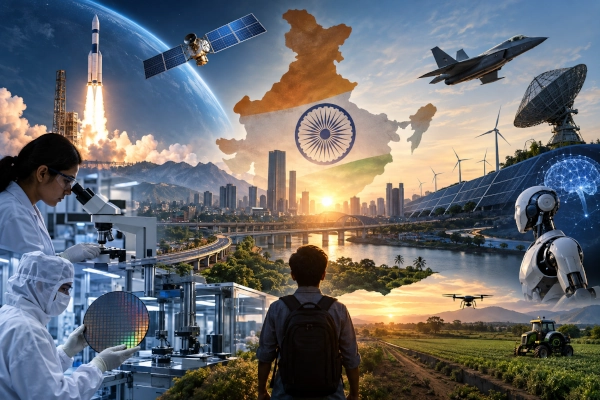
For most of the industrial age, national power rested on familiar foundations such as land, minerals, energy, factories, ports and trade routes. Those assets still matter, but the centre of gravity is shifting towards technologies that influence every other sector. Semiconductors, artificial intelligence, advanced communications, space systems, biotechnology, quantum technologies, robotics and advanced materials are increasingly becoming the infrastructure on which future industries will depend.
India therefore faces a question that goes beyond access to technology. The real issue is how much of the technology on which its economy and security depend should be understood, designed, manufactured and improved within the country itself. Buying an advanced system may solve an immediate requirement, but owning the underlying capability creates something more durable because it gives a country room to modify systems, protect critical supply chains, develop domestic companies, retain intellectual property and build successive generations of technology without remaining permanently dependent on an overseas supplier.
Technology Is Becoming Infrastructure
Many technologies that were once treated as specialised products are becoming foundational infrastructure. Semiconductors are embedded in telecommunications equipment, automobiles, aircraft, medical devices, industrial machines, power grids, defence systems and data centres. A serious disruption in semiconductor supply can therefore affect multiple sectors at the same time.
Artificial intelligence is moving in the same direction, as are cloud computing, satellite navigation, cybersecurity and advanced communication networks. These technologies no longer sit neatly inside individual industries because they increasingly provide common digital and physical foundations across the economy. The distinction between using a technology and controlling it therefore becomes more important as that technology becomes more deeply embedded in national infrastructure.
A country may use thousands of advanced systems while possessing very little of the design knowledge, manufacturing capability or intellectual property behind them. That gap between use and ownership is becoming one of the central questions in technology policy.
Ownership Means More Than Manufacturing
Technology ownership does not mean manufacturing every component within national borders. Modern supply chains are too interconnected for complete technological isolation to be practical or desirable. The more important question is whether a country possesses enough knowledge, engineering depth and industrial capability to understand, modify and reproduce critical systems when necessary.
A nation that imports a finished product may know how to operate it but may not control its architecture, software, upgrades or specialised components. Domestic capability changes that relationship because engineers can adapt products for local conditions, replace imported subsystems, develop improved versions and create new products based on the same knowledge base. The real value of ownership therefore lies in having choices rather than simply having possession of a finished product.
Semiconductors Show Why the Difference Matters
India has long had strong semiconductor-design talent, with Indian engineers contributing to processors, communication devices, memory systems and complex integrated circuits across the global chip industry. The larger gap has been in manufacturing, advanced packaging, equipment, materials and other parts of the supporting supply chain.
India is now attempting to narrow that gap. The Union Cabinet approved Semicon 2.0 in July 2026 with an outlay of ₹1,27,500 crore, while official data showed that 105 Indian startups were already developing chips. The objective is larger than simply producing more semiconductors inside India because a functioning semiconductor ecosystem creates manufacturing expertise, packaging know-how, testing infrastructure, specialised materials suppliers and companies capable of designing proprietary chips.
A fabrication plant therefore matters, but the knowledge and supplier base that develops around it matter even more.
Intellectual Property Is Where Much of the Value Sits
The economic value of advanced technology is not captured only in the final stage of production. A large share often lies in the design, architecture, patents, software and engineering knowledge behind the product. A company that owns a processor architecture or specialised chip design can improve it over successive generations, licence it, incorporate it into multiple products and build an entire commercial ecosystem around the same intellectual property.
A company that only assembles the final product captures a smaller share of that value. India’s long-term technological ambition therefore cannot end with becoming an efficient place to manufacture other companies’ products. Manufacturing is essential, but true technology ownership requires Indian companies to create designs, patents, platforms and products of their own.
That is the difference between participating in a technology industry and helping shape it.
Defence Makes Ownership a Strategic Requirement
The consequences of technological dependence become even clearer in defence because military systems remain in service for decades. During that period they require upgrades, software changes, spare parts, weapons integration and replacement of obsolete components. A foreign purchase can therefore create a chain of dependency long after the original contract has been signed.
Domestic capability provides considerably more freedom because engineers can integrate locally developed weapons, modify software, replace imported subsystems and develop specialised variants for Indian operational requirements. India’s defence production reached a record ₹1.78 lakh crore in FY2025-26, almost four times the level recorded in FY2013-14, while the private sector accounted for around 24% of production.
The importance of these figures lies in the engineering capability being accumulated behind them. Every radar, missile, electronic-warfare system, vehicle or aircraft component designed domestically adds knowledge to the wider industrial base, and that knowledge remains available for the next programme.
The Hardest Technologies Take the Longest to Master
Some technological dependencies are much harder to reduce than others because they depend on accumulated expertise built over decades. Aircraft engines are a clear example, requiring advanced metallurgy, turbine technology, thermal coatings, precision manufacturing and sophisticated control systems. A country can design much of an aircraft and still remain dependent on an imported engine.
The same problem appears in semiconductor manufacturing equipment, high-end sensors, specialised materials and advanced industrial machinery. These technologies cannot be created through a single investment or one successful prototype because they depend on laboratory work, repeated testing, failed designs, specialised manufacturing and supplier development over many years.
This is precisely why long-term investment in difficult technologies matters. The countries that persist through several generations of development gradually accumulate capabilities that are very difficult for others to reproduce quickly.
Space Shows How Knowledge Compounds
India’s space programme offers one of the clearest examples of technological capability accumulating over time. The value of developing launch vehicles was never limited to the rockets themselves because the programme created expertise in propulsion, guidance, electronics, materials, software, structures, mission planning and systems engineering.
Each generation of technology became the foundation for the next. India is now attempting to extend that accumulated capability into a wider commercial space industry, with more than 400 space startups working across launch vehicles, satellites, propulsion, payloads, ground infrastructure and space-based services by 2026.
Government support includes a ₹1,000 crore venture-capital fund, a ₹500 crore Technology Adoption Fund, access to ISRO infrastructure and technology-transfer mechanisms. The larger objective is to convert national scientific capability into an industrial ecosystem capable of producing globally competitive companies.
Technology Ownership Creates Ecosystems
An indigenous technology programme rarely produces only one product because the process also creates suppliers, manufacturing methods, testing facilities, trained engineers and companies capable of applying similar knowledge elsewhere. A firm that learns to manufacture high-precision components for rockets may later work in aerospace, defence or energy, while a company developing military sensors may find applications in industrial automation.
Semiconductor expertise can similarly support telecommunications, automobiles, medical systems and artificial intelligence. The economic value therefore extends beyond the original programme because knowledge moves between industries and creates capabilities that can be reused.
Technology ecosystems become powerful precisely because they allow one difficult technological achievement to strengthen several other sectors.
Deep Tech Needs Patient Capital
One of the greatest barriers to technology ownership is financing because deep-tech companies operate on very different timelines from conventional consumer businesses. A semiconductor, quantum device, rocket engine, advanced battery, medical platform or robotic system may require years of research before becoming commercially viable.
That creates a financing gap because investors must support laboratories, engineers and prototypes long before revenues become predictable. India’s Research, Development and Innovation Scheme, with an outlay of ₹1 lakh crore over six years, is intended to address part of this problem by supporting research-driven areas including quantum computing, robotics, space, artificial intelligence, biotechnology and advanced energy technologies.
The underlying logic is that deep technology cannot be financed in the same way as a conventional digital startup. It requires capital willing to wait for engineering milestones rather than immediate commercial returns.
Artificial Intelligence Raises a New Form of Dependence
Artificial intelligence introduces another layer to the technology-ownership debate because AI increasingly depends on specialised chips, large-scale computing infrastructure, advanced models, datasets and highly trained researchers. A country can become a major user of artificial intelligence without controlling any of those underlying layers.
That creates a new form of technological dependence. The applications may be local, but the infrastructure, models and intellectual property may remain external. This matters because artificial intelligence is likely to influence manufacturing, healthcare, agriculture, finance, education, defence and public administration simultaneously.
India’s AI programmes therefore sit alongside semiconductor, robotics and quantum initiatives as part of a broader attempt to build more of the underlying technology stack domestically rather than relying only on applications built on external platforms.
Telecom Already Demonstrated the Risk
Telecommunications provides an earlier example of why technology depth matters. Modern economies depend on communication networks for banking, government, transport, industry and national security, which makes excessive dependence on a small number of foreign suppliers a vulnerability far larger than the value of the equipment itself.
India’s effort to develop indigenous telecom stacks and domestic 4G and 5G capabilities reflects an awareness that communications infrastructure has strategic importance. The same reasoning now extends to semiconductors, artificial intelligence, quantum systems and satellite networks because these technologies are becoming part of the infrastructure on which future industries will operate.
The lesson from telecom is that technological dependence becomes more serious when a product evolves into a system that the entire economy relies upon.
Supply Chains Can Become Strategic Pressure Points
Recent disruptions to global trade have shown that supply chains are not always neutral commercial arrangements. Export restrictions, geopolitical tensions, shipping disruptions and strategic competition can suddenly affect access to critical technologies and components.
A country that depends heavily on one external source for a key input has limited room to respond when that supply becomes uncertain. Domestic capability does not eliminate dependence, but it provides alternatives through local production, multiple suppliers and indigenous intellectual property.
Technology ownership is therefore increasingly connected with economic security because resilience depends on having more than one route to the systems that matter most.
Capability Changes the Nature of Partnerships
Domestic technology also changes the way countries negotiate with one another. A nation with little technological capability approaches partnerships mainly as a buyer, while a country that possesses valuable technology can participate as a supplier, co-developer or equal partner.
Advanced sensors, missiles, digital platforms, pharmaceuticals, satellites and semiconductor designs can all become part of international cooperation. India’s growing defence exports, space partnerships and digital-payment links already show how domestic capability can eventually become an instrument of foreign engagement.
Technology purchased from abroad solves an internal requirement, while technology developed at home can create commercial influence and strategic leverage abroad.
Ownership Does Not Mean Isolation
Technology sovereignty should not be confused with technological isolation because the world’s most advanced industries depend on international networks. Semiconductor production alone involves design software, lithography systems, chemicals, materials, manufacturing equipment and fabrication spread across several countries.
India neither needs nor benefits from trying to reproduce every element of every technology chain domestically. The more realistic objective is selective depth, with strong national capabilities in areas where complete dependence would create serious strategic or economic vulnerability.
Technological strength comes from entering international partnerships with something valuable to contribute rather than entering them without alternatives.
Moving Higher Up the Value Chain
There is also a straightforward economic reason to pursue technology ownership. Countries that supply raw materials or low-value manufacturing capture only part of the value contained in sophisticated products, while countries controlling design, intellectual property and technology usually capture a larger share.
India’s software industry has already demonstrated this progression. Indian companies moved from lower-value outsourcing towards global consulting, engineering and technology services, and a similar transition is now being attempted in manufacturing and deep technology.
The objective is not simply to produce more goods in India. It is to increase the amount of Indian design, engineering and intellectual property contained inside those goods.
The Next Generation of Indian Companies Matters
Startups working in defence, space, semiconductors, robotics, artificial intelligence and biotechnology are important for reasons that go beyond employment numbers because they are potential repositories of Indian intellectual property.
Many will fail, while others will remain specialised suppliers, and only a smaller number may eventually become globally significant technology companies. The important objective is to create enough depth in the ecosystem that this process becomes repeatable rather than exceptional.
India’s deep-tech funds, semiconductor design programmes, defence innovation schemes and space-sector reforms are all attempts to create such an environment. The ambition is not simply to produce more entrepreneurs, but to produce entrepreneurs who own difficult technologies.
Technology Ownership Expands National Choice
The strongest argument for domestic technological capability is not complete self-sufficiency, but freedom of choice. A country with technological capability can decide whether to manufacture domestically, import, collaborate or export, while a country without that capability has fewer options because procurement becomes the only practical route.
The same principle applies to companies. A firm that owns its core technology can determine how that technology evolves, where it is manufactured and which markets it enters.
Technological capability therefore expands the range of decisions available to both companies and governments, giving ownership economic and strategic value at the same time.
The Technologies of the Future Will Shape National Power
The technologies emerging today will influence far more than economic growth. Semiconductors will determine computing capacity, artificial intelligence will reshape services and manufacturing, quantum technologies may transform communication and sensing, biotechnology will influence medicine and agriculture, space systems will underpin navigation and surveillance, and advanced energy technologies will shape industrial competitiveness.
Countries that own meaningful capabilities in these sectors will gain advantages extending beyond export earnings because they will influence standards, supply chains, industrial ecosystems and the direction in which future technologies develop.
Technology ownership is therefore increasingly becoming part of national power rather than merely an industrial objective.
India Wants to Become Technologically Consequential
India will continue importing technology, working with global companies and participating in international research networks because an interconnected economy benefits from collaboration and specialisation. The strategic objective is not technological isolation but a growing share of critical technologies containing Indian engineering, Indian intellectual property and Indian manufacturing capability.
Semiconductor fabs, private rockets, defence systems, AI research, quantum programmes and deep-tech startups may appear to belong to separate sectors, but they are connected by the same ambition. India wants to move from being primarily a large market for technologies created elsewhere to becoming one of the countries capable of creating, improving and exporting technologies of its own.
The countries that shape the future will not necessarily be those that consume the most technology. They will be those that understand it deeply enough to build the next generation. India’s challenge is therefore larger than becoming technologically self-reliant; it is to become technologically consequential.
References
Ministry of Electronics and Information Technology / PIB — Cabinet Approves Semicon 2.0, 15 July 2026
https://www.pib.gov.in/PressReleasePage.aspx?PRID=2284796
Ministry of Electronics and Information Technology / PIB — Semicon 2.0 Implementation and Semiconductor Ecosystem, 17 September 2026
https://www.pib.gov.in/PressReleaseIframePage.aspx?PRID=2311630
Department of Science and Technology / PIB — Research, Development and Innovation Scheme, 29 July 2026
https://www.pib.gov.in/PressReleasePage.aspx?PRID=2291145
Ministry of Defence / PIB — Defence Production Reaches Record ₹1.78 Lakh Crore in FY2025-26, 17 June 2026
https://www.pib.gov.in/PressReleasePage.aspx?PRID=2273824
Department of Space / PIB — Private Space Ecosystem Crosses 400 Startups, 26 April 2026
https://www.pib.gov.in/PressReleasePage.aspx?PRID=2255657
Department of Space / PIB — Development of Space Technology, 6 August 2026
https://www.pib.gov.in/PressReleasePage.aspx?PRID=2295424
Department of Space / PIB — Space Venture Capital Fund, 5 August 2026
https://www.pib.gov.in/PressReleasePage.aspx?PRID=2294772
Ministry of Science and Technology / PIB — Artificial Intelligence, Research and Innovation, 12 August 2026
https://www.pib.gov.in/PressReleasePage.aspx?PRID=2298231
You may also like
-
India Post and Blue Dart Join Forces to Expand Parcel Delivery Across Urban and Rural India
-
Starlink-Ukraine, Myanmar and Drug Smuggling: Why India Must Regulate Satellite Internet for National Security
-
GST Council Recommends Major Compliance Reforms, Raises Prosecution Threshold to ₹5 Crore
-
Narendra Modi Completes 25 Years in Government: From Gujarat to the Mission of Viksit Bharat
-
Andhra Pradesh Launches India’s First 3D Concrete-Printed Rural Housing Pilot With 177 Homes
