Prime Minister Narendra Modi completed 25 years of continuous service as a head of government on October 7, 2026, marking a political journey that began when he took oath as Chief Minister of Gujarat on October 7, 2001 and continued after he became Prime Minister of India in May 2014.
The milestone reflects not only political longevity but also the evolution of a governance model centred on development, welfare delivery, technology, infrastructure, national security, self-reliance and the long-term objective of building a developed India by 2047.
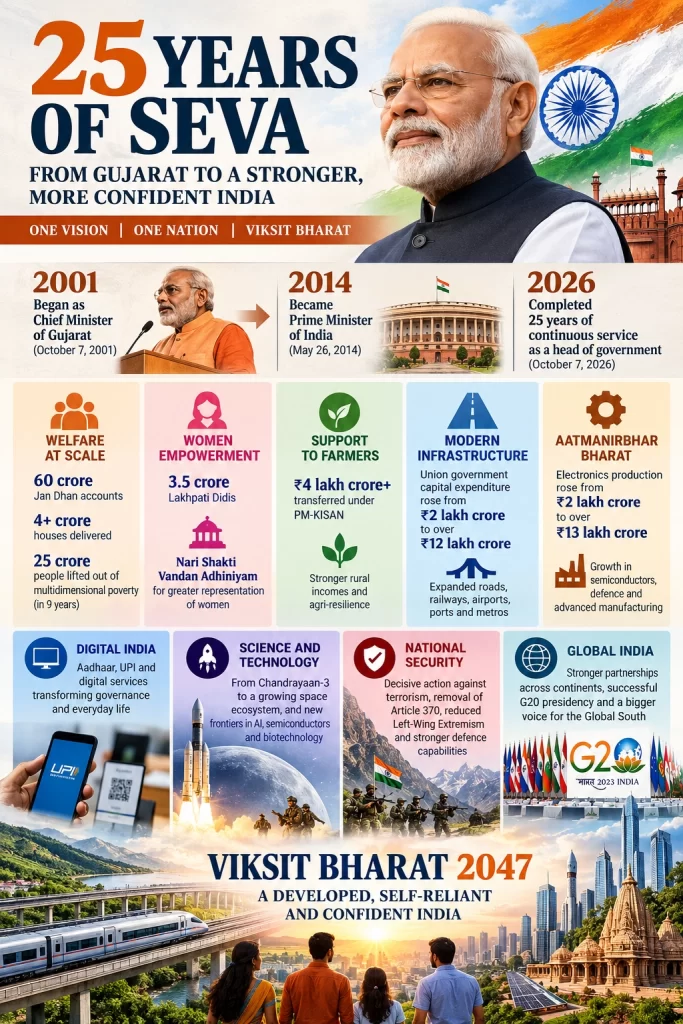
A Union Cabinet resolution adopted on October 6 traced this journey from Gujarat to the national stage, highlighting governance reforms, social programmes, industrial expansion, technological transformation and strategic decision-making.
From Gujarat to New Delhi
Narendra Modi served as Gujarat Chief Minister from October 2001 until May 2014, becoming the state’s longest-serving Chief Minister. Several administrative ideas from this period later influenced national governance.
The Cabinet resolution cited SWAGAT, Gujarat’s technology-enabled grievance-redressal system, and Jyotigram, which improved rural electricity supply through feeder separation. At the national level, similar emphasis on direct monitoring and implementation emerged through initiatives such as PRAGATI.
Modi became Prime Minister on May 26, 2014. He returned to office after the 2019 general election and began a third consecutive term following the 2024 Lok Sabha election.
Seva as a Governing Philosophy
Modi has consistently framed political office through the idea of seva, or public service. He has described duty, public trust and constitutional responsibility as central to his approach to governance.
This philosophy has shaped a strong focus on programmes intended to reach citizens directly, particularly through housing, sanitation, drinking water, financial inclusion, healthcare, electricity and direct benefit transfers.
The broader objective has been to reduce the distance between government schemes and intended beneficiaries.
Welfare at Scale
One of the most visible features of the Modi years has been the use of digital systems to expand welfare delivery.
According to the Union Cabinet’s official resolution, nearly 60 crore Jan Dhan bank accounts have been opened, while more than four crore houses have been delivered under government housing programmes. The government has also cited NITI Aayog estimates indicating that around 25 crore people moved out of multidimensional poverty over a nine-year period.
Aadhaar, bank accounts, mobile connectivity and direct transfers have created an administrative architecture capable of delivering benefits at national scale.
UPI represents a parallel transformation in the digital economy, turning India into one of the world’s largest real-time payment markets while also becoming an increasingly important part of India’s international economic engagement.
Women, Farmers and Tribal Communities
The expansion of targeted welfare has also placed greater attention on women, farmers and historically underserved communities.
The Cabinet resolution states that approximately 3.5 crore women have become Lakhpati Didis through programmes designed to raise rural household incomes. The passage of the Nari Shakti Vandan Adhiniyam also introduced a framework for reservation of women in the Lok Sabha and state legislatures after the required delimitation process.
PM-KISAN has become one of the world’s largest direct income-support programmes for farmers, with cumulative transfers exceeding ₹4 lakh crore by 2026.
For tribal communities, initiatives such as PM-JANMAN focus on housing, roads, education, healthcare, telecommunications and other essential services for Particularly Vulnerable Tribal Groups.
Infrastructure as an Economic Strategy
Infrastructure has become one of the defining features of the Modi government’s development model.
The Cabinet resolution noted that Union government capital expenditure increased from roughly ₹2 lakh crore to more than ₹12 lakh crore. Roads, railways, airports, ports, metro systems and freight corridors have all expanded during this period.
These investments increasingly support a larger industrial strategy. Faster logistics, better connectivity and improved energy infrastructure are intended to reduce costs and make India more competitive as a manufacturing base.
Aatmanirbhar Bharat and Manufacturing
The idea of Aatmanirbhar Bharat has grown into a broad industrial policy covering electronics, defence, semiconductors, energy, space and advanced manufacturing.
According to the Cabinet resolution, India’s electronics production rose from about ₹2 lakh crore to more than ₹13 lakh crore during the period under review. Mobile-phone manufacturing expanded rapidly, while India also began building a domestic semiconductor ecosystem.
Defence production has followed a similar direction, with greater emphasis on indigenous missiles, artillery, naval platforms, electronic systems, aircraft components and private-sector participation.
The objective is increasingly strategic: India seeks domestic capability in sectors that directly affect economic resilience and national security.
Technology and Scientific Capability
Technology has become both a public-service tool and a strategic national asset.
Digital identity, payments and online government services have transformed citizen interaction with the state. At the same time, national investment has expanded into artificial intelligence, quantum technologies, semiconductors, biotechnology, space and advanced telecommunications.
The opening of the space sector to private companies has created a growing ecosystem of launch, satellite, propulsion and geospatial startups.
Chandrayaan-3’s successful lunar landing became a prominent symbol of this wider effort to strengthen India’s scientific and technological capabilities.
COVID-19 and Strategic Capacity
The COVID-19 pandemic tested India’s public-health, manufacturing and administrative systems on an unprecedented scale.
India developed and manufactured vaccines domestically while conducting one of the world’s largest vaccination programmes. Vaccine Maitri subsequently extended India’s pharmaceutical and manufacturing capacity to partner countries.
The experience reinforced a wider policy lesson that has influenced later programmes: critical sectors require stronger domestic capability when global supply chains are disrupted.
National Security and Strategic Change
National security has been another major area of change during Modi’s premiership.
The government cites the 2016 surgical strikes, the 2019 Balakot air strikes and Operation Sindoor in 2025 as examples of a more direct response to terrorism and cross-border threats.
The effective removal of Article 370’s special provisions in August 2019 and the reorganisation of the former state of Jammu and Kashmir represented one of the most consequential constitutional decisions of the period.
The creation of the Chief of Defence Staff post, increased emphasis on indigenous defence procurement and the contraction of Left-Wing Extremism have also formed part of the government’s security agenda.
Structural Economic and Legal Reform
The period has also included several major institutional reforms.
The Goods and Services Tax created a nationwide indirect-tax framework, while insolvency reform introduced new mechanisms for dealing with distressed corporate assets.
The replacement of colonial-era criminal laws with the Bharatiya Nyaya Sanhita, Bharatiya Nagarik Suraksha Sanhita and Bharatiya Sakshya Adhiniyam marked a significant legal restructuring.
Greater tax digitisation and formalisation have also changed how businesses and citizens interact with government systems.
India’s Expanding Global Role
India’s international profile has grown substantially over the past decade.
The government has pursued strategic autonomy while deepening partnerships with the United States, Europe, Japan, Australia, Russia, West Asia, Africa and Southeast Asia.
India’s G20 presidency demonstrated this wider diplomatic ambition. New Delhi secured consensus on the G20 declaration despite geopolitical divisions and supported permanent membership of the African Union in the grouping.
India has also expanded its role through BRICS, the Quad, the International Solar Alliance, the Coalition for Disaster Resilient Infrastructure and wider engagement with the Global South.
World Leaders Mark the Milestone
The 25-year anniversary drew congratulatory messages from several foreign leaders.
Nigerian President Bola Ahmed Tinubu described the milestone as historic and highlighted India’s advances in infrastructure, digital public goods, financial inclusion and innovation.
Leaders from Bhutan, Belgium, Dominica and Japan also extended congratulations while referring to their countries’ growing partnerships with India.
These messages reflected India’s wider diplomatic weight as well as recognition of Modi’s long tenure in public office.
Development and Civilisational Confidence
A distinct feature of Modi’s political approach has been the effort to connect economic modernisation with civilisational identity.
Major infrastructure and technology programmes have advanced alongside the redevelopment of cultural and religious centres, including Kashi Vishwanath Dham. The consecration of Ram Lalla at Ayodhya in January 2024 became one of the defining cultural events of his premiership.
Yoga, millets and traditional knowledge systems have also been promoted internationally, linking India’s cultural heritage with contemporary diplomacy.
Viksit Bharat as the Next National Mission
The major political themes of the Modi era have increasingly converged around Viksit Bharat 2047.
Sabka Saath, Sabka Vikas emphasised inclusive development. Aatmanirbhar Bharat focused on strategic self-reliance. Panch Pran linked national development with unity, responsibility and civilisational confidence.
Viksit Bharat now brings these strands together into a single long-term goal: transforming India into a developed nation by the centenary of Independence.
Manufacturing, infrastructure, technology, energy security, defence capability, human development and social inclusion all form part of that larger objective.
Twenty-Five Years and the Road Ahead
Narendra Modi’s journey from Gandhinagar in 2001 to New Delhi in 2026 spans a period of major transformation in India’s welfare systems, infrastructure, digital economy, manufacturing base, national-security posture and global engagement.
Its defining characteristic has been continuity of direction. Administrative ideas tested at the state level expanded into national systems, while welfare, infrastructure, technology and industrial policy increasingly became parts of a single development framework.
The 25-year milestone therefore represents more than political longevity. It marks a transition from one phase of governance to a larger national ambition centred on Viksit Bharat 2047.
The coming two decades will determine how effectively today’s investments in manufacturing, technology, infrastructure, social development and strategic capability translate into that goal. The direction, however, is clear: towards a more capable, self-reliant and confident India entering its second century of Independence.
References
- Press Information Bureau, Government of India — Cabinet passes resolution congratulating Prime Minister Shri Narendra Modi on 25 Years of Unbroken Leadership, October 6, 2026.
- Prime Minister of India — Official profile and biographical material on Narendra Modi’s tenure as Gujarat Chief Minister and assumption of office as Prime Minister.
- Prime Minister’s Office — PM expresses gratitude to people as he enters 25th year of serving as head of a government, October 7, 2025.
- Press Information Bureau — Official background material on PM-KISAN and direct benefit transfers.
- Prime Minister’s Office — Official speeches and statements on Viksit Bharat, Aatmanirbhar Bharat and India’s development priorities.
- Press Information Bureau, Ministry of Home Affairs — Official material on national-security policy, Article 370, Left-Wing Extremism and counter-terrorism measures.
- State House, Federal Republic of Nigeria — Official message from President Bola Ahmed Tinubu on Prime Minister Narendra Modi’s 25-year milestone, October 7, 2026.
- DD News — Official public broadcaster report on messages from international leaders marking the 25-year milestone.
You may also like
-
India to Track Challenges Faced by Women Entrepreneurs in New National Business Survey
-
India Updates Vehicle Rules to Strengthen E85 and E100 Flex-Fuel Technology
-
India Creates History with Record 114 Medals at Asian Para Games 2026, Prime Minister Modi Hails Para-Athletes
-
Government Launches ₹8,941-Crore Yamuna Rejuvenation Projects, Targets Cleaner River by May 2029
-
CCPA Removes 3,940 Explosive Substance Listings from Seven Online Platforms, Imposes ₹30 Lakh in Penalties
