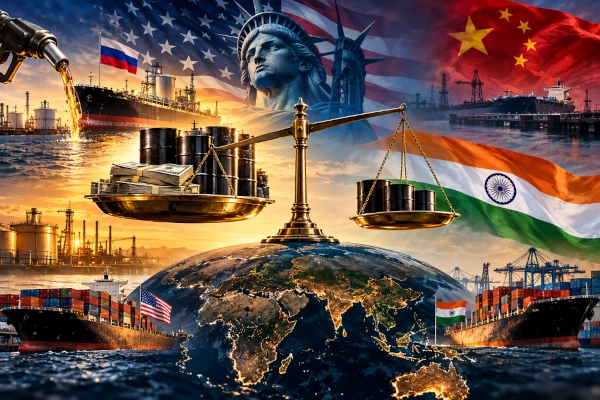
The United States has long presented itself as a defender of international law, free trade, national sovereignty, democracy and a rules-based global order. However, several American foreign policy decisions have attracted criticism because Washington has applied different standards to other countries while making exceptions to protect its own economic and strategic interests.
One of the clearest recent examples emerged in October 2026, when the United States announced an agreement allowing Russian diesel to enter American and international markets. The decision came barely a year after Washington imposed additional tariffs on Indian goods because India continued importing Russian crude oil. The American government had previously argued that such purchases generated revenue for Moscow and undermined international efforts to restrict Russia’s ability to finance its war in Ukraine.
The controversy extends beyond energy. American policies concerning trade, agricultural subsidies, nuclear proliferation, climate change, international justice and maritime law have also prompted questions about consistency. Although different legal and strategic circumstances can justify different policies, these examples demonstrate how national interests frequently influence the application of principles that Washington presents as universal.
1. Penalising India for Russian Oil While Arranging Russian Diesel Imports
On August 6, 2025, US President Donald Trump signed an executive order imposing an additional 25% tariff on Indian goods because of India’s continued purchases of Russian crude oil. The tariff took effect on August 27, 2025, adding substantial pressure to the India-US trade relationship.
The White House argued that Indian purchases contributed to Russian export revenues and weakened American efforts to counter Moscow’s military operations in Ukraine. India defended its energy imports as a matter of national economic security, pointing to its dependence on imported crude oil and the need to maintain affordable energy supplies.
However, on October 9, 2026, Trump announced an agreement with Russian President Vladimir Putin to facilitate Russian diesel supplies to the United States and global markets. The announcement covered an initial volume exceeding 300,000 metric tonnes, with additional supplies proposed for subsequent months. The US Treasury also authorised temporary sanctions relief to facilitate the arrangement.
The American administration justified the decision by citing rising diesel prices and the need to ease fuel supply pressures. The agreement was confirmed, although the proposed shipments should not be confused with completed deliveries.
The contrast is substantial. Washington had penalised India for purchasing Russian petroleum while subsequently permitting Russian diesel imports when domestic economic conditions created pressure for additional supplies. Although crude oil and diesel are different products, the central question concerns whether energy-security considerations should receive equal recognition when invoked by different countries.
2. Criticising India’s Russian Trade While Continuing Selected Russian Imports
India’s Ministry of External Affairs challenged American criticism of its Russian oil purchases in August 2025 by pointing to continuing Western trade with Russia.
The Indian government noted that the United States continued importing selected Russian commodities, including uranium hexafluoride, palladium and fertilisers. These materials support important American industries, ranging from nuclear energy and advanced manufacturing to agriculture.
Washington maintained that its sanctions targeted specified transactions and commodities rather than imposing a complete prohibition on every Russian product. Consequently, certain imports remained legally permissible under American regulations.
Nevertheless, India’s criticism highlighted a broader inconsistency in political messaging. American industrial requirements were accommodated through exemptions and selective restrictions, while India’s energy requirements became the basis for punitive tariffs.
The distinction between legally permitted and prohibited transactions is important, but it does not eliminate questions about how governments decide which economic activities are strategically necessary.
3. Imposing Russian Oil Penalties on India While Treating China Differently
India was not the only major economy purchasing Russian petroleum after the outbreak of the Ukraine war. China also maintained substantial Russian oil imports, benefiting from its extensive commercial and energy relationship with Moscow.
However, the additional 25% Russian-oil-related tariff announced by Washington in August 2025 specifically targeted India. The United States did not impose an equivalent penalty on China at that time.
In September 2025, US Treasury Secretary Scott Bessent indicated that Washington wanted European partners to take stronger action before introducing comparable measures against China.
This difference raised questions about the consistency of American sanctions policy. If purchasing Russian petroleum was considered sufficient justification for penalising Indian exports, the absence of an equivalent Russian-oil-specific measure against China required an explanation.
China already faced other American trade restrictions, and its overall trade relationship with Washington differed substantially from India’s. Nevertheless, the selective application of the additional Russian oil tariff demonstrated how geopolitical considerations can influence economic pressure.
4. Recognising American Energy Security While Questioning India’s Energy Decisions
Energy security is a fundamental responsibility of national governments. Reliable fuel supplies affect transportation, agriculture, electricity generation, industrial production and household expenditure.
India imports the majority of its crude oil requirements. Access to competitively priced petroleum is therefore important for containing inflation, supporting economic growth and maintaining the stability of domestic fuel markets.
When India increased purchases of discounted Russian crude, its government argued that energy procurement decisions must reflect national requirements and prevailing international market conditions.
Washington nevertheless sought to influence India’s purchasing decisions through diplomatic and economic pressure.
The October 2026 Russian diesel agreement illustrated a different approach when American domestic energy interests were involved. Faced with rising diesel prices, the US administration considered Russian supplies acceptable under a temporary arrangement.
Both governments invoked energy security, but their decisions received different treatment from Washington. The episode raises a broader question about whether the economic interests of developing countries should receive the same consideration as those of major industrialised economies.
5. Supporting Free Trade While Using Tariffs to Influence Foreign Policy
The United States frequently advocates reciprocal market access, reduced commercial barriers and compliance with international trade rules.
However, Washington has also employed tariffs to influence decisions that extend beyond conventional trade disputes.
The additional duties imposed on Indian goods in August 2025 arose from India’s commercial relationship with Russia rather than an allegation that the affected Indian exports violated American trade regulations.
The White House subsequently removed the Russian-oil-related tariff in February 2026, citing commitments associated with India’s energy procurement decisions.
This approach demonstrated how access to the American market could become a negotiating instrument in broader geopolitical disputes.
Governments routinely use trade measures to pursue national-security objectives, and American law provides mechanisms for doing so. Nevertheless, using tariffs to influence another country’s foreign-policy choices creates tension with the principle that international trade should operate through predictable and consistently applied rules.
6. Questioning India’s Agricultural Subsidies While Supporting American Farmers
Agricultural support has been a longstanding point of disagreement between India and the United States at the World Trade Organization.
In May 2018, Washington challenged India’s calculations of market price support for wheat and rice. American officials argued that India’s subsidy notifications did not accurately represent the assistance provided to agricultural producers.
India defended its approach under WTO rules and maintained that public procurement and minimum support prices played important roles in protecting farmer livelihoods and supporting national food security.
Meanwhile, the United States maintains extensive agricultural assistance programmes of its own. American farmers benefit from federal crop insurance subsidies, commodity support mechanisms and other government programmes designed to reduce financial risks.
The two countries use different subsidy instruments, and WTO rules distinguish between various categories of agricultural support. Therefore, the existence of American farm subsidies does not automatically make its legal objections to India’s policies invalid.
The dispute nevertheless illustrates contrasting agricultural priorities. India emphasises livelihood protection and food availability across a large farming population, while the United States relies on its own extensive support mechanisms to maintain agricultural stability.
7. Challenging India’s Solar Manufacturing Requirements While Promoting American Clean-Energy Industry
India’s National Solar Mission sought to expand renewable energy generation while developing domestic manufacturing capabilities.
As part of this effort, certain solar power projects were subject to domestic-content requirements intended to encourage the use of Indian-manufactured solar cells and modules.
The United States challenged these requirements at the WTO in 2013, arguing that they discriminated against imported products. WTO dispute proceedings subsequently found that the contested measures violated relevant trade obligations.
However, Washington later introduced major incentives to encourage American clean-energy manufacturing. The Inflation Reduction Act of 2022 included extensive support for domestic production of batteries, renewable energy equipment and other clean technologies.
The two approaches involved different regulatory instruments. India’s disputed measures imposed specified domestic-content requirements, while American programmes relied substantially on tax incentives and subsidies.
Nevertheless, the comparison raises an important issue for developing economies. Policies intended to establish domestic industries may face international trade challenges even as wealthier economies possess greater financial resources to support their own manufacturers through alternative mechanisms.
8. Advocating WTO Rules While Defending Disputed American Steel and Aluminium Tariffs
Washington has repeatedly emphasised the importance of international trade rules and compliance with WTO obligations.
However, in 2018, the United States imposed additional tariffs on imported steel and aluminium under Section 232 of its Trade Expansion Act, citing national-security concerns.
Several trading partners challenged the measures, arguing that they violated American commitments under international trade agreements.
In December 2022, WTO dispute panels concluded that the tariffs were inconsistent with certain provisions of the General Agreement on Tariffs and Trade. The United States rejected the panels’ interpretation of the national-security exception.
Washington maintained that national-security decisions were sovereign matters that should not be second-guessed by WTO adjudicators.
The dispute exposed a fundamental disagreement over the limits of international trade obligations. Other countries argued that allowing governments unrestricted discretion to invoke national security could weaken the predictability of the multilateral trading system.
The controversy demonstrates how tensions arise when a country strongly supports international rules while asserting broad exceptions for its own policies.
9. Advocating International Justice While Sanctioning the International Criminal Court
The United States has frequently supported international investigations into war crimes, human rights abuses and violations of humanitarian law.
However, Washington has also opposed investigations by the International Criminal Court involving American personnel and certain allied countries.
On February 6, 2025, President Trump signed an executive order authorising sanctions against the ICC. The administration objected particularly to investigations involving the United States and Israel.
The American government argued that the court had exceeded its authority by pursuing cases connected to countries that had not accepted its jurisdiction.
The ICC maintains that its jurisdiction can extend to crimes committed within the territory of states that are parties to the Rome Statute or have otherwise accepted the court’s authority.
The United States has never ratified the Rome Statute, which established the ICC.
The resulting dispute illustrates a major tension in international justice. Washington supports accountability through certain international mechanisms while rejecting the authority of an institution that could investigate American personnel or selected partners.
The disagreement concerns jurisdiction as well as political consistency, and both dimensions are important when assessing the controversy.
10. Condemning Terrorism While Historically Providing Military Assistance to Pakistan
Counterterrorism has remained a central objective of American national-security policy for decades.
Following the September 11, 2001, terrorist attacks, the United States intensified military operations against al-Qaeda and associated organisations while seeking cooperation from regional governments.
Pakistan became an important partner because of its geographic proximity to Afghanistan and its role in supporting American military and logistical operations.
However, American Congressional Research Service assessments repeatedly documented concerns regarding militant organisations operating from Pakistani territory and alleged relationships between elements of Pakistan’s security establishment and extremist groups.
Despite these concerns, Washington continued providing military and economic assistance to Pakistan during significant periods of the Afghanistan conflict.
India repeatedly raised concerns about Pakistan-based organisations involved in cross-border terrorism and questioned the consequences of continued American assistance.
Washington argued that cooperation with Islamabad was necessary for operations against al-Qaeda and for broader regional stability.
The experience demonstrates how competing security objectives can influence foreign partnerships, even when a partner faces serious allegations concerning militant networks.
11. Imposing Nuclear Sanctions While Granting Waivers for Strategic Reasons
The United States imposed sanctions on India and Pakistan following their nuclear weapons tests in May 1998.
The restrictions reflected American non-proliferation legislation and Washington’s opposition to the expansion of nuclear weapons capabilities outside the established nuclear framework.
However, following the September 11 attacks in 2001, the Bush administration waived remaining nuclear-test-related sanctions on both countries.
The decision formed part of a wider reassessment of American strategic priorities as Washington prepared military operations in Afghanistan.
The waivers were authorised under American law and did not erase the underlying differences between the nuclear policies of the two South Asian countries.
Nevertheless, they demonstrated how restrictions justified through non-proliferation concerns could be modified when other national-security interests became more immediate.
The episode remains an example of the tension between maintaining consistent international non-proliferation objectives and responding to changing strategic circumstances.
12. Demanding Climate Action While Carrying a Much Larger Historical Emissions Footprint
The United States has repeatedly called for global cooperation to reduce greenhouse-gas emissions and accelerate the transition towards cleaner energy.
India has supported climate action while arguing that responsibilities should reflect historical emissions, development requirements and differences in economic capacity.
The United States industrialised much earlier than India and accumulated substantial carbon emissions during its economic development.
American per-capita emissions have also remained significantly higher than India’s. Historical emissions data published by American scientific agencies confirm the scale of this difference.
India maintains that its climate commitments must account for the energy requirements of a large developing population, including the need to expand electricity access, industrial production and employment.
This disagreement concerns the distribution of responsibilities rather than whether countries should address climate change.
The Paris Agreement recognises the principle of common but differentiated responsibilities and respective capabilities, reflecting the fact that countries have contributed differently to global emissions and possess different resources for addressing them.
The continuing debate highlights the importance of considering historical responsibility alongside current emissions when evaluating international climate commitments.
13. Restricting Iranian Petroleum Exports While Relaxing Russian Diesel Sanctions
The United States has long used financial and commercial sanctions to restrict Iran’s petroleum exports.
Washington argues that Iranian oil revenue can support military activities, sanctioned organisations and programmes that threaten regional security.
On October 8, 2026, the US Treasury announced additional sanctions targeting networks involved in Iranian petroleum transportation.
The following day, Washington announced arrangements facilitating Russian diesel supplies to American and international markets.
The two decisions concerned different countries and distinct national-security objectives. American officials have justified sanctions against Iran and Russia through separate legal authorities and policy considerations.
Nevertheless, the announcements illustrated the selective flexibility available within American sanctions policy.
While restrictions on Iranian petroleum networks were being tightened, sanctions affecting certain Russian diesel transactions were being relaxed to address economic pressures.
The comparison raises questions about how energy market conditions influence decisions that governments otherwise present primarily as matters of international security.
14. Criticising Indian Medical Price Controls While Seeking Lower Healthcare Costs for Americans
Affordable healthcare has become an important concern in both India and the United States.
India regulates the prices of selected medicines and medical devices to protect patients from excessive treatment costs. Such measures are particularly significant in a country where many households bear substantial healthcare expenditure directly.
American trade authorities have raised concerns about aspects of India’s medical-device pricing policies, arguing that certain controls could discourage manufacturers from introducing products into the Indian market.
Meanwhile, the United States has pursued measures to reduce medicine prices for American patients.
American initiatives include Medicare drug-price negotiations and executive actions intended to reduce prescription drug expenditure.
The policies differ in design and scope. India’s medical-device price ceilings are not identical to American pharmaceutical price negotiations.
Nevertheless, both governments face the same underlying challenge of balancing patient affordability with incentives for medical innovation and manufacturing.
The disagreement illustrates how policies viewed as legitimate consumer protection measures domestically can become subjects of trade criticism when adopted by another country.
15. Defending Freedom of Navigation While Remaining Outside UNCLOS
The United States regularly advocates freedom of navigation, respect for international maritime law and the protection of international shipping routes.
These principles are particularly prominent in American policy concerning the Indo-Pacific and the South China Sea.
The United States Navy conducts Freedom of Navigation Operations to challenge maritime claims that Washington considers excessive.
However, the United States has never ratified the United Nations Convention on the Law of the Sea, commonly known as UNCLOS.
India, China and most major maritime nations are parties to the convention.
Washington maintains that many navigational principles reflected in UNCLOS are also part of customary international law and therefore apply independently of treaty membership.
That position has a recognised basis in international law. Non-ratification does not automatically exempt the United States from customary maritime obligations.
Nevertheless, remaining outside UNCLOS limits American participation in the treaty’s institutional arrangements while Washington continues advocating compliance with many of its substantive principles.
The situation demonstrates the distinction between supporting particular international legal norms and accepting the complete institutional framework established by a treaty.
Blocking Chinese Electric Vehicles While Protecting American Manufacturers Including Tesla
The United States has repeatedly advocated free markets, fair competition and consumer choice in international trade. However, Washington has adopted extensive restrictions on Chinese electric vehicle manufacturers, including BYD, whose competitively priced vehicles have challenged established automobile manufacturers in several international markets.
On May 14, 2024, the Biden administration announced that tariffs on Chinese electric vehicles would increase from 25% to 100% under Section 301 of the Trade Act of 1974. The US Department of Commerce explicitly stated that the measure was intended to protect American manufacturers and workers from what Washington described as unfair Chinese trade practices, government subsidies and industrial overcapacity. The decision made Chinese-made electric passenger vehicles substantially less competitive in the American market.
Washington subsequently introduced restrictions extending beyond import tariffs. On January 14, 2025, the US Department of Commerce finalised regulations restricting connected vehicles and certain automotive technologies associated with China and Russia. The rules prohibit specified software in vehicles beginning with model year 2027, with additional hardware restrictions scheduled for model year 2030. The regulations also restrict sales of connected vehicles by manufacturers under Chinese or Russian jurisdiction, subject to specified authorisations. These measures create substantial regulatory barriers for companies such as BYD seeking to expand their passenger vehicle business in the United States.
The restrictions have direct competitive implications for American manufacturers, including Tesla, General Motors and Ford. BYD has developed a broad portfolio of electric and plug-in hybrid vehicles, including relatively affordable models that could compete with vehicles sold by established American manufacturers. By imposing high tariffs and restrictions on Chinese-connected vehicle technology, Washington has limited the opportunities available to Chinese manufacturers in the American passenger vehicle market. The measures benefit domestic producers collectively, rather than exclusively protecting Tesla.
The policy also raises questions about the relationship between free-market principles and national industrial protection. While Washington challenges certain manufacturing incentives and market restrictions maintained by other countries, it has employed substantial tariffs and regulatory barriers to protect its own automotive industry. American officials argue that Chinese government subsidies and potential security risks associated with connected vehicles justify these restrictions. Critics, however, question whether such measures also reduce consumer choice and prevent competition from more affordable foreign-made electric vehicles.
The issue became particularly relevant in 2026 as Chinese electric vehicle manufacturers continued expanding internationally while remaining largely excluded from the American passenger car market. On October 8, 2026, Reuters reported that electric vehicle sales were growing strongly in Europe, where Chinese manufacturers had contributed to the availability of more affordable models. The American market, by contrast, experienced declining EV sales amid changes to incentives and broader electric vehicle policies.
The comparison illustrates the tension between Washington’s support for international market access and its willingness to restrict foreign competition when domestic industrial interests are involved. The United States has chosen to protect its automotive manufacturing base through tariffs and national-security regulations, while companies such as BYD face substantial obstacles to entering one of the world’s largest automobile markets. The central question is whether similar industrial development and market-protection measures adopted by other countries receive comparable recognition within the international trading system.
Summary: Where the Policy Inconsistencies Arise
| Issue | US position toward other countries | US action or exception |
|---|---|---|
| Russian oil | Penalised India’s purchases in 2025 | Arranged Russian diesel supplies in October 2026 |
| Russian commodities | Criticised trade supporting Russian revenues | Continued selected strategic imports |
| Russian oil and China | Penalised India | Did not impose an equivalent oil-specific tariff on China in 2025 |
| Energy security | Pressured India to alter its purchases | Cited domestic fuel needs in relaxing diesel restrictions |
| Free trade | Promoted reciprocal market access | Used tariffs to influence foreign-policy decisions |
| Agricultural subsidies | Challenged India’s farm-support calculations | Maintained extensive US agricultural programmes |
| Solar manufacturing | Challenged Indian domestic-content rules | Introduced incentives for domestic clean-energy production |
| WTO compliance | Advocated rules-based trade | Defended tariffs found inconsistent by WTO panels |
| International justice | Called for accountability under international law | Sanctioned the International Criminal Court |
| Terrorism | Called for action against militant networks | Maintained strategic assistance to Pakistan despite documented concerns |
| Nuclear non-proliferation | Imposed sanctions after the 1998 nuclear tests | Waived restrictions when strategic priorities changed |
| Climate responsibility | Called for emissions reductions globally | Maintained a much higher historical per-capita emissions footprint |
| Iran sanctions | Restricted Iranian petroleum revenues | Relaxed Russian diesel restrictions |
| Healthcare prices | Criticised certain Indian price controls | Pursued domestic medicine-price reductions |
| Maritime law | Advocated rules reflected in UNCLOS | Remained outside the convention |
| Chinese electric vehicles | Promoted market access and open competition | Imposed 100% tariffs and connected-vehicle restrictions limiting BYD and other Chinese manufacturers, benefiting US automakers including Tesla |
National Interests and the Application of International Rules
The examples demonstrate that American foreign policy has frequently involved balancing declared international principles against national economic and security interests.
In some cases, the differences reflect legitimate distinctions in legal frameworks, strategic threats or commercial arrangements. In others, policy reversals and selective enforcement create reasonable questions about consistency.
The Russian oil controversy provides a particularly direct comparison because the United States used economic penalties to influence India’s petroleum purchases before easing restrictions on Russian diesel to address its own fuel requirements.
The distinction between crude oil and diesel does not eliminate the broader issue of energy security. Both products contribute to national economic stability, and both can generate revenue for Russian suppliers.
Similarly, disputes involving agricultural support, domestic manufacturing and international institutions demonstrate how governments seek to preserve policy flexibility when their own national priorities are involved.
These tensions are not unique to the United States, but its economic influence and international leadership make American decisions particularly consequential for other countries.
India’s Strategic Autonomy and the Importance of Consistent International Standards
India’s foreign policy has traditionally emphasised strategic autonomy, national sovereignty and the freedom to pursue economic and security relationships according to its national interests.
The country’s approach to international partnerships reflects its diverse requirements across energy, defence, trade, technology and development.
India maintains substantial relationships with the United States, Russia, Europe, Japan and other international partners. These relationships serve different purposes and are not necessarily mutually exclusive.
At the same time, India’s experience with Russian oil-related tariffs illustrates the pressures that can emerge when a major trading partner attempts to influence decisions involving third countries.
A predictable international order depends on transparent rules, clearly justified exceptions and recognition that governments face different economic and security circumstances.
India’s continued emphasis on strategic autonomy, diversified partnerships and a rules-based international system provides a framework for protecting its national interests while strengthening cooperation with major global powers. Consistent international standards, applied with due regard for legal differences and national circumstances, remain essential to building trust and maintaining stable international relations.
References
Russian Oil, Diesel and American Trade Policy
- The White House — August 6, 2025. Addressing Threats to the United States by the Government of the Russian Federation. Executive order imposing an additional 25% tariff on Indian goods because of Russian oil imports.
https://www.whitehouse.gov/presidential-actions/2025/08/addressing-threats-to-the-united-states-by-the-government-of-the-russian-federation/ - The White House — February 6, 2026. Modifying Duties to Address Threats to the United States by the Government of the Russian Federation. Executive order removing the additional Russian-oil-related tariff on Indian goods.
https://www.whitehouse.gov/presidential-actions/2026/02/modifying-duties-to-address-threats-to-the-united-states-by-the-government-of-the-russian-federation-04b2/ - Reuters — October 9, 2026. Trump Says Russia to Immediately Supply 300,000 Tons of Diesel Fuel. Report on the US-Russia diesel arrangement and proposed supply volumes.
https://www.reuters.com/business/energy/trump-says-russia-immediately-supply-300000-tons-diesel-fuel-2026-10-09/ - Associated Press — October 10, 2026. Report on Trump’s Russian diesel agreement, temporary sanctions relief and reactions from American lawmakers.
https://apnews.com/article/12baccc7aade559bf329079b0548c9da - Ministry of External Affairs, Government of India — August 2025. Official statements concerning India’s Russian oil purchases and energy-security requirements.
https://www.mea.gov.in/
International Trade and Economic Policy
- World Trade Organization — June 2018. Committee on Agriculture proceedings concerning agricultural subsidies and market price support.
https://www.wto.org/english/news_e/news18_e/agcom_12jun18_e.htm - World Trade Organization — Dispute DS456. India — Certain Measures Relating to Solar Cells and Solar Modules.
https://www.wto.org/english/tratop_e/dispu_e/cases_e/ds456_e.htm - World Trade Organization — Dispute DS544. United States — Certain Measures on Steel and Aluminium Products.
https://www.wto.org/english/tratop_e/dispu_e/cases_e/ds544_e.htm - Office of the United States Trade Representative — 2026. National Trade Estimate Report on Foreign Trade Barriers.
https://ustr.gov/sites/default/files/files/Press/Releases/2026/National%20Trade%20Estimate%20Report%202026.pdf
International Security, Nuclear Policy and Justice
- The White House — February 6, 2025. Imposing Sanctions on the International Criminal Court.
https://www.whitehouse.gov/presidential-actions/2025/02/imposing-sanctions-on-the-international-criminal-court/ - US Congressional Research Service. Reports on Pakistan-US relations, security assistance and counterterrorism cooperation.
https://www.congress.gov/crs-products - US Department of State — September 28, 2001. Sanctions on India and Pakistan.
https://2001-2009.state.gov/r/pa/prs/ps/2001/5101.htm - United Nations — International Criminal Court. Rome Statute and the international legal framework governing the court.
https://www.icc-cpi.int/
Climate, Energy and Maritime Law
- National Oceanic and Atmospheric Administration (NOAA). Official analysis of historical carbon emissions and international per-capita emissions.
https://www.climate.gov/news-features/climate-qa/does-it-matter-how-much-united-states-reduces-its-carbon-dioxide-emissions - US Department of the Treasury — October 8, 2026. Sanctions announcement targeting Iranian petroleum transportation networks.
https://home.treasury.gov/news/press-releases/sb0653 - United Nations — Division for Ocean Affairs and the Law of the Sea. United Nations Convention on the Law of the Sea and treaty participation.
https://www.un.org/depts/los/convention_agreements/convention_overview_convention.htm
You may also like
-
India’s Economic Warfare Challenge: Strategic Autonomy, Energy Security and the Rise of a Global Power
-
India-US Trade Deal Stalemate: Why Washington’s Tariff Pressure Has Failed to Secure an Agreement
-
India’s Arctic Energy Ambitions: Russian Oil, LNG and a New Sea Route to Indian Ports
-
Indian Navy Vice Chief Inspects Japan’s Mogami-Class Stealth Frigate as India-Japan Shipbuilding Cooperation Expands
-
India and Russia Explore Joint Icebreaker Construction as Maritime Industrial Cooperation Expands
