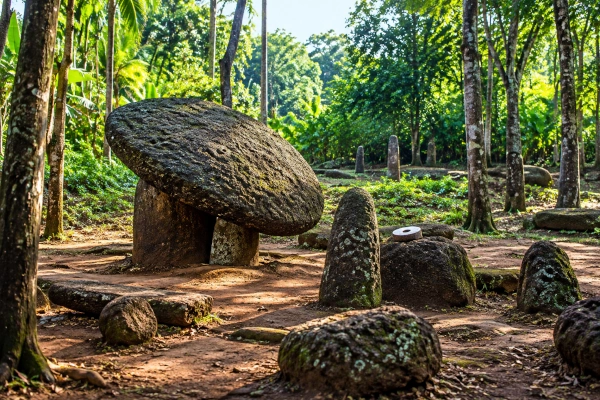
Scientific conservation work by the Kerala State Department of Archaeology at a cluster of megalithic umbrella stones in Karivellur, Kannur district, has revealed unusual stone features associated with the ancient burial monuments, adding fresh archaeological interest to an already important prehistoric site in northern Kerala.
The work is being carried out at Perikamana Illamparamba in the Kozhummal–Peralam area of Karivellur, where seven megalithic umbrella stones, locally known as kudakkals, have been identified.
According to K. Krishnaraj, an Archaeology Department official and officer associated with the Pazhassi Raja Archaeological Museum, the team is conducting scientific examination alongside restoration of the surviving monuments.
Stone Slabs Found Beneath Kudakkals
During the restoration work, archaeologists encountered two stone slabs, a hat stone or thoppikkal, and an unusual circular stone feature in association with the megalithic monuments.
One of the slabs measures approximately 70 cm by 70 cm, while another measures about 80 cm by 80 cm.
Krishnaraj said this was the first time such stone slabs had been encountered beneath kudakkals in Kannur district during Archaeology Department work.
The discovery is significant because megalithic monuments in Kerala are closely associated with funerary practices of the Iron Age.
The Kerala State Department of Archaeology’s official account of previous excavations explains that umbrella stones, hat stones, hood stones, stone circles and dolmens formed part of Kerala’s megalithic burial tradition. Excavations at other Iron Age sites have produced burial urns, bone fragments, earthen vessels, copper objects and iron implements.
Rare Circular Stone Feature Draws Attention
Among the most unusual discoveries at Karivellur is a roughly circular or wheel-like stone feature.
The structure reportedly contains a depression or socket close to its centre. Its precise function has not yet been established, making further archaeological examination important before conclusions are drawn about its original purpose.
The find should therefore be described as an unusual archaeological feature rather than assigned a ritual or functional interpretation without further evidence.
Fragments of pottery have also been reported from the site during the ongoing work.
Seven Megalithic Monuments at the Site
The Karivellur location contains seven kudakkals, although their state of preservation varies considerably.
According to the Archaeology Department official overseeing the work, only about three can presently be restored close to their original form, while others have suffered greater damage and loss of stone components.
The department intends to reconstruct the monuments using the surviving original stones wherever possible, rather than replacing the archaeological material unnecessarily.
A team of around ten Archaeology Department personnel has been involved in the scientific examination and conservation exercise.
Kudakkals Are Distinctive Monuments of Kerala’s Megalithic Culture
Umbrella stones are among the most recognisable archaeological monuments of prehistoric and early historic Kerala.
The Kerala Archaeology Department officially identifies umbrella stones and hat stones among the principal forms of Iron Age burial monuments found in the state. Previous departmental excavations at megalithic sites have shown that such monuments can occur alongside burial urns, pottery, bone remains and iron objects.
Kerala’s official archaeological records also include numerous protected megalithic monuments and burial sites, reflecting the importance of this cultural phase to the state’s early history.
These structures provide evidence about burial customs, technology and social practices among communities that inhabited Kerala during the megalithic period.
Karivellur Adds to Northern Kerala’s Megalithic Landscape
Northern Kerala possesses an important but comparatively less publicly known concentration of megalithic remains.
Archaeological research has previously documented multiple hood-stone circles at Kozhummal near Karivellur, placing the locality within a broader prehistoric burial landscape extending across Kannur and neighbouring regions.
The present restoration therefore provides an opportunity not only to conserve the surviving monuments but also to examine their construction more closely.
Conservation May Reveal More Than Restoration Alone
The Kerala Archaeology Department officially identifies survey, excavation, structural conservation and protection of archaeological monuments among its central responsibilities. Its previous work on Iron Age burial sites has shown that conservation itself can reveal previously hidden archaeological information when collapsed or damaged structural elements are carefully examined.
That is precisely what makes the Karivellur work noteworthy.
A project that began primarily as an attempt to stabilise and restore deteriorating kudakkals has exposed previously unseen stone components and an unusual circular feature associated with the burial complex.
Further examination will be necessary before archaeologists can determine what these elements reveal about the original construction and funerary practices at the site.
For now, the discoveries reinforce the archaeological importance of Karivellur–Peralam as part of Kerala’s wider megalithic landscape and demonstrate why conservation of surviving prehistoric monuments can itself generate valuable new evidence about the state’s distant past.
You may also like
-
Samatata — The Low-Lying Deltaic Realm of Southeastern Bengal
-
Tamralipta — The Maritime Gateway of the Lower Ganga
-
Suhma — The River-and-Forest Country of Southwestern Bengal
-
Gauda — The Western Bengal Country of the Bhagirathi and the Rise of Karnasuvarna
-
Pundra — The Northern Bengal Kingdom of the Karatoya and the Ancient City of Pundranagara
