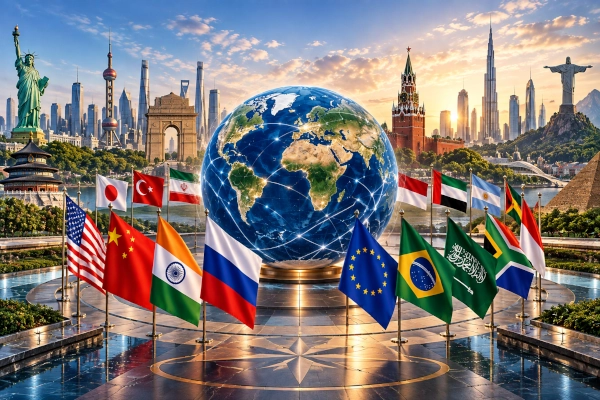
For roughly two decades after the collapse of the Soviet Union, international politics appeared to revolve around a single dominant centre of power. The United States possessed unmatched military reach, commanded the world’s most influential financial system, dominated many of the institutions that shaped international rules and sat at the centre of an alliance network stretching across Europe and Asia. No other country could combine economic, military, technological and diplomatic power on a comparable scale.
That period is steadily giving way to something different. The United States remains the world’s most powerful individual state, but it increasingly operates in an international system where China, India, Russia, the European Union, major Gulf states and influential middle powers possess greater ability to shape events independently. The emerging order is therefore not defined by the replacement of one superpower by another. It is characterised by the gradual dispersal of power among several centres.
Even the World Trade Organization now describes the global economy as increasingly “multipolar and diverse.” Its 2026 World Trade Report notes that low- and middle-income economies accounted for only 23 per cent of global merchandise trade in 1995 but around 45 per cent by 2024. Economic weight has moved considerably beyond the traditional industrial powers, and political influence is beginning to follow it.
The Unipolar Moment Was Historically Unusual
International politics has rarely been organised around one overwhelmingly dominant state. European powers competed for centuries before the twentieth century produced two competing blocs centred on the United States and Soviet Union. The disappearance of the Soviet Union in 1991 created an unusual concentration of power in Washington.
American predominance during the following years was real. The US possessed the world’s largest economy, unrivalled global military infrastructure, technological leadership, the dominant reserve currency and immense influence within institutions created after the Second World War. NATO expanded, globalisation accelerated and American financial and technological companies occupied central positions in the emerging digital economy.
Yet many of the same processes encouraged by that order eventually helped redistribute global power. International trade expanded dramatically, capital and technology moved across borders, Asian economies industrialised and emerging states accumulated financial, industrial and technological capabilities that they had lacked a generation earlier.
Globalisation strengthened the United States, but it did not strengthen only the United States.
China’s Rise Changed the Strategic Equation
No transformation has affected the distribution of global power more than China’s economic and technological rise. China developed from a comparatively poor manufacturing economy into the world’s second-largest economy, the largest merchandise trader and a central component of global industrial supply chains.
Economic power was followed by military modernisation, technological investment, infrastructure diplomacy and expanding international institutions. China created the Belt and Road Initiative, became central to critical-mineral and clean-technology supply chains and increased its diplomatic presence across Africa, Latin America, Asia and the Middle East.
Its military transformation has been equally consequential. SIPRI estimates Chinese military expenditure reached $336 billion in 2025, second only to the United States. China has increased military spending for 31 consecutive years while investing heavily in naval power, missiles, space systems, cyber capabilities and nuclear forces.
China still does not possess America’s worldwide alliance system or equivalent global military infrastructure. It nevertheless has sufficient economic and military weight to prevent the Indo-Pacific from being organised exclusively according to American preferences. That alone represents a fundamental change from the strategic environment of the 1990s.
India Is Emerging Without Joining a Fixed Bloc
India represents a different form of rising power. Unlike China, New Delhi is not seeking to construct a geopolitical bloc directly opposed to the United States. It has instead expanded cooperation simultaneously with countries that frequently oppose one another.
India participates in the Quad with the United States, Japan and Australia while remaining a leading member of BRICS and the Shanghai Cooperation Organisation. It purchases substantial quantities of Russian energy and continues defence cooperation with Moscow while conducting increasingly sophisticated military exercises with Western partners. It maintains deep relations with Israel while simultaneously strengthening political and economic engagement with the Arab world.
This is not simply diplomatic ambiguity. It reflects the behaviour of a country that increasingly possesses enough economic and strategic weight to resist being forced permanently into someone else’s camp.
India’s military expenditure reached an estimated $92.1 billion in 2025, making it the world’s fifth-largest military spender, according to SIPRI. Its economic scale, population, technological industries, growing manufacturing capabilities and position in the Indian Ocean add other dimensions of influence.
India’s rise illustrates one of the defining characteristics of multipolarity: major states may cooperate with one another on specific issues without becoming permanent allies across every issue.
Russia Remains a Major Power Despite Economic Limitations
Russia presents another example of why international power cannot be measured by GDP alone. Its economy is considerably smaller than those of the United States, China or the European Union, yet Moscow retains one of the world’s largest nuclear arsenals, substantial military-industrial capabilities, vast energy and mineral resources, a permanent seat on the UN Security Council and significant influence across Eurasia.
The war in Ukraine demonstrated both the limitations and persistence of Russian power. Western sanctions and military assistance to Ukraine imposed enormous costs on Moscow, but attempts to isolate Russia globally proved incomplete. Russia maintained extensive economic relationships with China, India and numerous countries across Asia, Africa, Latin America and the Middle East.
Its military expenditure reached approximately $190 billion in 2025, making Russia the world’s third-largest military spender.
Russia cannot reconstruct the Soviet Union’s bipolar system. It can, however, prevent many regional and global questions from being resolved without taking Russian interests into account. In a multipolar system, that capacity matters.
Europe Is Searching for Greater Strategic Weight
The European Union complicates conventional measurements of international power because it is neither a single state nor merely an economic organisation. Collectively, however, Europe remains one of the largest economic markets in the world, possesses advanced industrial and technological capabilities and includes two nuclear-armed permanent members of the UN Security Council.
Growing uncertainty over long-term American security commitments has encouraged European governments to invest more heavily in their own defence capabilities. SIPRI estimates that European military spending rose 14 per cent in 2025 to $864 billion, its sharpest recent increase, while NATO members have adopted significantly more ambitious future defence-spending goals.
A more militarily capable Europe would itself reinforce multipolarity. Europe may remain closely aligned with Washington, but strategic capacity gives governments greater freedom to pursue policies that do not always coincide perfectly with those of the United States.
Middle Powers Are Gaining Room to Manoeuvre
The changing order is not being shaped solely by the largest countries. Türkiye, Saudi Arabia, the UAE, Indonesia, Brazil and other middle powers increasingly pursue foreign policies that cross traditional bloc boundaries.
Saudi Arabia remains a longstanding American security partner while deepening economic engagement with China and joining BRICS. The UAE maintains strong Western security relationships while developing commercial and political ties across Russia, China, India and Africa. Türkiye is a NATO member but has pursued an autonomous regional strategy and maintained working relationships with Moscow in areas where Western governments have sought greater isolation.
Brazil similarly works closely with Western economies while pushing for greater representation of developing countries within global institutions.
These states are not necessarily trying to overturn the international order. They are taking advantage of a world in which several major powers compete for partnerships. That competition gives middle powers more bargaining power than they would possess in a rigid bipolar or unipolar system.
BRICS Reflects the Changing Distribution of Power
The expansion of BRICS is one of the most visible political expressions of this shift. What began as a grouping of Brazil, Russia, India, China and South Africa has expanded to include several important economies from the Middle East, Africa and Southeast Asia.
At the September 2026 New Delhi Summit, BRICS leaders explicitly called for international institutions to be adapted to contemporary realities and reaffirmed their support for “multilateralism and multipolarity.” They also demanded greater representation for emerging and developing economies in international decision-making structures.
BRICS should not be mistaken for an alliance comparable to NATO. Its members disagree on many important questions and maintain very different relationships with the United States. India and China have a disputed border. Iran and the UAE have different strategic alignments in the Gulf. Brazil has little interest in becoming part of a military confrontation between great powers.
That diversity is precisely why BRICS is revealing. Countries do not have to agree on everything to conclude that global institutions should no longer be organised around the political and economic balance that existed at the end of the twentieth century.
Economics Is Driving the Political Shift
The movement towards multipolarity is rooted in economics as much as diplomacy. The share of international commerce conducted by emerging economies has increased dramatically, while manufacturing, energy production, critical minerals and technological capabilities have become distributed across a wider range of countries.
The WTO reports that the share of low- and middle-income economies in global merchandise trade has nearly doubled since 1995. It argues that the trading system must now adapt to a world where economic power is considerably more dispersed than when many of today’s rules were negotiated.
This redistribution does not mean Western economies are becoming unimportant. The United States, European Union and Japan remain extraordinarily wealthy and technologically sophisticated. Instead, their relative ability to determine global outcomes without negotiating with emerging powers has declined.
A manufacturer may depend on American software, Taiwanese semiconductors, Chinese processing capacity, Australian or African minerals, Gulf energy, Indian engineering talent and European machinery simultaneously. That interdependence makes concentrated political control of the international economy increasingly difficult.
Military Power Is Also Becoming More Distributed
The same trend is visible in defence spending. The United States remained by far the largest military spender in 2025 at approximately $954 billion, accounting for around one-third of global military expenditure. But China, Russia, Germany and India occupied the next four positions, while Saudi Arabia, Japan, France, South Korea and several European countries were also investing heavily in military modernisation.
Global military expenditure reached a record $2.887 trillion in 2025, according to SIPRI. Spending outside the United States increased by 9.2 per cent during the year. Asia and Oceania recorded an 8.1 per cent increase, while European expenditure increased 14 per cent.
The United States still possesses capabilities no other military can reproduce globally. What is changing is the number of countries capable of denying another power easy dominance within their own regions.
That distinction lies at the heart of modern multipolarity.
Technology Has Become Another Source of Sovereignty
Power in the twenty-first century is also increasingly measured in semiconductors, artificial intelligence, satellites, telecommunications networks, biotechnology, energy systems and control over critical minerals.
The United States retains enormous advantages in advanced computing, software and capital markets. China dominates important portions of electronics manufacturing, batteries, solar technology and critical-mineral processing. Europe remains influential in advanced industrial technology and regulation. India has emerged as a major digital economy and is attempting to expand semiconductor, defence, space and electronics manufacturing.
Countries increasingly view technological dependence as a strategic vulnerability. Washington restricts advanced semiconductor technology flowing to rivals. China has tightened controls involving strategic minerals and technologies. India, Europe, Japan and others are subsidising domestic semiconductor and defence-industrial capacity.
The result is not complete economic separation. It is a world in which countries increasingly seek to preserve enough technological capability to avoid being completely dependent on a rival.
The International System Is Becoming More Transactional
Multipolarity is also changing diplomacy. During the Cold War, membership of one camp often determined a country’s strategic relationships across a broad range of issues. The emerging system is much less tidy.
India can cooperate with the United States on maritime security while buying Russian oil. Saudi Arabia can maintain American security ties while developing major commercial links with China. Brazil can work within BRICS while maintaining extensive economic relations with Europe and North America. The UAE can host Western military forces while becoming an increasingly important commercial bridge between East and West.
Countries are increasingly choosing partnerships issue by issue rather than accepting a single political alignment that determines every relationship.
This creates opportunities, but it can also make international politics less predictable.
Multipolarity Does Not Automatically Mean Stability
There is sometimes a tendency to portray multipolarity as inherently fairer or more peaceful than a system dominated by one or two great powers. History does not support such certainty.
More centres of power create more opportunities for balancing and autonomy, but they can also produce more points of friction. Competing security systems, military build-ups, overlapping territorial disputes and technological blocs can generate instability if diplomatic institutions fail to keep pace.
The current increase in military expenditure illustrates that danger. The world is becoming multipolar at the same time that states are investing heavily in weapons and increasingly treating economic interdependence as a national-security issue.
The WTO has warned that a world fragmented into geopolitical trade blocs would carry enormous economic costs. Its 2026 modelling estimates that deep geopolitical fragmentation could eventually reduce global GDP by 5.1 per cent and global exports by 18.6 per cent compared with a functioning multilateral system.
Multipolarity therefore does not make multilateral institutions obsolete. It makes effective institutions more necessary.
Institutions Built for an Earlier Era Face Growing Pressure
Many of today’s international institutions still reflect the distribution of power that existed after the Second World War. The composition of the UN Security Council is the clearest example. Africa and Latin America have no permanent representation, while India—the world’s most populous country and one of its largest economies—also remains outside the permanent membership.
Similar debates surround voting power and leadership within international financial institutions.
As emerging powers become economically and politically stronger, demands for institutional reform will intensify. If existing institutions adjust, multipolarity could be incorporated within a reformed rules-based system. If they fail to adjust, emerging powers will have stronger incentives to build parallel organisations.
The growth of BRICS, the New Development Bank, regional development institutions and new payment arrangements should be understood partly in this context.
The United States Will Remain Central, but Not Alone
None of these developments means an imminent end to American power. The United States remains exceptionally well positioned. It possesses the world’s deepest capital markets, the dominant international currency, leading universities and technology companies, enormous military capabilities and an unmatched network of formal allies.
The transition towards multipolarity is therefore not equivalent to American collapse.
It is better understood as the end of America’s ability to operate in a world where no other power could seriously constrain it across major regions and economic sectors.
Washington will remain one of the principal centres of global power. It will simply have to operate alongside several others.
A World of Several Centres
The emerging international system is unlikely to resemble either the Cold War or the unipolar decades that followed it. The world is instead moving towards overlapping centres of economic, military, technological and diplomatic power.
The United States will remain central. China will remain its largest systemic competitor. India will continue building strategic weight without necessarily joining either camp. Europe will search for greater autonomy. Russia will retain significant military and resource power. Gulf states will use energy, capital and geography to expand their influence, while countries such as Brazil, Türkiye, Indonesia and South Africa will increasingly resist being treated merely as followers of larger powers.
This order will be more complicated than the one it replaces. Alliances will coexist with issue-based partnerships. Economic integration will continue even as governments build strategic safeguards against dependence. Countries will compete while simultaneously trading, negotiating and cooperating.
Multipolarity, therefore, should not be understood simply as the rise of BRICS or the decline of the West. It is a broader redistribution of international power brought about by decades of economic development, technological diffusion and the growing ability of states outside the traditional Western core to pursue independent interests.
The question is no longer whether the world is moving beyond a single centre of power. The evidence increasingly suggests that it already has. The larger question is whether the institutions governing international politics can adapt quickly enough to manage a world in which several centres of power must coexist.
You may also like
-
EON Space Labs and Dhruva Space Advance Indian Space Hardware on Transporter-18 Mission
-
SatLeo Labs’ TAPAS-1 Reaches Orbit, Advancing India’s Private Thermal-Imaging Capability
-
TakeMe2Space’s MOI-1A Reaches Space on Falcon 9 Transporter-18 Mission
-
Bank of Baroda Enters Pension Fund Management After PFRDA Appointment
-
SCI and India’s Push for a Larger Indigenous Maritime Fleet
