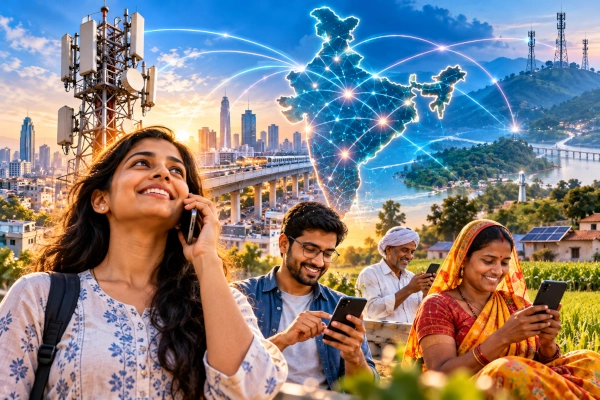
India’s telecommunications sector continued to expand during September 2026, with the country’s total telephone subscription base reaching 136.79 crore, according to the latest figures released by the Telecom Regulatory Authority of India (TRAI). The country recorded a net addition of approximately 72.3 lakh telephone subscriptions during the month, reflecting continued demand for mobile communication, fixed-line services and digital connectivity across urban and rural regions.
The Ministry of Communications released the September 2026 telecom subscription statistics on 27 October 2026. The report provides a comprehensive assessment of the country’s wireless and wireline telecommunications services, broadband subscriptions, active mobile connections, mobile number portability and urban–rural connectivity.
According to TRAI, India’s total telephone subscription base increased from approximately 136.07 crore at the end of August 2026 to 136.79 crore at the end of September, representing a monthly growth rate of 0.53 per cent. The figures demonstrate the expanding scale of India’s telecommunications infrastructure and its growing importance to economic activity, public services and everyday communication.
The subscription figures represent telecommunications connections rather than individual users. A person may maintain more than one mobile or fixed-line connection, while some subscriptions are used by businesses, institutions and automated devices.
Wireless Telecommunications Continue to Dominate India’s Connectivity Landscape
Wireless telecommunications remain the foundation of India’s communication network, accounting for the overwhelming majority of telephone subscriptions across the country.
At the end of September 2026, India’s wireless subscription base reached approximately 131.92 crore, compared with 131.23 crore at the end of August. The sector registered a net addition of approximately 69.4 lakh wireless subscriptions during the month, representing growth of 0.53 per cent.
The continued expansion of wireless connectivity reflects the central role of mobile communication in India’s digital economy. Mobile networks provide access to voice services, internet connectivity, digital payments, education platforms, healthcare information, government services and numerous other applications.
The widespread availability of mobile connectivity has also enabled businesses and entrepreneurs to participate more extensively in digital commerce. Small enterprises, agricultural producers, service providers and local businesses increasingly use mobile communication networks to reach customers, access financial services and manage commercial activities.
TRAI’s wireless subscription data includes conventional mobile telephone connections as well as certain machine-to-machine cellular connections and fixed wireless access services. Consequently, the total wireless subscription figure should not be interpreted as the number of unique individuals using mobile phones.
Wireline Connections Increase to 4.87 Crore
Alongside the expansion of mobile networks, India’s wireline telecommunications sector also recorded growth during September 2026.
The country’s wireline subscription base increased from approximately 4.85 crore at the end of August to 4.87 crore at the end of September. The sector recorded a net addition of approximately 2.9 lakh connections, representing monthly growth of 0.60 per cent.
Although mobile services account for most telecommunications subscriptions, wireline infrastructure continues to play an important role in providing dependable connectivity to households, businesses, educational institutions, government offices and industrial establishments.
The expansion of fibre-optic networks has also contributed to the continuing relevance of fixed-line infrastructure. Modern broadband connections frequently support voice communication alongside high-speed internet access, allowing service providers to deliver multiple communication services through integrated networks.
Reliable fixed connectivity is particularly important for enterprises that depend on uninterrupted communication, cloud computing, digital transactions and high-capacity data transmission.
The growth in wireline subscriptions indicates that fixed communication networks continue to complement India’s expanding mobile telecommunications infrastructure.
Broadband Subscriptions Reach 110.77 Crore
India’s broadband sector recorded another important milestone during September 2026, with total broadband subscriptions reaching approximately 110.77 crore, including machine-to-machine cellular connections.
According to TRAI, wireless broadband accounted for approximately 105.88 crore subscriptions, while wireline broadband represented approximately 4.89 crore connections.
When machine-to-machine cellular subscriptions are excluded, the broadband subscription base stood at approximately 101.39 crore.
This distinction is important because machine-to-machine connections are generally used by electronic devices and automated systems to exchange information without requiring conventional human interaction.
Such connections support a wide range of emerging technologies, including smart electricity meters, connected vehicles, industrial monitoring systems, logistics tracking equipment and Internet of Things applications.
The expansion of broadband connectivity is strengthening India’s digital infrastructure by supporting online education, telemedicine, financial technology, e-commerce, cloud computing and digital public services.
High-speed internet access is also becoming increasingly important for industrial automation, artificial intelligence applications and the development of digitally connected manufacturing systems.
However, broadband subscription growth alone does not establish that all users enjoy equally reliable or affordable services. Network quality, connection speeds, geographical coverage and accessibility remain important considerations in evaluating the country’s digital development.
Urban India Accounts for Nearly 59 Per Cent of Telephone Subscriptions
TRAI’s September 2026 figures indicate that urban areas continue to account for the majority of India’s telephone subscriptions.
At the end of September, urban India had approximately 80.78 crore telephone subscriptions, representing 59.05 per cent of the national total.
Urban wireless subscriptions stood at approximately 76.44 crore, while wireline connections accounted for approximately 4.34 crore.
During September, urban areas registered a net addition of approximately 55 lakh telephone subscriptions, demonstrating continued growth in demand for communication services across cities and towns.
The concentration of telecommunications subscriptions in urban areas reflects several factors, including population density, commercial activity, access to telecommunications infrastructure and increasing dependence on digital services.
Urban telecommunications networks support major sectors of the economy, including banking, information technology, manufacturing, transportation, retail and professional services.
The expansion of advanced communication networks in urban centres is also supporting demand for data-intensive applications, including cloud services, video communication, digital entertainment and artificial intelligence technologies.
Rural Telephone Subscriptions Increase to 56.02 Crore
Rural India also recorded growth in telecommunications subscriptions during September 2026, although the pace of expansion remained lower than in urban areas.
The rural telephone subscription base reached approximately 56.02 crore, accounting for 40.95 per cent of India’s total subscriptions.
Rural wireless connections stood at approximately 55.48 crore, while wireline subscriptions accounted for approximately 53.2 lakh.
The rural subscription base increased by approximately 17.3 lakh connections during September, representing monthly growth of 0.31 per cent.
The figures highlight the continuing importance of mobile connectivity in rural areas, where wireless networks frequently serve as the primary means of accessing telecommunications and internet services.
Improved connectivity can help rural communities access agricultural information, weather forecasts, digital banking, government welfare schemes, educational resources and healthcare consultations.
For farmers, mobile networks provide opportunities to obtain market information, monitor agricultural conditions and communicate with buyers and service providers.
For students and educational institutions, reliable broadband connectivity can improve access to online learning materials and digital educational platforms.
However, the comparatively slower growth in rural telecommunications subscriptions indicates that improving infrastructure and affordability in underserved regions remains an important national priority.
Urban–Rural Tele-Density Gap Highlights Connectivity Challenges
Despite the continued expansion of telecommunications services, TRAI’s latest report reveals a substantial difference between urban and rural telephone penetration.
India’s overall tele-density, including machine-to-machine cellular connections, reached approximately 95.52 per cent at the end of September 2026.
Urban tele-density stood at approximately 155.85 per cent, while rural tele-density was considerably lower at 61.30 per cent.
Tele-density measures the number of telephone subscriptions per 100 inhabitants. It should not be interpreted as the percentage of people who individually possess a telephone connection.
Urban tele-density can exceed 100 per cent because individuals and organisations may maintain multiple connections, including separate subscriptions for personal, professional and commercial use.
When machine-to-machine cellular connections are excluded, India’s overall tele-density stood at approximately 85.41 per cent.
The difference between urban and rural tele-density demonstrates that telecommunications subscriptions remain unevenly distributed across the country.
Geographical challenges, lower population densities, infrastructure costs and differences in household income can influence network deployment and service adoption in rural areas.
Addressing these disparities requires continued investment in mobile networks, optical fibre infrastructure, reliable electricity supplies and affordable digital services.
Improving connectivity in remote and geographically difficult regions will remain essential to ensuring that India’s digital transformation reaches a broader section of the population.
Active Wireless Subscriptions Reach 121.28 Crore
The September 2026 report also provides information about the number of wireless connections actively registered on telecommunications networks.
According to TRAI, the number of active wireless subscriptions reached approximately 121.28 crore during the reporting period.
The figure is based on Visitor Location Register data, which provides an indication of the number of mobile connections active on a network during a specified measurement period.
Active wireless subscriptions are lower than the total number of registered wireless connections because some subscriptions may not be actively used during the measurement period.
The distinction provides additional information about network utilisation and subscriber activity across telecommunications service providers.
However, active subscriptions are not equivalent to unique active users, since individuals and organisations may maintain multiple functioning mobile connections.
The data also includes connections associated with different commercial and technological applications.
Mobile Number Portability Requests Reach 1.68 Crore
TRAI recorded approximately 1.68 crore Mobile Number Portability requests during September 2026, reflecting continued activity within India’s telecommunications market.
Mobile Number Portability allows subscribers to change their telecommunications service provider while retaining their existing telephone number, subject to applicable regulatory conditions.
The facility provides consumers with greater flexibility in selecting operators based on network coverage, service quality, tariffs and other considerations.
The availability of number portability also encourages telecommunications operators to compete on the quality and affordability of their services.
The number of portability requests recorded during a month does not necessarily represent completed transfers, because requests must undergo applicable eligibility checks and processing procedures.
Nevertheless, the figures provide an indication of consumer activity and changing service preferences within the telecommunications sector.
Telecommunications Infrastructure Strengthens India’s Digital Economy
The continued expansion of telephone and broadband subscriptions reflects the increasingly important role of telecommunications infrastructure in India’s economic development.
Digital communication networks now support essential activities across virtually every major sector, including agriculture, manufacturing, financial services, education, healthcare, transportation and public administration.
The growth of mobile connectivity has been particularly important in expanding access to digital payment services and online government platforms.
Businesses depend on reliable communication networks for financial transactions, customer engagement, logistics management and access to domestic and international markets.
Educational institutions increasingly use digital platforms to provide learning materials, conduct academic activities and support research collaboration.
Healthcare providers use telecommunications infrastructure to support telemedicine, electronic health records and remote consultation services.
Meanwhile, emerging technologies such as artificial intelligence, machine learning, industrial automation and connected devices are increasing demand for reliable high-capacity data networks.
These developments underline the importance of continued investment in optical fibre networks, advanced wireless technologies and secure digital infrastructure.
Continued Expansion Brings Opportunities and Challenges
India’s total telephone subscription base reaching 136.79 crore represents another milestone in the expansion of the country’s telecommunications sector.
The addition of approximately 72.3 lakh telephone subscriptions during September 2026 demonstrates continued demand for communication services across wireless and wireline networks.
Broadband subscriptions reaching 110.77 crore, including machine-to-machine cellular connections, also reflect the growing importance of internet connectivity and digitally connected systems.
At the same time, TRAI’s data highlights the persistent disparity between urban and rural telecommunications penetration.
The challenge for the telecommunications sector is therefore not limited to increasing the total number of subscriptions. It also involves improving network reliability, extending coverage to underserved regions, maintaining affordable services and ensuring that digital infrastructure can support emerging technological requirements.
The September 2026 figures released by TRAI on 27 October provide an important assessment of the country’s telecommunications development and demonstrate the continuing expansion of India’s digital communication infrastructure.
You may also like
-
Government Introduces ₹1,500 Annual Highway Toll Pass for Residents Living Within 20 Kilometres of Toll Plazas
-
Indian Space-Tech Startup SpectraGaze Raises ₹3.7 Crore to Develop Indigenous Infrared Sensors
-
India’s Kaynes Space Partners with WISeSat to Develop Quantum-Secure Satellites
-
India to Track Challenges Faced by Women Entrepreneurs in New National Business Survey
-
India Updates Vehicle Rules to Strengthen E85 and E100 Flex-Fuel Technology
