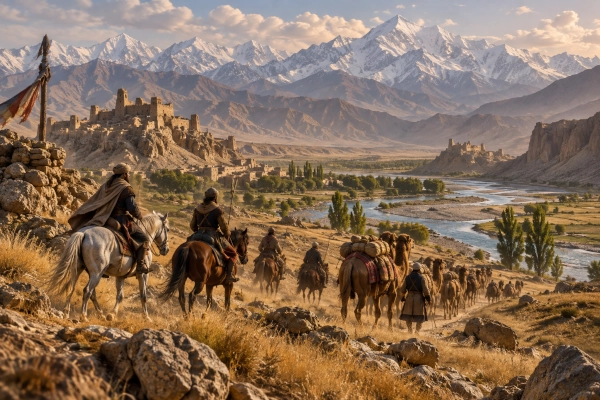
The Mahabharata’s northern world includes mountain routes, distant communities and warriors whose homes lay beyond its central kingdoms. Tushara belongs to this wider geography. Its people appear in accounts of royal tribute and the Kurukshetra war, while the related name Tukhara occurs in the description of the Pandavas’ travels during exile. These references connect the region with several stages of the epic, from Yudhishthira’s imperial ceremony to Arjuna’s confrontation with Karna.
Tushara is commonly associated with historical Tukhara or Tokharistan, a region connected with Bactria north of the Hindu Kush. On a modern map, the most useful broad setting is northern Afghanistan and adjoining parts of southern Tajikistan and southern Uzbekistan. The identification provides a geographical guide, rather than a precise boundary for an epic kingdom.
Tushara, Tukhara and the Bactrian Connection
Names such as Tushara, Tukhara and Tokhara occur in discussions of ancient Indian and Central Asian geography. Historical Tokharistan developed as a name for the Bactrian region, although its extent changed over time. Bactria’s original geographical core lay between the Hindu Kush and the Amu Darya, the river known to classical writers as the Oxus. Its political reach sometimes extended beyond that core.
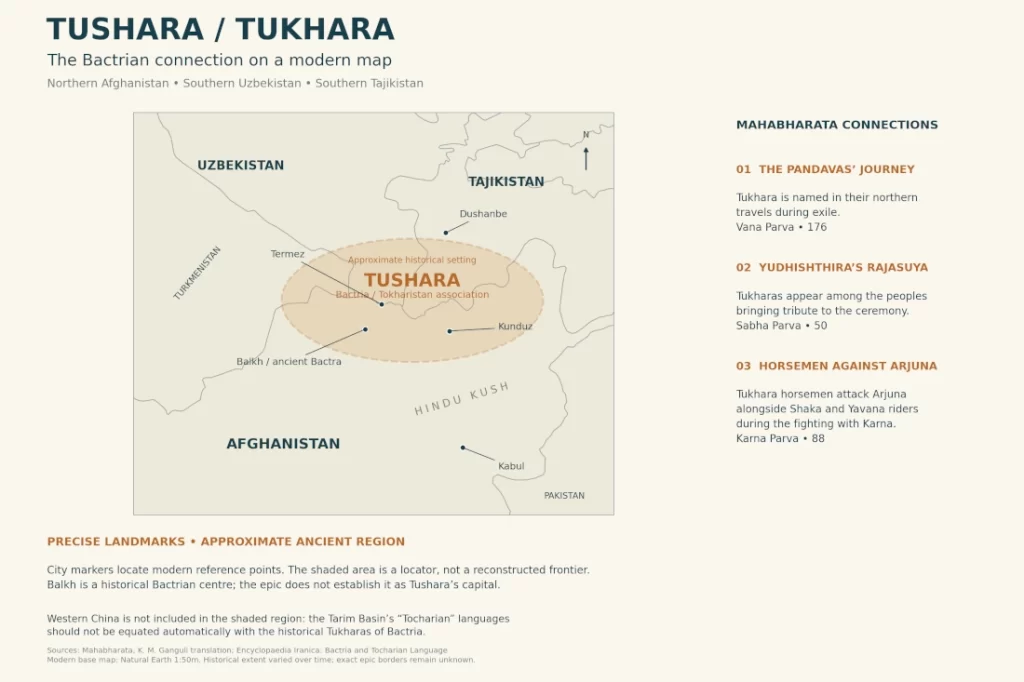
Balkh, ancient Bactra, provides a useful modern landmark. The surrounding region contained agricultural oases, settlements and routes linking Central Asia with lands south of the mountains. This makes the Bactrian association more specific than a general description of Tushara as a remote northern country. However, Balkh’s historical importance does not establish it as the capital of the Tusharas mentioned in a particular Mahabharata episode.
Why Western China Requires a Separate Explanation
The word “Tocharian” can cause confusion because modern scholarship also uses it for two ancient Indo-European languages of the northern Tarim Basin in present-day Xinjiang. Manuscripts in these languages come from places including Kucha, Karashahr and Turfan. Their geographical setting lies well east of Bactria.
The shared terminology does not establish that their speakers were the same people as the historical Tukharas of Afghanistan. Encyclopaedia Iranica’s linguistic survey explicitly distinguishes the two. Consequently, western China should not automatically be included within a map of the Mahabharata’s Tushara kingdom. It belongs in a discussion of Central Asian connections and the history of the name, with the uncertainty clearly explained.
Tukhara in the Pandavas’ Journey During Exile
A direct geographical reference appears in the Vana Parva. After their mountain sojourn, the Pandavas spend time at Badari and then proceed towards the realm of Suvahu, king of the Kiratas. The narrative describes them crossing difficult Himalayan country and the regions of China, Tukhara, Darada and Kulinda before reaching his capital.
Suvahu welcomes them, and they reunite with their charioteers, attendants and other members of their travelling household. Tukhara therefore appears within a journey involving the principal characters, rather than only in a catalogue of distant peoples.
The passage is valuable evidence for the epic’s northern geographical outlook. It does not supply distances, identifiable passes or a sequence that can be plotted confidently as a modern itinerary. Nor does it describe a Pandava conquest of Tukhara or name a Tukhara king defeated along the way. Its explicit subject is travel through a broad mountain world.
The Tukharas at Yudhishthira’s Rajasuya
The Sabha Parva places the Tukharas among the peoples associated with the tribute gathering for Yudhishthira’s Rajasuya sacrifice. Duryodhana recalls the immense wealth assembled there and the crowds awaiting admission. In this account, Tukharas appear alongside Shakas, Kankas, Romakas and other groups bringing valuable offerings.
The passage collectively mentions horses, elephants and gold. These gifts should not all be assigned exclusively to Tukhara. A grouped tribute list cannot establish that every named community supplied each animal or commodity, or that those goods originated in its homeland.
Within the story, the gathering demonstrates the reach of Yudhishthira’s prestige. Duryodhana’s recollection also reveals how deeply that prosperity troubles him. The Tukharas form part of the wider world whose attendance makes the Pandava king’s success so impressive—and so painful to his rival.
Krishna Names the Tusharas Among Duryodhana’s Warriors
The Karna Parva gives the Tusharas a clear military affiliation. On the seventeenth day of the war, Krishna addresses Arjuna as he advances with the determination to kill Karna. Reviewing the struggle, Krishna names numerous powerful peoples who have fought for Duryodhana.
The Tusharas appear among them, together with Yavanas, Khasas, Daradas, Shakas and other communities. Krishna describes these forces as formidable opponents and praises Arjuna’s ability to overcome them. Their inclusion confirms their place within the Kaurava coalition in this passage.
The speech also has a dramatic purpose. Krishna is strengthening Arjuna’s resolve before a decisive encounter, so the description emphasises the strength of the enemies he has faced. It offers evidence of Tushara participation, but it is not a separate record of their army’s size or command structure.
Tukhara Horsemen Attack Arjuna During the Battle with Karna
A more specific incident follows during the confrontation between Arjuna and Karna. The Karna Parva describes a force of chariots and elephants, together with Shaka, Tukhara and Yavana horsemen, rushing against Arjuna. Leading Kamboja fighters accompany the attack.
Arjuna counters with arrows, cutting down weapons and combatants and striking their horses, elephants and chariots. The narrative thus places Tukhara cavalry within the fighting around one of the epic’s central duels. Their role is active and immediate: they take part in an assault intended to kill the Pandava warrior.
This episode is particularly significant because it explicitly identifies horsemen. There is no need to infer their mounted role simply from a Central Asian association. The text itself supplies that detail, although it does not identify a separate Tukhara commander or explain the contingent’s journey to Kurukshetra.
A Region Connected Through Travel, Tribute and War
Taken together, these episodes place Tushara within several kinds of contact. The Pandavas traverse a region called Tukhara during exile; Tukharas appear at Yudhishthira’s great ceremony; and Tushara or Tukhara fighters support Duryodhana in battle. The references give the name a recurring place in the narrative without providing a continuous history of one royal house.
Their attendance at the Rajasuya and later appearance in the opposing army should not be turned into an invented story of betrayal. The passages do not establish that the same ruler or group acted in both settings, nor do they explain a change of allegiance. What they establish is the presence of northern peoples within the epic’s wider political and military world.
For a modern geographical presentation, the Bactrian and upper Amu Darya setting offers the strongest broad association. Northern Afghanistan and adjoining southern parts of Tajikistan and Uzbekistan provide useful orientation. The Mahabharata adds journeys, visitors and battlefield encounters to that setting, while leaving its exact frontiers and capital unresolved.
You may also like
-
Shaka in the Mahabharata: Central Asia’s Steppe Peoples, Nakula’s Campaign and the Alliance with Duryodhana
-
Yavana in the Mahabharata: Greek Connections, Pandava Campaigns and the Warriors of Kurukshetra
-
India and Sri Lanka Launch SAMHiTA Manuscript Digitisation Project to Preserve Ancient Buddhist Heritage
-
ASI Uses Ground-Penetrating Radar to Investigate Ancient Buddhist Stupa at Ujjain After Nearly 90 Years
-
Pahlava: The Parthian World Beyond India’s Northwestern Frontiers in the Mahabharata
