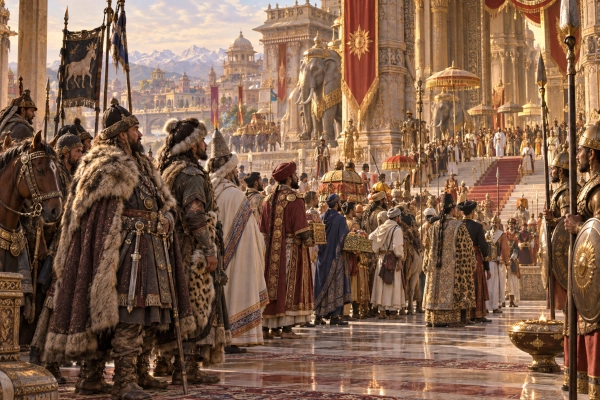
The Mahabharata includes the Harahunas among the distant peoples drawn into the political world of the Pandavas. Nakula encounters them during his western campaign, Duryodhana remembers them among the crowds at Yudhishthira’s Rajasuya, and Krishna names them while recalling the prosperity the Pandavas lost after the dice game. These references place them within the epic’s accounts of conquest, ceremonial recognition and exile.
For a geographical study, however, the familiar label “Huna kingdom” needs qualification. The passages examined here use the name Harahuna, while historical studies distinguish several later Hunnic powers in Central Asia and the northwestern subcontinent. Their names invite comparison, but the epic does not provide enough information to identify its Harahunas with one particular historical dynasty or draw their borders.
Huna and Harahuna: Why the Names Matter
The most reliable starting point is the wording of the epic itself. In Kisari Mohan Ganguli’s translation, the relevant passages in the Sabha and Vana Parvas name the Harahunas. Preserving that form prevents the text from appearing more specific than it is. Nakula’s campaign account supplies a western orientation, but does not name a Harahuna capital or identify their ruler.
The broader historical term “Huns” also covered different populations and political formations. Scholars distinguish groups such as the Kidarites, Alchon, Nezak and Hephthalites. Their territories and periods of power overlapped in complicated ways. They should not be merged into one timeless nation, nor automatically equated with the European Huns associated with Attila.
Where Were the Hunnic Territories on a Modern Map?
Afghanistan and adjoining Central Asian regions provide a useful setting for the history of several Hunnic powers. The Hephthalites, in particular, established extensive authority in Central Asia and Afghanistan. Their historical world included the Bactrian and Oxus regions, which connect northern Afghanistan with adjoining areas of present-day Uzbekistan and Tajikistan. This is a guide to later historical geography, not a demonstrated map of the Mahabharata’s Harahuna country.
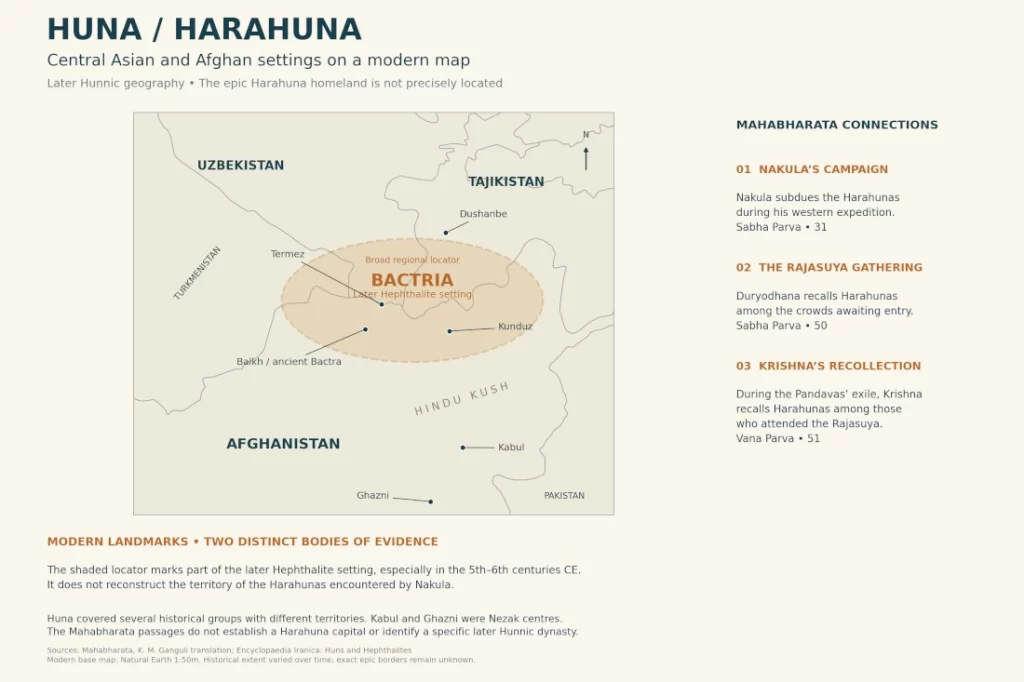
Different groups also held territories south of the Hindu Kush and towards the northwestern subcontinent. A map labelled simply “Huna” therefore needs a period and a named political group. Afghanistan, Uzbekistan and Tajikistan can orient the reader, but their complete modern territories cannot be presented as one epic kingdom.
Nakula’s Western Campaign Against the Harahunas
The clearest military incident occurs in the Sabha Parva, during the campaigns undertaken before Yudhishthira’s Rajasuya sacrifice. Nakula advances westward to obtain the submission and tribute of rulers beyond the Pandavas’ immediate domain.
The narrative explicitly states that he subdues the Ramathas, the Harahunas and various western kings by force. It then describes his communications with Vasudeva and his arrival at Sakala, where his maternal uncle Shalya accepts Pandava supremacy. Nakula eventually returns to Indraprastha with the wealth collected during the expedition.
The Harahunas thus have a definite role in the story of Yudhishthira’s rise. Their submission helps demonstrate the reach of Pandava power before the royal sacrifice. Yet the account does not describe a separate siege, name a Harahuna opponent or provide a route into a recognisable Central Asian city. The episode establishes a conquest within the narrative, while leaving its precise modern location unresolved.
Harahunas at Yudhishthira’s Rajasuya
The Harahunas appear again in the Sabha Parva when Duryodhana describes the extraordinary gathering at Yudhishthira’s Rajasuya. He recalls numerous peoples waiting for admission, including Chinas, Shakas, Harahunas and communities associated with the Himalayan regions.
Their presence contributes to the picture of a ceremony attended by people from far beyond the Kuru heartland. The scene presents Yudhishthira’s prosperity through crowds, valuable possessions and the recognition of distant rulers. Duryodhana remembers it because that success has deepened his resentment.
This passage does not identify a distinct Harahuna gift. Nearby descriptions assign particular goods to other peoples, and those offerings should not be transferred to the Harahunas merely because their name appears in the same catalogue. What the text securely establishes is their presence within the gathering that symbolises Yudhishthira’s prestige.
Krishna Recalls the Harahunas During the Pandavas’ Exile
A further reference occurs in the Vana Parva, within Sanjaya’s report to Dhritarashtra. Sanjaya recounts Krishna’s visit to the Pandavas after their defeat at dice. Disturbed by their condition, Krishna remembers the prosperity he had witnessed at the Rajasuya.
In that recollection, Krishna names the Harahunas alongside Pahlavas, Daradas, Yavanas, Chinas, Tukharas and many other peoples. Their attendance becomes evidence of the standing Yudhishthira once enjoyed. Krishna promises to restore the prosperity that now benefits the Pandavas’ enemies.
Yudhishthira responds by insisting that his pledged period of exile must first be fulfilled. The reference therefore belongs to an emotionally important exchange about lost sovereignty, loyalty and the obligation to keep a promise. It recalls the earlier ceremony; it does not describe another Harahuna campaign or establish their later allegiance at Kurukshetra.
The Later Huna Rulers Belong to a Different Historical Setting
The historically documented Hunnic powers became prominent in the Iranian and Indian borderlands during the fourth to sixth centuries CE. Toramana and Mihirakula belong to this later history, associated with the Alchon group. They are not the named opponents of Nakula in the passage discussed above.
Hephthalite history likewise supplies its own rulers, wars and changing territories. It can help readers understand why Hunnic names became important across Central Asia, but it cannot fill the gaps in an epic account. Identifying Nakula’s Harahunas specifically as Hephthalites would require evidence beyond the similarity of names and a broad western association.
What the Harahuna References Reveal
The three episodes follow a clear narrative progression: western conquest, recognition at the Rajasuya, and remembrance of that recognition during exile. The Harahunas help express the scale of Yudhishthira’s former authority and the political consequences of its loss.
Their place in Mahabharata geography is therefore meaningful even without a recoverable capital or frontier. The epic preserves their name within its wider western world. Later history supplies a much fuller picture of Hunnic powers in Afghanistan and Central Asia, but keeping those records distinct allows each to illuminate the past without turning uncertainty into an invented kingdom.
You may also like
-
India and France Sign Agreement to Preserve and Digitise Ancient Indian Manuscripts
-
GeM’s AABHAR Collection Showcases 294 Indigenous Products, Strengthens Market Access for Indian Artisans
-
Tushara in the Mahabharata: The Lands Beyond the Hindu Kush and the Horsemen Who Faced Arjuna
-
Shaka in the Mahabharata: Central Asia’s Steppe Peoples, Nakula’s Campaign and the Alliance with Duryodhana
-
Yavana in the Mahabharata: Greek Connections, Pandava Campaigns and the Warriors of Kurukshetra
