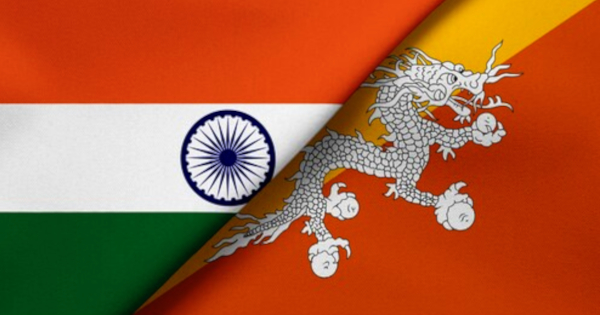
India and Bhutan have reviewed the progress of Indian-assisted development projects being implemented across the Himalayan country, reaffirming their long-standing partnership in infrastructure, education, healthcare, energy and capacity building.
The review took place during the fifth India–Bhutan Development Cooperation Talks held in Thimphu on July 30, 2026. Indian Foreign Secretary Vikram Misri and Bhutanese Foreign Secretary Dasho Pema Lektup Dorji co-chaired the discussions.
The meeting examined the implementation of projects supported by India under Bhutan’s 13th Five-Year Plan and discussed measures to accelerate schemes across priority sectors.
Twelve New Development Projects Approved
During the talks, the two countries reportedly approved 12 additional development projects with a combined value of approximately ₹332 crore.
The new initiatives are expected to supplement the wider group of Indian-supported projects already being implemented under Bhutan’s current national development plan.
Project details are generally selected according to priorities identified by the Royal Government of Bhutan. Indian development assistance has traditionally supported sectors such as roads, bridges, schools, hospitals, agriculture, digital infrastructure, skills, cultural heritage and community facilities.
The latest approvals demonstrate the continuing expansion of the partnership as both governments assess emerging requirements and adjust assistance to Bhutan’s development priorities.
Reviewing Projects Across Multiple Sectors
The two delegations reviewed the implementation status of ongoing projects and considered issues affecting funding, construction schedules and programme delivery.
India and Bhutan had previously approved 61 Project Tied Assistance projects worth ₹4,958 crore under the 13th Five-Year Plan. These projects cover infrastructure, energy, healthcare, education, skill development, cultural heritage, sports, youth exchanges, the digital economy and space technology.
The development talks serve as the principal institutional mechanism for discussing India’s bilateral assistance to Bhutan. They allow officials from both countries to review existing projects, approve new proposals and modify programmes according to changing requirements.
Regular monitoring is particularly important for large infrastructure and social-development schemes that involve several government departments and implementation agencies.
India’s ₹10,000-Crore Commitment
India has committed ₹10,000 crore in development assistance for Bhutan’s 13th Five-Year Plan.
The support was announced during Prime Minister Narendra Modi’s state visit to Bhutan in March 2024 and represented a substantial increase over assistance provided during the previous planning period.
India’s assistance includes Project Tied Assistance, High Impact Community Development Projects, programme grants and support for Bhutan’s Economic Stimulus Programme.
Project Tied Assistance is used for larger schemes identified by the Bhutanese government, while community-development projects generally focus on smaller initiatives capable of directly improving services in towns and rural areas.
These may include drinking-water systems, irrigation channels, farm roads, schools, health facilities, waste-management infrastructure and community centres.
Development Based on Bhutan’s Priorities
A defining feature of the India–Bhutan partnership is that projects are selected in accordance with priorities identified by Bhutan’s government and people.
Rather than operating as isolated aid programmes, Indian-supported initiatives are incorporated into Bhutan’s national planning framework. This helps align external assistance with the country’s broader social, economic and environmental objectives.
Bhutan’s 13th Five-Year Plan covers the period from 2024 to 2029 and focuses on strengthening economic growth, improving public services, generating employment and building greater resilience.
India’s assistance is expected to support both major infrastructure and grassroots projects during this period.
Infrastructure and Connectivity
Infrastructure remains one of the principal areas of cooperation.
Indian-assisted programmes have supported highways, bridges, urban infrastructure, power transmission systems and public buildings across Bhutan.
Improved transport connectivity can reduce travel time between remote settlements and major economic centres, while better roads and bridges can expand access to schools, healthcare institutions and markets.
India and Bhutan are also advancing their first cross-border railway projects. Proposed links between Kokrajhar and Gelephu and between Banarhat and Samtse are expected to strengthen trade and passenger connectivity between Bhutan and the Indian states of Assam and West Bengal.
Education and Skills
Education and human-resource development form another major component of the partnership.
Indian assistance has supported school construction, higher-education institutions, scholarships, teacher training, digital learning and vocational-skills programmes.
During earlier rounds of development cooperation, projects were approved for education, capacity building and youth exchanges alongside investments in infrastructure and technology.
These initiatives are intended to help Bhutan build a skilled workforce capable of supporting economic diversification beyond traditional sectors such as agriculture and hydropower.
Healthcare Cooperation
Health projects supported by India have included hospitals, basic health units, medical training and specialised healthcare infrastructure.
Such investments are particularly valuable in remote and mountainous regions where difficult terrain can limit access to advanced medical services.
India has previously assisted Bhutan in developing medical institutions and strengthening public-health capacity. Continued cooperation under the 13th Five-Year Plan can improve both healthcare infrastructure and the availability of trained professionals.
Energy Partnership
Hydropower has historically formed the centrepiece of India–Bhutan economic cooperation.
India has supported the construction of major hydroelectric projects in Bhutan, while surplus electricity generated by these facilities is exported to the Indian market.
The arrangement provides Bhutan with an important source of revenue and gives India access to clean electricity. The two countries are also widening cooperation into renewable energy, cross-border transmission, project financing and regional power trade.
Energy cooperation is therefore evolving beyond individual hydropower plants into a wider partnership involving grid connectivity and sustainable development.
Community-Level Development
High Impact Community Development Projects are designed to deliver visible improvements at the local level.
These initiatives are normally smaller and faster to implement than major infrastructure projects. Local communities often identify the facilities they require, allowing assistance to respond directly to grassroots needs.
Projects can include water supply, irrigation, farm connectivity, flood protection, market facilities, tourism infrastructure and waste management.
Their relatively short implementation period makes them useful for addressing practical challenges faced by rural and urban communities.
A Relationship Based on Trust
India and Bhutan share a close bilateral relationship founded on mutual trust, goodwill and extensive people-to-people connections.
The 2007 India–Bhutan Friendship Treaty provides the contemporary framework for bilateral relations, while cooperation extends across development, security, trade, energy and cultural exchanges.
India remains Bhutan’s largest development and trading partner and has played a significant role in the country’s modernisation.
Bhutan, in turn, occupies an important place in India’s Neighbourhood First policy and regional cooperation strategy.
Supporting Sustainable Development
Bhutan places strong emphasis on environmental protection, cultural preservation and sustainable growth.
Indian-assisted development programmes increasingly include clean energy, digital technology, climate resilience, heritage conservation and environmentally responsible infrastructure.
Future cooperation is likely to focus on areas such as renewable energy, e-mobility, digital public infrastructure, space technology, entrepreneurship and skills for emerging industries.
Such diversification can support Bhutan’s economic ambitions while remaining consistent with its development philosophy and environmental priorities.
Strengthening a Long-Term Partnership
The fifth India–Bhutan Development Cooperation Talks reaffirmed the commitment of both countries to implement projects efficiently and adapt their partnership to new national priorities.
The approval of additional projects worth approximately ₹332 crore adds to a much larger portfolio of Indian-supported initiatives under Bhutan’s 13th Five-Year Plan.
By combining major infrastructure investments with community-level programmes, the partnership seeks to improve connectivity, public services, employment opportunities and economic resilience.
The latest talks underline the enduring character of India–Bhutan relations and their shared commitment to pursuing development through consultation, mutual respect and practical cooperation.
You may also like
-
India, Russia and the Ukraine Conflict: Putin Highlights Modi’s Continued Push for Dialogue and a Negotiated Settlement
-
India and France Discuss Aerospace Manufacturing, UPI Integration and India-EU FTA
-
Côte d’Ivoire Military Delegation Visits HAL, Shows Interest in India’s Indigenous Aerospace Platforms
-
India and Netherlands Move to Deepen Agricultural Cooperation in Seeds, Horticulture and Innovation
-
Tarang Shakti Delegates from 28 Countries Visit HAL and BEL to Explore India’s Defence Manufacturing Ecosystem
