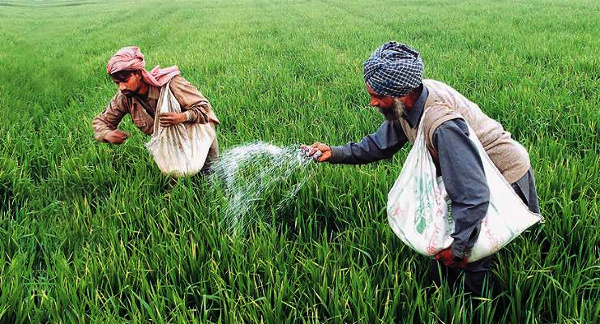
India maintained adequate stocks of major subsidised fertilizers during the ongoing Kharif 2026 season, supported by advance demand assessment, centralised digital monitoring, coordinated imports and priority railway movement.
Under the One Nation, One Fertilizer initiative, urea, DAP, MOP and NPKS fertilizers supplied by public-sector, cooperative and private manufacturers are marketed across India under the common Bharat brand. The programme operates under the Pradhanmantri Bhartiya Janurvarak Pariyojana and has been in effect since 24 August 2022.
National Fertilizer Availability Remains Comfortable
Between 1 April and 29 July 2026, the total availability of all four major fertilizer categories reached 323.54 lakh metric tonnes, compared with an assessed requirement of 223.47 lakh metric tonnes.
This meant that aggregate availability exceeded the assessed requirement by approximately 100.07 lakh metric tonnes during the period.
| Fertilizer | Requirement | Availability | DBT sales | Closing stock |
|---|---|---|---|---|
| Urea | 122.84 LMT | 177.27 LMT | 112.53 LMT | 64.75 LMT |
| DAP | 35.44 LMT | 43.03 LMT | 26.59 LMT | 16.44 LMT |
| MOP | 11.20 LMT | 14.31 LMT | 5.85 LMT | 8.47 LMT |
| NPKS | 53.99 LMT | 88.93 LMT | 44.73 LMT | 44.19 LMT |
| Total | 223.47 LMT | 323.54 LMT | 189.70 LMT | 133.85 LMT |
Urea availability exceeded the assessed requirement by 54.43 LMT, while NPKS availability was higher by 34.94 LMT. DAP and MOP availability exceeded national requirements by 7.59 LMT and 3.11 LMT, respectively.
Common Bharat Brand Simplifies Farmer Choice
Before the introduction of the common branding system, farmers encountered fertilizers marketed under numerous company-specific product names. Although the nutrient content of subsidised fertilizers was regulated, differences in branding could influence purchasing decisions and encourage the unnecessary movement of products across regions.
The One Nation, One Fertilizer programme requires participating manufacturers to sell subsidised products under uniform names such as Bharat Urea, Bharat DAP, Bharat MOP and Bharat NPKS.
The common identity is intended to simplify farmers’ choices, improve transparency, discourage branding-related malpractices and reduce avoidable criss-cross transportation of equivalent fertilizer products between states.
Requirements Assessed Before Each Cropping Season
The fertilizer supply process begins before the agricultural season. The Department of Agriculture and Farmers’ Welfare consults state governments to estimate monthly and state-wise requirements.
Based on these projections, the Department of Fertilizers prepares monthly supply plans and allocates quantities to different regions. The system allows the Centre and states to identify expected shortages in advance and direct additional supplies towards high-demand agricultural areas.
Domestic production is supplemented through imports wherever necessary. Import arrangements are finalised ahead of the cropping season to reduce the risk of delays during peak sowing and fertilizer-application periods.
Digital Platform Tracks Fertilizer Movement
The movement of major subsidised fertilizers is tracked through the Integrated Fertilizer Management System, an online platform covering different stages of the supply chain.
The system supports real-time monitoring of dispatches, movement, receipts, sales and stocks. It helps authorities compare available quantities with projected requirements and intervene when supplies need to be redirected.
DBT sales recorded between April and 29 July 2026 amounted to 112.53 LMT of urea, 26.59 LMT of DAP, 5.85 LMT of MOP and 44.73 LMT of NPKS.
Railways Support Priority Movement
Fertilizer distribution requires the movement of large quantities from manufacturing plants and ports to consumption centres across India.
The Department of Fertilizers coordinates with the Ministry of Railways to secure sufficient railway rakes, prioritise fertilizer consignments and facilitate their timely evacuation to different states. State governments, fertilizer producers and importers are also advised to coordinate the placement of supply indents.
Once fertilizer reaches a state, district-level allocation and distribution are managed by the respective state government.
Large Agricultural States Hold Significant Stocks
Uttar Pradesh recorded the country’s highest assessed urea requirement during the reported period at 26.04 LMT, against availability of 35.96 LMT and a closing stock of 14.52 LMT.
Punjab had a urea requirement of 12.34 LMT and availability of 15.87 LMT, while Madhya Pradesh reported requirement of 10.77 LMT against availability of 15.27 LMT.
Maharashtra held particularly large NPKS supplies, with availability of 22.08 LMT against a requirement of 12.42 LMT. Karnataka reported NPKS availability of 12.56 LMT, compared with requirement of 7.81 LMT.
Coordinated System Supports Kharif Agriculture
Timely access to fertilizers is critical during the Kharif season because delays around sowing and early crop development can affect productivity. The combination of advance planning, common branding, digital tracking, planned imports and railway coordination is intended to create a more predictable national supply network.
The government stated that the availability of urea, DAP, MOP and NPKS remained adequate during Kharif 2026. The information was provided by Union Chemicals and Fertilizers Minister J.P. Nadda and Minister of State Anupriya Patel in a written reply in the Rajya Sabha on 4 August 2026.
SOURCE
Press Information Bureau, Government of India
Ministry of Chemicals and Fertilizers
Department of Fertilizers
“One Nation, One Fertilizer’ Initiative Strengthens Fertilizer
Availability and Distribution Across the Country”
Published: 4 August 2026
Release ID: 2294272
The information was provided by Union Minister of Chemicals and
Fertilizers J.P. Nadda and Minister of State Anupriya Patel in a
written reply in the Rajya Sabha.
You may also like
-
India’s Economic Warfare Challenge: Strategic Autonomy, Energy Security and the Rise of a Global Power
-
India-US Trade Deal Stalemate: Why Washington’s Tariff Pressure Has Failed to Secure an Agreement
-
US Double Standards in Foreign Policy: 16 Recent Cases Involving India, Russia, China and Global Trade
-
India’s Arctic Energy Ambitions: Russian Oil, LNG and a New Sea Route to Indian Ports
-
India and Russia Explore Joint Icebreaker Construction as Maritime Industrial Cooperation Expands
