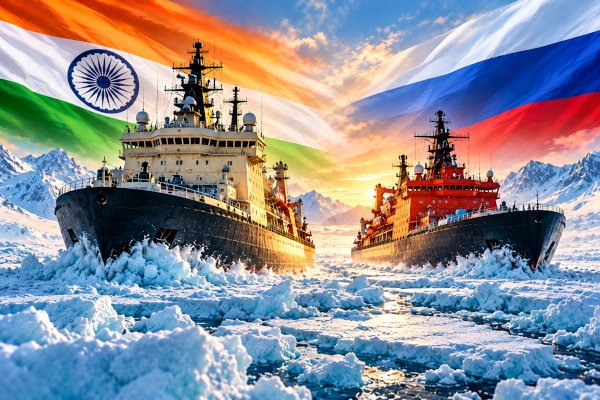
India and Russia are advancing discussions on the joint construction of icebreaker vessels, opening a new avenue for cooperation in specialised shipbuilding and Arctic maritime transportation. Union Minister for Ports, Shipping and Waterways Sarbananda Sonowal confirmed on 8 October 2026 that India is developing the industrial capabilities needed to construct icebreakers in cooperation with Russia, with leading Indian shipbuilding companies becoming involved in the initiative.
Speaking to Russian state news agency TASS, Sonowal expressed India’s commitment to strengthening its domestic shipbuilding ecosystem and expanding cooperation with Russia in specialised maritime technologies. The initiative forms part of India’s wider ambition to become a globally competitive shipbuilding and ship-owning nation.
The development is especially significant because icebreakers represent a technically demanding category of vessels designed to operate in frozen waters. Their construction requires specialised hull engineering, powerful propulsion systems and expertise in Arctic operating conditions.
The minister’s remarks confirm that cooperation is being pursued, although neither government has announced a final shipbuilding contract, vessel specifications or construction schedule.
India Developing Industrial Capacity for Joint Icebreaker Construction
During his interaction with TASS in New Delhi on 8 October, Sonowal confirmed that India was building an ecosystem capable of supporting icebreaker construction with Russia.
The minister indicated that some of India’s leading shipbuilding companies were taking responsibility for developing the required capabilities. He also emphasised the government’s determination to establish India as a major maritime power across different segments of the shipping industry.
His remarks represent a progression from broader maritime cooperation discussions towards preparations for specialised shipbuilding activities.
However, the minister did not identify the participating Indian shipyards or disclose the number of vessels under consideration. Details concerning project financing, technology transfer and industrial responsibilities also remain undisclosed.
The initiative therefore remains at the stage of developing industrial capability and pursuing cooperation rather than executing an announced construction contract.
What Makes Icebreaker Ships Different from Conventional Vessels?
Icebreakers are specialised ships designed to navigate waters covered by sea ice. Unlike conventional commercial vessels, they must withstand significant structural loads while maintaining sufficient propulsion power to move through frozen maritime environments.
Their hulls incorporate reinforced structures that allow them to break or displace ice. Many icebreakers use specially shaped bows that help the vessel ride onto ice and fracture it through the ship’s weight.
The propulsion system must deliver high thrust at relatively low speeds. Depending on the design, icebreakers may employ diesel-electric, hybrid or nuclear propulsion arrangements.
Steering and propulsion equipment also require protection against contact with ice, while onboard machinery must remain reliable under extremely low temperatures.
These requirements make icebreaker construction a specialised branch of marine engineering, involving naval architecture, advanced metallurgy, propulsion technology and cold-weather systems integration.
Developing competence in these areas would expand India’s capabilities beyond conventional merchant vessels and naval shipbuilding.
Russia’s Northern Sea Route Creates New Maritime Opportunities
One of the principal areas of India–Russia maritime cooperation is the Northern Sea Route, which runs along Russia’s Arctic coastline and connects European and Asian maritime regions.
The route passes through Arctic waters extending from the Barents Sea region towards the Bering Strait.
It offers a potential alternative for certain voyages between northern European and East Asian ports, although its commercial attractiveness depends on the origin and destination of cargo, seasonal ice conditions, vessel characteristics and operating costs.
Icebreakers support navigation along parts of the route by creating passages through ice-covered waters and assisting vessels operating under difficult conditions.
Russia has extensive experience operating icebreaker fleets, including powerful nuclear-powered vessels used to support Arctic shipping.
For India, cooperation in this sector offers opportunities to acquire industrial experience in a specialised field while participating in the development of international maritime connectivity.
The Northern Sea Route nevertheless presents considerable operational challenges. Ice conditions, limited supporting infrastructure, environmental risks and the need for specialised vessels influence the feasibility of regular commercial services.
India–Russia Maritime Working Groups Provide the Foundation
The latest development builds upon several years of institutional engagement between India and Russia.
During the India–Russia Annual Summit in July 2024, both governments expressed support for developing shipping cooperation through the Northern Sea Route. They also agreed to establish a joint working mechanism under their Intergovernmental Commission on Trade, Economic, Scientific, Technological and Cultural Cooperation.
The first meeting of the joint working group on the Northern Sea Route took place in New Delhi on 10 October 2024. Discussions covered cargo transportation, shipbuilding cooperation and training Indian seafarers for polar navigation.
A subsequent meeting took place in Murmansk on 3 July 2025, continuing discussions on cooperation associated with Arctic maritime operations.
These engagements established an institutional framework for examining the commercial, technical and logistical requirements of greater Indian participation in Arctic shipping.
November 2025 Consultations Expanded Shipbuilding Cooperation
On 17 November 2025, India and Russia held high-level interagency maritime consultations in New Delhi.
The Indian delegation was led by Sarbananda Sonowal, while the Russian delegation was headed by Nikolai Patrushev, Aide to the President of the Russian Federation and Chairman of Russia’s Maritime Board.
According to the Ministry of Ports, Shipping and Waterways, the discussions covered shipbuilding, port development, maritime logistics, Arctic operations, scientific cooperation and training.
Both sides reaffirmed their commitment to developing a stronger maritime partnership that could support international connectivity and industrial growth.
The consultations were important because they brought together maritime policymakers and technical representatives to examine cooperation across several interconnected sectors.
Icebreaker construction represents one possible industrial outcome of this wider engagement.
Indian Shipyards Could Enter a Specialised Global Market
India has developed significant shipbuilding capabilities through public-sector shipyards and private maritime engineering companies.
Domestic facilities already construct warships, patrol vessels, commercial ships, offshore support vessels and specialised maritime platforms.
However, building icebreakers requires additional expertise in reinforced hull structures, extreme-temperature engineering and propulsion systems suited to ice-covered waters.
Cooperation with Russia could help Indian manufacturers develop capabilities in these specialised areas through appropriate industrial arrangements.
Potential opportunities extend beyond hull construction to marine electrical equipment, propulsion components, structural materials and shipboard machinery.
Such projects could also involve Indian suppliers of precision-engineered components and specialised industrial systems.
The actual participation of individual companies will depend on future commercial agreements and technical requirements. Although earlier industry reports discussed possible involvement by Cochin Shipyard and Reliance Naval and Engineering, Sonowal’s October statement did not confirm either company as a selected construction partner.
Earlier Reports Discussed Four Non-Nuclear Icebreakers
The possibility of constructing icebreakers in India has been under discussion since 2024.
Earlier maritime-industry reports indicated that Russian authorities were exploring the construction of four non-nuclear icebreakers through cooperation with Indian shipyards.
The proposed vessels were associated with Russia’s requirements for supporting navigation along the Northern Sea Route.
Industry reporting in early 2025 suggested that discussions concerning potential Indian construction partners had advanced.
However, these reports did not establish that binding construction contracts had been signed.
The distinction remains relevant following Sonowal’s latest remarks. His 8 October statement confirmed the development of Indian industrial capacity but did not specifically reaffirm a four-vessel order.
Consequently, the proposed quantity should be treated as an earlier reported possibility rather than a confirmed element of a new agreement.
Chennai–Vladivostok Corridor Strengthens the Wider Maritime Partnership
India and Russia are also working to improve maritime connectivity through the Chennai–Vladivostok Eastern Maritime Corridor.
The initiative seeks to strengthen shipping links between India’s eastern coast and Russia’s Far Eastern ports.
Vladivostok provides access to Russia’s Pacific maritime infrastructure and serves as an important centre for commercial shipping, logistics and regional economic activity.
Improved connectivity could facilitate the movement of commodities, industrial products and other cargo between the two countries.
The Eastern Maritime Corridor and the Northern Sea Route are geographically distinct initiatives, but both form part of India’s expanding engagement with Russia in maritime transportation.
During his October 2026 interaction with TASS, Sonowal also addressed the prospects of developing these transport corridors. He emphasised the importance of mutual understanding and constructive cooperation between the two governments.
Arctic Shipping Requires Specialised Indian Maritime Skills
Icebreaker construction represents only one component of participation in Arctic maritime operations.
Vessels operating in polar waters require crews trained to understand ice navigation, extreme weather, emergency procedures and the limitations of shipboard equipment.
The International Maritime Organization’s Polar Code establishes requirements for ships operating in Arctic and Antarctic waters, covering areas such as vessel design, equipment, operations, training and environmental protection.
Indian participation in Arctic shipping would therefore create opportunities for specialised maritime education and professional training.
Navigation officers, marine engineers and technical personnel would need experience in operating vessels under conditions that differ substantially from those encountered in tropical and temperate waters.
India and Russia have already included polar-navigation training among the subjects discussed through their maritime cooperation mechanisms.
This educational dimension could support the development of a skilled Indian workforce capable of participating in specialised international shipping operations.
Advanced Shipbuilding Could Support India’s Maritime Manufacturing Ambitions
India’s Maritime Amrit Kaal Vision 2047 seeks to transform the country into a major global maritime economy.
The strategy emphasises shipbuilding capacity, port infrastructure, logistics, maritime services and the development of a competitive domestic industrial ecosystem.
On 2 October 2026, Sonowal urged the Shipping Corporation of India to play a leading role in strengthening India’s maritime capabilities. He highlighted the importance of building a larger national fleet and improving the country’s position in global shipping and shipbuilding.
Specialised projects such as icebreaker construction could complement this ambition by expanding the range of vessels that Indian shipyards are technically capable of producing.
Such diversification can help manufacturers move into more complex segments of the global maritime market.
It may also support greater investment in ship design, industrial research, testing facilities and advanced production technologies.
Icebreaker Construction Presents Significant Engineering Challenges
Successful entry into icebreaker manufacturing requires more than access to conventional shipbuilding infrastructure.
The hull must withstand repeated contact with ice while maintaining the structural integrity necessary for prolonged maritime operations.
Engineers must account for unusual loading patterns, vibration, low-temperature material behaviour and the interaction between the vessel’s hull and propulsion systems.
Icebreakers also require reliable heating, ventilation, power generation and machinery-protection arrangements.
Material selection is particularly important because certain metals can experience reduced toughness at very low temperatures. Shipbuilders must therefore ensure that structural materials satisfy the appropriate strength and fracture-resistance requirements.
These challenges require specialised engineering knowledge, rigorous testing and close coordination between designers, manufacturers and classification authorities.
Russian industrial experience could provide a valuable technical reference for Indian companies developing expertise in this sector.
India–Russia Cooperation Remains Focused on Civilian Maritime Development
The proposed icebreaker initiative concerns maritime transportation and industrial development rather than an announced military shipbuilding programme.
Although both India and Russia maintain extensive defence cooperation, the current discussions focus on specialised vessels that support navigation, shipping and maritime infrastructure.
Icebreakers can perform different roles depending on their design and operator, including escorting merchant ships, supporting scientific activities and assisting maritime operations in ice-covered waters.
No official announcement has identified the proposed India–Russia construction initiative as a naval combat-vessel project.
This distinction is important because the industrial and commercial objectives of civilian icebreaker construction differ from those of military shipbuilding.
India and Russia Move Towards a Broader Maritime Industrial Partnership
The 8 October 2026 statement by Sarbananda Sonowal marks another development in India–Russia maritime cooperation.
It confirms India’s intention to build the industrial capabilities required for icebreaker construction and indicates the involvement of leading domestic shipbuilding companies in the preparatory effort.
The next stage will involve defining technical requirements, identifying industrial partners and establishing the commercial arrangements needed to translate discussions into construction programmes.
For India, participation in specialised vessel manufacturing offers an opportunity to expand its marine engineering expertise and strengthen the domestic shipbuilding ecosystem.
For Russia, cooperation with Indian industry could provide additional manufacturing capacity for projects associated with its wider maritime infrastructure requirements.
The initiative reflects the growing scope of the India–Russia strategic partnership, bringing together shipbuilding, Arctic connectivity, industrial development and maritime skills. It also advances India’s ambition to become a major global shipbuilding nation with capabilities extending into some of the most technically demanding segments of maritime engineering.
References
- TASS — 8 October 2026. India Developing Industrial Ecosystem for Joint Icebreaker Construction with Russia. Statement by Union Minister Sarbananda Sonowal.
https://tass.ru/ekonomika/28193925 - Ministry of Ports, Shipping and Waterways — 17 November 2025. India and Russia Hold High-Level Interagency Consultations in New Delhi. Press Information Bureau.
https://www.pib.gov.in/PressReleasePage.aspx?PRID=2191056 - Ministry of Ports, Shipping and Waterways — 9 December 2025. International Partnership in Ports, Shipping and Maritime Geo-Logistics. Press Information Bureau.
https://www.pib.gov.in/PressReleasePage.aspx?PRID=2200911 - Government of India — July 2024. Joint Statement Following the 22nd India–Russia Annual Summit.
https://www.pib.gov.in/PressReleasePage.aspx?PRID=2031946 - Prime Minister’s Office — 5 December 2025. Joint Statement Following the 23rd India–Russia Annual Summit.
https://www.pmindia.gov.in/en/news_updates/joint-statement-following-the-23rd-india-russia-annual-summit/ - Ministry of Ports, Shipping and Waterways — 2 October 2026. SCI Should Play a Leading Role in Strengthening India’s Maritime Capabilities: Union Minister Sarbananda Sonowal.
https://www.pib.gov.in/PressReleseDetailm.aspx?PRID=2318496 - Baird Maritime — 9 October 2026. India Developing Icebreaker Construction Capacity with Russia, Shipping Minister Says.
https://www.bairdmaritime.com/work-boat-world/icebreaking/india-russia-icebreaker-shipbuilding-capacity
You may also like
-
Centre Approves ₹710 Crore for 509 Km of Rural Roads in Mizoram, Connecting 48 Habitations for First Time
-
India Plans EV Charging and Battery-Swapping Stations on Panchayat Land to Expand Rural Electric Mobility
-
India Expands Electric Vehicle Research Infrastructure as ARAI Inaugurates Advanced Testing Facilities
-
India Launches DEPA Framework to Enable Secure AI Training While Protecting Data Sovereignty
-
Sun Pharma Reportedly Secures Indian Regulatory Approval for Generic Oral Semaglutide Tablets
