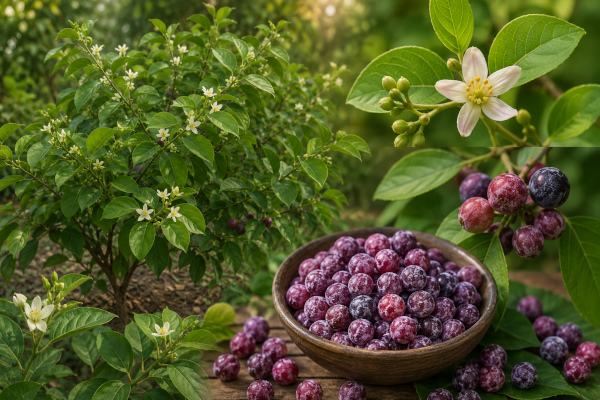
Parushaka, widely known as Phalsa or Falsa, is a small purple berry valued in Ayurveda as a cooling, nourishing and thirst-relieving fruit. Its pleasant combination of sweetness, mild acidity and astringency makes it especially suitable for refreshing summer drinks. Classical Ayurvedic texts associate ripe Parushaka with relief from fatigue, excessive thirst, burning sensations and conditions involving aggravated Vata and Pitta.
The accepted botanical name is Grewia asiatica L. The spelling “Grewia asiatical” sometimes seen in secondary documents is incorrect. Modern taxonomy places the plant in the Malvaceae family, although older botanical and Ayurvedic publications often classify it under Tiliaceae. Kew recognises Grewia asiatica as an accepted species native across a broad region extending from southern Iran through the Indian subcontinent and Southeast Asia to Queensland.
Botanical Identity
Sanskrit name: Parushaka, Parushaka Phala
Common English names: Phalsa, Falsa, Sherbet berry, Indian sherbet berry
Hindi: Phalsa, Falsa
Botanical name: Grewia asiatica L.
Family: Malvaceae
Older family classification: Tiliaceae
Part principally used: Ripe fruit
Other traditionally used parts: Leaves, bark and roots
Parushaka grows as a shrub or small tree in tropical and subtropical climates. It develops broad leaves and small yellow flowers, followed by round berries that change from green to reddish-purple and finally deep purple or nearly black when fully ripe. The fruit is soft, juicy, delicately acidic and contains small seeds.
Its short harvesting season and highly perishable nature mean that the fruit is usually eaten fresh or converted quickly into juice, syrup, squash, sherbet and other beverages.
Parushaka in Classical Ayurveda
Parushaka appears in several important Ayurvedic contexts. The Charaka Samhita places it among substances associated with Virechana support, fever relief and the alleviation of exhaustion. It is also mentioned in the fruit group and in preparations intended to counter the adverse effects of excessive alcohol consumption.
The classical description changes according to the maturity of the fruit. This distinction is essential because unripe and ripe Phalsa do not exert identical dietary effects.
Unripe Parushaka
The unripe fruit is predominantly sour and astringent. The Sushruta Samhita describes it as light but capable of increasing Pitta while reducing Kapha. Its strong acidity can therefore become irritating when consumed excessively, particularly by people already troubled by acid reflux, gastritis or Pitta-related burning.
Ripe Parushaka
When fully ripe, the fruit becomes sweeter, cooling and more nourishing. Classical descriptions associate ripe Parushaka with the pacification of Vata and Pitta. It is traditionally considered helpful in thirst, heat, fatigue and certain bleeding conditions.
Ayurvedic Properties
The commonly accepted Ayurvedic profile of ripe Parushaka is:
Rasa—taste: Madhura or sweet, with Amla or sour and Kashaya or astringent undertones
Guna—qualities: Laghu or light and Snigdha or mildly unctuous
Virya—potency: Shita or cooling
Vipaka—post-digestive effect: Madhura or sweet
Dosha action: Pacifies Vata and Pitta when the ripe fruit is used appropriately
Principal actions: Brimhana, Tarpana, Balya, Hridya, Trishnaghna, Shramahara and Ruchya
Charaka describes Parushaka as nourishing and recommends it in Vata- and Pitta-related conditions.
Brimhana and Balya: Nourishment and Strength
Parushaka is traditionally regarded as Brimhana, meaning that it helps nourish and replenish the tissues. It is also considered Balya, or supportive of physical strength.
Unlike extremely rich Brimhana foods such as heavy milk preparations, ripe Phalsa provides nourishment through a comparatively light and refreshing fruit. This makes it useful during hot weather, after physical exertion or when a person requires gentle nourishment without an excessively heavy meal.
Its classical use in energy-restoring drinks reflects this balance between refreshment and tissue support.
Trishnaghna: Relief from Excessive Thirst
One of Parushaka’s most characteristic Ayurvedic applications is its use in Trishna, or excessive thirst. Its juicy nature, mild acidity, sweetness and cooling potency make the ripe fruit particularly suitable for beverages during the hot season.
Sushruta’s Parushakadi group is traditionally described as Vata-pacifying, heart-supportive, thirst-relieving and appetite-promoting.
Fresh Phalsa juice may therefore be viewed as a classical summer refreshment rather than merely a sweetened commercial drink. The quantity of added sugar should nevertheless be controlled because the fruit’s natural tartness often encourages excessive sweetening.
Shramahara: Support During Fatigue
The Charaka Samhita includes Parushaka in the Shramahara Mahakashaya, a group of substances associated with the alleviation of exhaustion.
This traditional action explains its inclusion in Mantha preparations. A Mantha is produced by macerating or churning selected ingredients in water and filtering the mixture. Such preparations are usually consumed fresh and provide fluid, natural sugars, flavour and the combined qualities of their ingredients.
Parushaka is particularly suited to this dosage form because its sour-sweet taste improves palatability while its cooling nature balances heat and fatigue.
Hridya: A Pleasant and Heart-Supportive Fruit
Ayurvedic texts describe Parushaka and preparations containing it as Hridya. The word can indicate something pleasing, agreeable or supportive to the heart.
In traditional dietary understanding, a food may be considered Hridya because it refreshes the senses, improves taste, relieves thirst and produces a feeling of satisfaction. This designation should not be interpreted as proof that Phalsa treats cardiovascular disease.
Ruchya: Supporting Taste and Appetite
Parushaka’s combination of sweet, sour and mildly astringent tastes makes it Ruchya, or capable of improving the appreciation of food. Its fruit drinks may be useful when heat, fatigue or convalescence has reduced the desire to eat.
The sour component can stimulate salivation, while the sweet and cooling qualities make the fruit pleasant after exertion. Very sour, unripe fruits may have the opposite effect in people with sensitive digestion.
Parushaka in Fever and Heat-Related Discomfort
Parushaka is traditionally associated with Jwarahara and Dahahara actions—support in fever and burning sensations. This does not mean that the fruit directly cures infection or replaces medical evaluation.
Its role is better understood as a supportive food or beverage that may provide hydration, palatability and cooling nourishment during recovery, where the patient can safely consume fruit. Persistent fever, severe weakness, dehydration or altered consciousness requires medical attention.
Parushaka and Bleeding Disorders
Classical descriptions of ripe Parushaka mention its use in Raktapitta, a broad Ayurvedic category involving bleeding associated with aggravated Pitta. Sushruta also associates the ripe fruit with benefit in haemoptysis.
These references reflect traditional Ayurvedic practice and should never encourage self-treatment of coughing blood, gastrointestinal bleeding, abnormal uterine bleeding or unexplained bruising. Such symptoms require urgent medical investigation.
Digestive Effects
The digestive influence of Parushaka depends strongly on ripeness and quantity.
A fully ripe fruit is sweet, cooling and comparatively gentle. Its mild acidity can support taste and appetite. The unripe fruit is sharper, more astringent and more likely to aggravate Pitta.
Excessive intake, especially in the form of strongly sweetened syrup, may contribute to:
- Acidic discomfort or reflux
- Abdominal heaviness
- Loose stools in sensitive individuals
- Fluctuations in blood glucose
- Reduced appetite when consumed immediately before a meal
The small seeds should also be strained from beverages prepared for people who have difficulty swallowing or digesting coarse material.
Kharjuradi Mantha: A Classical Energy Drink Containing Parushaka
Kharjuradi Mantha is a drinkable Ayurvedic preparation in which Parushaka is combined with dates, pomegranate, raisins, tamarind and Amalaki.
Ingredients
Water: 4 parts
Kharjura—dates, Phoenix dactylifera: 1/6 part
Dadima—pomegranate, Punica granatum: 1/6 part
Draksha—raisins, Vitis vinifera: 1/6 part
Amlika—tamarind, Tamarindus indica: 1/6 part
Amalaki—Indian gooseberry, Phyllanthus emblica: 1/6 part
Parushaka—Phalsa, Grewia asiatica: 1/6 part
Method of Preparation
Remove the seeds and inedible portions from the fruits. Grind or crush all the fruit ingredients into a coarse paste. Add four parts of clean drinking water and allow the mixture to soak for approximately two to three hours.
After soaking, churn or macerate the mixture thoroughly so that the soluble fruit components disperse into the water. Filter it through a clean cloth or fine sieve and consume it freshly prepared.
Because the formulation contains moist, crushed fruit without preservatives, it should not be stored for a prolonged period at room temperature.
Ayurvedic Properties of the Drink
The supplied classical table describes Kharjuradi Mantha as:
Guru: Substantial or relatively heavy to digest
Madhura: Sweet
Amla: Sour
Anulomaka: Supportive of the normal downward movement of Vata, flatus and faeces
Snigdha: Unctuous or nourishing
Balya: Strength-promoting
The sweetness of dates and raisins balances the acidity of tamarind, pomegranate, Amalaki and Parushaka. The resulting Mantha combines hydration, energy and a complex sweet-sour taste.
Classical Indication
The preparation is traditionally mentioned as beneficial in Madyavikara or Madatyaya, referring to disorders arising from the inappropriate or excessive consumption of alcohol.
This should be understood as a classical dietary and therapeutic indication rather than a modern clinical claim. Acute alcohol poisoning, repeated vomiting, severe confusion, seizures, breathing difficulty or loss of consciousness requires emergency medical treatment. Alcohol dependence and withdrawal should be managed under medical supervision.
A modern research protocol has also examined freshly prepared Kharjuradi Mantha as an adjunct to multidisciplinary care for alcohol-withdrawal-related problems, but such investigation remains exploratory and does not establish it as an independent treatment.
Note on Variations in the Formula
The version supplied here uses six fruit ingredients in equal proportions. Some published editions and modern reconstructions of Kharjuradi Mantha include an additional sour fruit identified as Tintidika or Vrikshamla. This is an example of textual or interpretive variation between editions. A preparation intended for formal Ayurvedic treatment should follow the edition and interpretation selected by a qualified physician or Bhaishajya Kalpana specialist.
The Manuscript and Classical Textual Tradition
The recipe does not represent a formula derived from only one isolated manuscript. It brings together references preserved in three Ayurvedic Sanskrit treatises: the Sharngadhara Samhita, Yoga Ratnakara and Gada Nigraha.
The principal reference is Sharngadhara Samhita, Madhyama Khanda, Chapter 3, where Mantha preparations and Kharjuradi Mantha are described. The Sharngadhara Samhita, probably composed during the early fourteenth century, became one of Ayurveda’s most influential practical manuals. It belongs to the Laghutrayi and is particularly important for Bhaishajya Kalpana—the science of preparing medicines. Its Madhyama Khanda systematically discusses dosage forms, proportions and pharmaceutical procedures, making it a valuable working handbook for physicians and pharmacists.
The same therapeutic tradition is cited in Yoga Ratnakara, under the treatment of Panatyaya or alcohol-related disorders. Yoga Ratnakara is a later practical compendium known for arranging formulations and treatments according to diseases. Modern historical reviews generally place it in the medieval or early modern phase of Ayurvedic literature, with some assigning it to approximately the sixteenth century.
The formula is also referenced in Gada Nigraha, Part II, Kayachikitsa Khanda. Gada Nigraha is an earlier pharmaceutical and therapeutic compilation traditionally associated with the twelfth century. A modern critical review describes it as a two-part work containing hundreds of formulations arranged for practical medical use.
Together, these references demonstrate how Ayurvedic recipes were transmitted, repeated and adapted across successive compendia rather than remaining confined to a single manuscript copy.
Modern Nutritional and Phytochemical Perspective
Modern research identifies Phalsa as an edible fruit containing carbohydrates, dietary fibre, organic acids, minerals and several classes of phytochemicals. Studies have reported anthocyanins, flavonoids, phenolic acids and tannins, although concentrations vary with cultivar, ripeness, climate, processing and analytical method.
Its dark purple colour is associated with anthocyanin pigments. Laboratory investigations of Grewia asiatica extracts have reported antioxidant, antimicrobial, anti-inflammatory and metabolism-related activities. Most of these findings come from chemical assays, cell studies or animal experiments and cannot be treated as proof that ordinary Phalsa fruit prevents or cures human disease.
A small human study has investigated the fruit’s glycaemic response and certain immune parameters in healthy volunteers. Such limited research is interesting but insufficient for establishing therapeutic recommendations, particularly for diabetes or immune disorders.
Culinary Uses
Ripe Parushaka can be used in:
Fresh fruit: Eaten after washing, usually in modest portions because of the seeds.
Phalsa juice: Crushed fruit mixed with water and strained.
Sherbet or Panaka: Fruit juice diluted with water and balanced with suitable sweetening and aromatic spices.
Mantha: Macerated fruit combined with other nourishing and sour fruits.
Syrup or squash: A preserved preparation, although commercial varieties may contain substantial added sugar.
Fruit pulp preparations: Used in frozen desserts, preserves, sauces and natural food colour applications.
Fresh fruit or minimally sweetened juice is generally preferable to heavily sweetened syrup.
Cultivation and Harvesting
Grewia asiatica grows best in warm tropical or subtropical conditions and tolerates seasonally dry environments. It can be maintained as a shrub through pruning, which encourages fresh fruit-bearing growth.
The berries ripen progressively rather than all at once and therefore require repeated harvesting. Fully ripe fruits are deep purple, soft and easily damaged. Their perishability partly explains why Phalsa remains a seasonal and regionally marketed fruit rather than a widely transported commercial crop.
Safety and Precautions
Ripe Phalsa is generally consumed as a food, but medicinal or concentrated preparations require care.
People with diabetes should account for the fruit and any added sugar in their dietary plan. Commercial sherbets may contain far more sugar than fruit. Sour or unripe berries may aggravate acidity, mouth sensitivity or Pitta-related discomfort. Fruits should be washed carefully and obtained from sources free from pesticide contamination.
Pregnant and breastfeeding women may consume the ripe fruit as an ordinary food in suitable quantities, but concentrated extracts, bark, root preparations and medicinal formulations should be used only under qualified guidance.
The roots and other non-food parts of the plant should never be used for self-medication. Traditional references involving strong actions from these parts do not establish their safety for unsupervised internal use.
Conclusion
Parushaka is a distinctive example of an Ayurvedic fruit that joins food, medicine and seasonal refreshment. Its ripe berries are sweet, cooling, mildly sour and nourishing, making them especially valuable during heat, thirst and physical exhaustion.
Classical texts recognise Parushaka as Brimhana, Balya, Hridya, Trishnaghna and Shramahara. Its inclusion in Kharjuradi Mantha reflects these qualities: the berry contributes acidity, colour, flavour and cooling refreshment to a formulation designed to restore strength and support the body following exhaustion or alcohol-related disturbance.
Modern research confirms that Phalsa contains nutritionally and chemically interesting compounds, particularly polyphenols and anthocyanins. Nevertheless, its strongest established role remains that of a wholesome seasonal fruit and a traditional ingredient used according to Ayurvedic principles.
REFERENCES
1. Charaka Samhita. Sutra Sthana 4/9; 23/38; 27/128 and related references concerning Parushaka, Shramahara Mahakashaya, Phala Varga and Mantha used in alcohol-related disorders.
2. Sushruta Samhita. Sutra Sthana, Chapter 38, Parushakadi Gana; and Sutra Sthana, Chapter 46, description of unripe and ripe Parushaka fruit.
3. Sharngadhara Samhita. Madhyama Khanda, Mantha Kalpana, Chapter 3, verses 9–10. Kharjuradi Mantha.
4. Yoga Ratnakara. Panatyaya Chikitsa, Shloka 47. Kharjuradi Mantha in the management of disorders associated with alcohol consumption.
5. Gada Nigraha. Part II, Kayachikitsa Khanda, 17/27. Kharjuradi Mantha.
6. Royal Botanic Gardens, Kew. Plants of the World Online. Grewia asiatica L. Family: Malvaceae.
7. Zia-Ul-Haq M, Stanković MS, Rizwan K, Feo VD. Grewia asiatica L., a Food Plant with Multiple Uses. Molecules. 2013;18(3):2663–2682. DOI: 10.3390/molecules18032663.
8. Akhtar N, et al. Phytochemical and Pharmacological Characteristics of Phalsa (Grewia asiatica L.): A Comprehensive Review. Heliyon. 2024;10(3):e25279. PMID: 38312640.
9. Abou Zeid AH, et al. The Chemical Composition and Health-Promoting Effects of the Grewia Species—A Systematic Review and Meta-Analysis. Nutrients. 2021;13(12):4565. DOI: 10.3390/nu13124565.
10. Ullah W, et al. Effect of Grewia asiatica Fruit on Glycemic Index and Phagocytosis Tested in Healthy Human Subjects. Asian Pacific Journal of Tropical Biomedicine. 2012;2(12):969–971. PMID: 23261731.
11. Solanki HJ, Umretia B. Gada Nigraha—A Critical Review. Research and Reviews: A Journal of Unani, Siddha and Homeopathy. 2023;10(2). DOI: 10.37591/rrjoush.v10i2.3289.
12. Savrikar SS, Ravishankar B. Sharangadhara—His Contribution in Ayurvedic Literature. Bulletin of the Indian Institute of History of Medicine. 2006;36(1):1–10. PMID: 17333662.
Ayurvedic health disclaimer: This article presents traditional Ayurvedic and nutritional information for educational purposes. It does not diagnose disease or replace treatment from a qualified Ayurvedic physician, dietitian or registered medical practitioner.
You may also like
-
Ayurveda on Cold Foods and Iced Drinks: Why Food Temperature Matters for Digestion
-
Serum Institute of India-Manufactured Ebola Vaccine Enters Clinical Trial in Uganda
-
Ayurveda and Hydration: How Much Water Should We Really Drink?
-
Warm Water in Ayurveda: When and Why It Is Recommended
-
Women Make Up 43% of India’s Ayush Workforce as Sector Supports 17.6 Lakh Livelihoods
:%20Ayurveda’s%20Cooling%20and%20Restorative%20Phalsa%20Berry)