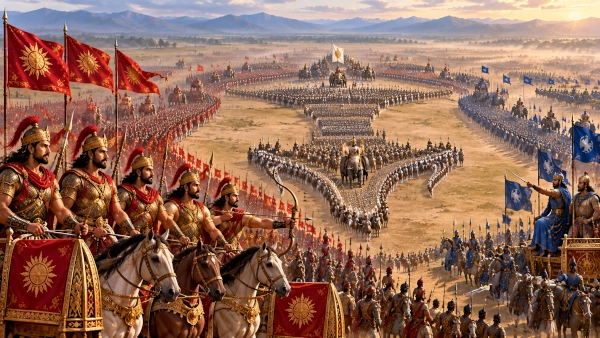
Among the important northwestern kingdoms of the Mahabharata, Kekaya, also written Kaikeya, occupied a strategic position in the river lands of ancient Punjab. The kingdom is generally placed in western Punjab in present-day Pakistan, with its core associated with the country around the Jhelum and Chenab river systems. Historical geographical studies have variously identified Kekaya with the old Jhelum and Shahpur districts and adjoining territory, placing it east of Gandhara and west of the Madra country.
The kingdom occupies a distinctive place in the Mahabharata because the Kekaya royal family became closely related to the Pandavas. Yet the great war eventually divided the Kekayas themselves. Princes of the same regional and dynastic world appear fighting on opposite sides at Kurukshetra, turning Kekaya into another example of the family divisions that run throughout the epic.
The Land of Kekaya
Kekaya belonged to the wider Punjab river country, a region shaped by the great waterways descending from the Himalayas towards the Indus. One geographical reconstruction places the northern part of the Jhelum-Chenab Doab within the Kaikeya sphere, while older historical studies associate the kingdom more broadly with the Jhelum and Shahpur districts of pre-Partition Punjab.
This identification should not be treated as a precisely surveyed ancient boundary. The extent of early kingdoms could change between periods, and literary references preserved over centuries do not always describe exactly the same political territory. A reasonable modern approximation places Kekaya around the Jhelum region and adjoining western Punjab, extending towards the country between the Jhelum and Chenab in Pakistan.
This was fertile and strategically valuable country. The river plains supported agriculture and settlements, while routes through Punjab connected the region eastwards with Madra and the Kuru territories and northwestwards towards Gandhara and the Indus frontier. The position of Kekaya therefore placed it within one of the principal corridors linking the interior of ancient Bharat with its northwestern regions.
Rajagriha and the Traditional Capital of Kekaya
The Ramayana and later geographical traditions associate the capital of Kekaya with Rajagriha or Girivraja. This should not be confused with the famous Rajagriha of Magadha in eastern India. Alexander Cunningham proposed that the Kekaya capital should be identified with Girjak or Jalalpur on the Jhelum, an identification repeated by several later historians, although it remains a scholarly reconstruction rather than a securely established archaeological identification.
The proposed location nevertheless fits the broader geographical picture of Kekaya as a western Punjab kingdom situated along important river and overland routes.
An Ancient Kingdom Known Before the Mahabharata
The name Kaikeya has a history extending beyond the Mahabharata. The Chandogya Upanishad remembers Ashvapati Kaikeya, a celebrated king renowned for his knowledge of the Vaishvanara Self. Learned householders are described as going to him for instruction, making Ashvapati one of the notable philosopher-kings of early Indian sacred literature.
This reference is valuable because it shows that Kaikeya was not merely a geographical name created for the narrative of the epic. It belonged to a much wider body of ancient Indian tradition associated with the northwestern regions.
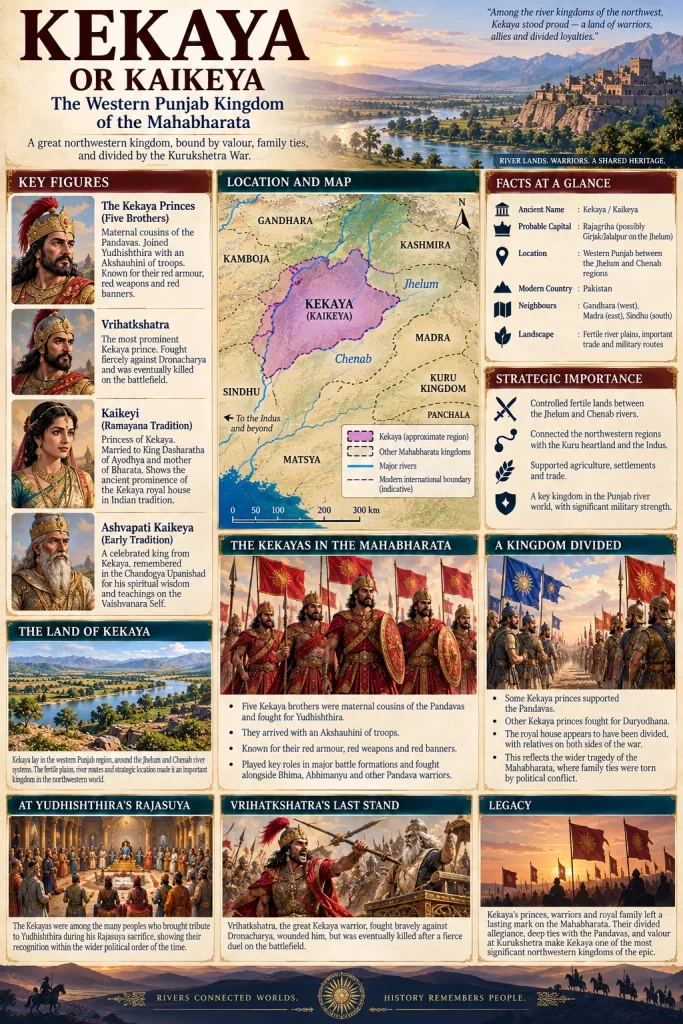
The kingdom is also famous in the Ramayana through Kaikeyi, queen of Dasharatha and mother of Bharata, who belonged to the Kekaya royal house. The Mahabharata, however, presents a different generation of Kekaya princes who became deeply involved in the political struggle between the Pandavas and Kauravas.
The Kekayas at Yudhishthira’s Rajasuya
The Kekayas appear among the numerous peoples who participated in the extraordinary political gathering surrounding Yudhishthira’s Rajasuya sacrifice. When Duryodhana later described the wealth and tribute that had poured into Indraprastha, he specifically included the Kaikeyas among the well-born warrior peoples who brought tribute to Yudhishthira.
Their presence demonstrates that Kekaya was integrated into the wider political network recognised by the Pandavas. Although geographically distant from the Kuru heartland, the western Punjab kingdom participated in the system of alliances and ceremonial relationships surrounding Yudhishthira’s imperial ambitions.
The Kekaya Princes and the Pandavas
The strongest bond between Kekaya and the Pandavas was one of kinship. The Drona Parva explicitly describes five Kekaya brothers as maternal cousins of the Pandavas and states that they desired victory for the sons of Pandu. The same passage portrays them as formidable warriors wearing red armour and carrying red weapons and banners.
This relationship explains their prominent position within the Pandava coalition.
When both sides assembled their forces before Kurukshetra, the five Kekaya brothers joined the Pandavas with substantial military strength. The Udyoga Parva records that they arrived with an Akshauhini of troops, demonstrating that their contribution represented a major military commitment rather than symbolic participation.
The Kekayas therefore formed one of the important western contingents supporting Yudhishthira.
Kekaya Was Divided by the War
The political situation was more complicated than a simple alliance between Kekaya and the Pandavas.
The Mahabharata also records Kekaya princes fighting for Duryodhana. During the gathering of the Kaurava forces, five royal brothers from Kekaya are described as arriving with an Akshauhini and joining Duryodhana’s army.
Other battle passages likewise place Kekaya warriors within Kaurava formations.
This apparently contradictory evidence is best understood as showing a divided royal house or divided Kekaya political community. Some branches or princes supported the Pandavas, while others supported the Kauravas. The epic itself indicates that the Pandava-aligned Kekaya princes had been dispossessed from their kingdom and were seeking restoration, which provides a political explanation for their support of Yudhishthira.
Kurukshetra therefore became, for the Kekayas, a conflict between relatives as well as between rival alliances.
The Five Kekaya Brothers in the Pandava Army
The Pandava-aligned Kekaya brothers repeatedly appear in important battlefield formations.
During one phase of the Bhishma Parva, the five brothers formed the left wing of the Pandava Makara formation, while Dhrishtaketu and Chekitana held the opposite side. This indicates the confidence placed in the Kekaya contingent, since entire sections of large battle arrays were entrusted to them.
On another day, the five Kaikeya brothers protected the rear of the Pandava army together with other leading kings and commanders.
They also repeatedly fought alongside Bhima, Abhimanyu, Dhrishtadyumna, Satyaki, Nakula and Sahadeva. The epic therefore treats them as part of the main fighting strength of Yudhishthira’s coalition rather than peripheral allies.
Vrihatkshatra — The Great Kekaya Warrior
Among the Kekaya princes, Vrihatkshatra, also rendered Brihatkshatra, emerges as one of the most prominent.
The Drona Parva describes him as a mighty Kaikeya warrior borne into battle by fine Sindhu-bred horses. He repeatedly confronted powerful Kaurava commanders and eventually fought directly against Dronacharya.
Their duel became one of the major Kekaya episodes of the war.
Vrihatkshatra attacked Drona with showers of arrows and successfully countered one of the preceptor’s formidable weapons. He struck Drona and even wounded his charioteer, forcing the veteran commander into a severe exchange.
Drona eventually destroyed Vrihatkshatra’s horses, killed his charioteer, brought down his standard and finally struck the Kekaya prince through the chest. Vrihatkshatra fell from his chariot and died on the battlefield.
His death illustrated the enormous losses suffered by the western kingdoms drawn into the Kuru civil war.
Red Banners of Kekaya
The Mahabharata gives the Kekaya brothers an unusually distinctive battlefield identity.
They are described as wearing red coats of mail, carrying red weapons and fighting beneath blood-red banners. This repeated colour imagery makes the Kekaya warriors among the more visually recognisable contingents described in the battle narrative.
The detail may preserve a remembered martial tradition, dynastic colour or simply an epic literary device used to distinguish their force on the enormous battlefield. Whatever its origin, the red-clad Kekaya princes became closely associated with the Pandava battle formations.
Kekaya and the Northwestern Political World
Kekaya belonged to a dense cluster of kingdoms occupying ancient Punjab and the wider northwest. Gandhara lay towards its northwest, while Madra occupied territory farther east around the Ravi-Chenab country. Sindhu and other Indus regions lay beyond the Punjab plains.
Historical geographical traditions place Kekaya east of Gandhara and west of Madra, with one reconstruction encompassing the old districts of Jhelum, Gujarat and Shahpur.
This position helps explain why Kekaya repeatedly appears alongside peoples such as the Madras, Vahlikas, Gandharas and other northwestern groups in ancient literature.
The Punjab rivers created natural corridors across this political landscape. The Jhelum and Chenab were not simply boundaries; their valleys also supported agriculture, communications, animal movement and trade. Control of territory in this region therefore carried both economic and strategic importance.
Kekaya in Modern Geography
In present-day geographical terms, ancient Kekaya can be placed broadly within Punjab Province in Pakistan, particularly around the historic Jhelum and Shahpur regions and the adjoining country connected with the Jhelum-Chenab river system.
The proposed identification of its traditional capital with Jalalpur on the Jhelum reinforces this western Punjab placement, although the exact position of Rajagriha remains debated.
It is therefore preferable to describe Kekaya as a regional kingdom rather than assign it exact modern borders. Its historical territory may have expanded, contracted or shifted during different periods represented in ancient literature.
A Kingdom Divided Between Kinship and Politics
Kekaya’s importance in the Mahabharata comes not from one single ruler or episode but from the way the kingdom reflects the wider tragedy of the epic.
Its princes were closely related to the Pandavas. Five Kekaya brothers became prominent members of Yudhishthira’s army, marched beneath distinctive red banners and fought repeatedly against the greatest Kaurava commanders. Yet other Kekaya princes joined Duryodhana, meaning warriors from the same broader royal and regional community faced one another at Kurukshetra.
The kingdom therefore demonstrates how the war fractured political families far beyond Hastinapura itself.
Kekaya or Kaikeya can be identified broadly with the western Punjab region of present-day Pakistan, particularly the country associated with the Jhelum and adjoining Chenab river systems. Situated between the political worlds of Gandhara and Madra, it was an old and influential northwestern kingdom whose royal house was drawn directly into the struggles of the Pandavas and Kauravas. Its divided allegiance at Kurukshetra turned Kekaya into one of the clearest examples of how the Mahabharata war crossed regional boundaries and separated even close relatives into opposing armies.
You may also like
-
Madra: The Ancient Punjab Kingdom of Shalya and Madri in the Mahabharata
-
BRICS Theatre Festival 2026 Opens in New Delhi, Bringing Together Nine Nations to Strengthen Cultural Cooperation
-
Sauvira: The Indus Realm Linked With Jayadratha in the Mahabharata
-
Sindhu: The Indus Kingdom of Jayadratha in the Mahabharata
-
Kuninda or Kulinda: The Himalayan Realm of the Mahabharata in Uttarakhand and Himachal Pradesh
