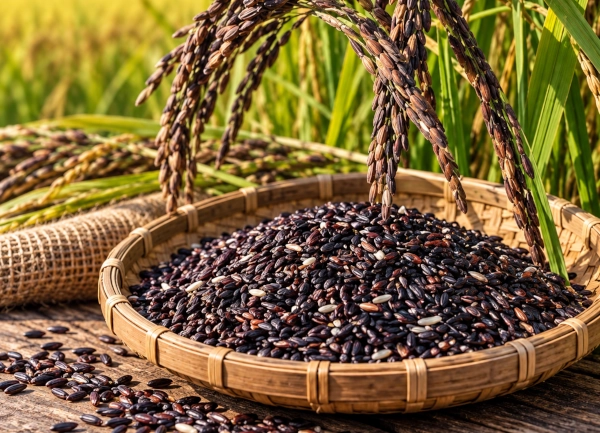
Across the fertile valleys and hill-fringed agricultural landscapes of India’s Northeast grows a rice whose appearance changes dramatically when it reaches the cooking pot. Almost black when dry, its grains gradually release shades of deep purple and violet as they cook, accompanied by a distinctive aroma that has made the rice part of the culinary identity of Manipur for generations.
This is Chak-Hao, the traditional aromatic black rice associated above all with Manipur and also cultivated within the adjoining parts of Nagaland included in its protected geographical region. Unlike ordinary polished rice, Chak-Hao retains a dark pigmented bran layer rich in naturally occurring anthocyanins. Yet colour alone does not define the grain. Its combination of fragrance, soft sticky texture and traditional cultivation gives Chak-Hao a character that distinguishes it from many other black rice varieties grown in India and elsewhere.
The Government of Manipur’s Organic Mission describes Chak-Hao as a black aromatic rice valued particularly for its pleasant aroma and characteristic stickiness. The official Geographical Indications Registry recognises the protected geographical area as Manipur and Nagaland, making Chak-Hao an unusual GI product whose traditional production zone extends across two northeastern states.
A Rice Deeply Rooted in Manipuri Culture
The relationship between Chak-Hao and the people of Manipur extends far beyond commercial agriculture. The rice has traditionally occupied a special place in local food culture, particularly in preparations associated with celebrations, family gatherings and important occasions. Its distinctive fragrance and dark colour made it a grain that stood apart from the everyday white rice varieties cultivated across the valley.
The Manipuri name itself has become inseparable from the identity of the grain. While black rice varieties occur across Asia, Chak-Hao represents a particular northeastern Indian tradition of aromatic pigmented rice that farmers have maintained through generations of seed selection and cultivation.
The rice is particularly associated with the fertile agricultural districts of the Imphal Valley, where abundant rainfall, low-lying paddy fields and traditional farming practices provide favourable conditions for rice cultivation. The registered GI geography includes Imphal East, Imphal West, Bishnupur and Thoubal districts of Manipur, along with Peren district of Nagaland.
This geographical spread is important because Chak-Hao is sometimes described simply as “Manipur Black Rice.” That description reflects its strongest cultural association, but the official GI protection is broader. Genuine GI-protected Chak-Hao may originate from the recognised areas of both Manipur and Nagaland.
The Extraordinary Colour of Chak-Hao
Perhaps the most immediately recognisable feature of Chak-Hao is its extraordinary colour. The uncooked grain possesses a very dark purple-black bran layer, while cooking releases the pigments into the surrounding moisture and produces shades ranging from violet to deep purple.
The colour comes principally from anthocyanins, naturally occurring plant pigments also responsible for the red, blue and purple colours found in several fruits, vegetables and grains. Manipur’s Organic Mission identifies Chak-Hao as particularly notable for its anthocyanin content and describes black aromatic rice as an important source of these pigments among food grains.
The dark outer layer also means that Chak-Hao is normally consumed less heavily polished than conventional white rice. Much of the pigmentation and many of the compounds associated with coloured rice remain concentrated in this bran layer.
Its appearance should not, however, overshadow another equally important quality: aroma. Chak-Hao releases a recognisable fragrance during cooking, giving it a sensory character quite different from generic black rice varieties selected primarily for colour.
Aroma and Stickiness Set It Apart
Traditional Chak-Hao is both aromatic and glutinous. In this context, glutinous refers to the sticky texture produced after cooking rather than the presence of gluten. Rice itself does not contain the gluten proteins associated with wheat.
The Manipur Organic Mission identifies the combination of pleasant aroma and stickiness as one of the distinctive qualities of the region’s black aromatic rice. This combination gives cooked Chak-Hao a rich, cohesive texture particularly suitable for desserts and ceremonial preparations.
The grain is also relatively large and requires a different cooking approach from highly polished white rice. Because the pigmented outer layers remain intact, the rice generally takes longer to soften. Once cooked, however, the grains develop their characteristic dark violet colour and distinctive fragrance.
Chak-Hao Amubi and Chak-Hao Poireiton
Several traditional forms of Chak-Hao have been maintained by farmers, but two names are particularly prominent: Chak-Hao Amubi and Chak-Hao Poireiton.
Chak-Hao Amubi is closely associated with the deep black form familiar to consumers as Manipuri black rice. Chak-Hao Poireiton is another important traditional form grown in the region. The Manipur Organic Mission identifies both Amubi and Poireiton among the varieties cultivated organically in the state.
These varieties are products of generations of farmer selection rather than the standardised high-yield rice systems that dominate many large agricultural regions. Their survival therefore represents not merely the preservation of an unusual food grain but also the conservation of traditional agricultural biodiversity.
From Paddy Field to Purple Rice
Chak-Hao is grown within a landscape in which rice cultivation forms a central part of rural life. Paddy fields occupy extensive areas of Manipur’s valleys, surrounded by hills that influence local rainfall, drainage and microclimates.
Traditional cultivation has played an important role in maintaining the qualities associated with the grain. The GI documentation describes Chak-Hao as a scented glutinous rice that has been cultivated for centuries and highlights its characteristic aroma.
Farmers preserve seed from selected harvests and cultivate the crop through seasonal paddy cycles. Once mature, the grain is harvested, dried and milled carefully enough to retain the pigmented bran responsible for its colour.
This is particularly significant for black rice because excessive polishing would remove much of the dark outer layer and consequently diminish both its characteristic appearance and some of the compounds concentrated in the bran.
Chak-Hao Kheer: The Grain’s Most Famous Transformation
One of the most celebrated uses of Chak-Hao is Chak-Hao Kheer, a Manipuri black-rice pudding in which the grain is slowly cooked until it becomes soft and the surrounding liquid develops a striking purple colour.
Milk and sugar transform the already aromatic rice into a rich dessert, while ingredients such as cardamom, nuts or other flavourings may be added according to household preference. The resulting preparation is visually unlike the pale rice puddings familiar across much of India.
The grain’s sticky quality is particularly well suited to such preparations because prolonged cooking produces a naturally thick texture. The aroma remains noticeable while the dark bran pigments spread through the dish.
Chak-Hao can also be eaten as cooked rice and processed into flour and other value-added foods. The Manipur Organic Mission lists potential products including flour, flattened rice, breads, cakes and sweets, illustrating how a traditional grain is increasingly being adapted to modern food markets.
More Than an Exotic Black Rice
The growing popularity of black rice internationally has sometimes resulted in very different varieties being marketed under broadly similar descriptions. Chak-Hao should therefore not be treated simply as another generic “black rice.”
Its GI identity combines place, traditional cultivation, aroma, grain characteristics and cultural heritage. The black pigmentation is only one component of that identity.
This distinction is particularly important as premium coloured rice markets expand. Geographic protection allows consumers to distinguish Chak-Hao originating within its recognised production area from unrelated black rice varieties cultivated elsewhere.
For farmers, the same protection creates the possibility of attaching greater economic value to an agricultural tradition that might otherwise struggle against higher-yielding commercial rice varieties.
Organic Cultivation and New Markets
The commercial future of Chak-Hao increasingly intersects with India’s organic agriculture movement. The Manipur Organic Mission has promoted organised organic cultivation of black aromatic rice, with significant areas brought under certification programmes associated with the National Programme for Organic Production.
This creates opportunities beyond the traditional regional market. Premium rice, organic foods, nutritionally differentiated grains and heritage agricultural products now occupy expanding niches in Indian and international food markets.
Chak-Hao possesses characteristics suited to all four categories. Its striking appearance attracts consumers, its aroma distinguishes it gastronomically, its anthocyanin-rich bran adds nutritional interest, and its association with a specific traditional landscape provides the provenance increasingly valued in premium food markets.
GI protection therefore gives farmers and producer organisations an opportunity to market not simply a commodity but a geographically identifiable agricultural product.
Preserving a Northeastern Rice Heritage
The importance of Chak-Hao extends beyond its market price. Traditional rice landraces represent stores of agricultural diversity accumulated through generations of cultivation. Each survives because farmers repeatedly select, conserve and sow its seed.
As agriculture increasingly relies on a smaller number of uniform commercial varieties, locally adapted grains such as Chak-Hao acquire additional significance. They preserve distinctive colours, aromas, textures and genetic characteristics while maintaining links between agriculture and regional food traditions.
Protecting Chak-Hao therefore helps conserve both a crop and the farming knowledge associated with it.
The inclusion of production areas in both Manipur and Nagaland also illustrates how traditional agricultural landscapes often predate modern administrative boundaries. Crops, seeds and food traditions moved between neighbouring communities long before state borders assumed their present form.
The GI Journey
The effort to provide legal protection to Chak-Hao culminated in an application for Geographical Indication registration filed on 26 December 2017.
The current records of the Geographical Indications Registry, Intellectual Property India, provide the following details:
Geographical Indication: Chak-Hao
GI Application Number: 602
Category: Agricultural
Class: 30
Geographical Area: Manipur and Nagaland
Applicant: Consortium of Producers of Chak-Hao (Black Rice), Manipur
Date of Filing: 26 December 2017
GI Journal: No. 126
Journal Availability Date: 29 November 2019
Certificate Number: 364
Certificate Date: 20 April 2020
Current Registration Valid Until: 25 December 2027
The official GI register presently records Chak-Hao as a registered geographical indication covering the recognised production areas of Manipur and Nagaland.
The registration gives the traditional name a formal geographical identity and provides a mechanism through which genuine producers can distinguish their rice from black rice cultivated outside the protected area.
From the Northeast to the Wider World
Chak-Hao represents the kind of agricultural heritage that India’s GI system was created to protect. A grain once known largely within communities of Northeast India now possesses an identity capable of travelling into premium markets without losing the connection to the landscape from which it originated.
Its deep purple-black colour may first attract attention, but the real story of Chak-Hao lies in the combination of aroma, sticky texture, traditional varieties, farmer knowledge and the rice-growing landscapes of Manipur and neighbouring Nagaland.
For generations, farmers preserved the grain because it had cultural and culinary value. GI recognition has given that inheritance a modern legal framework.
Today, every bowl of genuine Chak-Hao carries something larger than an unusual colour. It carries the agricultural memory of India’s Northeast — preserved seed by seed, harvest after harvest, in a rice that turns from black to brilliant purple when it reaches the table.
You may also like
-
India Expands Global Trade Partnerships to Economies Worth $70 Trillion, Says Piyush Goyal
-
Pune Startup Hyperonic Engineering Develops Indigenous Hydrogen Refuelling Systems for Clean Transportation
-
IIT Madras Startup Folium Sensing Develops Fibre-Optic Technology to Monitor Railways, Pipelines and Border Security
-
IIT Roorkee Startup Metastable Materials Develops Indigenous Technology to Recover Critical Battery Metals
-
Chennai Startup Evoxia Develops Hydrogen Plasma Technology for Indigenous Silicon Manufacturing
