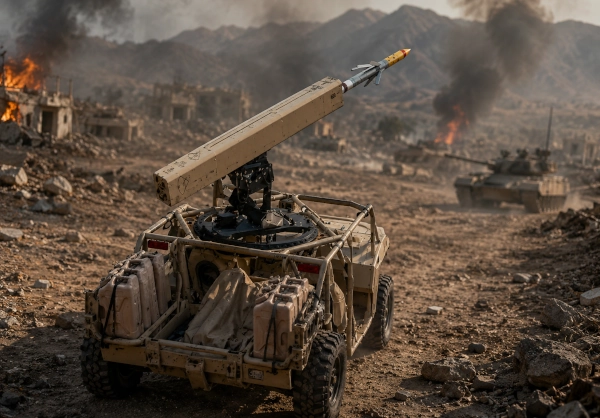
India is set to establish a new domestic manufacturing capability for advanced 70-mm battlefield rockets under a strategic partnership between Kalyani Strategic Systems Limited (KSSL) and European defence major Thales. The agreement covers both conventional unguided rockets and precision laser-guided variants, with the first fully assembled rocket produced in India targeted for early 2027.
KSSL, the wholly owned defence subsidiary of Bharat Forge, and Thales signed the Strategic Alliance Agreement in New Delhi on September 3, 2026, during the high-level Belgian visit to India. The arrangement creates a framework for technology transfer, local production and distribution of 2.75-inch, or 70-mm, rocket systems and associated equipment.
From Technology Partnership to Indian Production
The programme is designed around a division of capabilities between the two companies. Thales will contribute its established 70-mm rocket and launcher technology developed in Belgium, while KSSL will provide Indian manufacturing, system-integration and testing infrastructure.
Production in India will also incorporate components sourced through Thales’ qualified supply chain, allowing the Indian facility to manufacture systems to established international standards. KSSL will support the industrialisation and integration process through its existing defence manufacturing ecosystem and its upcoming energetics facility in Andhra Pradesh.
The agreement is therefore broader than licensed assembly. Technology transfer, production engineering, testing and development of a local supply chain form part of the industrial framework, providing India with an indigenous base for sustaining and expanding the rocket family.
Unguided and Laser-Guided Rockets Under One Programme
The partnership covers two distinct categories within Thales’ 70-mm family. Unguided rockets provide a relatively economical means of engaging battlefield targets, while laser-guided versions add precision engagement capability to the same basic weapon class.
This combination provides armed forces with greater flexibility in matching ammunition to different targets rather than employing a more expensive precision weapon for every mission. The compact 70-mm class also allows multiple rockets to be carried in launcher pods, making the system suitable for platforms requiring considerable firepower without the weight associated with larger missile systems.
Thales’ 70-mm rocket solutions are already used by armed forces internationally and the company says the family is trusted by 70 armed forces across 55 countries. The systems are also already in service with the Indian Armed Forces, giving the localisation programme an existing operational foundation rather than introducing an entirely new weapon family.
Suitable for Air, Land and Maritime Platforms
One of the strengths of the 70-mm architecture is its ability to operate across different types of launch platforms. Thales describes the system as suitable for air, land and maritime applications, enabling the same basic rocket family to support different operational requirements.
Within India, the company specifically identifies rotary-wing platforms including the Advanced Light Helicopter Weapon System Integrated, or ALH-WSI, and the Light Combat Helicopter among platforms associated with its 70-mm solutions. This makes the localisation initiative relevant to India’s expanding indigenous combat-helicopter ecosystem as well as potential future ground and naval applications.
Domestic manufacturing can also strengthen long-term ammunition availability for platforms that require rockets in substantial numbers during intensive operations. Unlike major aircraft or missile platforms produced in relatively limited quantities, battlefield ammunition requires a manufacturing system capable of replenishing stocks continuously and scaling production when operational demand rises.
New Counter-Drone Role for the 70-mm Rocket
The partnership comes as conventional rocket systems are also being adapted for a rapidly changing battlefield dominated increasingly by inexpensive unmanned aerial vehicles.
Thales says advanced variants of its 70-mm rockets are being positioned for counter-UAS missions, including engagements against drones and drone swarms. This gives the weapon family a potential role beyond traditional air-to-ground missions at a time when militaries are seeking more economical ways to defeat large numbers of relatively low-cost aerial threats.
Using adaptable rocket systems for counter-drone missions could complement electronic warfare, guns, directed-energy systems and dedicated surface-to-air missiles. The key attraction lies in expanding the number of available interception options rather than relying exclusively on high-value missiles against comparatively inexpensive drones.
India to Become a Production and Export Hub
The KSSL-Thales programme has also been structured around international sales. The companies intend Indian production to address domestic requirements while supporting global market opportunities, turning the manufacturing line into a potential export base rather than a facility restricted to Indian orders.
Thales brings an established international customer network, while KSSL has developed a growing defence manufacturing and export business spanning artillery, armoured vehicles, ammunition, small arms, marine systems and unmanned platforms. Combining those networks could allow Indian-manufactured rockets and associated equipment to enter markets already operating compatible 70-mm launch systems.
This export dimension is important for defence manufacturing economics. Larger production runs can improve utilisation of specialised facilities, spread manufacturing costs across more units and support a deeper supplier network for components and energetic materials.
Part of a Wider India-Belgium Defence Industrial Push
The rocket agreement formed part of a much broader expansion in India-Belgium defence-industrial engagement on September 3. At the India-Belgium Defence CEOs Roundtable in New Delhi, the two countries encouraged partnerships based on co-development, co-production, technology transfer and manufacturing of specialised defence equipment.
KSSL was one of the most active Indian companies during the engagement. In addition to its partnership with Thales Belgium and Thales India, it signed a separate agreement with Belgian weapons manufacturer FN Herstal. Other agreements involved Larsen & Toubro and Exail Robotics, India Optel and OIP, Tembo Classic Engineering and Lachaussée, and several other Indian and Belgian companies.
The Indian government has specifically identified advanced weapons, unmanned systems, cyber security, underwater platforms and emerging technologies as potential areas for deeper bilateral industrial cooperation.
A Significant Addition to India’s Ammunition Manufacturing Base
For Kalyani Strategic Systems, the 70-mm project extends an increasingly diversified defence portfolio that already includes artillery systems, protected vehicles, ammunition, small arms, marine equipment and unmanned platforms. Bharat Forge has been steadily transforming its defence business from component manufacturing towards complete weapon systems and large-scale production programmes.
The partnership with Thales adds another important category: a widely deployed rocket system with conventional, precision-guided and emerging counter-drone applications.
The planned early-2027 production milestone will mark the transition from the newly signed industrial agreement to an operational Indian manufacturing capability. With technology transfer, testing infrastructure, local supply-chain development and export markets incorporated into the programme from the outset, the KSSL-Thales alliance represents a broader shift in India’s defence partnerships from importing finished weapons towards producing internationally established systems at home.
You may also like
-
ICAR Scientists Develop Indigenous Protective Gloves for Cotton Farmers, Sign Commercial Manufacturing Agreement
-
India Moves Towards Five-Year Assured Orders for Defence Startups Under New Procurement Reforms
-
BHEL–Coal India Joint Venture Begins Construction of ₹25,016 Crore Indigenous Coal Gasification Project in Odisha
-
Zen Technologies Introduces Indigenous Hyper-Strike Falcon AI-Guided Counter-Drone Interceptor
-
L&T and Germany’s SCHOTTEL Expand Partnership for Controllable Pitch Propeller Systems in Indian Shipbuilding
