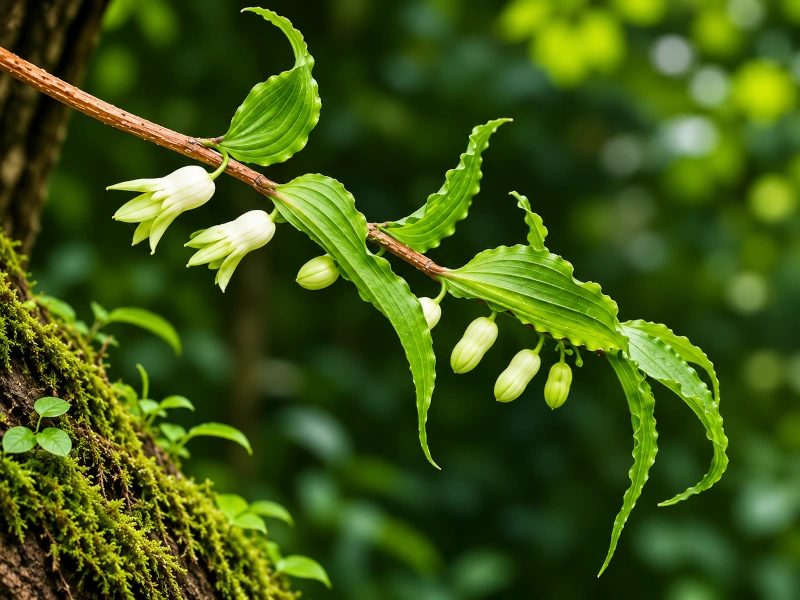
Scientists have discovered a new flowering plant species, Disporopsis crispata, in the remote high-altitude forests of Vijoynagar in Arunachal Pradesh’s Changlang district, marking the first recorded occurrence of the genus Disporopsis in India. The discovery expands the country’s documented botanical diversity and establishes a previously unrecognised geographical connection between the flora of India’s eastern Himalayas and the mountainous forests of neighbouring Myanmar.
The discovery was formally documented in the international botanical journal Phytotaxa on November 10, 2026. The research was conducted by an international team of botanists, including scientists associated with the Botanical Survey of India, Missouri Botanical Garden, New York Botanical Garden and Royal Botanic Garden Edinburgh. The findings were subsequently highlighted by Arunachal Pradesh Deputy Chief Minister Chowna Mein on November 12, who emphasised the ecological importance of the state’s forests.
Discovery in the Remote Forests of Vijoynagar
The newly identified plant was collected during a botanical exploration of Vijoynagar in Changlang district, a geographically remote region situated close to India’s international border with Myanmar.
Botanical Survey of India researcher Vinay Kumar Sahani collected flowering material in June 2026, providing the specimens necessary for detailed taxonomic examination.
The species was found growing at elevations between approximately 2,500 and 2,800 metres above sea level, particularly on damp slopes within temperate forest ecosystems dominated by mixed rhododendron and bamboo vegetation.
These high-altitude forests support a distinctive combination of Himalayan and Southeast Asian plant species, making them important locations for botanical exploration.
The identification of Disporopsis crispata is particularly significant because it introduces an entirely new plant genus into India’s documented flora rather than merely adding another species to an already recorded Indian genus.
A Previously Unrecorded Plant Genus in India
The genus Disporopsis belongs to the family Asparagaceae, within the subfamily Convallarioideae. Its members are perennial herbaceous plants occurring primarily in the forests of East and Southeast Asia.
Before the latest discovery, the genus was known principally from regions including China, Myanmar, Taiwan and the Philippines.
The identification of Disporopsis crispata in Arunachal Pradesh extends the known western distribution of the genus into Indian territory.
The finding also provides additional botanical evidence of the ecological relationship between northeastern India and the adjoining Indo-Burma biodiversity region.
The discovery illustrates the importance of continued botanical exploration in geographically isolated forest landscapes, where species may remain undocumented because of difficult terrain, limited accessibility and incomplete scientific collections.
Distinctive Crinkled Leaves and White-Green Flowers
The newly discovered species possesses several morphological features that distinguish it from other members of the genus.
Disporopsis crispata is a perennial herbaceous plant with reddish stems that generally grow between 30 and 80 centimetres in height. Its lance-shaped leaves measure approximately 5–15 centimetres in length.
The most distinctive feature is the strongly undulating or crinkled margins of its leaves, which provide the basis for its scientific name.
The species name crispata refers to the conspicuous crinkled or wavy edges of the leaves, a diagnostic characteristic used by researchers to distinguish the plant from related species.
The plant produces delicate white-and-green flowers, while its fruits are fleshy and white, typically containing between three and eight seeds.
According to the reported botanical observations, flowering occurs primarily during May and June, while fruiting has been recorded between July and December.
These morphological and reproductive characteristics contributed to the scientific identification and description of the species.
Historical Botanical Specimens from Myanmar Provide an Important Connection
An interesting aspect of the discovery is its connection with earlier botanical collections from Myanmar.
A specimen collected from the Kachin Hills of Myanmar in 1962 had previously attracted scientific attention but was initially associated with the genus Polygonatum.
The historical specimen lacked flowering material, limiting the ability of researchers to establish its precise taxonomic identity.
The collection of flowering specimens from Arunachal Pradesh in June 2026 provided additional morphological evidence that enabled scientists to examine the plant’s diagnostic characteristics and describe it as a distinct species.
The research consequently draws upon botanical material associated with both India and Myanmar.
The discovery demonstrates how modern field exploration, combined with the re-examination of historical herbarium collections, can resolve botanical identities that have remained uncertain for decades.
Herbarium collections preserve plant specimens for long-term scientific study, allowing researchers to compare newly collected material with historical records and reassess earlier classifications.
Scientific Collaboration Across International Botanical Institutions
The research was authored by Aaron Floden, Vinay Kumar Sahani, Kate E. Armstrong, Colin Pendry and Krishna Chowlu.
The authors are associated with several internationally recognised botanical research institutions, including the Missouri Botanical Garden in the United States, the Botanical Survey of India’s Arunachal Pradesh Regional Centre, the New York Botanical Garden and the Royal Botanic Garden Edinburgh.
Their findings were published in Phytotaxa, Volume 784, Issue 1, on November 10, 2026, under the research title A New Species of Disporopsis (Asparagaceae: Convallarioideae) from India and Myanmar.
The study provides the formal taxonomic description of the species, together with information on its geographical distribution, habitat, morphological characteristics and provisional conservation assessment.
The publication establishes the scientific record of the species and provides a reference for future botanical investigations involving the genus in northeastern India.
Conservation Concerns Surrounding the Newly Discovered Species
The discovery has also drawn attention to the conservation requirements of narrowly distributed plant species inhabiting remote Himalayan forest ecosystems.
Available field observations indicate that only a very small number of individuals of Disporopsis crispata have been documented in India.
Researchers have provisionally assessed the species as Data Deficient under IUCN conservation assessment criteria because the available information is insufficient to establish its population size, distribution and overall extinction risk reliably.
The limited number of recorded individuals does not necessarily establish that the species is on the verge of extinction, but it demonstrates the need for additional field surveys before its conservation status can be determined.
Its known habitat consists of damp temperate forest slopes supporting rhododendron and bamboo vegetation, conditions that may be sensitive to changes in forest cover and local environmental conditions.
Further botanical surveys in Arunachal Pradesh and adjoining regions of Myanmar would help researchers establish whether the species is confined to a small geographical area or occurs more widely in suitable forest habitats.
Arunachal Pradesh’s Importance in India’s Botanical Diversity
Arunachal Pradesh occupies an important position within India’s eastern Himalayan biodiversity landscape.
The state’s mountains, valleys and forest ecosystems encompass substantial variations in elevation, rainfall, temperature and vegetation, supporting a remarkable diversity of plant and animal life.
Its geographical position near the meeting zone of the eastern Himalayas and Indo-Burma region contributes to the presence of distinctive botanical communities.
The discovery of Disporopsis crispata adds to a continuing series of botanical findings from the state, including newly described flowering plants documented through field investigations by Indian researchers and collaborating scientific institutions.
Such discoveries are important not only for expanding the scientific inventory of India’s flora but also for improving understanding of plant evolution, geographical distribution and ecological relationships across international boundaries.
A New Addition to India’s Scientific Record
The formal description of Disporopsis crispata represents an important achievement in botanical taxonomy and the documentation of India’s natural heritage.
By recording the genus Disporopsis within India for the first time, the research expands the known geographical distribution of this group of plants and establishes an additional connection between the flora of northeastern India and neighbouring Southeast Asia.
The discovery also highlights the contribution of the Botanical Survey of India and international scientific collaboration in identifying plant species that remain poorly documented in remote forest habitats.
The recognition of Disporopsis crispata demonstrates that India’s eastern Himalayan forests continue to contain botanical diversity awaiting scientific documentation, reinforcing the importance of sustained field research, historical specimen analysis and habitat conservation.
You may also like
-
Critically Endangered Spoon-Billed Sandpiper Returns to Bengal Coast After 8,000-Km Migration from Russia
-
Assam Releases 240 Critically Endangered Black Softshell Turtle Hatchlings into Roumari Beel
-
Golden Rattlepod Flowers Transform Munnar’s Yellapetty Hills into a Sea of Yellow
-
Scientists Discover New Scorpion Species in Odisha’s Similipal Tiger Reserve
-
Rare Bird Sightings in Maharashtra Highlight Rich Biodiversity of Melghat Forests and Navi Mumbai Wetlands
