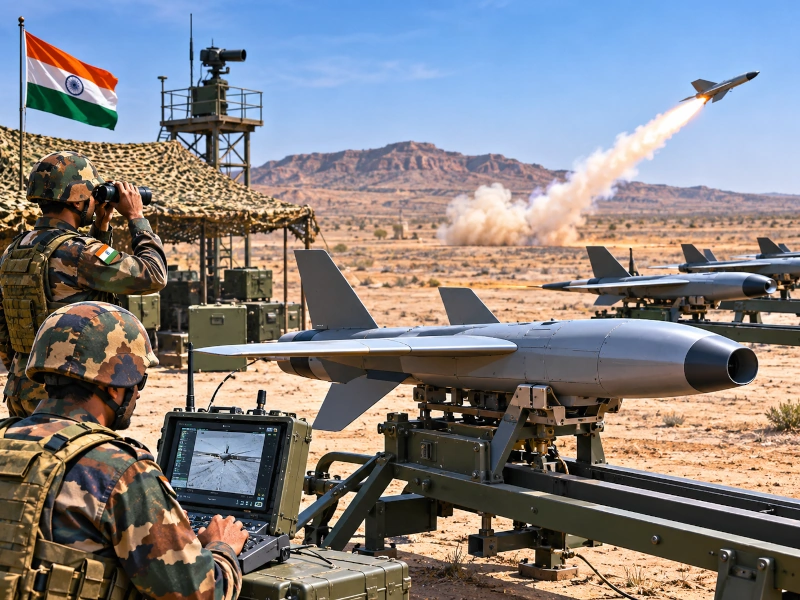
The Indian Army is preparing to conduct field trials of indigenous jet-powered kamikaze drones at the Pokhran Field Firing Range in Rajasthan as part of a major procurement initiative to strengthen its high-speed unmanned strike capabilities. The proposed programme, estimated at approximately ₹2,000 crore, involves the acquisition of 540 jet-powered kamikaze drones through the Fast Track Procurement (FTP) route.
According to defence industry reports published between November 10 and 13, 2026, the Army has shortlisted 11 Indian companies for the evaluation process. The trials are expected to assess competing indigenous platforms under field conditions, with particular emphasis on their suitability for rapid precision strikes and operations in contested environments.
The initiative forms part of the Indian Army’s broader efforts to incorporate advanced unmanned systems into its operational capabilities while encouraging the development and production of military technologies within India.
Defence Acquisition Council Approves Jet-Based Kamikaze Drone Programme
The procurement initiative follows the Defence Acquisition Council’s approval of a Jet-Based Kamikaze Drone System for the Indian Army on July 3, 2026. Chaired by Defence Minister Rajnath Singh, the council granted Acceptance of Necessity for several major defence acquisitions valued collectively at approximately ₹52,000 crore.
The Ministry of Defence specifically identified jet-based kamikaze drones among the systems approved for the Army. According to the ministry, these drones are intended to provide improved electronic warfare capability, greater lethality and survivability, and cost-effective operational performance.
The approval established the administrative basis for pursuing the acquisition. However, Acceptance of Necessity represents an in-principle procurement clearance rather than a final purchase agreement or confirmation of operational induction.
Eleven Indian Companies Reportedly Qualify for Field Evaluation
The procurement programme has reportedly attracted substantial participation from India’s domestic defence industry. According to Chakra News, which reported the development on November 10, approximately 60 companies responded to the Army’s Request for Information issued in July 2026. Of these, 18 subsequently submitted bids, while 11 reportedly qualified for the next stage of evaluation.
Companies identified in the reporting include Bharat Forge in association with VEDA Aeronautics, Adani Defence, NIBE, SMPP in association with NewSpace Research and Technologies, Tonbo, Munitions India Limited and Apollo Micro Systems. The complete list of participating companies and their qualification status has not been independently confirmed through an official Army announcement.
The reported evaluation process is intended to identify indigenous systems capable of meeting the Army’s requirements for high-speed unmanned strike operations. The proposed acquisition of 540 drones would represent a substantial addition to the Army’s inventory of expendable precision-strike platforms, subject to successful trials, procurement approvals and final contracting.
Jet Propulsion Provides Higher-Speed Strike Capability
Jet-powered kamikaze drones differ from conventional propeller-driven loitering munitions primarily in their propulsion systems and potential operating speeds. While many propeller-driven systems prioritise endurance and prolonged surveillance over a target area, jet-powered platforms can achieve substantially higher speeds, reducing the time required to reach designated targets.
Reports concerning the Army’s proposed programme indicate that some of the indigenous platforms under consideration are designed to achieve speeds of approximately 450 kilometres per hour. Actual performance will depend on the selected system’s configuration, payload, propulsion characteristics and operating conditions.
The principal military advantage of jet-powered kamikaze drones lies in their ability to conduct rapid strikes while reducing the reaction time available to opposing air defence systems. Their higher speeds can make detection, tracking and interception more demanding, particularly when employed against time-sensitive targets.
Unlike reusable unmanned combat aircraft, kamikaze drones are designed to strike their targets directly, with the air vehicle and its explosive payload expended during the attack. Depending on their design, such systems can be employed against military infrastructure, equipment and other designated battlefield targets.
Pokhran Trials to Assess Operational Suitability
The Pokhran Field Firing Range provides an established environment for evaluating military equipment under demanding field conditions. The facility has previously hosted demonstrations and trials involving artillery systems, missiles, armoured platforms and emerging defence technologies.
The forthcoming evaluations are expected to examine the operational suitability of the competing jet-powered drone systems. Relevant parameters for such an assessment include flight performance, navigation accuracy, target engagement, communications reliability, payload effectiveness and integration with ground-based control arrangements.
For the Indian Army, the significance of these trials extends beyond the performance of individual drones to the wider requirement for integrating high-speed unmanned precision-strike systems into battlefield operations. Successful evaluation would help establish which indigenous platforms are suitable for progressing through the remaining procurement stages.
Although media reports indicate that trials were scheduled for the week of November 9–15, 2026, an official announcement confirming their commencement or completion has not yet been established.
Indigenous Defence Industry Expands Unmanned Strike Capabilities
The proposed acquisition reflects the growing involvement of Indian private-sector defence manufacturers, startups and public-sector enterprises in developing unmanned military technologies.
Domestic companies are working on increasingly sophisticated loitering munitions incorporating propulsion systems, navigation equipment, flight-control technologies, mission-planning capabilities and specialised payloads. Jet-powered designs represent an additional category within this expanding ecosystem.
India has also pursued indigenous unmanned systems through military technology demonstrations, innovation programmes and competitive procurement initiatives. These efforts seek to develop domestic capabilities across the wider unmanned aviation supply chain rather than relying exclusively on imported platforms.
The participation of multiple Indian manufacturers in the proposed competition is significant because it allows the Army to evaluate alternative domestic designs while supporting the development of indigenous high-speed unmanned strike technologies.
The procurement process also provides an opportunity for manufacturers to demonstrate the maturity of their systems under military evaluation conditions, although participation in trials does not guarantee selection or future production orders.
Strengthening the Indian Army’s Precision-Strike Capabilities
The growing importance of unmanned aerial systems in modern warfare has increased military interest in platforms capable of combining precision, speed and operational flexibility. Loitering munitions offer an additional strike option between conventional artillery, guided missiles and reusable unmanned aircraft.
Jet-powered systems are particularly relevant where rapid engagement is required and where slower unmanned aircraft may face increased exposure to hostile countermeasures.
The proposed 540-drone acquisition would strengthen the Indian Army’s ability to field high-speed expendable strike platforms alongside its existing conventional and unmanned weapons. The operational benefits would ultimately depend on the capabilities demonstrated during trials, the systems selected and their integration into Army formations.
The Ministry of Defence’s July 2026 approval confirms the government’s intention to pursue this category of weapon system. The subsequent reporting on the Pokhran evaluations indicates that the programme is moving towards competitive assessment of indigenous platforms.
Final procurement quantities, contract values, selected manufacturers and delivery schedules remain subject to confirmation through the formal acquisition process.
You may also like
-
India and Indonesia Strengthen Counter-Terrorism Cooperation at Seventh Joint Working Group Meeting
-
Russian Pacific Fleet Warships Arrive in Kochi, Strengthening India–Russia Naval Engagement
-
Astra Microwave Advances Indigenous Virupaksha Radar Programme with Prototype Hardware Delivery to DRDO
-
ISRO Successfully Tests Upgraded PSLV Third Stage at Sriharikota
-
XINFINITI Aerospace Advances Indian Navy Chetak Helicopter-to-Drone Conversion Project
