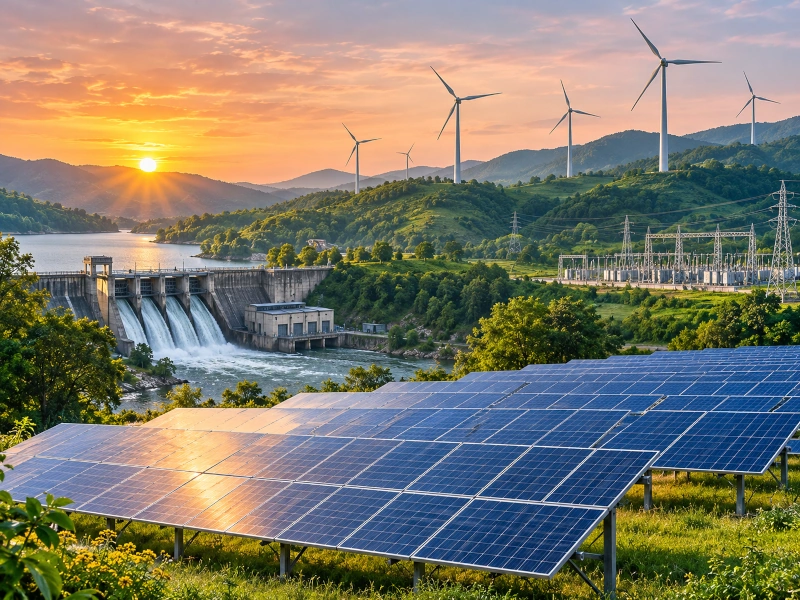
India’s renewable energy sector has recorded substantial growth, with installed solar power capacity reaching approximately 175 GW as of October 31, 2026, compared with just 2.8 GW in 2014. The country’s total installed electricity generation capacity has also increased from approximately 249 GW in 2014 to around 560 GW, reflecting the expansion of renewable and conventional power infrastructure across the country. India now ranks third globally in installed renewable energy capacity, according to a factsheet released by the Press Information Bureau on November 13, 2026.
The expansion has been supported by investments in solar power, wind energy, hydropower, bioenergy and emerging clean energy technologies. The government reported that India’s renewable energy sector attracted US$63.7 billion in investments between July 2024 and June 2026, demonstrating the scale of capital deployment associated with the country’s energy transition. The growth of renewable energy infrastructure has also been accompanied by increased domestic manufacturing of solar equipment and wind turbines, alongside initiatives supporting energy storage, green hydrogen and the modernisation of electricity transmission systems.
India’s Installed Electricity Generation Capacity Reaches 560 GW
India’s total installed electricity generation capacity has more than doubled over the past twelve years, increasing from approximately 249 GW in 2014 to around 560 GW in October 2026. The expansion reflects the development of additional electricity generation infrastructure across different technologies, with renewable energy accounting for an increasing proportion of the country’s installed capacity.
The government’s latest assessment highlights the increasing contribution of solar and wind power to India’s electricity infrastructure, alongside established sources such as hydropower and bioenergy. The expansion of non-fossil energy capacity is also linked to India’s national objective of achieving 500 GW of installed non-fossil electricity generation capacity by 2030. This objective includes renewable energy technologies as well as nuclear power, making it broader than a target restricted exclusively to renewable energy sources.
The increase in installed non-fossil generating capacity represents a structural transformation in India’s electricity infrastructure. However, installed capacity represents the rated output of electricity generation facilities rather than the actual amount of electricity produced. Solar and wind installations generate electricity according to prevailing weather conditions, while hydropower output depends on water availability and operational requirements. Consequently, the expansion of renewable capacity is being accompanied by investments in electricity storage, transmission networks and grid management systems.
Solar Power Capacity Expands from 2.8 GW to Nearly 175 GW
Solar energy has emerged as one of the principal drivers of India’s renewable energy expansion, with installed capacity increasing from 2.8 GW in 2014 to approximately 175 GW by October 31, 2026. This represents an increase of more than sixty times over the twelve-year period and reflects the development of large solar parks, utility-scale projects, rooftop installations and distributed electricity generation facilities across the country.
India’s solar power expansion has also strengthened its position in the international renewable energy market. According to the government’s factsheet, India became the world’s second-largest market for new solar capacity additions in 2025, installing more than 37 GW during the year, compared with approximately 34 GW added by the United States. This growth was supported by investments from public and private sector developers, increasing domestic demand for clean electricity and government programmes encouraging solar power adoption.
The development of solar infrastructure has been accompanied by efforts to expand domestic manufacturing of photovoltaic modules, associated electrical equipment and other components required for renewable electricity projects. The rapid increase in solar generating capacity has made solar power a major component of India’s energy development strategy, while creating opportunities for manufacturers, engineering companies, installation service providers and technology developers.
PM Surya Ghar Scheme Benefits Over 65 Lakh Households
The PM Surya Ghar: Muft Bijli Yojana has become an important component of India’s rooftop solar development programme. Launched in February 2024 with an approved financial outlay of ₹75,021 crore, the scheme aims to facilitate rooftop solar installations for one crore households. According to the latest government figures, 65.26 lakh households were benefiting from rooftop solar installations as of November 2, 2026, reflecting the expansion of household-level electricity generation.
The government reported that approximately ₹35,800 crore in subsidies had been transferred to beneficiaries under the programme, while nearly 21 lakh households had received zero electricity bills up to October 2026. Rooftop solar capacity commissioned under the scheme had reached approximately 19.1 GW, contributing to the growth of distributed electricity generation across residential areas.
Rooftop solar installations allow households to generate electricity directly from sunlight, reducing their dependence on purchased electricity during periods of solar generation. The programme also supports domestic solar equipment manufacturing and creates opportunities for electricians, installers, maintenance technicians and small businesses associated with renewable energy infrastructure. By expanding access to distributed power generation, the initiative complements the development of large utility-scale solar projects.
Government Approves ₹5,070 Crore Floating Solar Programme
India has expanded its solar energy development strategy to include floating photovoltaic installations on suitable water bodies. The government approved the Pradhan Mantri Surya Sarovar Yojana on July 31, 2026, with an estimated financial outlay of ₹5,070 crore, targeting the development of 5,000 MW of floating solar power capacity supported by co-located energy storage systems.
The programme provides for storage infrastructure with a minimum discharge duration of two hours, corresponding to an aggregate storage requirement of approximately 10,000 MWh. Projects are scheduled to be sanctioned between FY 2026–27 and FY 2030–31, with implementation expected to proceed through the designated development framework.
Floating solar technology involves installing photovoltaic panels on structures positioned over reservoirs and other suitable water bodies. Such projects can provide an alternative to land-based solar development where appropriate water surfaces are available. The inclusion of energy storage is intended to strengthen the operational flexibility of these installations by allowing electricity generated during periods of sunlight to be stored and supplied when required. The proposed 5,000 MW represents a programme target rather than generating capacity already commissioned.
Wind Power Capacity Reaches 59.20 GW
India’s installed wind energy capacity reached 59.20 GW as of October 29, 2026, maintaining the country’s position as the world’s fourth-largest wind power market in terms of installed capacity. The sector recorded its highest annual capacity addition during FY 2025–26, installing 6.05 GW of new wind power capacity, an increase of approximately 46% compared with the previous financial year.
According to the government, approximately 28 GW of additional wind power capacity was under implementation at the time of the factsheet. The expansion is being supported by new wind energy projects, investments in electricity transmission infrastructure and the development of domestic manufacturing capabilities.
India’s annual wind turbine manufacturing capacity has increased from approximately 10 GW in 2014 to around 24 GW by March 2026. The domestic industry has achieved an estimated 70–80% indigenisation across important turbine components, reflecting the development of engineering and manufacturing capabilities within the country. The expansion of domestic wind turbine manufacturing connects India’s renewable energy development with industrial production, equipment manufacturing and technological capabilities.
The government has also approved a ₹7,453 crore viability gap funding scheme to support the development of 1 GW of offshore wind energy projects. Approved in June 2024, the scheme is intended to encourage the establishment of offshore wind infrastructure and support the development of an emerging segment of India’s renewable energy industry.
Hydropower Capacity Reaches 57.49 GW
Hydropower continues to contribute significantly to India’s renewable electricity infrastructure, with cumulative installed capacity reaching 57.49 GW as of October 29, 2026, including both large and small hydroelectric projects. Unlike solar and wind generation, reservoir-based hydropower facilities can provide greater operational flexibility by adjusting electricity output according to demand and water availability.
This flexibility is particularly relevant as India expands variable renewable energy capacity. Hydropower facilities capable of adjusting their output can contribute to balancing electricity supply and demand, while pumped-storage hydropower can support the storage and subsequent release of energy when electricity requirements increase.
In March 2026, the government approved the Small Hydro Power Development Scheme for FY 2026–27 to FY 2030–31, with a financial outlay of ₹2,584.60 crore. The programme aims to add approximately 1,500 MW of small hydropower capacity through projects ranging from 1 MW to 25 MW. Particular attention is being directed towards hilly regions and northeastern states, where geographical conditions provide opportunities for smaller hydropower installations.
Bioenergy Capacity Expands to 11.75 GW
India’s installed biopower capacity reached 11.75 GW as of October 29, 2026, reflecting the contribution of biomass, agricultural residues, organic waste and other biological materials to the country’s electricity generation infrastructure. The sector includes bagasse-based cogeneration, non-bagasse biomass projects, waste-to-energy installations and other bioenergy applications.
According to government figures, bagasse-based cogeneration capacity stood at approximately 9,821 MW as of September 30, 2026, while non-bagasse biomass cogeneration accounted for another 1,048 MW. Grid-connected waste-to-energy capacity reached 324.24 MW, with off-grid installations contributing approximately 554.16 MW.
The compressed biogas sector has also recorded growth. As of November 2, 2026, 839 compressed biogas plants had been registered, of which 210 had been commissioned and 255 were under construction. These facilities are intended to convert suitable organic materials into biogas that can be upgraded for use as compressed biogas in transportation, industrial and other energy applications.
The government approved the GOBARdhan National Circular Bioenergy Scheme on August 6, 2026, with an outlay of ₹23,731 crore for FY 2026–27 to FY 2035–36. The programme is intended to expand compressed biogas production, encourage productive utilisation of agricultural and organic waste, and support circular bioenergy development. By converting biological waste into useful energy products, these initiatives connect renewable energy generation with waste management and agricultural resource utilisation.
National Green Hydrogen Mission Supports Industrial Energy Transition
India’s renewable energy strategy includes the development of green hydrogen as an alternative fuel and industrial feedstock. The National Green Hydrogen Mission, approved in January 2023 with a financial outlay of ₹19,744 crore, targets annual green hydrogen production of 5 million metric tonnes by 2030, supported by renewable electricity, electrolyser manufacturing and associated hydrogen infrastructure.
According to the November 2026 factsheet, Indian companies have signed green hydrogen offtake commitments totalling approximately 5.5 lakh tonnes per annum since 2023. During 2026, another 18 offtake agreements covering more than four lakh tonnes per annum of green hydrogen equivalent were signed. More than 70% of the cumulative offtake commitments have been earmarked for exports, indicating the international commercial orientation of several proposed projects.
The government also reported that approximately 8,000 tonnes per annum of green hydrogen production capacity had been commissioned by February 2026. This figure represents operational capacity and is distinct from announced projects or contracted future supplies. Green hydrogen is being explored for applications in fertiliser production, petroleum refining, steel manufacturing and other industries where replacing conventional fuels and feedstocks can be technically challenging.
Geothermal Energy Identified as an Emerging Resource
The government has also identified geothermal energy as a potential contributor to India’s future energy development. The National Policy on Geothermal Energy, notified on September 15, 2025, provides a framework for exploring, developing and utilising geothermal resources across the country.
According to the Geological Survey of India, India possesses an estimated geothermal potential of approximately 10,600 MW, based on investigations involving 381 hot springs and the identification of 42 promising geothermal manifestations. These estimates represent potential resources rather than installed electricity generation capacity.
Five geothermal-related projects were sanctioned during July and August 2025, including a pilot production plant, resource assessment initiatives and a solar-geothermal hybrid project. These activities are intended to examine the technical characteristics and economic feasibility of geothermal energy applications under Indian geological and environmental conditions.
Geothermal energy differs from solar and wind power because suitable geothermal resources can provide relatively continuous energy output. However, commercial development depends on the availability of accessible geothermal reservoirs, suitable geological conditions and economically viable extraction technologies.
Renewable Energy Investments Reach US$63.7 Billion
India’s renewable energy sector attracted investments worth approximately US$63.7 billion between July 2024 and June 2026, according to the PIB factsheet. These investments reflect the continuing expansion of electricity generation projects, manufacturing facilities and supporting infrastructure associated with the country’s clean energy transition.
The growth of renewable energy infrastructure has created demand across several industrial sectors, including electrical equipment, solar photovoltaic manufacturing, wind turbine production, power electronics, transmission systems and energy storage technologies. Domestic manufacturing has consequently become an important component of India’s renewable energy development strategy, complementing the deployment of new generation capacity.
The Bharat Renewable Energy Summit and Expo 2026, held in New Delhi from November 2 to 5, brought together policymakers, manufacturers, investors, startups, research institutions and technology developers. The event included representatives from international partners and 13 Indian states and Union Territories, alongside more than 400 manufacturers, startups and research organisations. Discussions addressed renewable energy financing, domestic manufacturing, electricity storage, technological innovation and workforce development.
India Advances Towards Its 500 GW Non-Fossil Energy Target
India has established a national objective of achieving 500 GW of installed non-fossil electricity generation capacity by 2030. The target encompasses solar, wind, hydropower, nuclear energy and other qualifying non-fossil technologies, reflecting the government’s broader strategy to diversify the country’s electricity generation infrastructure.
The expansion of solar and wind installations has increased the contribution of renewable sources to India’s installed capacity. However, integrating substantial quantities of variable renewable power also requires the development of transmission infrastructure, electricity storage systems and flexible generation resources capable of maintaining reliable electricity supply.
The government has therefore pursued renewable energy development alongside initiatives covering grid infrastructure, energy storage, domestic manufacturing and emerging clean energy technologies. These supporting investments are important for ensuring that additional generating capacity can be effectively integrated into the electricity system and delivered to consumers.
India’s energy transition is being shaped not only by the commissioning of renewable power plants but also by the expansion of industrial capabilities and infrastructure required to support a more diversified electricity system.
Renewable Energy Becomes a Major Component of India’s Power Infrastructure
The November 2026 renewable energy factsheet documents the substantial expansion of India’s electricity infrastructure over the preceding twelve years. Solar power capacity has increased from 2.8 GW in 2014 to approximately 175 GW, while wind power capacity has reached 59.20 GW. Hydropower contributes another 57.49 GW, and installed biopower capacity stands at 11.75 GW.
The expansion has been accompanied by the development of household rooftop solar installations, floating solar programmes, compressed biogas facilities, green hydrogen projects and geothermal resource investigations. Domestic manufacturing of renewable energy equipment has also increased, supporting the growth of India’s clean energy supply chain.
With total installed electricity generation capacity reaching approximately 560 GW, India’s power sector is undergoing a significant transformation in the composition of its generating infrastructure. Continued development of energy storage, transmission networks and grid flexibility will remain important as additional renewable capacity is brought into operation.
India’s renewable energy expansion represents a major development in the country’s energy infrastructure, combining large-scale solar and wind power deployment with domestic manufacturing, technological innovation and a growing range of non-fossil energy solutions.
You may also like
-
India Advances ₹68,816 Crore Ultra-High-Voltage Transmission Corridor to Strengthen National Power Grid
-
India’s Exports Rise 16.66% to $568.84 Billion During April–October 2026–27
-
PM Modi Inaugurates India’s First LED Dome Planetarium at Mysuru
-
Lakadong Turmeric of Meghalaya: The GI-Tagged Heritage of the Jaintia Hills’ Golden Spice
-
ISRO Successfully Tests Upgraded PSLV Third Stage at Sriharikota
