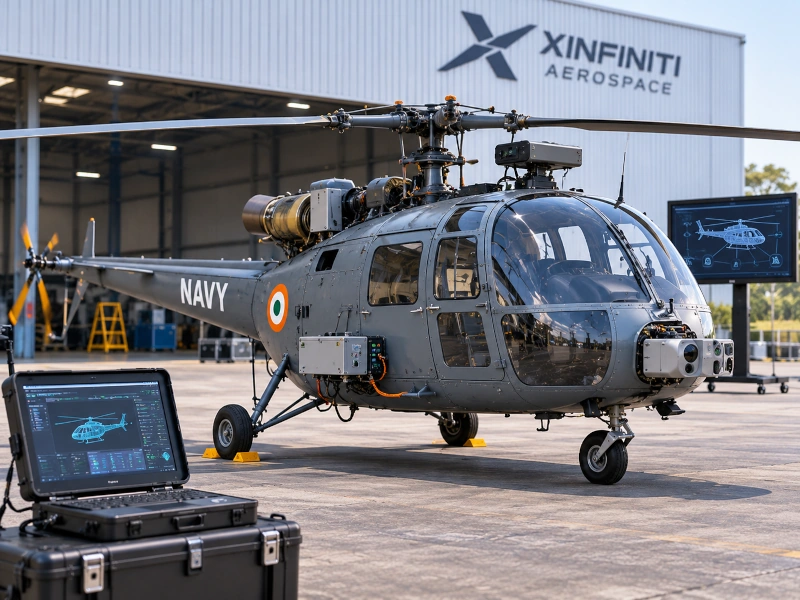
Bengaluru-based defence technology company XINFINITI Aerospace is developing an indigenous system to convert the Indian Navy’s Chetak helicopters into autonomous unmanned aerial platforms under the Innovations for Defence Excellence (iDEX) initiative. The project, known as the Naval Chetak Autonomous System (NCAS), seeks to transform an existing crewed helicopter into an aircraft capable of operating without an onboard pilot.
The programme forms part of the company’s Manned-to-Uncrewed Conversion (M2UC) technology development initiative, which focuses on integrating autonomous flight capabilities into existing aircraft platforms. XINFINITI Aerospace has confirmed that work on the Naval Chetak Autonomous System is underway in cooperation with the Indian Navy under the iDEX framework.
The development represents an indigenous aerospace engineering effort focused on converting an established military helicopter platform into an unmanned system rather than designing an entirely new aircraft.
Naval Chetak Autonomous System Under Development
The Naval Chetak Autonomous System is being developed around the Indian Navy’s Chetak helicopter, a rotary-wing aircraft based on the French Aérospatiale Alouette III design and manufactured in India by Hindustan Aeronautics Limited.
The Chetak has served the Indian Armed Forces in utility, training, reconnaissance and maritime support roles. Its established airframe and extensive operational history provide the foundation for XINFINITI Aerospace’s proposed autonomous conversion programme.
According to the company, NCAS is its principal manned-to-uncrewed conversion project. The initiative involves adapting an existing helicopter platform for unmanned operation through aerospace engineering, systems integration and flight-control technologies.
Unlike conventional unmanned aerial vehicle development programmes, which generally begin with the design of a purpose-built aircraft, the M2UC approach is based on modifying an existing aviation platform.
The project is intended to combine the established characteristics of the Chetak helicopter with new systems required for uncrewed aircraft operation.
Developing Manned-to-Uncrewed Conversion Technology
XINFINITI Aerospace identifies aircraft conversion, systems integration and flight testing among its principal engineering capabilities. The company is developing technologies intended to support the transformation of crewed aviation platforms into unmanned aircraft.
The M2UC programme requires the integration of aircraft control systems, associated electronics and equipment supporting uncrewed operation. Such conversions also involve engineering considerations concerning aircraft stability, control, system reliability and airworthiness.
The company’s broader development activities encompass technology design, aircraft modification, integration, certification support and flight testing.
XINFINITI Aerospace states that its engineering approach covers the progression of technologies from early development through integration, qualification and flight testing. The company also provides assistance with airworthiness certification and quality assurance requirements associated with military aviation systems.
Its facilities include design and management offices in Bengaluru’s New Thippasandra area, together with a workshop and aircraft hangar near Bengaluru Airport, where conversion, integration and testing activities are undertaken.
These facilities support the company’s wider aerospace engineering activities, including its manned-to-uncrewed conversion programme.
Ground Testing and Development Activities
The Naval Chetak Autonomous System has progressed into an active development programme, with XINFINITI Aerospace identifying NCAS as one of its ongoing projects with the Indian Navy.
The company has also published photographs of helicopter test-bed activities and flight trials associated with its wider aerospace development work. These activities demonstrate the company’s engagement in practical aircraft testing, although they do not independently establish that an autonomously converted naval Chetak has completed an unmanned flight.
The NCAS programme involves adapting a helicopter originally designed for crewed operations into a platform capable of functioning without an onboard pilot.
Aircraft conversion of this nature requires the integration and validation of flight-control equipment, communication systems and supporting onboard technologies before the modified platform can undergo the necessary qualification procedures.
XINFINITI Aerospace has not publicly disclosed complete technical specifications for the autonomous Chetak, including its final payload capacity, endurance, autonomous flight-control architecture or operational performance.
The company’s official project information confirms ongoing development but does not announce the successful completion of an autonomous NCAS flight or the operational induction of the converted helicopter.
Potential Applications in Naval Operations
The development of an unmanned version of the Chetak helicopter is relevant to the Indian Navy’s wider interest in autonomous aviation technologies.
Conventional helicopters provide vertical take-off and landing capabilities that allow them to operate from restricted landing areas and naval platforms. Adapting an existing helicopter design for unmanned operation offers a potential approach to employing rotary-wing aircraft without placing an aircrew onboard.
Autonomous rotary-wing systems can be developed for applications such as logistics support, aerial observation and missions where the absence of an onboard crew may be advantageous.
However, the specific operational roles, mission equipment and performance requirements of the Naval Chetak Autonomous System have not been publicly detailed by XINFINITI Aerospace.
The company’s current programme is therefore focused on developing and demonstrating the conversion technology rather than an officially announced operational deployment.
Army Chetak Autonomous System Forms Part of Wider Development Programme
In addition to NCAS, XINFINITI Aerospace has identified an Army Chetak Autonomous System (ACAS) within its Manned-to-Uncrewed Conversion portfolio.
The company’s official project documentation lists both NCAS and ACAS under its aircraft conversion activities, indicating its interest in adapting the underlying technology for different military aviation requirements.
While NCAS is specifically associated with ongoing cooperation with the Indian Navy, the company’s published information does not establish equivalent procurement or operational milestones for the Army variant.
The development portfolio reflects an approach centred on upgrading existing platforms through advanced engineering, systems integration and autonomous technologies.
XINFINITI Aerospace has also identified opportunities to extend its broader conversion expertise beyond rotary-wing aircraft, although individual projects remain subject to separate technical development and validation requirements.
XINFINITI Aerospace Expands Indigenous Naval Aviation Technologies
The Chetak conversion initiative forms part of a wider portfolio of defence aviation projects being undertaken by XINFINITI Aerospace in cooperation with the Indian Navy.
Among these is the Helicopter Emergency Flotation System (HEFS), developed to improve aircraft safety during emergency water landings. The system is intended to provide additional flotation capability to helicopters operating over maritime environments.
At the Indian Navy’s Swavlamban 2026 innovation and indigenisation event in New Delhi, XINFINITI Aerospace received a Certificate of Appreciation from Defence Minister Rajnath Singh for developing the indigenous Helicopter Emergency Flotation System under the iDEX initiative.
The company has also developed the Drone Inspector programme, associated with the Naval Aircraft Automated Inspection System (NAAIS). The initiative focuses on employing unmanned inspection technology to examine aircraft surfaces and support maintenance activities.
Together, the Naval Chetak Autonomous System, Helicopter Emergency Flotation System and Naval Aircraft Automated Inspection System represent different applications of indigenous aerospace engineering involving aircraft conversion, operational safety and maintenance technology.
Indigenous Defence Innovation Through iDEX
The Innovations for Defence Excellence initiative was established by the Ministry of Defence to encourage the participation of startups, MSMEs, individual innovators and other technology developers in addressing defence requirements.
The programme provides a framework through which emerging Indian companies can develop solutions for technical challenges identified by the Armed Forces.
XINFINITI Aerospace’s cooperation with the Indian Navy under iDEX illustrates the involvement of specialised private-sector engineering companies in indigenous defence aviation development.
Incorporated in 2024, XINFINITI Aerospace brings together aviation and engineering professionals with experience in the Indian Armed Forces. Its activities cover aircraft modifications, autonomous systems, engineering integration, flight testing and certification support.
The company’s leadership includes personnel with backgrounds in naval, army and air force aviation, while its founder and Chief Executive Officer, Vishal Kumar Verma, also serves as Chief Test Pilot.
Towards an Indigenous Unmanned Helicopter Capability
The Naval Chetak Autonomous System represents an ongoing Indian effort to develop technologies capable of converting an established military helicopter into an unmanned aerial platform.
By focusing on an existing aircraft design, XINFINITI Aerospace is pursuing an alternative approach to autonomous rotary-wing development, combining conventional helicopter engineering with emerging uncrewed aviation technologies.
The company’s official disclosures establish that the programme is underway under the iDEX framework, supported by its capabilities in aerospace design, integration, certification assistance and flight testing.
The successful demonstration of autonomous flight, completion of qualification requirements and potential operational adoption remain separate milestones that have not been confirmed in the company’s publicly available project information.
The NCAS initiative nevertheless adds to India’s expanding indigenous defence technology ecosystem, where private aerospace companies are developing specialised capabilities in autonomous aircraft, aviation safety systems and military engineering.
You may also like
-
Kalyani Strategic Systems Unveils Indigenous 120 mm Vehicle-Mounted Rapid Attack Mortar System
-
IIT Madras Develops SEANAV Digital Twin Platform for Autonomous Maritime Navigation
-
Naval Group Supports Indian Navy’s Kalvari-Class Submarine Sustainment and AIP Seminar
-
Cochin Shipyard and SFO Technologies Develop India’s First Indigenous Hybrid Laser Arc Welding System
-
BSF Issues ₹49.3 Lakh Tender for Drone Simulation and Maintenance Facility in Bengaluru
