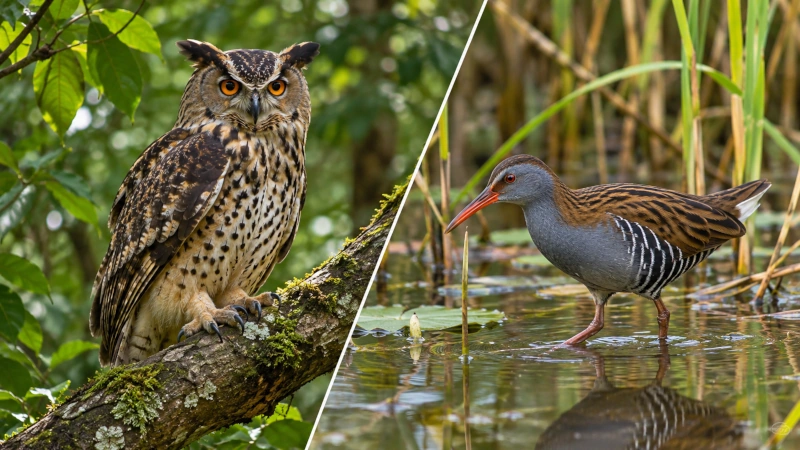
Two unusual bird sightings in Maharashtra have drawn attention to the state’s remarkable avian biodiversity, with a rare Spot-bellied Eagle-Owl recorded in Melghat Tiger Reserve and an elusive migratory Water Rail observed in the wetlands of Navi Mumbai. The sightings, reported on 11 November 2026, highlight the ecological importance of both protected forest landscapes and urban wetlands in supporting uncommon and difficult-to-observe bird species.
The Spot-bellied Eagle-Owl was documented in the Semadoh area of Melghat Tiger Reserve in Amravati district, marking its first reported record within the reserve. Meanwhile, a Water Rail was photographed at the TS Chanakya wetlands in Nerul, Navi Mumbai, attracting attention from birdwatchers because of the species’ infrequent appearances in the region.
Although the two birds inhabit distinctly different ecological environments, their observations demonstrate the importance of habitat conservation, biodiversity monitoring and the growing contribution of local naturalists and wildlife photographers to documenting India’s birdlife.
Rare Spot-bellied Eagle-Owl Recorded in Melghat Tiger Reserve
A rare Spot-bellied Eagle-Owl (Ketupa nipalensis), also known as the Forest Eagle-Owl, has been recorded for the first time in Maharashtra’s Melghat Tiger Reserve. The bird was observed in the Semadoh area of the Sipna forest landscape, adding an important species record to the reserve’s documented avian diversity.
The sighting was made by local nature guides working in the Semadoh tourism zone. The observers included Bhola Babu Mavaskar, Avinash H. Masram, Ashok S. Mavaskar and Akshay Bhola Mavaskar, whose knowledge of the forest and interest in bird identification contributed to documenting the unusual occurrence.
The Spot-bellied Eagle-Owl is a large, predominantly nocturnal bird of prey associated with forest habitats across parts of the Indian subcontinent and Southeast Asia. Its distinctive physical features include prominent ear tufts, powerful talons, a large rounded head and characteristic markings on its underparts.
The species is generally associated with dense forests, wooded valleys and habitats offering suitable roosting locations and adequate prey availability. Its secretive behaviour and preference for forested environments can make it difficult to observe, even in areas where it occurs.
The Melghat sighting has attracted particular interest because records of the species from the reserve have been limited. Although the owl has previously been documented in other parts of central India, including the Pench landscape, its observation at Semadoh provides additional information about its regional occurrence.
Ecological Importance of the Spot-bellied Eagle-Owl
The Spot-bellied Eagle-Owl is among the larger owl species found in Asia, with adults generally measuring approximately 50–65 centimetres in length. As a nocturnal predator, it feeds on a variety of animals, including small mammals, birds and other vertebrates.
Owls perform an important ecological function by regulating populations of prey species within forest ecosystems. Their presence contributes to the complex relationships between predators and prey that help maintain ecological balance.
The Spot-bellied Eagle-Owl’s dependence on suitable forest habitat also makes observations of the species valuable for understanding regional biodiversity and habitat connectivity.
Melghat Tiger Reserve, situated within the Satpura hill ranges of Maharashtra, supports a wide variety of wildlife, including tigers, leopards, sloth bears, deer, reptiles and numerous resident and migratory bird species.
The reserve is particularly important for bird conservation because it supports the endangered Forest Owlet (Athene blewitti), a species that was rediscovered in 1997 after remaining unrecorded for more than a century.
The newly reported Spot-bellied Eagle-Owl sighting further highlights Melghat’s significance as a habitat for forest-dependent birds and reinforces the importance of continued biodiversity surveys in the Satpura landscape.
Rare Migratory Water Rail Spotted in Navi Mumbai
In another notable development, a Water Rail (Rallus aquaticus) was spotted at the TS Chanakya wetlands near Palm Beach Road in Nerul, Navi Mumbai, on 10 November 2026.
The elusive bird was observed and photographed by wildlife photographer Yash Shetty, providing a documented record of its presence in the wetland.
The sighting generated interest among birdwatchers because the Water Rail is rarely encountered in the open and is an uncommon visitor to the region. According to local observations, the species had not been recorded at the particular wetland for approximately eight years.
The Water Rail is a secretive bird associated with freshwater wetlands, marshes and reed-covered habitats. It is recognised by its relatively long reddish bill, slate-grey face and underparts, brown upperparts with dark streaking, and distinctive barred flanks.
Unlike many conspicuous waterbirds, the Water Rail spends much of its time concealed within dense wetland vegetation. Its slender body allows it to move through reeds and aquatic plants while searching for food.
The species feeds on aquatic invertebrates, insects, small molluscs and other available food sources. Its dependence on vegetated wetland habitats makes the preservation of marshes and reedbeds particularly important.
Navi Mumbai Wetlands Support Migratory Bird Diversity
The TS Chanakya wetlands form part of the wider network of coastal and inland wetland habitats in Navi Mumbai that provide feeding, resting and seasonal refuge areas for numerous bird species.
During the winter migration season, wetlands across the Mumbai metropolitan region attract a variety of waterbirds, shorebirds and other migratory species. These habitats provide resources for birds moving across extensive migration routes connecting different parts of Asia.
The presence of the Water Rail illustrates the ecological importance of retaining dense wetland vegetation alongside open water and mudflat habitats. While larger birds such as flamingos, ducks and waders are often more visible, smaller and secretive species depend on less conspicuous habitat features.
Wetlands such as TS Chanakya, Talawe and other waterbodies around Navi Mumbai contribute to the region’s biodiversity by supporting birds, aquatic organisms and other wildlife.
However, urban wetlands face continuing pressures from land-use changes, habitat fragmentation, pollution and alterations to natural water movement. Changes in vegetation and water levels can affect the availability of suitable feeding and sheltering areas for wetland-dependent birds.
The Water Rail sighting therefore reinforces the importance of protecting the ecological characteristics of these habitats rather than considering wetlands merely as open waterbodies.
Local Naturalists Play an Important Role in Biodiversity Documentation
Both sightings demonstrate the contribution of local nature guides, birdwatchers and wildlife photographers to biodiversity documentation.
In Melghat, the Spot-bellied Eagle-Owl was recorded by nature guides familiar with the reserve’s terrain, wildlife movements and forest habitats. Their observation has provided additional information about a species that can remain undetected because of its nocturnal and secretive behaviour.
Similarly, the Water Rail sighting in Navi Mumbai was documented through the efforts of a wildlife photographer monitoring bird activity in the wetland.
Such observations can contribute to regional biodiversity databases, help researchers understand changes in species distribution and identify locations that may require more detailed scientific surveys.
Photographic documentation is particularly valuable because it allows specialists to examine identifying characteristics and assess unusual species records.
However, isolated sightings do not necessarily establish the presence of a breeding population or indicate a permanent expansion of a species’ geographical range. Repeated observations and systematic monitoring are necessary to determine whether the birds regularly occupy the respective habitats.
Forests and Wetlands Form Essential Components of India’s Biodiversity
The two sightings also illustrate the diversity of habitats required to conserve India’s bird species.
The Spot-bellied Eagle-Owl depends primarily on forest environments that provide suitable hunting territories, nesting opportunities and daytime shelter. The Water Rail, by contrast, relies on wetlands with dense vegetation, shallow water and adequate food resources.
These differences demonstrate why biodiversity conservation must extend beyond individual protected species and include the preservation of entire ecosystems.
Forest reserves such as Melghat provide large and relatively undisturbed habitats for numerous wildlife species, while urban and peri-urban wetlands function as important ecological refuges in landscapes increasingly influenced by human activity.
Conservation measures that maintain forest connectivity, protect wetland vegetation and prevent habitat degradation can benefit a wide range of species, including birds that are seldom encountered during routine wildlife observations.
Rare Sightings Reinforce Maharashtra’s Avian Conservation Significance
The reported presence of the Spot-bellied Eagle-Owl in Melghat Tiger Reserve and the migratory Water Rail in Navi Mumbai demonstrates the continuing importance of Maharashtra’s varied natural habitats.
The Melghat record adds to knowledge of the distribution of a secretive forest predator, while the Navi Mumbai observation highlights the capacity of urban wetlands to provide seasonal habitat for uncommon migratory birds.
Both developments underline the value of systematic wildlife monitoring and the participation of knowledgeable local observers in documenting biodiversity.
As habitat pressures increase across forest and wetland landscapes, protecting the ecological conditions that support such species remains essential. The two sightings provide timely reminders that India’s biodiversity extends from extensive tiger reserves and forested hill ranges to smaller wetlands situated within rapidly developing urban regions.
You may also like
-
Gujarat to Receive Four Great Indian Bustards from Rajasthan in Major Conservation Initiative
-
Indian Scientists Discover New Begonia Species in Arunachal Pradesh’s Siang Valley
-
Wildlife Institute of India Study Reveals How Lightning Helps Andaman Mangrove Forests Regenerate
-
Satellite-Tagged Vulture Travels 600 Kilometres from Nepal to Nest in Himachal Pradesh
-
Rare Migratory White Stork Recorded at Okhla Bird Sanctuary After Seven Years
