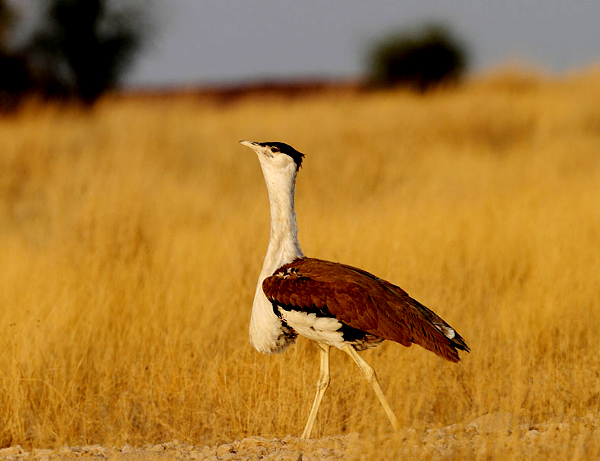
Gujarat is preparing to receive four Great Indian Bustards from Rajasthan in December 2026 as part of an ambitious conservation programme aimed at restoring the critically endangered bird’s population in the grasslands of Kutch. The proposed transfer, involving two males and two females, represents another important step in India’s efforts to rebuild viable populations of one of the country’s rarest birds.
The initiative follows the successful hatching of a male Great Indian Bustard chick in Gujarat on 21 May 2026, marking a significant achievement for a state where no male bird had been recorded since December 2018. With only three adult females remaining in the Naliya grasslands, the arrival of additional birds is expected to strengthen the prospects for establishing a sustainable breeding population.
The conservation programme is being implemented through coordinated efforts involving the Ministry of Environment, Forest and Climate Change, the Gujarat Forest Department, the Rajasthan Forest Department, and the Wildlife Institute of India (WII). It combines conservation breeding, scientific translocation, habitat restoration, predator management, and carefully supervised reintroduction into natural grassland habitats.
Four Bustards to Be Transferred to Kutch in December
According to information reported on 9 November 2026, four young Great Indian Bustards, comprising two males and two females, are scheduled to be transferred from Rajasthan to Gujarat in December.
The birds will be accommodated at a newly established soft-release facility in Naliya, Kutch, where they will undergo a carefully managed acclimatisation process before being considered for release into their natural habitat.
The soft-release approach allows captive-reared birds to gradually adapt to local environmental conditions while developing the behavioural characteristics necessary for survival in the wild. During this period, human contact is minimised to ensure that the birds retain their natural instincts and do not become dependent upon human interaction.
The four birds are expected to remain at the facility for approximately four to five months while wildlife specialists monitor their health, behaviour, and adaptation to the surrounding environment.
The planned transfer is particularly important because Gujarat’s remaining wild population has been severely affected by the absence of breeding males. Introducing birds from Rajasthan’s conservation-breeding programme offers an opportunity to improve the demographic balance and strengthen future breeding prospects.
First Male Bustard in Nearly Eight Years Marks Conservation Breakthrough
Gujarat’s conservation efforts received a major boost earlier this year when a Great Indian Bustard chick hatched in Kutch on 21 May 2026 under a pioneering intervention known as the Jumpstart Approach.
The initiative involves transferring viable eggs from Rajasthan’s conservation-breeding programme and placing them in the nests of wild female bustards in Gujarat. The receiving females incubate the eggs and subsequently raise the chicks in their natural grassland environment.
The approach combines the advantages of controlled conservation breeding with the ecological benefits of natural parental care. By allowing wild females to rear chicks, conservationists seek to improve their adaptation to local habitats and reduce dependence upon prolonged captive management.
The Wildlife Institute of India subsequently confirmed that the chick hatched on 21 May was male, making it the first known male Great Indian Bustard recorded in Gujarat since December 2018.
The achievement followed an earlier attempt in March 2026, when another chick hatched successfully but subsequently disappeared after surviving for approximately 24 days. Forest authorities suspected predation, highlighting the challenges involved in protecting young bustards during the vulnerable early stages of development.
The May chick survived its initial critical period and continued developing under intensive monitoring. Its successful growth provides an important foundation for Gujarat’s continuing efforts to rebuild a breeding population.
Naliya Soft-Release Centre to Support Reintroduction
The Great Indian Bustard Soft Release Centre at Naliya was inaugurated by Union Minister for Environment, Forest and Climate Change Bhupender Yadav on 14 September 2026.
Developed in accordance with scientific guidance from the Wildlife Institute of India, the facility is intended to support the gradual adaptation of captive-bred birds to Gujarat’s grassland environment.
The centre provides a controlled setting in which wildlife specialists can monitor the birds while preparing them for eventual release. Special attention is given to maintaining natural behaviour, minimising human disturbance, and ensuring that the birds develop the physical capabilities necessary for independent survival.
The establishment of the facility is an important component of Gujarat’s wider Great Indian Bustard recovery programme. It creates the infrastructure required to receive birds from Rajasthan and progressively strengthen the population through carefully managed introductions.
The proposed arrival of four additional bustards in December will represent an important step towards operationalising the centre’s role in the recovery programme.
Gujarat Targets a Viable Population of More Than 30 Bustards
In September 2026, the Ministry of Environment, Forest and Climate Change released the Gujarat Action Plan for Great Indian Bustard Conservation, prepared by the Wildlife Institute of India in collaboration with the Gujarat Forest Department.
The plan establishes a science-based roadmap for restoring the species in Kutch, with a long-term objective of developing a minimum viable population exceeding 30 birds.
It also identifies the need to secure between 200 and 500 square kilometres of safe, contiguous habitat capable of supporting a self-sustaining population.
The immediate focus is the approximately 200-square-kilometre Lala–Rawa grassland landscape, where conservation measures include habitat restoration, invasive vegetation removal, grazing management, predator management, and mitigation of infrastructure-related threats.
These measures are designed to restore the open grassland conditions preferred by the Great Indian Bustard, a large terrestrial bird that depends upon extensive, relatively undisturbed habitats for feeding, nesting, and movement.
The conservation programme therefore extends beyond increasing the number of birds. It also seeks to establish the ecological conditions necessary for their long-term survival and natural reproduction.
Grassland Restoration and Predator Protection Strengthen Conservation Efforts
The Gujarat Forest Department has undertaken extensive habitat improvement measures in the Naliya landscape to support the recovery of the Great Indian Bustard.
According to information released by the Ministry of Environment, Forest and Climate Change in September 2026, approximately 11 square kilometres of grassland affected by the invasive Prosopis juliflora have been restored.
The removal of invasive vegetation is particularly important because the Great Indian Bustard prefers open grasslands where visibility, movement, and nesting conditions are suited to its ecological requirements.
The department has also established approximately 30 kilometres of predator-proof fencing to protect an area covering around 15 square kilometres. These measures are intended to reduce threats to nesting birds and chicks while improving the prospects for successful breeding.
Predation remains a significant challenge because Great Indian Bustards generally lay only one egg during a breeding attempt, making every successful hatch particularly important for population recovery.
Habitat restoration and protective fencing are being complemented by field monitoring, scientific assessment, and coordinated conservation management.
The programme also recognises the importance of surrounding ecosystems, including habitats supporting chinkara, desert cats, raptors, vultures, and other wildlife associated with Kutch’s open natural landscapes.
Rajasthan’s Conservation-Breeding Programme Provides the Foundation
The planned transfer of birds to Gujarat is supported by India’s expanding Great Indian Bustard conservation-breeding programme in Rajasthan.
The national recovery initiative involves the Ministry of Environment, Forest and Climate Change, the Rajasthan Forest Department, and the Wildlife Institute of India, with technical collaboration from the International Fund for Houbara Conservation and financial support from National CAMPA.
According to the Ministry’s announcement on 3 October 2026, the conservation facilities at Sam and Ramdevra in Rajasthan housed 97 Great Indian Bustards.
Of these, 40 originated from eggs collected in the wild, while 57 had been bred in captivity. The programme maintained 86 birds for captive reproduction, while 11 had been identified for eventual release into natural habitats.
The breeding programme recorded 24 live chicks during 2025 and 29 during 2026, reflecting the gradual expansion of India’s scientific capacity to support the species’ recovery.
The Ministry also reported that the Jumpstart Approach had enabled six chicks to hatch in Rajasthan and two in Gujarat by placing viable eggs from the conservation-breeding programme in wild nests.
These developments demonstrate how conservation breeding, scientific intervention, and habitat management are being integrated to support recovery across the species’ remaining Indian range.
Rebuilding the Great Indian Bustard Population in Western India
The Great Indian Bustard (Ardeotis nigriceps) is one of India’s most threatened bird species and is classified as Critically Endangered by the International Union for Conservation of Nature.
Historically distributed across extensive grassland and semi-arid landscapes, the species has experienced a severe population decline due to habitat loss, fragmentation, infrastructure-related mortality, and other ecological pressures.
Rajasthan remains the principal stronghold of the species, while Gujarat’s surviving population is concentrated in the grasslands of Kutch.
The conservation programme seeks to strengthen these populations through a combination of managed breeding, translocation, habitat protection, and scientific monitoring.
The proposed introduction of four birds into Gujarat is particularly significant because it offers an opportunity to address the shortage of breeding males while expanding the number of individuals available for future population recovery.
The successful development of the male chick hatched in May 2026 adds another important dimension to these efforts. Wildlife authorities anticipate that the bird could reach reproductive maturity around 2029, potentially contributing to natural breeding in Gujarat.
The long-term objective is to establish a population capable of reproducing and surviving in the wild without continuous dependence upon conservation breeding.
A Major Step Towards Restoring India’s Grassland Heritage
The Great Indian Bustard conservation initiative reflects India’s increasing emphasis on protecting endangered species through landscape-level restoration, scientific breeding, and cooperation between states.
The proposed movement of four birds from Rajasthan to Gujarat demonstrates how conservation programmes developed in one region can support the recovery of wildlife populations elsewhere.
The successful hatching of a male chick in Kutch, the establishment of the Naliya soft-release facility, and the restoration of protected grassland habitats provide important foundations for this effort.
The broader recovery programme also highlights the ecological value of India’s grasslands, which support a wide range of specialised species but have historically received less conservation attention than forests and wetlands.
For Gujarat, the planned transfer represents an opportunity to move beyond protecting the last surviving individuals towards rebuilding a viable breeding population.
For India, it marks another stage in the effort to prevent the extinction of one of the country’s most distinctive and endangered birds through sustained scientific intervention, inter-state cooperation, and habitat conservation.
Official Sources and References
1. Ministry of Environment, Forest and Climate Change – Press Information Bureau
Union Environment Minister Visits Great Indian Bustard Habitat in Kachchh, Gujarat; Inaugurates GIB Soft Release Centre, Sayara Van Kavach and Reviews Mangrove Plantation Efforts.
Published: 14 September 2026.
2. Ministry of Environment, Forest and Climate Change – Press Information Bureau
Shri Bhupender Yadav Reviews Progress of Great Indian Bustard Conservation, Grassland Restoration and Project Cheetah at Bhuj; Releases Gujarat Action Plan for GIB Conservation.
Published: 13 September 2026.
3. Ministry of Environment, Forest and Climate Change – Press Information Bureau
In Culmination of 10 Years of Dedicated Efforts, Union Environment Minister and CM (Rajasthan) Initiate the Process for Release of Captive-Bred Great Indian Bustards into the Wild at Desert National Park, Jaisalmer.
Published: 3 October 2026.
4. The Times of India
New Year, New Hope: Four Great Indian Bustard Chicks to Arrive in Gujarat from Rajasthan.
Published: 9 November 2026.
5. Wildlife Institute of India
Great Indian Bustard Conservation Breeding and Recovery Programme, implemented in collaboration with the Ministry of Environment, Forest and Climate Change and participating state forest departments.
You may also like
-
Indian Scientists Discover New Begonia Species in Arunachal Pradesh’s Siang Valley
-
Wildlife Institute of India Study Reveals How Lightning Helps Andaman Mangrove Forests Regenerate
-
Satellite-Tagged Vulture Travels 600 Kilometres from Nepal to Nest in Himachal Pradesh
-
Rare Migratory White Stork Recorded at Okhla Bird Sanctuary After Seven Years
-
Jammu and Kashmir Orders Mission-Mode Conservation of Endangered Hangul Deer
