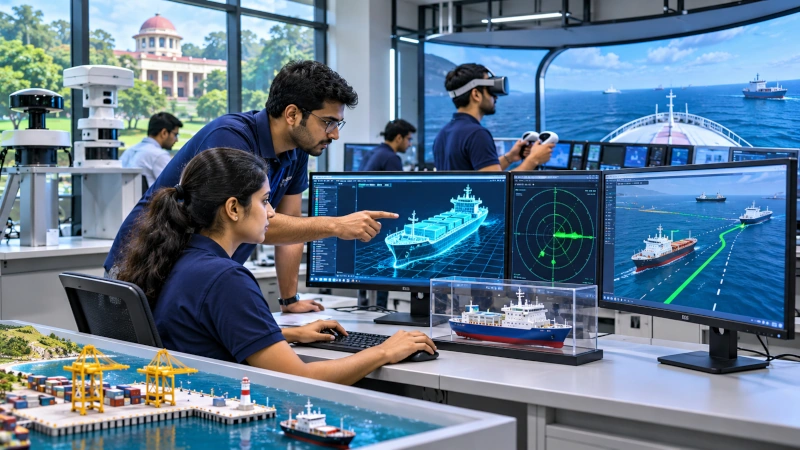
Researchers at the Indian Institute of Technology Madras (IIT Madras) have developed SEANAV, an advanced real-time digital twin platform designed to test, validate and train autonomous maritime navigation systems within realistic virtual environments. Announced on 12 November 2026, the indigenous research initiative combines artificial intelligence, advanced sensor technologies, ship hydrodynamics and virtual reality to support the development of safer and more efficient autonomous maritime operations.
Developed by the Department of Ocean Engineering at IIT Madras, SEANAV creates a high-fidelity digital representation of maritime environments, allowing researchers to simulate ship movements, ocean waves, navigation sensors and surrounding vessel traffic in real time. The platform enables autonomous navigation algorithms to be tested under complex operating conditions without exposing actual vessels, crews or maritime infrastructure to the risks associated with experimental sea trials.
The research team has already demonstrated autonomous path-following and artificial intelligence-driven collision avoidance under simulated ocean conditions incorporating realistic sensor behaviour and wave effects. The development has potential applications in commercial shipping, port operations, maritime training, coastal surveillance, search-and-rescue missions and defence-related maritime technologies.
Digital Twin Technology for Autonomous Maritime Navigation
SEANAV uses digital twin technology to reproduce the behaviour of vessels and their surrounding maritime environment within a computer-generated simulation. A digital twin is a computational representation of a physical system that can be used to study its behaviour, evaluate operating conditions and test potential responses to different situations.
Built using the Unity3D engine, the platform simulates ocean waves, vessel motion, navigation environments and interactions between ships. The system incorporates the physical characteristics of maritime operations, allowing navigation algorithms to be evaluated under conditions that resemble those encountered by vessels operating at sea.
The simulator has been calibrated using a benchmark tanker approximately 320 metres in length. This provides a representative large commercial vessel model through which researchers can examine ship manoeuvring behaviour and assess autonomous navigation algorithms under simulated operating conditions.
The digital environment allows researchers to conduct repeated experiments involving different traffic patterns, environmental conditions and navigation challenges. Such testing is important because autonomous vessels must operate safely while responding to changing sea conditions, nearby ships and obstacles.
The platform provides a controlled environment in which navigation strategies can be developed and refined before subsequent physical testing and deployment.
Artificial Intelligence Enables Autonomous Collision Avoidance
One of SEANAV’s major capabilities is the integration of artificial intelligence for autonomous navigation and collision avoidance. The platform supports the development and evaluation of algorithms that enable vessels to identify potential navigation hazards, assess surrounding maritime traffic and determine appropriate manoeuvres.
In conventional maritime operations, navigation decisions depend heavily on the experience and judgement of trained personnel. Autonomous navigation systems seek to perform selected navigation functions through the integration of sensors, computational models and automated decision-making algorithms.
SEANAV provides an environment for testing these capabilities under changing maritime conditions. The research team has demonstrated autonomous path-following and AI-driven collision avoidance within the simulation, representing progress in the development of intelligent navigation technologies.
The platform also supports multi-agent artificial intelligence, allowing multiple autonomous vessels to operate within the same simulated maritime environment. This capability is relevant to busy shipping routes and harbour approaches, where vessels must account for the movements and intentions of several nearby ships.
The simulations incorporate navigation scenarios involving the International Regulations for Preventing Collisions at Sea, commonly known as COLREGs. These international rules establish principles governing vessel conduct to reduce the risk of collisions.
By incorporating multiple vessels and complex traffic situations, SEANAV enables researchers to examine autonomous navigation strategies under conditions that more closely resemble real maritime operations.
Advanced Sensors Reproduce Realistic Maritime Conditions
SEANAV incorporates a multi-sensor fusion framework combining information from Light Detection and Ranging (LiDAR), marine radar and stereo vision cameras. These technologies provide different types of information about a vessel’s surroundings and are important components of autonomous navigation systems.
LiDAR uses laser measurements to estimate distances and identify surrounding objects, while marine radar detects vessels and other obstacles through radio-frequency signals. Stereo vision cameras provide visual information that can contribute to identifying objects and estimating their positions.
Combining these sensor inputs allows autonomous navigation algorithms to develop a more comprehensive representation of the surrounding environment.
A distinguishing feature of SEANAV is its ability to simulate the limitations of real-world sensors. Rather than assuming that every sensor provides complete and accurate information, the platform incorporates measurement noise, communication delays and other operational limitations.
These characteristics allow navigation systems to be evaluated under challenging conditions, including fog, rain and reduced visibility. Such simulations are particularly relevant because marine navigation systems must maintain reliable performance even when individual sensors provide incomplete or degraded information.
The integration of realistic sensor behaviour strengthens the platform’s usefulness for evaluating autonomous navigation technologies before they undergo physical trials.
Virtual Reality Enables Immersive Maritime Training
The IIT Madras research team has also incorporated a virtual reality interface into SEANAV, allowing users to experience simulated maritime operations from the perspective of a ship’s bridge.
The system uses Meta Quest virtual reality headsets to provide an immersive representation of the vessel’s surroundings, including maritime traffic, navigation conditions and environmental changes.
This capability allows researchers, trainees and maritime professionals to interact with simulated situations involving vessel manoeuvring, collision avoidance, port approaches and emergency response.
Virtual reality-based maritime simulation provides opportunities to reproduce complex navigation scenarios without the logistical requirements and safety risks associated with conducting equivalent exercises at sea.
The integration of immersive visualisation with autonomous navigation technologies also allows researchers to examine interactions between human operators and automated vessel systems.
SEANAV therefore combines algorithm development and testing with a training environment that can support the evaluation of maritime navigation procedures.
Potential Applications in Indian Ports and Shipping Operations
The development has potential applications in India’s commercial shipping and port operations, particularly as the maritime sector adopts digital technologies to improve efficiency and navigational safety.
Major Indian ports handle complex vessel movements involving large commercial ships, harbour craft and other maritime traffic. Navigation within these environments requires careful coordination because vessels must operate within confined waterways while accounting for changing weather, currents and surrounding traffic.
According to Dr. Suresh Rajendran, Associate Professor in IIT Madras’s Department of Ocean Engineering, SEANAV could support the development of AI-assisted navigation systems for major Indian ports, including Chennai, Mumbai, Visakhapatnam and Kochi.
The platform can be used to investigate navigation strategies intended to reduce collision and grounding risks, improve vessel manoeuvring and support safer approaches to harbour facilities.
More efficient navigation strategies could also contribute to reducing unnecessary fuel consumption and associated emissions. Improved collision avoidance and navigation planning may additionally help reduce the risk of maritime accidents involving hazardous cargo or oil spills.
These benefits represent potential applications of the research platform rather than operational improvements already demonstrated across Indian ports.
Applications in Coastal Surveillance and Maritime Defence
SEANAV’s ability to simulate interactions between multiple autonomous vessels also makes it relevant to research involving coastal surveillance, maritime security and search-and-rescue operations.
Autonomous surface vessels are being investigated for missions requiring persistent monitoring, data collection and operations in environments where continuous human presence may be difficult or hazardous.
The development and validation of navigation algorithms are important for such vessels because they must operate while responding to changing environmental conditions, other maritime traffic and potential obstacles.
SEANAV provides a virtual environment in which these navigation capabilities can be studied and evaluated before physical deployment.
Its multi-vessel simulation features also enable research into coordination among autonomous platforms, including situations involving multiple vessels operating within a shared maritime area.
The technology has potential relevance to India’s maritime defence research ecosystem, although no operational deployment by the Indian Navy or other defence organisation has been announced as part of the development.
Research Led by IIT Madras Department of Ocean Engineering
The SEANAV research programme was led by Dr. Suresh Rajendran of IIT Madras, working with Dr. Athira M. Nambiar of SRM Institute of Science and Technology and researchers and students from IIT Madras’s Department of Ocean Engineering.
The research team included Aniket Malviya, Jothish S., Mukesh S. K., Thirunavukarasu P. and Vaidesh, who contributed to the development of the maritime simulation platform.
The findings have been published in the peer-reviewed Journal of Offshore Mechanics and Arctic Engineering, published by the American Society of Mechanical Engineers. Related research findings were also presented at the ASME International Conference on Ocean, Offshore and Arctic Engineering in Vancouver in 2025 and Tokyo in 2026.
The research combines expertise in naval architecture, maritime engineering, artificial intelligence, sensor integration and virtual simulation.
The development also reflects IIT Madras’s wider research activities in autonomous marine systems, which include navigation algorithms, vessel control, ship hydrodynamics and the development of autonomous surface and underwater platforms.
Supporting India’s Maritime Digitalisation Initiatives
SEANAV aligns with India’s broader efforts to modernise maritime infrastructure and introduce advanced technologies into shipping and port operations.
The Sagarmala Programme and Maritime India Vision 2030 identify technological modernisation, improved operational efficiency and the development of advanced maritime infrastructure as important areas of national attention.
Digital technologies, automated systems and advanced navigation solutions form part of the wider transformation of maritime operations.
IIT Madras has an established research ecosystem supporting these objectives, including the Department of Ocean Engineering and the National Technology Centre for Ports, Waterways and Coasts.
The development of SEANAV adds a research capability focused on virtual testing and validation of intelligent maritime navigation systems.
By providing a simulated environment for evaluating autonomous navigation technologies, the platform contributes to research activities relevant to the adoption of digital systems in India’s maritime sector.
Future Development and Real-World Validation
The research team has identified further development activities intended to extend SEANAV’s capabilities beyond its existing simulation environment.
Future work will focus on developing digital twins of major Indian ports, expanding virtual reality-based maritime training and validating the technology through physical scale-model experiments.
The proposed port digital twins would provide representations of actual navigation environments, allowing researchers to examine vessel behaviour and navigation strategies in locations modelled on Indian harbour infrastructure.
The research team also intends to explore certified virtual reality-based pilot training applications, although certification and operational adoption remain future objectives.
Physical model testing will be important for comparing simulated navigation performance with the behaviour of vessels operating under controlled experimental conditions.
These activities are intended to strengthen the platform’s technical validation and support its progression towards applications beyond the research environment.
Indigenous Innovation in Autonomous Maritime Technology
The development of SEANAV represents an advancement in India’s research capabilities in autonomous maritime navigation, combining digital twin technology, artificial intelligence, advanced sensors and virtual reality within an integrated simulation platform.
The system provides researchers with a means of evaluating navigation algorithms under simulated ocean conditions while examining vessel interactions, collision avoidance and sensor performance.
Its demonstrated capabilities in autonomous path-following and AI-based collision avoidance establish a foundation for further research into intelligent maritime systems.
With potential applications spanning commercial shipping, port safety, maritime training, coastal surveillance and defence research, SEANAV contributes to India’s efforts to strengthen indigenous expertise in advanced maritime technologies.
You may also like
-
XINFINITI Aerospace Advances Indian Navy Chetak Helicopter-to-Drone Conversion Project
-
Kalyani Strategic Systems Unveils Indigenous 120 mm Vehicle-Mounted Rapid Attack Mortar System
-
Cochin Shipyard and SFO Technologies Develop India’s First Indigenous Hybrid Laser Arc Welding System
-
BSF Issues ₹49.3 Lakh Tender for Drone Simulation and Maintenance Facility in Bengaluru
-
India Targets First Made-in-India Civil Aircraft Within Two Years as Indigenous Aviation Manufacturing Gains Momentum
