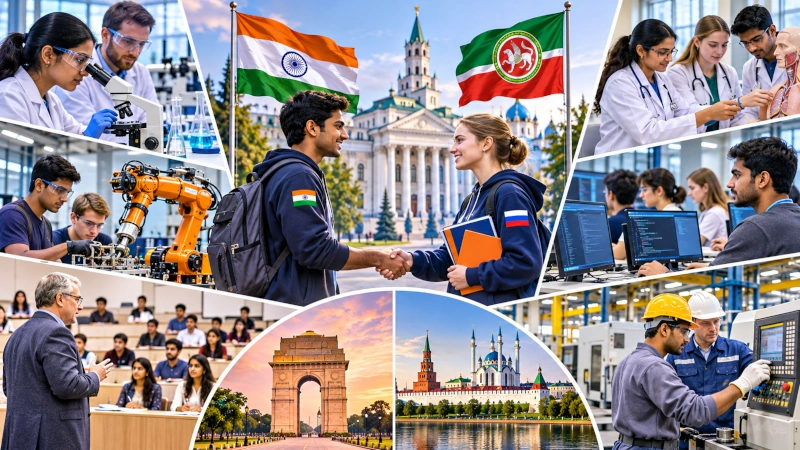
India and the Russian Republic of Tatarstan are strengthening cooperation in higher education, scientific research, professional training and industrial skills development, creating new opportunities for collaboration between universities, technology institutions and manufacturing industries. The expanding partnership includes student and faculty exchanges, joint research initiatives, technical education programmes and efforts to develop a skilled workforce for emerging industrial sectors.
The cooperation has gained momentum through engagements involving Indian educational institutions, Tatarstan’s universities, regional government authorities and industry representatives. A report published by the Russian newspaper Kommersant on October 14, 2026, highlighted the growing relationship, including academic cooperation between IIT Kharagpur and Innopolis University, partnerships involving Kazan Federal University and discussions on workforce training in manufacturing, information technology, pharmaceuticals and other specialised fields. Official statements from the Government of Tatarstan and Kazan Federal University provide further details of the institutional cooperation.
IIT Kharagpur and Innopolis University Strengthen Academic Cooperation
One of the important developments involves collaboration between the Indian Institute of Technology Kharagpur and Innopolis University, a specialised Russian institution located in Tatarstan’s Innopolis technology city.
According to Kommersant, the two institutions reached an understanding in 2025 to begin student exchanges and subsequently expand cooperation to include faculty members. Discussions have also explored opportunities for supporting technology startups and connecting innovation infrastructure between Tatarstan and India.
Innopolis University specialises in information technology and related fields, making the collaboration relevant to research involving software engineering, artificial intelligence, robotics, industrial automation and digital technologies.
Academic exchanges can provide students with opportunities to participate in research projects, work with international faculty and gain experience with technological facilities outside their home institutions. They also create connections between research groups that can support subsequent joint studies and technology development.
The proposed startup collaboration represents another dimension of the partnership. By connecting innovation centres and technology parks, participating institutions could create opportunities for entrepreneurs and researchers to explore emerging technologies and develop commercial applications.
The cooperation illustrates how university relationships can extend beyond conventional academic exchanges to include research, entrepreneurship and industrial innovation.
Kazan Federal University Expands Partnerships with Indian Institutions
Kazan Federal University, one of Russia’s established higher education and research institutions, is also expanding its academic relationship with India.
During a meeting with the Consul General of India in Kazan, Jaisundhar, university rector Lenar Safin discussed opportunities for cooperation in scientific research, student mobility and institutional partnerships.
According to the university’s official announcement, Kazan Federal University maintains agreements with ten Indian universities and higher education institutions. These include IIT Hyderabad, Thapar Institute of Engineering and Technology, Woxsen University and Partap College of Education.
The university has identified biotechnology, pharmaceuticals, oil and gas technologies, advanced materials, chemistry and information technology as promising areas for joint scientific research.
These subjects correspond with important sectors in India’s research and industrial development, creating opportunities for collaboration involving universities, engineering institutions and specialised research centres.
Kazan Federal University has also expressed interest in expanding two-way student mobility through academic exchange programmes, summer courses and language internships. Such initiatives would provide Indian students and researchers with access to additional academic facilities while encouraging Russian students to engage with Indian universities.
The university’s India-related academic activities are supported by its Centre for Indian Studies, which has operated for more than a decade with assistance from the Embassy of India in Russia and the Indian Council for Cultural Relations.
Scientific Collaboration Focuses on Pharmaceuticals and Advanced Technologies
The expanding India–Tatarstan partnership places particular emphasis on scientific fields that connect academic research with industrial requirements.
Biotechnology and pharmaceutical research represent important opportunities because India possesses substantial capabilities in pharmaceutical manufacturing, while Russian universities and scientific institutions contribute expertise in chemistry, materials science and specialised biomedical research.
Cooperation in these sectors can involve joint research projects, academic exchanges and the sharing of scientific expertise. Institutional partnerships also create opportunities for researchers to participate in international conferences and collaborative academic programmes.
Advanced materials and industrial chemistry represent another potential area of cooperation. Research involving specialised materials, chemical engineering and manufacturing processes can support applications across multiple industrial sectors.
Information technology and artificial intelligence are also prominent within Tatarstan’s economic development strategy. The region has invested in technology parks, digital infrastructure and specialised educational institutions, particularly around Kazan and Innopolis.
Connecting these capabilities with Indian institutions creates opportunities for research collaboration in software development, industrial digitalisation and emerging computational technologies.
The emphasis on research partnerships reflects a broader effort to connect universities with the technological requirements of industry.
Tatarstan and Telangana Discuss Industrial Skills Development
Alongside university cooperation, Tatarstan and Indian representatives have discussed opportunities for professional education and industrial workforce training.
The Russian regional government has reported discussions involving representatives from Telangana concerning training programmes aligned with industrial requirements in both countries.
The areas identified include pharmaceuticals, manufacturing, artificial intelligence, data centres, oil and gas operations and industrial technologies.
At the India–Russia TIME Business Forum in Kazan in October 2025, Telangana representative Dana Kishore discussed the possibility of establishing a Russian-language training centre in India and developing arrangements to prepare Indian professionals for employment opportunities in Russia.
The discussions also included the potential establishment of specialised skills and competency-development facilities with Russian participation.
Such initiatives would connect vocational education with specific requirements identified by employers, creating opportunities for technical graduates and skilled workers to develop expertise relevant to international industrial operations.
Language training is an important component of the proposed arrangements because professionals working in another country must be able to communicate effectively within technical and industrial environments.
The cooperation demonstrates how bilateral education initiatives can contribute to workforce development while supporting industrial relationships.
Indian Students Form an Important Part of Tatarstan’s Education Sector
Tatarstan has become an important destination for international students pursuing higher education in Russia, particularly in medicine, engineering and related professional disciplines.
According to the Government of Tatarstan, approximately 1,300 Indian students were studying at universities in the republic as of June 2026.
Medical education remains an important area of interest among Indian students attending Russian universities. Other fields include engineering, management, information technology and specialised technical education.
Kazan Federal University reported that approximately 150 Indian nationals were enrolled in programmes including general medicine, management and software engineering.
International student mobility contributes to educational cooperation by establishing long-term relationships between academic institutions and their graduates. Students who participate in international programmes also gain experience with different research environments, teaching methods and professional practices.
The growth of Indian student participation has encouraged universities and regional authorities to strengthen institutional support, language training and academic partnerships.
These developments provide an existing foundation for expanding cooperation into additional scientific and technical disciplines.
Industrial Training Cooperation Supports Manufacturing and Technology Sectors
Tatarstan is an important industrial region of Russia, with established activities in petrochemicals, automotive manufacturing, machinery, information technology and other industrial sectors.
The region’s economic structure creates demand for engineers, skilled technicians, manufacturing specialists and professionals with expertise in advanced technologies.
Indian educational and training institutions possess substantial experience in engineering education, industrial training and workforce development, creating opportunities for cooperation with Russian industry.
According to Kommersant, 707 Indian nationals were employed at 15 enterprises in Tatarstan during 2025. The report also identified proposals to expand recruitment through established employment arrangements and professional training programmes.
The regional government’s workforce initiatives are intended to connect personnel recruitment with language education, technical preparation and workplace adaptation.
These arrangements could support the development of more structured pathways linking vocational education, specialised training and employment opportunities.
For Indian institutions, the cooperation provides opportunities to develop international training relationships and strengthen connections between technical education and industrial applications.
TIME Business Forum Strengthens Institutional Engagement
The India–Russia TIME Business Forum has emerged as an important platform for strengthening cooperation between India and the Republic of Tatarstan.
The forum brings together government representatives, business leaders, educational institutions and industry organisations to explore opportunities in investment, manufacturing, research, technology and professional development.
The second edition of the forum was organised in Kazan in October 2026, providing another opportunity for discussions involving educational cooperation, industrial partnerships and workforce development.
The broader engagement includes cooperation in information technology, pharmaceuticals, petrochemicals, healthcare, education and labour-market development.
India’s diplomatic presence in the region has also expanded. The establishment of the Indian Consulate General in Kazan provides additional institutional support for relations involving education, trade, investment and cultural exchanges.
In June 2026, Tatarstan’s regional government reported that bilateral trade with India had reached approximately USD 353 million during 2025, illustrating the commercial foundation supporting further institutional engagement.
The development of educational and research partnerships complements these economic relationships by connecting industrial cooperation with the training of skilled professionals and the creation of scientific knowledge.
India–Tatarstan Partnership Creates Opportunities for Research and Technical Education
The growing relationship between India and Tatarstan demonstrates the expanding role of regional partnerships within India–Russia cooperation.
Universities such as IIT Kharagpur, IIT Hyderabad, Innopolis University and Kazan Federal University provide an institutional foundation for academic exchanges and specialised scientific research.
At the same time, discussions involving Telangana and Tatarstan’s industrial authorities offer opportunities to connect vocational training with the requirements of modern manufacturing, information technology and healthcare industries.
The combination of higher education, scientific collaboration and skills development creates a broad framework for mutually beneficial cooperation.
For Indian universities and research institutions, these partnerships provide opportunities to engage with international research programmes, exchange expertise and explore new technological applications.
For India’s technical education and skills ecosystem, the arrangements offer additional avenues for developing industry-oriented training and international professional experience.
The India–Tatarstan partnership therefore represents an expanding dimension of India–Russia relations, bringing together education, research, technology and industrial development. Through academic cooperation and professional training, the two sides are strengthening institutional connections that can contribute to scientific innovation, workforce development and long-term economic engagement.
Sources: Government of the Republic of Tatarstan; Kazan Federal University; TIME Business Forum; Kommersant, October 14 and 25, 2026.
You may also like
-
NCERT Introduces Personal Finance and Entrepreneurship in Class 9 Social Science Textbooks
-
India Pledges Protection for Medical Students in Uzbekistan Against Exploitation
-
India Sets Guinness World Record with Nearly 2.88 Lakh Student Innovation Project Submissions
-
NLC India Opens 1,067 Apprenticeship Opportunities in Technical and Professional Fields
-
Indian Physicist Ashoke Sen Becomes First Indian to Receive Prestigious Oskar Klein Medal
