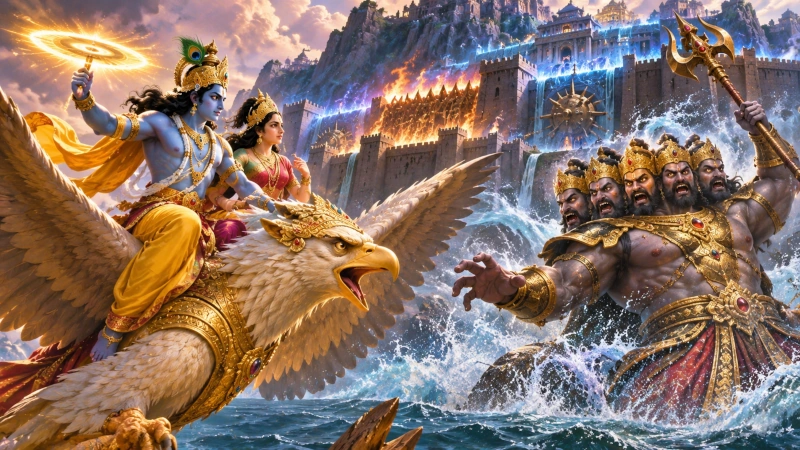
The Bhāgavata Purāṇa presents Krishna’s assault on the fortified city of Pragjyotiṣa as a remarkable narrative of offensive warfare against an extensively defended stronghold. Before confronting Narakāsura, also known as Bhaumāsura, Krishna encounters a formidable defensive system comprising mountainous barriers, weapons, water, fire, wind and mechanical obstacles. The protection of the capital is further reinforced by Mura, a powerful five-headed Asura whose defeat becomes an important stage in the campaign.
Recorded in the tenth Skandha, Chapter 59, the episode provides an opportunity to examine the Purāṇic understanding of fortified warfare, defensive depth, offensive mobility and the relationship between physical defences and their protectors. Krishna’s systematic overcoming of these obstacles illustrates how an apparently impregnable defensive establishment can be rendered ineffective when confronted by an adversary capable of responding to its different protective mechanisms.
The Strategic Importance of Pragjyotiṣa
Pragjyotiṣa serves as the fortified capital of Narakāsura, whose actions had brought him into conflict with the celestial order. Among the grievances described in the Bhāgavata Purāṇa are the seizure of Aditi’s earrings, Varuṇa’s umbrella and a celestial location associated with the Devas. Indra approaches Krishna regarding these transgressions, prompting the expedition against Narakāsura’s stronghold.
Krishna travels to Pragjyotiṣa accompanied by Satyabhāmā, mounted upon Garuḍa. The expedition brings the confrontation directly into the territory controlled by Narakāsura rather than allowing the conflict to remain unresolved. The narrative consequently presents the fortified capital as the principal objective of a campaign intended to overcome Narakāsura’s power and restore the possessions that he had unlawfully seized.
The Multi-Layered Defensive Architecture of Pragjyotiṣa
The Bhāgavata Purāṇa describes Pragjyotiṣa as a city protected by several distinct forms of fortification. Its defensive architecture incorporates natural terrain, weapon-based barriers, environmental obstacles and extensive entanglements associated with Mura. The Sanskrit description employs the term Durga, reflecting the significance of defensive structures and difficult approaches in protecting a political and military stronghold.
The mountainous barriers, described as Giri-durga, represent the use of geographical features to restrict access. These are supplemented by Śastra-durga, or weapon-based fortifications, and protective barriers associated with water, fire and wind. The city is additionally surrounded by formidable restraints known as Mura-pāśa, which constitute another obstacle to penetration.
From the perspective of warfare, this arrangement resembles the principle of layered defence, in which the protective strength of a fortified establishment does not depend exclusively upon a single barrier. Each obstacle presents a different challenge to an approaching adversary, while the accumulation of successive defensive mechanisms increases the difficulty of reaching the principal objective. The Purāṇic narrative portrays Pragjyotiṣa as a stronghold whose protection combines geography, weaponry and supernatural forces.
Krishna’s Systematic Penetration of the Fortifications
Krishna does not employ a single weapon against every defensive obstacle surrounding Pragjyotiṣa. The Bhāgavata Purāṇa describes him using different divine weapons according to the nature of the barriers confronting him. His mace breaks the rocky fortifications, while his arrows overcome the weapon-based defences protecting the approaches to the city.
The Sudarśana Chakra is employed against the barriers associated with fire, water and wind, while Krishna uses his sword to sever the Mura-pāśa entanglements. He subsequently sounds his conch, undermining the defensive establishment and the confidence of its protectors, before employing his mace against the earthen ramparts. The narrative presents the destruction of the fortifications as a coordinated employment of different capabilities rather than an indiscriminate application of force.
The strategic significance of this episode lies in the relationship between the character of an obstacle and the means employed to overcome it. Within the theological framework of the Purāṇa, Krishna possesses divine capabilities that transcend ordinary military limitations. Nevertheless, the narrative provides an enduring illustration of adaptability and the importance of possessing diverse capabilities when confronting complex defensive arrangements.
The Role of Garuḍa in Offensive Mobility
Garuḍa occupies an important position in Krishna’s campaign against Pragjyotiṣa. As Krishna’s divine mount, Garuḍa provides mobility that is not confined to conventional terrestrial movement. His presence introduces an additional dimension to the confrontation with a stronghold protected by difficult terrain and extensive ground-based obstacles.
The significance of this mobility becomes particularly evident when Mura emerges to confront Krishna and directs his attack against Garuḍa. The episode demonstrates that Garuḍa is not merely a means of transportation but an important participant in the broader military confrontation. Krishna’s ability to protect his mount preserves the mobility upon which the expedition depends.
Although Garuḍa’s capabilities belong to the sacred and supernatural setting of the Purāṇic narrative, the episode lends itself to a broader examination of operational mobility. The ability to move beyond the limitations imposed by difficult terrain can alter the relationship between an attacker and a fortified defender. Mobility consequently emerges as an important complementary element alongside offensive capability.
Psychological Warfare and the Sound of Pāñcajanya
The sounding of Krishna’s conch, Pāñcajanya, constitutes a significant moment in the assault upon Pragjyotiṣa. The Bhāgavata Purāṇa associates its powerful sound with the disruption of the fortress and the weakening of the courage of its defenders. Its effect is presented as both physical and psychological within the supernatural framework of the narrative.
The conch traditionally occupies an important position in Indian martial and sacred literature, where its sound may announce the commencement of confrontation, express confidence or communicate the presence of a powerful warrior. In the Pragjyotiṣa episode, Pāñcajanya also brings Mura into the confrontation. The sound awakens the Asura, who had been resting beneath the water surrounding the fortress.
From a strategic perspective, the passage illustrates that defensive strength involves more than physical structures and weapons. The confidence, determination and cohesion of those responsible for defending a position also influence its effectiveness. Krishna’s conch symbolically demonstrates the relationship between psychological pressure and the progressive weakening of an adversary’s resistance.
Mura: The Formidable Guardian of Pragjyotiṣa
Mura emerges in the Bhāgavata Purāṇa as a powerful five-headed Asura associated with the protection of Narakāsura’s stronghold. His emergence from the surrounding waters following the sounding of Pāñcajanya marks a transition from the destruction of physical barriers to direct confrontation with a formidable defender. The text describes his appearance through imagery conveying extraordinary power, ferocity and destructive potential.
Armed with a trident, Mura confronts Krishna and Garuḍa. His presence reveals that the protection of Pragjyotiṣa is not limited to its fortifications, but also depends upon powerful warriors capable of actively resisting an assault. Mura represents the fighting strength that complements the city’s extensive defensive architecture.
In strategic terms, Mura may be interpreted as the personification of an active defensive capability operating alongside passive barriers. Fortifications can obstruct an approaching adversary, but their effectiveness is strengthened when defenders possess the ability to respond to a developing threat. The confrontation with Mura therefore forms an integral part of Krishna’s campaign against the fortified capital.
The Confrontation Between Krishna and Mura
The Bhāgavata Purāṇa describes Mura employing his trident against Garuḍa, directing his offensive power towards an important element of Krishna’s mobility. Krishna intercepts and destroys the weapon before it reaches its intended target. He then confronts Mura directly, demonstrating his ability to protect Garuḍa while responding to the Asura’s aggression.
Mura subsequently employs a mace, which Krishna destroys with his own mace. When the confrontation continues, Krishna ultimately employs the Sudarśana Chakra to sever Mura’s five heads, bringing the encounter to an end. Mura falls into the surrounding waters, removing one of the principal sources of resistance protecting Pragjyotiṣa.
The narrative emphasises Krishna’s command over several forms of divine weaponry and his ability to respond to the changing circumstances of the confrontation. Mura possesses considerable offensive strength, but his successive efforts fail to overcome Krishna’s capabilities. His defeat marks a decisive transition in the campaign against Narakāsura.
The Sudarśana Chakra and Decisive Combat Power
The Sudarśana Chakra occupies a distinctive position in the military and theological narratives associated with Vishnu and Krishna. Within the Pragjyotiṣa campaign, it is employed both in overcoming supernatural barriers and in bringing the confrontation with Mura to a conclusion. Its repeated appearance establishes it as an instrument through which Krishna exercises decisive divine authority.
Unlike ordinary weapons confined to particular forms of engagement, the Chakra is portrayed in Purāṇic literature as possessing extraordinary capabilities. Its significance extends beyond physical destruction, representing the divine power associated with the protection of Dharma and the restoration of cosmic order. The destruction of Mura consequently carries both martial and theological meaning.
From the analytical perspective of Warcraft in the Purāṇas, the Chakra represents a capability whose effectiveness can fundamentally alter the conditions of a confrontation. The narrative illustrates how superior combat power, when combined with adaptability and mobility, can overcome resistance that initially appears formidable. This interpretation remains distinct from any suggestion that the Sudarśana Chakra represents a documented historical weapons technology.
The Seven Sons of Mura and the Continuity of Resistance
The destruction of Mura does not immediately bring the fighting at Pragjyotiṣa to an end. The Bhāgavata Purāṇa records that his seven sons subsequently confront Krishna, accompanied by forces under the leadership of Pīṭha. Their intervention demonstrates that the defensive establishment retains additional fighting elements even after the loss of its formidable guardian.
The seven sons are identified as Tāmra, Antarikṣa, Śravaṇa, Vibhāvasu, Vasu, Nabhasvān and Aruṇa. They engage Krishna in an attempt to continue the resistance following their father’s death. Krishna overcomes their opposition, further diminishing the fighting strength available to protect Narakāsura.
This episode provides an important qualification to the strategic significance of Mura’s defeat. The removal of a powerful defender does not necessarily eliminate every remaining source of resistance within a fortified establishment. The narrative recognises the persistence of subordinate fighting elements and the importance of overcoming their opposition before the principal confrontation can reach its conclusion.
The Collapse of Defensive Depth
The successive destruction of the fortifications, the defeat of Mura and the elimination of his sons progressively undermine the defensive strength of Pragjyotiṣa. Each stage removes another component of the protective system surrounding Narakāsura. The fortified capital consequently loses much of the defensive depth upon which its security had depended.
The episode demonstrates the distinction between possessing numerous defensive mechanisms and maintaining an effective defensive establishment. Physical barriers, formidable guardians and supporting warriors contribute to protection only while they retain their capacity to resist an adversary. Once these elements cease to function effectively, the principal authority within the stronghold becomes increasingly exposed.
Within the Purāṇic account, Krishna’s success arises from his ability to overcome the different components of this defensive establishment without losing his own mobility or offensive effectiveness. The campaign thus illustrates the vulnerability of even an elaborate protective architecture when its constituent elements cannot withstand the capabilities of an opposing force.
The Emergence of Krishna as Murāri
Krishna’s destruction of Mura is commemorated in the celebrated epithet Murāri, meaning the enemy or vanquisher of Mura. The designation preserves the memory of the confrontation within the wider devotional and literary traditions associated with Krishna. It also demonstrates how particular martial achievements acquire enduring significance within India’s sacred vocabulary.
The epithet is not merely a reference to victory over a powerful adversary. Within the Vaiṣṇava tradition, it expresses the divine capacity to overcome forces associated with Adharma and restore an appropriate cosmic order. The defeat of Mura consequently becomes part of the broader theological understanding of Krishna as the protector of Dharma.
The survival of this designation across devotional literature illustrates the relationship between sacred narrative, cultural memory and martial symbolism. A specific episode in the campaign against Pragjyotiṣa becomes an enduring expression of Krishna’s protective role. The military confrontation is thereby preserved not simply as an account of combat, but as a narrative of divine purpose.
Strategic Lessons From the Destruction of Mura
The first major strategic lesson emerging from the episode concerns the limitations of static fortifications. Pragjyotiṣa possesses several protective mechanisms, yet these cannot guarantee security against an adversary capable of adapting to their different characteristics. Defensive strength must therefore be understood as a relationship between physical protection, active resistance and the capabilities of the opposing force.
A second lesson concerns the importance of complementary capabilities. Krishna employs mobility, different forms of divine weaponry and psychological pressure throughout the campaign. The narrative demonstrates that the ability to respond appropriately to changing circumstances can be more significant than dependence upon any single instrument of power.
A third lesson involves the distinction between defeating an individual adversary and overcoming the broader defensive establishment. Mura’s destruction represents a decisive achievement, but the subsequent intervention of his sons demonstrates that organised resistance can persist beyond the loss of a principal defender. The episode therefore presents victory as the cumulative outcome of overcoming multiple sources of opposition.
The final lesson concerns the purpose underlying the exercise of martial power. Krishna’s campaign is undertaken in response to the grievances arising from Narakāsura’s actions rather than as an expedition for territorial acquisition. Within the theological framework of the Bhāgavata Purāṇa, the application of superior power remains connected to the restoration of Dharma.
Contemporary Relevance: Fortifications, Mobility and Adaptive Warfare
Modern military thought recognises the importance of defensive depth, mobility, resilience, morale and the integration of complementary capabilities. Although contemporary military institutions operate within technological and organisational frameworks fundamentally different from those described in the Purāṇas, certain conceptual parallels provide opportunities for comparative study. Krishna’s confrontation with the defences of Pragjyotiṣa is particularly relevant to examining the relationship between elaborate protection and adaptive offensive capability.
The narrative also encourages reflection on the limitations of relying excessively upon the apparent strength of established protective systems. Defensive arrangements derive their effectiveness from their ability to remain functional under changing circumstances, rather than merely from the number of barriers or capabilities they incorporate. Resilience, adaptability and institutional cohesion remain important considerations in the broader understanding of security.
These comparisons should be approached with appropriate historical and textual caution. The Bhāgavata Purāṇa is a sacred theological work containing supernatural narratives, and its descriptions should not be presented as archaeological evidence of modern weapons or military technologies in ancient India. Its contribution to the study of warfare lies in the strategic, ethical and symbolic ideas that can be examined through its narrative framework.
Conclusion
Krishna’s destruction of Mura and the defences of Pragjyotiṣa constitutes a distinctive episode in the Purāṇic presentation of fortified warfare. The narrative combines elaborate defensive architecture, supernatural obstacles, offensive mobility, psychological pressure and direct confrontation with formidable defenders. The defeat of Mura and his sons progressively dismantles the protective establishment surrounding Narakāsura, preparing the narrative for the principal confrontation that follows.
The enduring significance of the episode lies in its portrayal of adaptability as an essential characteristic of effective martial leadership. Krishna responds to different forms of resistance with appropriate capabilities while preserving the mobility and coherence of his expedition. His success illustrates that elaborate fortifications and powerful defenders do not independently guarantee the security of a stronghold.
Beyond its martial dimensions, the episode remains grounded in the Purāṇic understanding of Dharma and divine responsibility. Krishna’s victory is presented not as the unrestricted pursuit of power, but as an intervention against forces that have disturbed the established cosmic order. Through the figure of Murāri, the Bhāgavata Purāṇa preserves a narrative in which strategic intelligence, decisive capability and righteous purpose converge.
References
Śrīmad Bhāgavata Mahāpurāṇa — Skandha 10, Adhyāya 59
- Verses 1–3: Narakāsura’s transgressions, Indra’s appeal to Krishna and the description of Pragjyotiṣa’s defensive architecture.
- Verses 4–5: Krishna’s destruction of the fortified barriers, the Mura-pāśa entanglements and the surrounding ramparts.
- Verses 6–7: The emergence of the five-headed Mura following the sounding of Pāñcajanya.
- Verses 8–11: The confrontation between Krishna and Mura, culminating in Mura’s destruction by the Sudarśana Chakra.
- Verses 12–14: The intervention and subsequent defeat of Mura’s seven sons and their supporting forces.
- Verse 15 onwards: The subsequent confrontation with Narakāsura.
You may also like
-
Ramayana Diplomacy: Bharata’s Pādukā Diplomacy — Preserving Political Legitimacy Without Claiming the Throne
-
Fortifications in the Arthaśāstra: Urban Defence, Water Security and Strategic Geography
-
Krishna’s Assault on Narakāsura’s Fortress: The Fall of Prāgjyotiṣa
-
Rāma’s Counsel to Bharata: Governance, Intelligence and the Responsibilities of Kingship
-
The Economics of Warfare: Treasury, Revenue and Military Sustainability in Kauṭilya’s Statecraft
