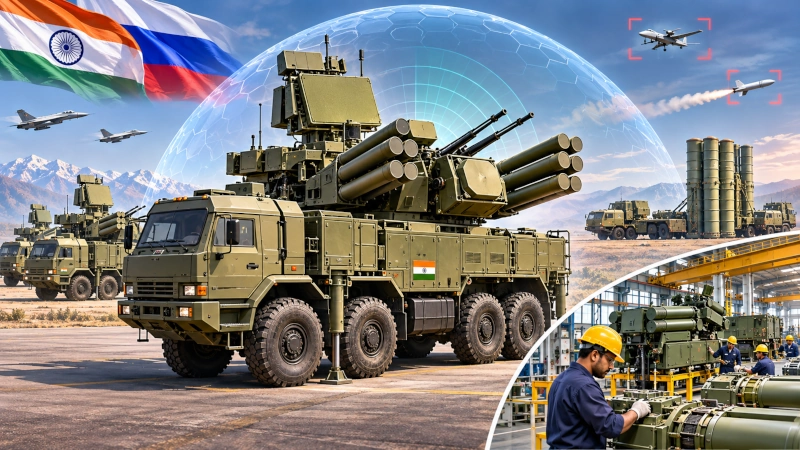
India is reportedly examining a proposal to acquire 52 Russian Pantsir short-range air-defence systems under a procurement arrangement combining direct imports with domestic manufacturing. The proposed acquisition would strengthen the short-range component of India’s integrated air-defence network, particularly against unmanned aerial vehicles, cruise missiles, low-flying aircraft and other airborne threats requiring rapid interception.
According to a report published by Hindustan Times on November 2, citing Indian government officials familiar with the discussions, the Ministry of Defence is evaluating an arrangement under which 13 Pantsir systems would be imported directly from Russia and another 39 manufactured or assembled in India. Russian news agencies TASS and Interfax subsequently reported the development on November 3, highlighting its potential significance for bilateral defence cooperation and India’s domestic defence manufacturing ecosystem. The proposal remains under consideration, and no procurement contract has been announced.
Proposed Acquisition Combines Russian Imports with Indian Manufacturing
The reported arrangement follows a procurement model in which an initial batch of equipment would be supplied directly by the foreign manufacturer, while a larger number of systems would be manufactured or assembled at Indian defence production facilities.
Under the proposal, 13 Pantsir systems would be delivered from Russia, while 39 systems would be produced in India. The domestic component would therefore account for approximately 75% of the proposed acquisition, creating opportunities for Indian manufacturers to participate in the production and integration of advanced air-defence equipment.
The arrangement could involve cooperation in vehicle integration, mechanical assemblies, electrical systems, maintenance infrastructure and other manufacturing activities, depending on the final scope of technology transfer and industrial participation. The identities of the Indian manufacturing partners, the proposed investment and the level of technology transfer have not been officially disclosed.
The reported discussions build upon earlier India–Russia engagements involving the potential local production of Russian defence systems. During Aero India 2023, Rosoboronexport confirmed that it was conducting technical consultations concerning the possible production of Pantsir-S1 air-defence systems and other military equipment in India.
The latest proposal indicates renewed interest in combining the acquisition of Russian short-range air-defence technology with domestic production capabilities.
Pantsir Combines Surface-to-Air Missiles and Automatic Cannons
The Pantsir family comprises self-propelled air-defence systems designed to detect, track and engage aerial threats at relatively short distances. The system combines guided surface-to-air missiles with rapid-firing automatic cannons, providing different interception options within a single combat platform.
This combination distinguishes Pantsir from missile-only air-defence systems. Guided missiles are intended to engage targets within their designated operating envelope, while automatic cannons provide an additional engagement option against suitable targets at shorter ranges.
Pantsir systems incorporate radar and electro-optical equipment for target detection, tracking and engagement. Their mobile configuration allows them to accompany military formations or provide protection to important installations and other defensive assets.
The Pantsir-S1M is a modernised version of the wider Pantsir family. Russian manufacturers have promoted the variant for countering contemporary aerial threats, including unmanned aircraft and precision-guided weapons.
Although Russian media reports have specifically referred to the Pantsir-S1M, the variant being evaluated by India has not been formally identified by the Ministry of Defence. The final technical configuration would therefore form part of any subsequent procurement announcement.
Strengthening India’s Layered Air-Defence Architecture
A major consideration behind the reported proposal is the development of a more integrated, multilayered air-defence system capable of addressing different categories of aerial threats.
India’s air-defence architecture already includes the Russian-origin S-400 Triumf long-range surface-to-air missile system, along with medium-range and short-range systems developed or acquired through different programmes.
These systems perform complementary roles. Long-range air-defence weapons provide coverage against threats at extended distances, while medium-range and short-range systems offer additional interception capabilities against aircraft, missiles and unmanned platforms operating within their respective engagement envelopes.
Pantsir could contribute to the shorter-range layer by providing mobile protection against low-flying threats, particularly those that approach important military installations or air-defence assets.
The reported proposal also identifies the protection of S-400 formations as a potential role. Long-range missile systems depend on supporting infrastructure, including radars, launchers and command facilities. Integrating shorter-range defensive systems around such assets can provide additional protection against nearby airborne threats.
Another possible application is the protection of mobile military formations. The Pantsir’s self-propelled configuration is intended to support deployment alongside military units, allowing short-range air-defence coverage to accompany changing operational requirements.
The proposed acquisition would therefore complement rather than replace India’s existing medium- and long-range air-defence programmes.
Counter-Drone Defence Becomes an Important Military Requirement
The growing use of unmanned aerial vehicles has increased the importance of short-range air-defence systems capable of responding to different categories of airborne threats.
Modern military operations involve reconnaissance drones, armed unmanned aircraft, loitering munitions and other remotely operated systems. These platforms vary considerably in size, speed, altitude and operating characteristics, creating a need for complementary detection and interception technologies.
Short-range missile-and-gun systems provide one approach to addressing these threats. Their effectiveness depends on sensor performance, target characteristics, engagement conditions, available ammunition and integration with the wider air-defence network.
India is also developing indigenous counter-drone capabilities through DRDO, defence public sector enterprises and private manufacturers. These programmes include radar systems, electro-optical sensors, electronic warfare technologies, directed-energy systems and different types of interception equipment.
The possible acquisition of Pantsir would add another element to this wider technological ecosystem, particularly if domestic manufacturing and systems integration become part of the eventual procurement arrangement.
The emphasis on layered defence reflects the need to combine different technologies rather than rely on a single weapon system for every category of aerial threat.
Reported Procurement Follows India’s S-400 Expansion Plans
The proposed Pantsir acquisition has emerged alongside developments concerning India’s existing S-400 procurement programme.
India signed a contract with Russia in 2018 for five S-400 Triumf systems, valued at approximately USD 5.43 billion. Deliveries began in 2021, and four systems had reportedly been received by India by mid-2026.
According to the November 2 Hindustan Times report, the fifth system is expected to arrive in January or February 2027. A pre-dispatch team is reportedly scheduled to visit Russia in December 2026 as preparations continue for the final delivery under the existing contract.
The report also stated that India’s Defence Acquisition Council granted Acceptance of Necessity for five additional S-400 systems in March 2026. Acceptance of Necessity represents a stage in the defence procurement process and does not itself constitute a signed purchase contract.
The proposed Pantsir systems would have a different operational role from the S-400. While the S-400 is designed for long-range interception, Pantsir provides short-range engagement capabilities that could contribute to the protection of military assets and the broader air-defence network.
The two procurement discussions therefore illustrate India’s continuing emphasis on developing air-defence capabilities across different ranges and threat categories.
Russian Defence Industry Seeks Expanded Manufacturing Cooperation
Russia has previously expressed interest in expanding defence manufacturing cooperation with India, including the production of military equipment through partnerships with Indian companies.
At Aero India 2023, Rosoboronexport chief executive Alexander Mikheyev identified Pantsir-S1 among the systems being discussed for possible production in India. The consultations also covered other Russian military equipment, reflecting the established industrial relationship between the two countries.
India and Russia already have experience with joint defence manufacturing through programmes involving aircraft, armoured vehicles, missiles and other military technologies.
The proposed manufacture of 39 Pantsir systems in India could extend this cooperation into the short-range missile-and-gun air-defence segment.
Domestic participation would be particularly relevant to India’s objective of expanding advanced defence manufacturing capabilities, strengthening maintenance infrastructure and developing the industrial expertise required to sustain sophisticated military equipment.
The final industrial benefits would be determined by the procurement structure, the components selected for local production and the manufacturing responsibilities assigned to participating Indian companies.
Procurement Proposal Remains under Evaluation
The figure of 52 Pantsir systems reflects the arrangement currently described in media reporting rather than an officially approved acquisition.
Interfax noted that an earlier Hindustan Times report in April 2026 had described a different proposed distribution involving 12 imported systems and 40 manufactured in India. The latest figures of 13 imported and 39 domestically produced systems therefore represent the more recent reported configuration.
The Ministry of Defence has not publicly announced a final selection, signed contract, confirmed manufacturing partner or delivery schedule for the proposed acquisition.
The available reporting nevertheless identifies a clearly defined area of interest: the expansion of short-range air defence through a combination of imported equipment and domestic industrial participation.
Any formal procurement announcement would establish the selected system variant, contract value, delivery arrangements, manufacturing structure and associated technology-transfer commitments.
Expanding India’s Short-Range Air-Defence Capabilities
India’s reported evaluation of 52 Russian Pantsir systems reflects the growing importance of mobile, multilayered air defence in the country’s military modernisation programme.
The proposed acquisition would provide an additional short-range interception capability while creating opportunities for Indian manufacturers to participate in producing sophisticated missile-and-gun defence equipment.
Its potential integration with existing S-400 formations and other air-defence systems highlights the complementary roles of long-range, medium-range and short-range technologies in protecting military infrastructure and operational formations.
The domestic manufacturing component is particularly significant. With 39 of the proposed 52 systems identified for production in India, the arrangement offers a potential avenue for expanding industrial participation in an advanced defence technology segment.
The discussions also reinforce the continuing importance of India–Russia military-technical cooperation, particularly in air defence and the development of supporting manufacturing capabilities.
As India advances its indigenous defence research, industrial production and military modernisation programmes, the evaluation of additional short-range air-defence systems represents another element in the country’s efforts to strengthen its integrated air-defence architecture.
Sources: TASS, November 3, 2026; Interfax, November 3, 2026; Rosoboronexport statements reported by TASS, February 14, 2023.
You may also like
-
Pune Fintech Fibe Enters UPI Payments Market After NPCI Approval
-
Indian AI Startup Sarvam Launches Prism, an Indigenous Decision Model for Enterprise Automation
-
Bengaluru Space Startup Akashalabdhi Tests Expandable Space Habitat Technology at 30 Kilometres Altitude
-
DRDO Successfully Tests Indigenous Pralay Quasi-Ballistic Missile from Odisha
-
India Targets ₹3 Lakh Crore Defence Production and ₹50,000 Crore Exports by 2029
