Warcraft in the Purāṇas | Bhāgavata Purāṇa, Viṣṇu Purāṇa, Harivaṃśa and Regional Literary Traditions
Among the numerous accounts of divine warfare preserved in India’s Purāṇic and epic traditions, the participation of Satyabhāmā in Śrī Kṛṣṇa’s campaign against Narakāsura occupies a distinctive position. Unlike narratives in which royal consorts remain removed from military operations, several traditions portray Satyabhāmā accompanying Kṛṣṇa into hostile territory and actively participating in combat. Her presence introduces important dimensions of battlefield preparedness, complementary combat capabilities, continuity of offensive operations and the responsibilities of royal leadership.
The Sanskrit Bhāgavata Purāṇa and Viṣṇu Purāṇa record Satyabhāmā accompanying Kṛṣṇa during the expedition against Narakāsura. More elaborate descriptions of her direct participation in combat appear in the Southern manuscripts of the Harivaṃśa, Pōtana’s Telugu Bhāgavatam and regional performance traditions, including Kerala’s Kṛṣṇanāṭṭam. These accounts collectively provide a distinctive perspective on the representation of women as active participants in divine warfare.
From a strategic perspective, Satyabhāmā’s participation illustrates the importance of developing complementary combat capabilities, maintaining operational continuity and recognising leadership potential beyond conventional battlefield roles.
The Strategic Background: Narakāsura’s Expansion of Power
Narakāsura, also known as Bhaumāsura, ruled the fortified kingdom of Prāgjyotiṣapura. His actions extended beyond the territorial boundaries of his kingdom and challenged the established celestial order through the seizure of sacred possessions belonging to the Devas and the imprisonment of numerous women. Among the objects appropriated were the earrings of Aditi, the royal umbrella of Varuṇa and Maṇiparvata.
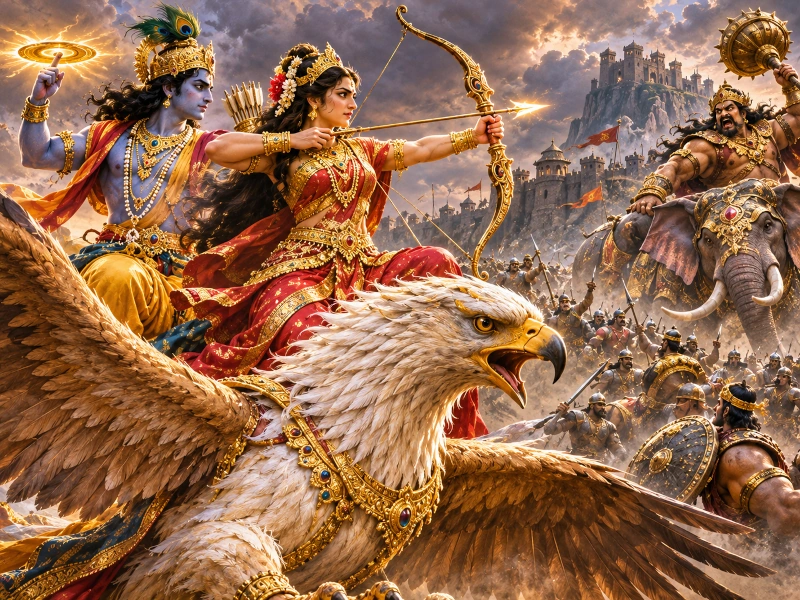
Indra approached Kṛṣṇa and communicated the circumstances created by Narakāsura’s actions. The resulting expedition was therefore directed towards ending his domination, recovering the appropriated possessions and liberating those held captive within his kingdom. Kṛṣṇa proceeded towards Prāgjyotiṣapura accompanied by Satyabhāmā and mounted upon Garuḍa.
The campaign possessed clearly defined strategic objectives that extended beyond battlefield victory: the removal of a hostile ruler, the recovery of strategic and symbolic assets, the liberation of captives and the restoration of the established order.
Satyabhāmā’s Decision to Enter the Battlefield
Pōtana’s Telugu Bhāgavatam provides a particularly detailed account of Satyabhāmā’s desire to accompany Kṛṣṇa into battle. When Kṛṣṇa prepares to depart, Satyabhāmā expresses her wish to witness his martial capabilities directly. Kṛṣṇa initially describes the dangers of warfare, contrasting the familiar surroundings of royal life with the noise, confusion and destructive forces of the battlefield.
Satyabhāmā remains determined to accompany him, expressing confidence in his capabilities and protection. Her initial desire to witness the campaign subsequently develops into active participation when she encounters the unfolding confrontation with Narakāsura. The narrative thereby presents a progression from battlefield observation to direct operational involvement.
Exposure to the realities of warfare, familiarity with battlefield conditions and the willingness to assume responsibility are important elements in the development of military leadership. Satyabhāmā’s transformation from an accompanying royal consort into an active combatant illustrates how leadership potential can emerge when individuals are confronted with extraordinary circumstances.
Battlefield Preparation and the Transition to Combat
Pōtana’s narrative describes Satyabhāmā preparing herself for direct combat as Narakāsura advances. She secures her hair, adjusts her garments and prepares herself for the physical demands of warfare. These descriptions distinguish her transformation into a warrior from the ceremonial appearance ordinarily associated with royal life.
Kṛṣṇa subsequently entrusts Satyabhāmā with his bow, enabling her to participate directly in the confrontation. The transfer of the weapon represents a recognition of her determination and ability to contribute to the campaign. Her subsequent performance establishes that her presence on the battlefield is not merely symbolic but operationally significant.
Combat effectiveness depends upon the integration of psychological preparedness, physical readiness, familiarity with weapons and the confidence to act under hostile conditions. The episode also illustrates how leadership must recognise available talent and provide individuals with the resources necessary to translate determination into effective action.
The Combined Combat Capabilities of Kṛṣṇa, Satyabhāmā and Garuḍa
The Narakāsura campaign brings together three distinct participants whose capabilities contribute to the overall expedition. Kṛṣṇa possesses divine weapons and exceptional martial proficiency, while Garuḍa provides mobility and participates directly in overcoming hostile forces. In the expanded regional narratives, Satyabhāmā contributes additional combat capability through her participation as an archer.
Garuḍa’s involvement is particularly significant because he functions as both the means of transportation and an active participant in the confrontation. The Bhāgavata Purāṇa describes his effectiveness against Narakāsura’s elephant formations, demonstrating that his contribution extends beyond carrying Kṛṣṇa and Satyabhāmā. The expedition consequently combines mobility, offensive capability and mutual support within a single operational arrangement.
The integration of complementary capabilities creates a combined operational advantage in which mobility, offensive power and battlefield support reinforce one another. Although the divine narrative cannot be equated directly with contemporary combined-arms warfare, it presents a literary illustration of the advantages of coordinated capabilities over isolated strength.
Satyabhāmā’s Archery and the Maintenance of Offensive Momentum
Pōtana celebrates Satyabhāmā’s archery through elaborate poetic descriptions emphasising speed, confidence and martial determination. Her performance unsettles Narakāsura’s forces, and the narrative describes enemy soldiers withdrawing under the intensity of her attack. The imagery establishes Satyabhāmā as a formidable participant capable of influencing the course of the engagement.
Her contribution also introduces the concept of distributing combat responsibilities rather than concentrating every battlefield function upon a single individual. Kṛṣṇa’s willingness to entrust her with his weapon reflects confidence in her ability to assume an active role during the confrontation. Her participation becomes an additional source of pressure upon an already contested adversary.
The ability to sustain offensive momentum through complementary combatants reduces excessive dependence upon a single source of battlefield capability. Satyabhāmā’s intervention illustrates the strategic value of having additional personnel capable of assuming important responsibilities when circumstances demand their participation.
Battlefield Resilience and Continuity of Command
One of the most strategically significant variations of the Narakāsura narrative survives in the Southern performance traditions of India. In the Bāṇayuddham episode of Kṛṣṇanāṭṭam, performed at Kerala’s Guruvayur Śrī Kṛṣṇa Temple, Kṛṣṇa temporarily loses consciousness during the confrontation. Satyabhāmā assumes an active combat role until Kṛṣṇa recovers and resumes the engagement.
This version introduces an important concept associated with battlefield resilience. The temporary incapacitation of a principal warrior does not result in the immediate termination of the confrontation because another capable participant remains available to respond. Satyabhāmā’s intervention preserves continuity during a moment of vulnerability.
An effective fighting organisation must possess sufficient redundancy in leadership and combat capability to withstand the temporary incapacitation of its principal personnel. The ability of subordinate or complementary leaders to assume responsibility during unexpected circumstances is an essential component of organisational resilience.
The Psychological Dimension of Warfare
Satyabhāmā’s participation also introduces a psychological dimension to the confrontation. Pōtana portrays her martial performance through imagery that contrasts the encouragement experienced by the divine forces with the apprehension experienced by their adversaries. Her emergence as an unexpectedly capable combatant challenges conventional assumptions about her battlefield role.
The narrative demonstrates how preconceived expectations can influence an adversary’s assessment of opposing capabilities. An opponent who relies excessively upon established assumptions may fail to recognise emerging sources of resistance. The appearance of an unexpected combatant can consequently alter both the psychological atmosphere and the perceived balance of an engagement.
Underestimating an adversary on the basis of social identity, conventional roles or incomplete assessments can create significant errors in strategic judgement. Effective military leadership requires the continuous evaluation of actual capabilities rather than dependence upon assumptions concerning who is expected to participate in warfare.
Mutual Confidence and the Delegation of Battlefield Responsibility
The relationship between Kṛṣṇa and Satyabhāmā during the campaign provides an illustration of mutual confidence under demanding circumstances. Kṛṣṇa’s decision to entrust Satyabhāmā with his bow acknowledges her willingness to contribute, while her acceptance of the responsibility demonstrates confidence in her own ability to participate. Their relationship develops an operational dimension alongside its personal and theological significance.
The episode also reflects the importance of leadership that permits initiative rather than insisting upon exclusive control over every responsibility. Individuals capable of contributing effectively must be given the opportunity to exercise their abilities within the broader objectives of an undertaking. Such confidence strengthens collective performance and creates greater flexibility when circumstances change.
Delegation, mutual confidence and decentralised initiative enhance organisational adaptability, particularly when rapidly changing circumstances require responsibilities to be redistributed. Satyabhāmā’s participation illustrates the value of leadership that recognises capability and enables meaningful contributions from trusted individuals.
The Warrior Queen and the Expansion of Strategic Responsibility
Satyabhāmā’s role is particularly noteworthy because she enters the confrontation as a queen rather than as a conventional military commander. Her participation challenges the assumption that royal responsibility must remain confined to ceremonial, administrative or domestic functions. The regional narratives preserve an image of queenship that accommodates courage, martial capability and active participation in the defence of dharma.
Her battlefield conduct does not diminish the importance of Kṛṣṇa’s leadership but demonstrates that responsibility for a larger objective can be shared. The campaign becomes a setting in which royal partnership encompasses both personal commitment and collective action. This representation gives Satyabhāmā an identity that extends beyond her association with Kṛṣṇa.
Strategic responsibility is strengthened when institutions recognise competence independently of conventional social roles and enable capable individuals to contribute towards collective security. The warrior queen tradition consequently provides an important cultural perspective on female agency, leadership and martial responsibility.
The Fall of Narakāsura and the Completion of Strategic Objectives
The Sanskrit Bhāgavata Purāṇa and Viṣṇu Purāṇa attribute the ultimate defeat of Narakāsura to Kṛṣṇa and his Sudarśana Cakra. Pōtana’s Telugu Bhāgavatam and the Guruvayur Kṛṣṇanāṭṭam performance tradition likewise portray Kṛṣṇa delivering the decisive blow after Satyabhāmā’s participation in the confrontation. Other popular retellings associated with Naraka Caturdaśī attribute Narakāsura’s death directly to Satyabhāmā, reflecting a distinct narrative tradition.
Following Narakāsura’s defeat, the campaign progresses towards the liberation of the imprisoned women, the recovery of the appropriated celestial possessions and the restoration of order. Kṛṣṇa also grants protection to Bhagadatta, the son of Narakāsura, following the appeal of Bhūdevī. These developments distinguish the defeat of a hostile ruler from the indiscriminate destruction of his lineage or kingdom.
Battlefield victory acquires strategic significance only when it produces the political, humanitarian and security outcomes for which the campaign was undertaken. The restoration of order and protection of those affected by Narakāsura’s rule demonstrate that the ultimate purpose of warfare within the narrative extends beyond the defeat of an adversary.
Satyabhāmā and the Principle of Dharma Yuddha
The Narakāsura campaign is situated within the broader Purāṇic understanding of warfare undertaken for the restoration of dharma. Satyabhāmā’s martial participation is presented within an expedition intended to overcome oppression, liberate captives and recover what had been wrongfully appropriated. Her courage consequently acquires significance through its relationship with the larger purpose of the campaign.
The association of Satyabhāmā with Bhūdevī in popular theological traditions further introduces questions concerning moral responsibility, kinship and justice. The Earth cannot indefinitely provide protection to an individual whose conduct threatens the welfare of others merely because of familial association. The narrative thus offers a framework for examining the relationship between personal attachments and wider ethical obligations.
The legitimacy of military power depends not merely upon the capabilities of those exercising it but upon the objectives, responsibilities and ethical principles governing its employment. Courage becomes an instrument of dharma when directed towards protection, justice and the restoration of collective welfare.
Contemporary Strategic Relevance
Satyabhāmā’s participation in the Narakāsura campaign offers several perspectives relevant to contemporary studies of military leadership and organisational effectiveness. Her portrayal in regional literary and performance traditions highlights the importance of recognising individual competence, developing complementary capabilities and maintaining continuity during unexpected circumstances. These principles remain relevant to institutions responsible for national security, crisis management and collective defence.
The narrative also provides a cultural foundation for examining women’s participation in military leadership. Although divine warfare cannot be directly equated with modern military institutions, the preservation of Satyabhāmā’s warrior identity demonstrates that Indian literary traditions contain representations of women exercising initiative and martial responsibility. Her example challenges interpretations that restrict women exclusively to passive roles within ancient narratives.
Military preparedness is ultimately an institutional capability rather than an individual achievement, requiring trained personnel, effective coordination, resilient leadership and the ability to adapt under pressure. The complementary contributions of Kṛṣṇa, Satyabhāmā and Garuḍa provide a literary framework through which these enduring principles can be examined.
Conclusion: Courage, Capability and the Warrior Queen
Satyabhāmā’s participation in the Narakāsura campaign represents one of the most distinctive portrayals of a warrior queen within India’s Purāṇic, epic and regional literary traditions. Her willingness to enter hostile territory, assume combat responsibilities and contribute to the larger expedition establishes her as an important figure in the study of divine warfare. The different textual traditions preserve complementary perspectives on her courage, initiative and relationship with Kṛṣṇa.
The principal strategic lesson of Satyabhāmā’s participation is that resilient combat power emerges from complementary capabilities, mutual confidence, continuity of leadership and the willingness to assume responsibility during critical circumstances. Her contribution demonstrates that collective strength is enhanced when leadership recognises competence and provides opportunities for individuals to exercise their abilities.
The enduring significance of Satyabhāmā’s warrior identity lies in the integration of courage with responsibility and martial capability with dharma. Her narrative enriches India’s intellectual and cultural traditions by preserving an image of queenship in which determination, leadership and battlefield participation coexist. It remains a powerful literary testament to the contribution of women towards collective security, justice and the preservation of righteous order.
References and Textual Sources
- Śrīmad Bhāgavata Purāṇa — Skandha 10, Adhyāya 59. Verses 1–6 describe the background of the campaign, Satyabhāmā accompanying Kṛṣṇa and the fortifications of Prāgjyotiṣapura. Verses 14–21 describe the principal confrontation, while the subsequent verses record the intervention of Bhūdevī, protection of Bhagadatta and liberation of the captives. vedabase.net
- Viṣṇu Purāṇa — Book V, Chapter 29, Narakāsuravadha. The expedition against Narakāsura, Satyabhāmā accompanying Kṛṣṇa, the defeat of Narakāsura and the liberation of the imprisoned women. Wisdom Library
- Harivaṃśa — Southern Manuscript Tradition. Bhandarkar Oriental Research Institute Critical Edition, edited by P. L. Vaidya, Volume II, Appendix 28A, pages 209–212, Narakāsatyabhāmāyuddham. The appendix preserves the encounter between Satyabhāmā and Narakāsura. dvaipayana.net
- Pōtana’s Andhra Mahābhāgavatamu — Daśama Skandha. Passages 149–200, particularly 168–187, describe Satyabhāmā’s preparation, archery and participation in combat, as presented in the English translation by Professor T. S. B. Narasaraju. andhraportal.org
- Kṛṣṇanāṭṭam — Bāṇayuddham. The living temple performance tradition of Guruvayur, Kerala, preserving Satyabhāmā’s intervention during Kṛṣṇa’s temporary incapacitation.
- A. Purushothaman and A. Harindranath — Fight between Narakāsura and Satyabhāmā in Harivaṃśa and Southern Performance Tradition. Research paper presented at the Symposium on the Living Traditions of Mahābhārata, Indira Gandhi National Centre for the Arts, New Delhi, February 2011. dvaipayana.net
Textual and Interpretative Note: Satyabhāmā’s direct participation in combat is explicitly preserved in the Southern Harivaṃśa manuscripts and regional literary and performance traditions. The standard Sanskrit Bhāgavata Purāṇa establishes her presence during the campaign but does not explicitly describe her fighting Narakāsura. The tactical and strategic observations highlighted in this article constitute contemporary interpretations of these narratives rather than military doctrines explicitly formulated in the original texts.
You may also like
-
Rāma and the Ocean: Persuasion, Patience and Coercive Diplomacy Before the Lanka Campaign
-
Warcraft in the Purāṇas: Krishna’s Destruction of Mura and the Defences of Pragjyotiṣa
-
Ramayana Diplomacy: Bharata’s Pādukā Diplomacy — Preserving Political Legitimacy Without Claiming the Throne
-
Fortifications in the Arthaśāstra: Urban Defence, Water Security and Strategic Geography
-
Krishna’s Assault on Narakāsura’s Fortress: The Fall of Prāgjyotiṣa
