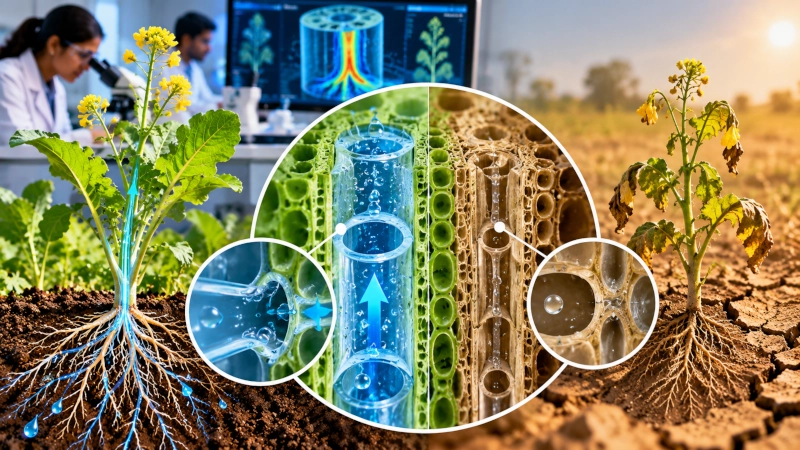
Researchers at the Indian Institute of Technology Guwahati (IIT Guwahati) have uncovered important mechanisms through which plants modify their internal water-transport systems during drought, providing new scientific insights that could contribute to the future development of drought-tolerant crop varieties. The research demonstrates how microscopic structures within plant stems respond to water shortages by altering their dimensions and the pathways through which water moves.
The findings were officially announced by IIT Guwahati on 26 October 2026. The study was conducted by researchers from the institute’s Department of Mechanical Engineering, who combined laboratory experiments with advanced three-dimensional computer simulations to investigate the response of plant tissues to water stress.
The research focused on Indian mustard plants and examined how their water-conducting tissues undergo structural and mechanical changes during periods of limited water availability. The findings were published in the international scientific journal Applied Physics Reviews.
The investigation could contribute to a better understanding of how plants maintain water balance during drought and provide valuable information for future research into crop resilience, agricultural water-use efficiency and sustainable farming.
Understanding the Natural Water Transport System in Plants
Water transport is one of the most important physiological processes supporting plant growth and survival. Plants absorb water from the soil through their roots and transport it towards the stems and leaves, where it supports photosynthesis, nutrient movement, cellular functions and temperature regulation.
This movement occurs primarily through specialised vascular tissues known as xylem, which form an interconnected network of microscopic water-conducting structures extending throughout the plant.
Xylem vessels contain small openings called pits that allow water to move between neighbouring conducting elements. These connections provide alternative routes for water movement and contribute to the functioning of the wider transport network.
Under normal environmental conditions, the xylem system supports the continuous movement of water from the roots towards the upper regions of the plant. However, when soil moisture becomes limited, plants experience increasing difficulty in maintaining water transport.
Drought can create substantial pressure within the water-conducting system because the plant must balance the need to supply its leaves with the necessity of limiting further moisture loss.
Understanding how the xylem network responds to these conditions is therefore important for explaining the physical processes that influence plant survival during water shortages.
Researchers Examine How Xylem Responds to Drought
The IIT Guwahati research team investigated how the physical characteristics of xylem tissues change when plants experience drought-induced water stress.
Earlier computational studies frequently represented xylem vessels as rigid tubes whose dimensions remained largely unchanged during water movement. Although such models could explain certain aspects of fluid transport, they were less capable of representing the structural adjustments occurring within plant tissues under environmental stress.
The researchers sought to address this limitation by examining the actual mechanical behaviour of xylem structures and incorporating their experimental observations into more realistic computer models.
The investigation was led by Professor Pranab Kumar Mondal of the Department of Mechanical Engineering at IIT Guwahati.
The team studied Indian mustard stems using advanced imaging techniques, microscopic force measurements and chemical tracking methods. These techniques enabled the researchers to examine changes in the dimensions, mechanical properties and wall characteristics of the water-conducting structures.
Particular attention was given to the tiny pits connecting neighbouring xylem vessels because these openings influence how water moves between different parts of the transport network.
By combining experimental measurements with computational modelling, the researchers developed a more detailed understanding of how drought alters the relationship between plant structure and internal fluid movement.
Xylem Vessels Become Narrower During Severe Water Shortages
One of the most important findings of the study concerns the structural changes occurring within xylem vessels during severe water stress.
The researchers found that the microscopic water-conducting tubes become narrower when plants experience acute water shortages. At the same time, the pits connecting neighbouring vessels become smaller.
These changes increase resistance to water movement within the plant’s vascular system.
As resistance increases, water flows less easily through the affected structures, particularly along the upward pathways connecting the roots with the leaves.
According to the researchers, this restriction helps limit water loss through transpiration, the process through which water vapour escapes from plant surfaces, primarily through openings in the leaves.
The ability to regulate internal water transport is important because excessive moisture loss during drought can threaten cellular functions and plant survival.
The findings demonstrate that the structure of the xylem network must be considered when investigating how plants respond to limited water availability.
Rather than functioning merely as a collection of rigid water-conducting tubes, the plant’s internal transport system exhibits mechanical changes that influence fluid movement under stressful conditions.
Sideways Water Movement Helps Maintain Internal Balance
The study also identified an important change in the direction of water movement within the xylem network.
While drought-induced narrowing increases resistance to the upward movement of water, the researchers found that water can move laterally through the pits connecting neighbouring conducting elements.
This sideways movement provides alternative pathways within the interconnected xylem system and helps maintain water balance during periods of stress.
The researchers’ observations and simulations suggest that these changes contribute to the continued functioning of the transport network despite reduced water availability.
This finding is significant because plant water transport is often described primarily in terms of vertical movement from the roots towards the leaves.
In reality, the vascular system contains interconnected pathways through which water can move between neighbouring structures.
The study demonstrates the importance of these connections and shows how structural changes can influence the distribution of water through the plant.
Understanding this behaviour could help scientists develop more accurate models of plant responses to drought and identify physical characteristics associated with the maintenance of water transport under difficult environmental conditions.
Advanced Three-Dimensional Simulations Reveal Internal Changes
An important feature of the IIT Guwahati investigation was the integration of laboratory observations with realistic three-dimensional computer simulations.
The researchers first examined actual plant tissues to measure changes in xylem dimensions, wall elasticity and mechanical behaviour under water stress.
These experimental measurements were then used to construct computational models capable of representing the effects of structural changes on fluid movement.
This approach differs from simplified models that assume the walls of water-conducting vessels remain rigid.
By incorporating the mechanical properties of plant tissues, the researchers were able to examine how changes in xylem geometry influence resistance to water movement and the distribution of fluid within the network.
The simulations also helped investigate the relationship between narrowing vessels, changing pit dimensions and the redistribution of water through interconnected pathways.
Such models are valuable because they allow researchers to examine microscopic processes that can be difficult to observe directly under continuously changing environmental conditions.
The combination of experimental measurements and computational simulations provides a framework for investigating plant water transport with greater attention to the physical behaviour of biological tissues.
The methodology also demonstrates how mechanical engineering and fluid dynamics can contribute to understanding biological processes traditionally studied within plant physiology.
Indian Mustard Plants Provide the Basis for the Investigation
The researchers selected Indian mustard as the plant system for examining drought-related changes in water transport.
Indian mustard is an important crop within India’s oilseed agricultural economy and is cultivated across several regions of the country.
Mustard cultivation is particularly relevant to agricultural research because crop productivity can be influenced by soil moisture availability, temperature and other environmental conditions.
The IIT Guwahati team examined mustard stems to understand how the internal xylem network responds when water availability becomes restricted.
Advanced imaging provided information about the structure of the conducting tissues, while microscopic force measurements helped the researchers investigate changes in their mechanical characteristics.
Chemical tracking techniques contributed additional information about fluid movement within the plant.
These observations were integrated into the three-dimensional models used to analyse the response of the transport system to water stress.
Although the investigation was conducted using Indian mustard, the physical principles explored may be relevant to broader research into plant vascular systems.
However, the findings should not automatically be assumed to apply identically to every crop species. Different plants possess distinct anatomical characteristics and physiological responses to drought, making further comparative research necessary.
Findings Could Support Development of Drought-Tolerant Crops
One of the potential applications of the research lies in the development of crop varieties capable of maintaining productivity under conditions of limited water availability.
Drought tolerance is a complex characteristic influenced by numerous factors, including root development, leaf structure, stomatal regulation, internal water transport and the plant’s ability to maintain cellular functions under stress.
The IIT Guwahati study provides information about one important component of this process: the physical behaviour of the xylem network during water shortages.
Understanding how vascular structures respond to drought could help scientists identify characteristics associated with more efficient water management.
Such information may eventually contribute to plant-breeding programmes seeking to develop crop varieties better adapted to water-scarce environments.
It could also support the development of predictive models that help researchers investigate how different plant characteristics influence responses to changing moisture conditions.
However, the research has not yet resulted in the release of a new drought-resistant crop variety. Its immediate contribution is to scientific understanding of plant water transport and the development of computational tools for studying drought responses.
Further research involving different crop species, environmental conditions and agricultural settings would be necessary before these findings could be translated into practical improvements in crop productivity.
Climate Change Increases Importance of Drought Research
Understanding how plants respond to drought has become increasingly important as agricultural systems face changing environmental conditions.
Variations in rainfall, prolonged dry periods, rising temperatures and increasing competition for water resources can affect crop growth and agricultural productivity.
Water shortages may reduce plant growth, interfere with physiological processes and influence the development of economically important agricultural products.
For farming communities, these effects can contribute to yield uncertainty and increased vulnerability during seasons characterised by inadequate rainfall.
Scientific research into drought response can help improve understanding of the characteristics that enable certain plants to tolerate water stress more effectively than others.
Studies involving root development, water transport, leaf physiology and cellular stress responses can provide complementary information for crop improvement programmes.
The IIT Guwahati investigation contributes to this wider research effort by examining the mechanical and fluid-transport properties of plant vascular tissues.
A more detailed understanding of these processes could eventually help researchers identify crop characteristics associated with improved resilience under water-limited conditions.
Such advances would be particularly relevant to agricultural regions where rainfall variability and limited irrigation resources present challenges for sustained crop production.
Mechanical Engineering Contributes to Plant Biology Research
The research also highlights the growing importance of interdisciplinary scientific approaches in addressing complex biological and agricultural problems.
Plant water transport involves physical principles associated with fluid mechanics, pressure differences, flow resistance and the mechanical properties of biological materials.
These processes can be investigated using analytical methods and computational techniques developed within engineering disciplines.
The IIT Guwahati team applied mechanical engineering expertise to examine how microscopic biological structures influence the movement of water through plant tissues.
By combining advanced imaging, mechanical measurements and numerical simulations, the researchers were able to investigate processes that cannot be fully understood through simplified descriptions of plant anatomy alone.
This integration of engineering and plant science creates opportunities for developing more accurate predictive models of biological systems.
The approach may also encourage further collaboration between mechanical engineers, plant physiologists, agricultural scientists and computational researchers.
Such interdisciplinary research can contribute to a deeper understanding of how biological organisms respond to environmental stresses and how physical processes influence their ability to survive.
Research Team and Scientific Publication
The investigation was conducted by a research team led by Professor Pranab Kumar Mondal of IIT Guwahati’s Department of Mechanical Engineering.
The other researchers included Jinmay Kalita, a research scholar in the department, Dr. Sumit Kumar Mehta, an ANRF National Post-Doctoral Fellow who worked in the department, and Dr. Suraj Panja, an Institute Post-Doctoral Fellow at IIT Guwahati.
The research findings were published in Applied Physics Reviews, an international peer-reviewed scientific journal covering developments in applied physics and related interdisciplinary fields.
The study draws attention to the mechanical characteristics of plant tissues and their influence on internal fluid transport during environmental stress.
Its combination of experimental observations and three-dimensional computational modelling provides a foundation for further investigations into the relationship between vascular structure and drought response.
The research also demonstrates the contribution of Indian scientific institutions to international studies involving plant physiology, computational science and sustainable agriculture.
Towards More Water-Efficient Agricultural Systems
The development of agricultural systems capable of coping with water shortages requires scientific progress across several interconnected fields.
Improved irrigation methods, soil moisture conservation, crop selection and the development of drought-tolerant varieties can all contribute to more efficient agricultural water management.
Research into the internal functioning of plants provides an additional foundation for these efforts by explaining how biological structures respond when environmental resources become limited.
The IIT Guwahati study demonstrates that microscopic changes within plant stems can influence the movement and distribution of water during drought.
By examining how xylem vessels narrow and how water is redistributed through interconnected pathways, the researchers have provided new information about the physical mechanisms involved in plant responses to water stress.
These findings may help scientists refine predictive models and investigate characteristics associated with drought tolerance.
The results also illustrate how advances in computational modelling can complement experimental plant research and improve understanding of processes occurring at microscopic scales.
Although practical agricultural applications will require further investigation, the study contributes to the scientific foundation needed for developing more resilient crop systems.
As India continues to strengthen agricultural research and address the challenges associated with climate variability, such investigations could play a role in improving understanding of crop responses to environmental stress.
The research undertaken at IIT Guwahati demonstrates how the integration of physics, engineering and plant biology can generate insights relevant to sustainable agriculture, water-use efficiency and long-term food security.
Official References
Indian Institute of Technology Guwahati, 26 October 2026. IIT Guwahati Study Reveals How Plants Adapt Their Internal Water Transport System During Drought. The institute’s official press release describes the investigation into Indian mustard plants, changes in xylem structure and pit openings, experimental measurements, three-dimensional computer simulations and the potential implications for drought-tolerant agriculture. The announcement identifies Professor Pranab Kumar Mondal and his collaborators and confirms publication of the findings in Applied Physics Reviews.
Indian Institute of Technology Guwahati — Research and Innovation Announcements. The institute’s official research archive lists the drought-response study under 26 October 2026, establishing the announcement date and providing institutional confirmation of the research.
Applied Physics Reviews. The peer-reviewed scientific journal published the IIT Guwahati research concerning plant xylem transport physics and its response to drought-induced water stress. The study combines experimental examination of plant tissues with computational modelling to investigate the effects of structural and mechanical changes on internal water movement.
You may also like
-
Indian Scientists Discover New Electric Ray Species in Arabian Sea, Revealing Hidden Deep-Ocean Biodiversity
-
ISRO Plans Four Operational Launch Pads by 2029 to Expand India’s Space Capabilities
-
Indian Scientists Discover How Rapidly Spinning Black Holes Produce High-Frequency X-Ray Oscillations
-
ISRO Completes Historic SPADEX Mission as Both Satellites Re-enter Earth’s Atmosphere After Successful Space Docking Experiments
-
Indian Scientists Discover Rare Accretion Disk Around Neutron Star 24,000 Light-Years Away
