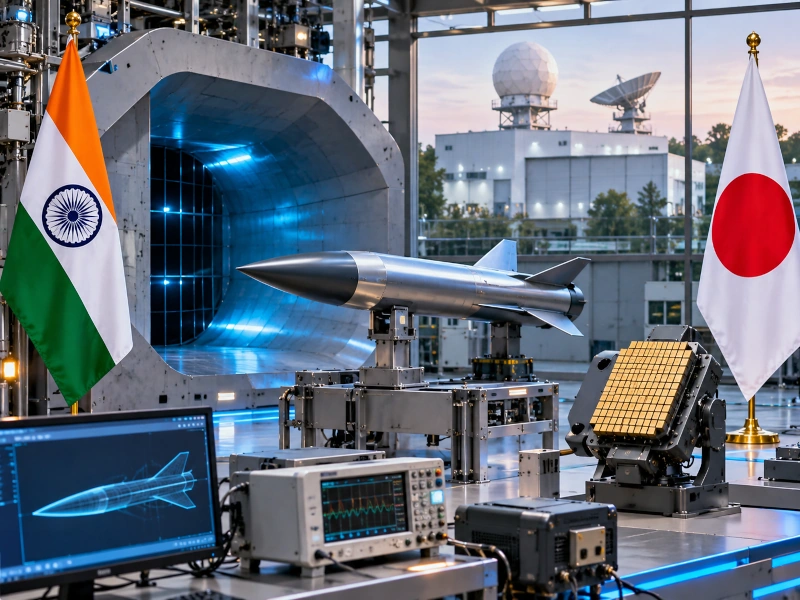
India and Japan have agreed to advance research and development cooperation in advanced missile and defence technologies through a partnership between India’s Defence Research and Development Organisation (DRDO) and Japan’s Acquisition, Technology and Logistics Agency (ATLA). The decision marks an important development in bilateral defence technology cooperation, bringing together two major national defence research organisations to explore opportunities in sophisticated military technologies.
The commitment was reaffirmed during bilateral talks between Defence Minister Rajnath Singh and Japanese Defence Minister Shinjiro Koizumi in Tokyo on 19 November 2026. The meeting took place alongside the fourth India–Japan Foreign and Defence Ministers’ Dialogue, commonly known as the 2+2 Dialogue, which reviewed the expanding defence and strategic partnership between the two countries.
According to the Indian Ministry of Defence, both ministers affirmed their intention to translate the existing DRDO–ATLA research cooperation framework into practical collaboration involving advanced missile and defence technologies. The development builds upon earlier agreements intended to strengthen technological cooperation, defence industrial partnerships and military research between India and Japan.
The announcement identifies advanced missile systems and defence technologies as priority areas for future cooperation. However, neither government has announced a specific jointly developed missile, technology-transfer agreement, research budget or development timetable.
DRDO and ATLA to Strengthen Advanced Defence Research Cooperation
The agreement represents a further step in the institutional relationship between DRDO and ATLA, the organisations responsible for supporting defence technology development in India and Japan, respectively.
DRDO is India’s principal defence research organisation, operating under the Ministry of Defence. Its laboratories and establishments undertake research and development across a wide range of military technologies, including missiles, radar systems, electronic warfare, aeronautics, naval systems, advanced materials, propulsion and battlefield equipment.
Over several decades, DRDO has contributed to the development of indigenous defence technologies intended to meet the operational requirements of the Indian Armed Forces. Its missile development programmes have included strategic and tactical systems, surface-to-air missiles, anti-tank guided missiles and other precision-guided weapons.
Japan’s ATLA operates under the Japanese Ministry of Defense and is responsible for major functions involving defence equipment acquisition, research, technological development and logistics. The agency works with Japanese research institutions, industrial manufacturers and defence organisations to support the development and acquisition of military equipment.
Cooperation between DRDO and ATLA provides an institutional framework through which the two countries can identify complementary research capabilities, exchange technical expertise and examine opportunities for collaborative development.
The decision announced in Tokyo establishes the intention to make this cooperation more substantial, particularly in advanced missile and defence technologies, while the selection of specific research projects remains subject to further bilateral discussions.
Advanced Missile Technologies Emerge as a Priority
One of the most significant aspects of the November 2026 announcement is the specific identification of advanced missile technologies as an area for bilateral research cooperation.
Modern missile systems incorporate several sophisticated technologies, including propulsion, guidance, navigation, control systems, seekers, sensors, electronic equipment, advanced materials and precision manufacturing.
Their development requires extensive expertise in aerodynamics, materials science, propulsion engineering, electronics, software and systems integration. Research organisations must also conduct ground testing, simulations and flight trials to evaluate the performance and reliability of new technologies.
India has developed substantial capabilities in missile design and development through DRDO and its associated industrial partners. Japan possesses advanced engineering, materials science, electronics and precision manufacturing capabilities that contribute to its domestic defence technology programmes.
Research cooperation between the two countries could provide opportunities to examine complementary technological strengths and identify areas where collaborative development would be beneficial.
However, the official announcement does not specify whether the proposed cooperation will focus on propulsion, guidance systems, seekers, missile defence, advanced materials or other particular technologies. These remain possible research fields rather than confirmed joint programmes.
Building on the India–Japan Security Cooperation Framework
The November 2026 announcement builds upon the broader security relationship established between India and Japan through successive bilateral agreements and high-level meetings.
In August 2025, the two countries adopted a Joint Declaration on Security Cooperation that identified defence research and development as an important component of their expanding strategic partnership.
The declaration specifically included the enhancement of cooperation between DRDO and ATLA, providing a formal basis for closer engagement between the two organisations.
The framework also identified opportunities for cooperation in emerging technologies, including artificial intelligence, robotics, quantum technologies, semiconductors, autonomous systems, biotechnology and cybersecurity.
These technologies are increasingly relevant to modern defence systems because military platforms depend on advanced computing, electronic components, secure communications, precision sensors and sophisticated control systems.
The decision to advance research cooperation in missile and defence technologies represents a continuation of this established framework rather than the creation of an entirely new bilateral relationship.
The November 2026 discussions therefore reflect an effort to move from broad commitments towards identifying practical areas of technological cooperation.
Earlier Defence Ministers’ Meetings Established the Foundation
The agreement in Tokyo followed several high-level interactions between the defence ministers of India and Japan during 2026.
During bilateral discussions in August 2026, both countries reaffirmed their intention to strengthen research and development cooperation between DRDO and ATLA in advanced defence technologies.
The defence ministers also discussed opportunities to expand collaboration in defence equipment, maritime security and industrial manufacturing.
Subsequent meetings continued this engagement, with both governments examining ways to develop practical cooperation involving specialised military technologies and defence production capabilities.
The November 19 meeting represented the third interaction between Rajnath Singh and Shinjiro Koizumi within a relatively short period, following their meetings in August and October 2026.
The frequency of these consultations demonstrates the growing institutional attention being given to defence cooperation between the two countries.
By reaffirming the DRDO–ATLA partnership at the November meeting, India and Japan identified advanced missile research as an area in which their earlier commitments could be translated into more concrete technological engagement.
Significance for India’s Indigenous Missile Development Ecosystem
India’s missile development ecosystem has evolved through decades of research undertaken by DRDO, supported by defence public sector undertakings, private manufacturers, academic institutions and specialised engineering companies.
The development of indigenous missile systems requires coordination across several technological disciplines. Research laboratories contribute to design and development, industrial partners manufacture components and subsystems, and specialised testing establishments evaluate performance under controlled conditions.
Indian companies such as Bharat Dynamics Limited and Bharat Electronics Limited participate in the country’s wider missile and defence electronics manufacturing ecosystem, alongside numerous private suppliers involved in propulsion components, precision engineering, electronic assemblies and advanced materials.
International research partnerships can complement domestic capabilities by providing opportunities for technical exchanges, joint investigations and collaboration in areas requiring specialised expertise.
For India, the proposed DRDO–ATLA cooperation is relevant to the wider objective of strengthening indigenous defence technology capabilities while maintaining access to international research partnerships.
The precise industrial implications will depend on the nature of future collaborative projects and whether they involve joint design, testing, technology development or production-related activities.
At present, the November 2026 announcement does not identify any Indian defence company as a participant in a specific DRDO–ATLA missile research project.
Japan’s Defence Technology Capabilities
Japan possesses a sophisticated defence technology ecosystem supported by government research organisations, major industrial manufacturers and specialised engineering institutions.
The country’s defence research activities encompass advanced electronics, radar systems, missile technologies, naval equipment, aerospace systems and precision engineering.
ATLA plays a central role in coordinating research and development activities intended to support the technological requirements of Japan’s Self-Defense Forces.
Japan’s industrial capabilities are particularly relevant in fields involving electronic systems, advanced materials, sensors, manufacturing precision and complex systems integration.
These capabilities provide a technological foundation for possible cooperation with international partners, including India.
For DRDO, engagement with ATLA could create opportunities for exchanges involving research methodologies, technical expertise and collaborative investigations in mutually identified fields.
Such cooperation would require agreement on project objectives, intellectual property arrangements, information security, technical responsibilities and other implementation requirements.
The extent of Japanese industrial participation or technology transfer has not been disclosed in the official announcement.
Defence Research Cooperation and the ‘Design with Japan, Make in India’ Approach
The DRDO–ATLA initiative forms part of a wider effort to strengthen India–Japan defence industrial cooperation.
During the fourth 2+2 Dialogue, both countries reaffirmed their intention to expand defence equipment and technology cooperation under the broader approach of combining Japanese technological expertise with India’s manufacturing capabilities.
The framework commonly described as “Design with Japan, Make in India” seeks to encourage closer cooperation in defence design, manufacturing and industrial development.
The approach is relevant to India’s efforts to strengthen domestic defence production through indigenous design, research partnerships and greater participation by Indian companies.
Collaborative research between DRDO and ATLA could complement this industrial engagement by helping identify technologies suitable for further development.
Research cooperation and industrial production, however, represent different stages of defence technology development. A bilateral commitment to undertake research does not automatically establish a manufacturing contract or guarantee production of a jointly developed system.
The transition from research cooperation to industrial development would depend on the technical feasibility, operational requirements and formal agreements associated with individual programmes.
Naval Technology Cooperation Demonstrates Expanding Partnership
The discussions concerning DRDO and ATLA took place alongside progress in other areas of defence technology cooperation.
India and Japan agreed to accelerate arrangements involving the Unified Complex Radio Antenna, known as UNICORN, an integrated naval antenna technology developed in Japan.
The two countries expressed expectations for the early conclusion of relevant arrangements and India’s Acceptance of Necessity for the proposed acquisition by February 2027.
UNICORN is intended to integrate selected naval antenna functions within a streamlined configuration, supporting the design of modern warships with more compact external equipment arrangements.
Both governments also discussed cooperation in naval shipbuilding, vessel design and mine countermeasure capabilities.
These discussions are relevant to India’s expanding naval modernisation and indigenous shipbuilding programmes.
Although the UNICORN initiative is separate from the DRDO–ATLA research partnership, both developments demonstrate the increasing importance of sophisticated defence technologies within India–Japan relations.
The parallel initiatives also indicate that cooperation is extending beyond conventional equipment purchases towards specialised systems, technological research and potential industrial partnerships.
Research Collaboration in Emerging Defence Technologies
Modern defence research increasingly involves technologies that extend beyond traditional weapons development.
Artificial intelligence, autonomous systems, advanced computing, electronic sensors, cybersecurity and semiconductor technologies contribute to the capabilities of contemporary military platforms.
Missile systems, naval vessels, aircraft and surveillance equipment depend on combinations of these technologies to perform complex operational functions.
India and Japan have recognised the importance of emerging technologies through their broader strategic and security cooperation frameworks.
Research collaboration in these fields can support the exchange of scientific expertise, joint studies and the development of technologies with potential defence applications.
For India’s defence research ecosystem, cooperation with technologically advanced partners offers opportunities to examine specialised approaches while continuing to develop indigenous capabilities.
The DRDO–ATLA partnership provides an institutional basis for identifying such opportunities, although the specific research subjects to be undertaken under the November 2026 commitment have not yet been disclosed.
Strategic Importance of India–Japan Defence Research Cooperation
India and Japan maintain a Special Strategic and Global Partnership that includes political dialogue, economic cooperation, maritime security and defence engagement.
Both countries have an interest in maintaining stable maritime routes, strengthening technological capabilities and improving cooperation across the Indo-Pacific.
Defence research collaboration adds a technological dimension to this relationship by creating opportunities for scientific and engineering institutions to work together.
Unlike conventional military exercises, research partnerships can support longer-term institutional engagement through technical exchanges, collaborative studies and the development of specialised expertise.
For India, cooperation with Japan provides an additional channel for international defence research while complementing the country’s emphasis on indigenous design and manufacturing.
For Japan, the partnership offers opportunities to engage with India’s expanding defence research establishment and industrial ecosystem.
The success of such cooperation will depend on identifying projects that meet the technical and operational requirements of both countries and establishing appropriate mechanisms for implementation.
Towards a More Technology-Oriented Defence Partnership
The decision announced in Tokyo on 19 November 2026 represents an important step in the continuing development of India–Japan defence technology cooperation.
By reaffirming their intention to advance collaboration between DRDO and ATLA in sophisticated missile and defence technologies, both countries have identified a specific research priority within their wider strategic partnership.
The commitment builds on the Joint Declaration on Security Cooperation adopted in August 2025 and subsequent ministerial discussions that emphasised the importance of closer defence research engagement.
The next stage will involve identifying suitable research projects, defining the responsibilities of participating organisations and establishing the technical and administrative arrangements necessary for implementation.
Although no specific joint missile development programme has yet been announced, the DRDO–ATLA initiative provides a framework for deeper institutional cooperation in advanced military research.
For India, the partnership offers an opportunity to complement indigenous defence research with international technological collaboration while strengthening the wider ecosystem of laboratories, manufacturers and specialised engineering institutions.
By combining India’s expanding defence research capabilities with Japan’s technological expertise, the DRDO–ATLA partnership can contribute to long-term research collaboration, stronger indigenous technological capabilities and a more comprehensive India–Japan defence relationship.
You may also like
-
Bhairav Robotics Begins Rajasthan Desert Trials of Indigenous Vrishabh Combat UGV, Plans Unmanned Combat Testing
-
India and Japan Sign Letter of Intent to Enable Japanese Military Live-Fire Training in India
-
India’s Mounted PCB Parts Exports Surge to $2.1 Billion as Electronics Manufacturing Diversifies
-
India and Japan Expand Defence Manufacturing Partnership, Accelerate UNICORN Naval Stealth Technology Cooperation
-
CSIR Transfers Five Indigenous Technologies to Industry for Sustainable Infrastructure and Industrial Development
