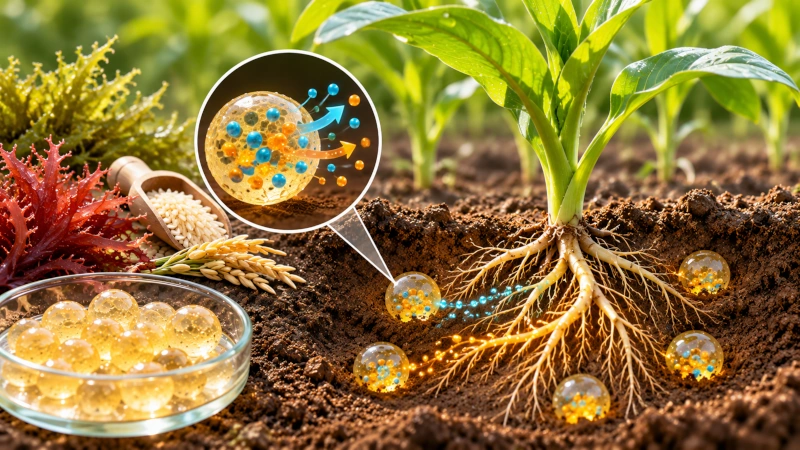
Researchers at the Indian Institute of Technology (IIT) Gandhinagar have developed an innovative seaweed-based nutrient delivery technology that responds to changes in soil acidity and releases essential micronutrients near plant roots. The development, announced by the Ministry of Education on November 17, 2026, introduces a promising approach to improving fertiliser efficiency, addressing micronutrient deficiencies and supporting more sustainable agricultural practices.
The technology uses small hydrogel beads manufactured from naturally derived materials to store essential plant nutrients and release them in response to changes in the surrounding soil environment. The beads contain micronutrients such as iron, zinc, manganese and copper, which are required in small quantities for normal plant development, photosynthesis and several important biological processes.
According to the researchers, the microbeads released up to 68% of their iron content and 66% of their zinc content under acidic conditions during laboratory experiments. Subsequent tests on model plants demonstrated improvements in chlorophyll content, leaf development and plant growth when the beads supplied a combination of essential micronutrients.
The research, published in the peer-reviewed journal ACS Omega, represents an important application of advanced biomaterials research to agriculture. By adapting hydrogel technology originally investigated for controlled drug delivery, the IIT Gandhinagar team has developed a system intended to improve the availability of plant nutrients while reducing some of the limitations associated with conventional fertiliser application.
Smart Nutrient Delivery Technology Responds to Soil Acidity
One of the most distinctive features of the technology is its ability to respond to changes in soil chemistry rather than release its entire nutrient content immediately after application.
Plant roots interact continuously with the surrounding soil through chemical and biological processes. The narrow region immediately surrounding the roots, known as the rhizosphere, is particularly important because it is where plants absorb water and nutrients and interact with soil microorganisms.
When certain plants experience deficiencies of micronutrients such as iron or zinc, their roots can release organic compounds that modify the chemical environment of the rhizosphere. These compounds may lower the local soil pH, increasing acidity and helping dissolve mineral nutrients that would otherwise remain unavailable.
The IIT Gandhinagar researchers designed the hydrogel beads to respond to this change in acidity. As the surrounding environment becomes more acidic, the structure of the beads changes, allowing a greater proportion of the stored micronutrients to move into the surrounding medium.
The principal innovation is the use of soil acidity as a natural chemical trigger for controlled nutrient release, potentially allowing fertiliser delivery to become more responsive to conditions around plant roots.
Unlike a conventional fertiliser granule that begins dissolving after exposure to moisture, the experimental microbeads exhibit different nutrient release rates depending on the acidity of their environment.
The system is not an absolute on-and-off mechanism, since some nutrients are released under neutral and alkaline conditions as well. However, laboratory results demonstrate that acidic conditions substantially increase nutrient release, establishing the pH-responsive behaviour of the material.
Microbeads Manufactured Using Red Seaweed and Natural Plant Compounds
The experimental beads are approximately 3.5 millimetres in diameter and are manufactured using two principal naturally derived ingredients: κ-carrageenan and trans-ferulic acid.
Carrageenan is a gel-forming substance extracted from certain species of red seaweed. It is widely studied for its ability to form water-absorbing structures and is used in several industrial, food and biomedical applications.
The second component, trans-ferulic acid, is a naturally occurring antioxidant found in cereal crops such as rice, wheat and oats. In the IIT Gandhinagar formulation, ferulic acid contributes to the structural properties of the gel and helps make it responsive to changes in acidity.
To manufacture the beads, the researchers dissolve the gel-forming ingredients in water and incorporate salts containing essential micronutrients. The resulting mixture is introduced into a calcium chloride solution, where calcium ions help connect the carrageenan chains and form a three-dimensional gel network.
The micronutrients become incorporated within this structure, allowing the beads to function as small nutrient reservoirs.
When the surrounding environment becomes acidic, interactions within the gel network change. This influences the material’s swelling behaviour and enables nutrients to move more readily into the surrounding solution.
The use of seaweed-derived carrageenan is particularly interesting for India because red seaweeds such as Kappaphycus are cultivated along parts of the country’s southern coastline.
Although the researchers obtained the ingredients from chemical suppliers for their experiments, the underlying materials have potential connections to India’s developing seaweed cultivation and agricultural biomass sectors.
Laboratory Tests Demonstrate 68% Iron and 66% Zinc Release
The research team conducted controlled laboratory experiments to examine how the microbeads behaved under acidic, neutral and alkaline conditions.
The results demonstrated substantial differences in the degree of swelling and the amount of micronutrients released.
At a pH of 4, representing strongly acidic conditions, the beads swelled by approximately 80% over two days. Under neutral conditions, the corresponding swelling was around 49%, while at an alkaline pH of 9, swelling was approximately 37%.
These differences are important because the swelling of the hydrogel influences the movement of water and dissolved nutrients through its internal structure.
The researchers also monitored micronutrient release over 14 days to determine how environmental acidity affected the movement of stored minerals.
Under acidic conditions, the microbeads released approximately 68% of their iron content and 66% of their zinc content.
At neutral pH, the corresponding release levels were approximately 46% for iron and 44% for zinc.
Under alkaline conditions, nutrient release declined to approximately 28% for iron and 27% for zinc.
The experiments demonstrated that the beads released substantially more iron and zinc in acidic environments than under neutral or alkaline conditions, confirming the intended pH-responsive nutrient delivery mechanism.
The findings provide experimental evidence that chemical conditions surrounding plant roots could potentially be used to influence nutrient availability.
However, the percentages represent controlled laboratory measurements over a defined experimental period. They do not establish that an equivalent proportion of nutrients would necessarily become available to crops under every agricultural soil condition.
Plant Experiments Show Encouraging Improvements in Growth
Following the laboratory evaluation of nutrient release, the IIT Gandhinagar researchers examined whether the formulation could support plant growth under controlled experimental conditions.
The team selected two model plant species commonly used in biological research: Arabidopsis thaliana and Nicotiana benthamiana.
Arabidopsis thaliana is widely used in plant science because its biological characteristics are well studied, while Nicotiana benthamiana, a relative of tobacco, is frequently used in research involving plant physiology and molecular biology.
The researchers cultivated the plants in nutrient-poor potting material adjusted to an acidic pH of 4.
Different groups received varying nutrient treatments, including microbeads containing iron, zinc, copper and manganese.
The results demonstrated that the combination of four micronutrients was more beneficial than formulations containing only individual nutrients.
In Arabidopsis thaliana, plants receiving the four-nutrient beads developed approximately 3.3 times more chlorophyll than plants grown without micronutrient supplementation.
The treated plants also developed substantially larger leaves, with reported leaf areas of approximately 22 square millimetres compared with around 2 square millimetres in plants that received no micronutrients.
The four-nutrient bead treatment also supported flowering. In the experiment, the plants receiving the complete laboratory nutrient solution and those receiving the four-nutrient beads were the only groups that reached the flowering stage.
In Nicotiana benthamiana, plants without micronutrient supplementation did not survive, while those receiving the four-nutrient beads recorded the highest chlorophyll content among the tested groups.
These results demonstrate the ability of the formulation to support plant development under the conditions examined.
The experiments provide encouraging evidence that controlled delivery of multiple micronutrients can improve plant growth, although the findings have not yet been established through large-scale agricultural field trials.
Addressing Widespread Micronutrient Deficiencies in Indian Soils
The research is particularly relevant to India because deficiencies of essential micronutrients affect agricultural soils across several regions.
Although plants require iron, zinc, copper and manganese in relatively small quantities, these elements perform important functions in enzyme activity, chlorophyll formation, photosynthesis, growth and cellular metabolism.
A shortage of essential micronutrients can interfere with normal plant development, leading to symptoms such as yellowing leaves, reduced growth, poor flowering and lower agricultural productivity.
The availability of these nutrients depends not only on their total concentration in soil but also on soil chemistry, pH, moisture and interactions with other minerals.
For example, iron may be present in substantial quantities but remain chemically unavailable to plants under certain soil conditions. Zinc can also become less accessible when it interacts with soil particles and other chemical constituents.
An analysis of India’s Soil Health Card data published in 2021 estimated that approximately 39% of Indian soils were deficient in zinc and around 19% were deficient in iron.
These findings illustrate the scale of micronutrient management challenges in Indian agriculture.
The IIT Gandhinagar technology seeks to address part of this problem by developing a material that can retain nutrients and release them more effectively in response to environmental conditions.
If successfully adapted for agricultural applications, such systems could provide additional tools for managing micronutrient availability, particularly in situations where conventional fertiliser application is inefficient.
Conventional Micronutrient Fertilisers Face Availability Challenges
Farmers commonly address micronutrient deficiencies through soil application of mineral salts, foliar sprays and specialised fertiliser formulations.
These methods can be effective when selected and applied appropriately. However, their performance is influenced by soil chemistry, crop requirements, weather conditions and application practices.
In some soils, micronutrient salts may react with other compounds and become less available for uptake by plant roots.
Water movement through soil can also redistribute dissolved nutrients, potentially reducing the proportion remaining within the active root zone.
Foliar spraying provides another method of supplying micronutrients directly to plant leaves, but its effectiveness depends on the crop, application timing, equipment and environmental conditions.
Chelated micronutrients can improve nutrient availability in certain circumstances, although their cost and environmental behaviour vary according to the formulation used.
The IIT Gandhinagar researchers have therefore investigated a different delivery approach in which micronutrients are incorporated into a hydrogel structure.
Instead of relying exclusively on immediate dissolution, the material is designed to release its stored nutrients progressively, with higher release rates under acidic conditions.
This approach could provide opportunities to improve the timing and localisation of nutrient delivery.
However, comparisons with existing commercial fertilisers will require further studies examining crop performance, nutrient uptake, application rates, manufacturing costs and field conditions.
Technology Adapted from Biomedical Hydrogel Research
An important aspect of the development is the transfer of a scientific concept from biomedical research into agricultural technology.
Hydrogels are water-absorbing polymer networks capable of holding substantial quantities of liquid and dissolved substances within their internal structures.
In biomedical research, hydrogels are investigated for applications such as wound dressings, tissue engineering and controlled delivery of therapeutic compounds.
One of their advantages is the possibility of designing formulations that release stored substances gradually or in response to changes in their surroundings.
The IIT Gandhinagar researchers recognised that similar principles could be applied to agricultural nutrient delivery.
The research was undertaken by doctoral scholars Hitasha Vithalani and Subhojit Ghosh of IIT Gandhinagar’s Department of Biological Sciences and Engineering.
Vithalani works on biomaterials for cancer and wound-treatment applications in the laboratory of Dr Mukesh Dhanka, while Ghosh studies biomolecules in plant systems under the guidance of Dr Subramanian Sankaranarayanan.
The collaboration brought together expertise in biomaterials engineering and plant biology to investigate a common agricultural challenge.
The resulting formulation demonstrates how technologies developed for one scientific discipline can be adapted to address problems in another.
The research is also an example of interdisciplinary innovation, combining polymer chemistry, materials science, plant physiology and agricultural nutrient management.
Potential to Improve Nutrient Use Efficiency and Agricultural Sustainability
The long-term significance of the technology lies in its potential to improve the efficiency with which applied micronutrients become available to crops.
In agricultural systems, the effectiveness of fertiliser use depends on the relationship between nutrient application, soil processes and plant uptake.
Nutrients that become chemically unavailable or move away from the root zone may provide less benefit than expected from the quantity applied.
Controlled delivery materials are being investigated as one way to influence these processes by retaining nutrients and releasing them under selected environmental conditions.
The IIT Gandhinagar microbeads could potentially help maintain nutrient availability near roots while reducing unnecessary early release.
If this behaviour translates successfully to agricultural soils, it may provide opportunities to improve micronutrient management and reduce avoidable nutrient losses.
Another potentially important characteristic is the use of naturally derived gel-forming materials.
Carrageenan and ferulic acid provide a basis for developing formulations using materials originating from biological sources.
However, the environmental sustainability of the finished product will depend on factors including manufacturing processes, material breakdown, application rates and effects on soil ecosystems.
The researchers have already identified these questions as priorities for future investigation.
Researchers Examine Biodegradability and Soil Safety
The IIT Gandhinagar team has also begun examining how the experimental microbeads behave after exposure to soil.
In one investigation, the researchers studied beads that had remained in soil for ten days.
Their analysis identified changes in the chemical characteristics and porous structure of the material, indicating that degradation-related processes had begun.
These observations are relevant because agricultural delivery materials must not only perform their intended function but also interact safely with the surrounding soil environment.
However, the researchers have not yet demonstrated complete biodegradation of the beads under field conditions.
Further investigations are planned to examine the long-term breakdown of the material and the environmental behaviour of its components.
The team also intends to evaluate possible effects on soil microorganisms.
This is particularly important because soil microbial communities contribute to nutrient cycling, organic matter decomposition and several processes essential to agricultural productivity.
A material intended for widespread agricultural use must therefore be assessed for both its nutrient delivery performance and its ecological compatibility.
The ongoing safety investigations will help determine whether the technology can be developed into a practical product suitable for sustained agricultural application.
Future Research to Examine Crop Yields and Nutritional Quality
Although the initial experiments demonstrated encouraging results in model plants, the researchers recognise that additional investigation is necessary before the technology can be applied commercially.
One priority is to evaluate the formulation under more realistic agricultural conditions.
Laboratory and controlled pot experiments allow researchers to isolate variables and understand how a technology functions. However, agricultural fields contain considerably more complex environments involving changing soil moisture, microbial activity, temperature fluctuations and different soil compositions.
The performance of pH-responsive microbeads may therefore vary between crops, soil types and agricultural regions.
The team plans to investigate the technology’s influence on crop yield, micronutrient accumulation in plant tissues and the nutritional quality of agricultural produce.
These studies will be important for determining whether the observed improvements in model plants can translate into practical agricultural benefits.
The researchers must also establish suitable manufacturing methods, application rates and storage characteristics.
Production costs will be another important consideration, particularly if the technology is intended for use by small and medium-sized farmers.
The research therefore remains at an experimental development stage, with field validation and commercial evaluation representing important next steps.
Indian Patent Filed as Researchers Explore Industrial Partnerships
The IIT Gandhinagar team has filed an Indian patent application covering the technology.
The application, numbered 202521114626, reflects the researchers’ efforts to protect the intellectual property associated with their nutrient delivery formulation.
Patent filing represents an important step towards potential technology commercialisation, although it does not establish that a patent has already been granted or that a commercial product is available.
The researchers are also exploring opportunities for collaboration with industrial partners to support further development.
Industry participation could provide access to expertise in manufacturing, formulation development, quality control, agricultural field testing and commercial distribution.
The team has identified the possibility of adapting the technology for different scales of application, ranging from home gardening to larger agricultural trials.
The eventual feasibility of these applications will depend on the outcome of further scientific testing and product development.
The development demonstrates how research institutions can contribute to agricultural innovation through intellectual property creation and collaboration with industry.
IIT Gandhinagar Researchers Receive National Recognition
The research has also received recognition from the Soluble Fertilizer Industry Association.
Doctoral scholars Hitasha Vithalani and Subhojit Ghosh secured first prize in the SOMS Thesis Showdown, a competition organised by the association to recognise research relevant to fertiliser technologies.
The recognition highlights the interest of the fertiliser industry in new approaches to nutrient management and controlled delivery systems.
The research team also includes Harshil Dave of IIT Gandhinagar and Kashish Agrawal of DY Patil Deemed to be University, Navi Mumbai.
The work received support through IIT Gandhinagar’s seed and start-up grants and the Department of Biotechnology.
The institutional support and industry recognition reflect the contribution of Indian academic research to developing technologies intended to address practical agricultural challenges.
Seaweed-Based Technology Opens Opportunities for Indian Bio-Based Materials
The use of carrageenan derived from red seaweed creates an additional connection between the research and India’s emerging marine biomass economy.
Seaweed cultivation is being developed in several coastal regions as a source of materials for food processing, agricultural products, industrial applications and other value-added uses.
Certain red seaweeds are commercially important because they contain compounds capable of forming gels and other functional materials.
Carrageenan is one such compound, and its properties make it relevant to applications requiring water retention, gel formation and controlled release.
The IIT Gandhinagar formulation demonstrates a potential application of this marine-derived material in agricultural micronutrient delivery.
The inclusion of ferulic acid, a compound naturally present in cereal crops, also highlights the possibility of combining materials associated with different biological resources to create functional products.
Although the research does not yet establish a commercial supply chain using domestically cultivated seaweed, it provides an example of how bio-based materials could be incorporated into advanced agricultural technologies.
Such research contributes to India’s broader scientific efforts to develop value-added materials from renewable biological resources.
Advancing Indigenous Agricultural Technology Development
The seaweed-based nutrient delivery system represents a contribution to India’s efforts to develop advanced agricultural technologies through domestic scientific research.
Modern agriculture increasingly depends on approaches that improve resource efficiency while maintaining soil health and supporting crop productivity.
These include precision fertilisation, advanced soil testing, controlled-release formulations, biological inputs and technologies designed to improve nutrient availability.
The IIT Gandhinagar research contributes to this expanding field by demonstrating a material that responds to its chemical environment and releases essential micronutrients under selected conditions.
Its development also highlights the importance of combining knowledge from different scientific disciplines to address challenges faced by farmers.
The research remains at an early stage of technological development, but the experimental findings provide a foundation for investigating more efficient micronutrient delivery systems.
The filing of a patent application and the search for industrial partners indicate that the researchers are examining ways to advance the technology beyond laboratory studies.
Towards More Efficient and Sustainable Nutrient Management
The development of seaweed-based smart fertiliser beads by IIT Gandhinagar marks an important advance in research into controlled micronutrient delivery for agriculture.
The technology uses naturally derived materials to create small hydrogel reservoirs that release greater quantities of iron and zinc when exposed to acidic conditions.
Laboratory experiments demonstrated the intended pH-responsive behaviour, while controlled plant studies showed improvements in chlorophyll content, leaf development and survival when multiple essential micronutrients were supplied through the beads.
The findings highlight the potential of advanced biomaterials to address problems associated with nutrient availability and fertiliser efficiency.
Further research will be necessary to establish field performance, complete biodegradability, ecological safety, manufacturing costs and practical benefits for crop production.
Nevertheless, the project demonstrates how Indian scientific institutions are developing original approaches to agricultural challenges by combining biological materials, engineering expertise and plant science.
With continued research and industry collaboration, the technology provides a promising foundation for developing more responsive nutrient delivery systems that could support efficient fertiliser use, improved crop nutrition and sustainable agricultural practices.
The IIT Gandhinagar innovation reinforces the importance of indigenous research in building a technologically capable agricultural sector and creating practical solutions suited to India’s long-term farming requirements.
You may also like
-
IIT Kharagpur Research Finds 37.76% Decline in Metal Pollution Index of Ganga–Hooghly Estuary
-
IIT Mandi Researchers Advance Next-Generation Memory Materials for Brain-Inspired Computing
-
Archaeological Survey Identifies 21 Prehistoric Sites and Over 580 Stone Artefacts in Madhya Pradesh
-
Former ISRO Chairman S. Somanath Highlights India’s Human Spaceflight and Lunar Exploration Roadmap
-
India Commits Over €7 Million to Italy’s Elettra 2.0 Synchrotron Research Programme
