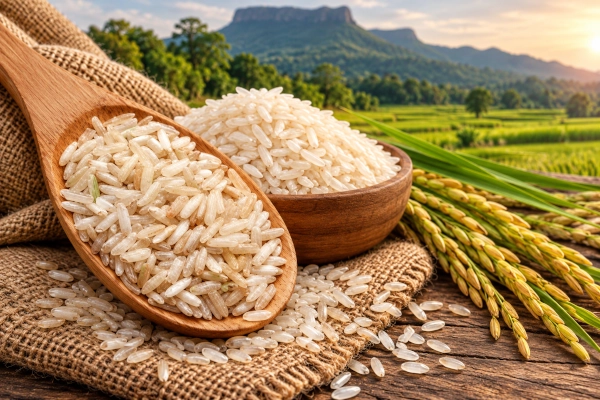
In the lush valleys of Maharashtra’s Western Ghats grows Ambemohar, an indigenous aromatic rice renowned for its delicate fragrance, soft texture and distinctive flavour. Traditionally cultivated in the Maval and Mulshi regions of Pune district, this heritage grain has been cherished for generations in Maharashtrian households, religious ceremonies and festive meals.
The name Ambemohar comes from two Marathi words: ambe, meaning mango, and mohar, referring to blossoms. The name describes the rice’s most celebrated characteristic—its natural fragrance, which resembles the delicate aroma of mango blossoms, particularly when the grains are cooked.
Unlike long-grained Basmati rice, Ambemohar has small, short white grains that become soft and slightly sticky after cooking. Its distinctive aroma, gentle sweetness and tender texture have made it especially suitable for traditional preparations such as varan-bhat, khichdi and ceremonial rice dishes.
Ambemohar received Geographical Indication (GI) registration on March 9, 2017, formally recognising its connection with Maharashtra’s traditional rice-growing regions. The recognition has helped protect the identity of a crop that represents centuries of agricultural knowledge and an important part of the state’s culinary heritage.
GI Details at a Glance
- Geographical Indication: Ambemohar Rice
- State: Maharashtra
- Product: Agricultural – Rice
- Class: 30
- Application Number: 478
- Date of Filing: 26 March 2014
- GI Journal: 88
- Journal Availability Date: 28 July 2016
- Certificate Number: 279
- GI Certificate Date: 9 March 2017
- Registered Proprietor: Mulshi Taluka Ambemohar Samvardhan Sangha
- Registered Proprietor’s Address: At/Post Khechare, Taluka Mulshi, District Pune – 412115, Maharashtra
- Geographical Area: Maharashtra
- Traditional Cultivation Region: Maval and Mulshi, Pune district
- Registration Valid Until: 25 March 2034
The official Geographical Indications Registry confirms these details under Application Number 478. The current validity date reflects the renewal recorded by the Registry in December 2023.
Origins and History of Ambemohar Rice in Maharashtra
Ambemohar belongs to Maharashtra’s longstanding tradition of cultivating indigenous aromatic rice varieties. Its history is closely associated with the Maval region of Pune district, where farmers have maintained locally adapted rice varieties over several centuries.
The precise date when Ambemohar first entered cultivation remains uncertain. However, historical accounts included in its GI documentation describe its use during the Peshwa period, when fine aromatic rice was valued for ceremonial feasts and important gatherings.
The Peshwa administration, centred in Pune, developed close connections with the surrounding agricultural settlements. Farmers in the Maval and Mulshi regions supplied agricultural produce to markets and households associated with the city.
The GI documentation records the historical association of Ambemohar with feasts organised during the Peshwa era. This connection reflects the rice’s established reputation as a desirable grain long before the development of modern agricultural marketing systems.
Ambemohar remained important because of its distinctive fragrance and cooking qualities. Generations of farmers continued preserving its seed material even as higher-yielding commercial varieties became increasingly popular.
Its survival illustrates the importance of traditional agricultural communities in maintaining crop varieties whose value extends beyond productivity alone.
The Geography and Climate Behind Ambemohar Rice
The traditional cultivation of Ambemohar is concentrated in the Maval and Mulshi regions, west of Pune, within the Sahyadri mountain landscape.
The Sahyadri ranges form part of the Western Ghats, one of India’s most important ecological regions. Their hills, valleys and seasonal streams create varied agricultural environments where farmers have developed locally adapted rice cultivation practices.
Ambemohar cultivation is particularly associated with the rain-fed paddy fields of the Maval tract. These areas receive substantial rainfall during the southwest monsoon, providing the moisture required for traditional rice farming.
The official GI documentation identifies the Kolwan Valley of Mulshi taluka as an important agricultural landscape. Its soils include reddish-brown silty soils and black clayey soils, with recorded acidity ranging approximately between pH 5.5 and 6.7.
The region’s agricultural conditions are also influenced by the Mula and Mutha river systems. Seasonal rainfall and moisture retained in valley soils support the development of paddy crops during the monsoon.
The interaction between the local environment, traditional seed material and established cultivation practices forms an important part of Ambemohar’s geographical identity.
What Makes Ambemohar Rice Unique?
Ambemohar is distinguished by its fragrance, short grain structure, cooking characteristics and naturally sweet taste.
Its most recognisable quality is the aroma released during cooking. The fragrance resembles mango blossoms, giving the rice its name and distinguishing it from many other indigenous aromatic varieties.
The official GI documentation describes Ambemohar as a white, short-grained rice with an average grain length of approximately 4.73 millimetres and an average breadth of 2.37 millimetres.
The grains become soft and slightly sticky after cooking. Unlike long-grained rice varieties that are often valued for remaining separate, Ambemohar is appreciated for its tender consistency and characteristic mouthfeel.
The rice also possesses a gentle sweetness that complements traditional Maharashtrian meals.
Scientific analysis identifies 2-acetyl-1-pyrroline (2AP) as an important aromatic compound associated with its fragrance. The same compound contributes to the characteristic scent of several other aromatic rice varieties, including Basmati.
However, Ambemohar’s overall sensory character is distinctive because of its combination of aroma, short grains, softness and traditional cultivation background.
These characteristics have established it as an important speciality rice within Maharashtra’s agricultural heritage.
Traditional Cultivation in the Maval and Mulshi Regions
Ambemohar cultivation follows agricultural practices developed by farmers in the rain-fed paddy landscapes of western Pune district.
The crop is traditionally established during the southwest monsoon. Farmers prepare nursery beds after the first seasonal rains, allowing seeds to germinate before transplanting the young seedlings into prepared fields.
The official GI documentation describes transplanting as an important method of establishing Ambemohar. Farmers prepare wet fields through puddling, which helps create suitable conditions for rice cultivation.
Traditional cultivation also involves careful seed selection. Farmers preserve grains from previous harvests and select suitable seed material to maintain the characteristics associated with the variety.
Organic manure and compost form part of documented field-management practices, although farmers may also use conventional agricultural inputs. Traditional cultivation should therefore not automatically be described as certified organic production.
Ambemohar generally requires 140–160 days to reach maturity, according to the registered product documentation. Its relatively long growing period makes seasonal rainfall and field moisture important considerations.
Farmers traditionally harvest the mature crop using hand tools before threshing, drying and storing the grain.
These methods reflect the agricultural knowledge developed through generations of cultivation in Maharashtra’s Western Ghats.
Ambemohar Rice in Traditional Maharashtrian Cuisine
Ambemohar occupies a distinctive place in Maharashtrian food traditions, particularly in dishes where the aroma and softness of rice are central to the eating experience.
One of its most familiar applications is varan-bhat, a traditional preparation of steamed rice served with lightly seasoned dal and ghee. Ambemohar’s fragrance and tender texture complement the simplicity of this meal.
The rice is also well suited to khichdi, where its soft grains combine with lentils and spices to create a comforting preparation.
In households that value traditional aromatic rice, Ambemohar may also be used for sweet dishes, including kheer, where its fragrance enhances the flavour of milk-based preparations.
Its sticky texture makes it particularly suitable for dishes that benefit from a cohesive consistency rather than long, separate grains.
The GI documentation also identifies Ambemohar’s use in religious ceremonies, marriage celebrations and traditional preparations such as vapholya, associated with Makar Sankranti.
Through these culinary traditions, Ambemohar remains connected with Maharashtra’s domestic food culture and ceremonial heritage.
Geographical Indication Recognition in 2017
Ambemohar received Geographical Indication registration under India’s Geographical Indications of Goods (Registration and Protection) Act, 1999.
The application was filed on March 26, 2014, by Mulshi Taluka Ambemohar Samvardhan Sangha, an organisation representing the interests of producers associated with the traditional cultivation region.
The Geographical Indications Registry published the application in Journal Number 88 on July 28, 2016. The rice subsequently received GI Certificate Number 279 on March 9, 2017.
The registration acknowledges Ambemohar’s geographical origin, distinctive characteristics and established reputation.
GI protection provides a legal framework for distinguishing authentic geographical products from unrelated goods marketed under the same designation.
For traditional rice varieties, this protection is particularly important because consumers may find it difficult to distinguish genuine heritage grains from similar-looking commercial products.
The registration also establishes a mechanism for maintaining product standards and protecting the reputation associated with the geographical indication.
Ambemohar’s registration was renewed in December 2023, extending its validity until March 25, 2034.
Agricultural Research and the Development of Ambemohar Varieties
Ambemohar has attracted scientific interest because of its aromatic properties, genetic characteristics and significance as an indigenous rice landrace.
Traditional rice landraces represent valuable genetic resources shaped by long-term cultivation and farmer selection. They may possess characteristics useful for crop improvement, including adaptation to local environmental conditions and distinctive grain qualities.
The official GI documentation identifies three pure-line selections developed from Ambemohar: Ambemohar-157, Ambemohar-159 and Ambemohar-102.
Pure-line selection involves identifying desirable plants within an existing crop population and developing more uniform breeding lines from their descendants.
Such efforts can help researchers improve crop consistency while retaining valuable characteristics of traditional varieties.
Research involving the University of Pune and the Bhabha Atomic Research Centre also examined genetic relationships among aromatic rice accessions using molecular marker techniques.
The study included Ambemohar material and identified genetic markers useful for distinguishing particular accessions.
This work demonstrates how molecular research can contribute to identifying traditional crop varieties and understanding their genetic diversity.
Scientific Research into the Fragrance of Ambemohar
The characteristic fragrance of Ambemohar is associated with naturally occurring volatile compounds released from the grain.
Among these, 2-acetyl-1-pyrroline plays an important role in producing the aroma associated with several fragrant rice varieties.
The GI documentation describes studies examining the presence of this compound in Ambemohar and comparing its aromatic characteristics with other rice varieties.
Understanding these compounds is important because fragrance is one of the principal qualities that determine consumer preference for speciality rice.
Agricultural researchers also study how genetic characteristics, cultivation conditions, harvesting and storage influence the sensory quality of aromatic grains.
Another study cited in the GI documentation examined the response of Ambemohar and Indrayani rice to salt stress.
The research reported differences in germination, plant growth and biochemical responses under the experimental conditions, with Ambemohar displaying greater tolerance in certain measured characteristics.
Such findings are relevant to understanding traditional rice diversity, although laboratory or seedling-stage tolerance does not automatically establish superior field performance under all growing conditions.
Scientific investigation of indigenous varieties can therefore contribute to future breeding programmes while supporting the conservation of traditional agricultural resources.
Traditional Rice Varieties and the Challenge of Higher-Yielding Crops
The continued cultivation of Ambemohar faces challenges common to many indigenous aromatic rice varieties.
Traditional landraces are often valued for grain quality rather than maximum agricultural productivity. Commercial high-yielding varieties may offer farmers advantages in yield, crop management and market availability.
Consequently, farmers may gradually reduce cultivation of heritage varieties when the returns from conventional crops become more predictable.
Ambemohar’s relatively tall plants and extended cultivation period can also influence agricultural management decisions.
The GI documentation identifies the spread of high-yielding varieties as one of the pressures affecting indigenous aromatic rice cultivation.
The preservation of Ambemohar therefore depends on maintaining its commercial value alongside its agricultural and cultural importance.
Distinctive grain quality, reliable market access and authentic geographical identification can help create incentives for farmers to continue cultivating the variety.
The Role of Mulshi Taluka Ambemohar Samvardhan Sangha
Mulshi Taluka Ambemohar Samvardhan Sangha played a central role in securing GI recognition for the rice.
The organisation submitted the registration application and provided documentation concerning the product’s history, geographical association, cultivation practices and distinguishing characteristics.
The GI application also describes an inspection and quality-assurance structure involving producer representatives, agricultural experts and GI specialists.
This system is intended to monitor the characteristics associated with Ambemohar and support compliance with the registered product specifications.
Quality assurance is particularly important for traditional rice because grain mixing, unsuitable seed material and inconsistent processing can affect the characteristics expected by consumers.
Producer organisations can also support farmers through collective marketing, seed conservation and coordination with agricultural institutions.
Such cooperation helps protect the identity of the rice while providing a framework for developing its commercial potential.
Ambemohar and Maharashtra’s Market for Heritage Rice
Growing consumer interest in regional foods and traditional grains has created opportunities for speciality rice varieties such as Ambemohar.
Unlike ordinary rice sold primarily according to grain grade and market price, Ambemohar attracts consumers because of its fragrance, culinary characteristics and geographical identity.
The growing market for traditional Maharashtrian ingredients provides opportunities for farmers, processors and local agricultural enterprises.
Improved packaging and transparent product information can help consumers recognise genuine Ambemohar and understand its distinctive qualities.
Restaurants specialising in Maharashtrian cuisine can also contribute to promoting traditional rice varieties by incorporating them into regional preparations.
However, GI registration does not automatically guarantee commercial success or higher farm incomes. Farmers still require reliable buyers, appropriate processing facilities, consistent grain quality and suitable marketing channels.
Collective branding and producer-led marketing can help maintain the product’s identity while expanding its reach beyond traditional growing areas.
Preserving Ambemohar’s Genetic Heritage
Ambemohar represents an important component of India’s indigenous aromatic rice diversity.
Landraces preserved through farmer-managed seed systems contain genetic characteristics that may differ from those found in modern commercial cultivars.
These differences provide valuable resources for agricultural research and future crop improvement.
Maintaining original Ambemohar seed populations is particularly important because repeated substitution with other varieties could gradually erode the characteristics associated with the traditional grain.
Community seed conservation, documentation of local varieties and scientific characterisation can help protect this genetic resource.
Agricultural institutions can contribute by studying crop performance, disease response, grain quality and sustainable cultivation practices.
The continued participation of farmers remains central to these efforts. A traditional crop survives as a living agricultural resource only when communities continue planting, harvesting and preserving its seeds.
The Future of Ambemohar Rice in Maharashtra
Ambemohar has opportunities for development within India’s growing market for distinctive regional agricultural products.
Its natural fragrance, traditional reputation and GI recognition provide a foundation for positioning it as a speciality rice associated with Maharashtra’s Western Ghats.
Improved cultivation practices can help farmers manage production challenges while preserving the grain’s defining characteristics.
Scientific research into aromatic compounds, varietal purity and crop performance can also support the development of suitable production systems.
Producer organisations have an important role in connecting farmers with processors, retailers and consumers who value authentic heritage products.
Greater awareness of traditional Maharashtrian cuisine can further encourage demand for Ambemohar, particularly among consumers interested in regional food traditions.
The long-term preservation of the variety depends on ensuring that its geographical identity remains connected with genuine cultivation, seed conservation and consistent grain quality.
Ambemohar Rice: Maharashtra’s Fragrant Agricultural Heritage
Ambemohar rice represents the enduring relationship between Maharashtra’s Sahyadri landscape, traditional agriculture and regional food culture.
Its short white grains, mango-blossom fragrance and soft cooking texture distinguish it from many commercially available rice varieties. Generations of farmers in the Maval and Mulshi regions have preserved these characteristics through traditional cultivation and seed selection.
The GI recognition granted in 2017 formally acknowledges this heritage and provides a framework for protecting the rice’s geographical reputation.
Agricultural research, producer organisations and improved market access can now help strengthen its position within India’s speciality rice sector.
Beyond its culinary appeal, Ambemohar remains a valuable genetic resource and a reminder of the diversity preserved within India’s traditional agricultural systems.
By maintaining authentic seed material, supporting farmers and encouraging appreciation of indigenous grains, Maharashtra can carry the fragrance and agricultural legacy of Ambemohar to future generations.
References
- Geographical Indications Registry, Intellectual Property India — Ambemohar Rice, Application Number 478. Official registration, certificate date, applicant details, GI journal publication and renewed validity.
https://search.ipindia.gov.in/GIRPublicSearch/Application/Details/478 - Geographical Indications Registry — GI Journal Number 88, July 28, 2016. Official registered product documentation covering historical origins, grain characteristics, cultivation practices, geographical conditions and scientific research.
https://www.origin-gi.com/wp-content/uploads/2017/06/5-ambemohar-rice.pdf - Agricultural and Processed Food Products Export Development Authority (APEDA) — Geographical Indications of Maharashtra. Official listing of Ambemohar Rice and its registered proprietor.
https://apeda.gov.in/Maharashtra - Intellectual Property India — Registration Details of Geographical Indications. Government register listing Ambemohar Rice among Maharashtra’s registered agricultural GI products.
https://www.ipindia.gov.in/writereaddata/Portal/News/367_1_Registered_GI.pdf - Intellectual Property India — Introduction to Geographical Indications. Legal framework, protection of geographical products, registration and renewal provisions.
https://www.ipindia.gov.in/gi-introduction
You may also like
-
India Post and UTI Mutual Fund Expand Partnership to Provide Doorstep KYC Verification Across India
-
India Advances Research in Reusable Rockets, Green Propulsion and Autonomous Spacecraft Technologies
-
India Advances $4 Billion Thoothukudi Mega Shipyard Project with South Korea’s HD Hyundai
-
India Releases ₹1,000 Crore MSME Subsidy to Support 11,333 New Enterprises and Over One Lakh Jobs
-
Navin Fluorine Expands US Specialty Chemicals Supply Contract to $590 Million, Extends Agreement Until 2032
