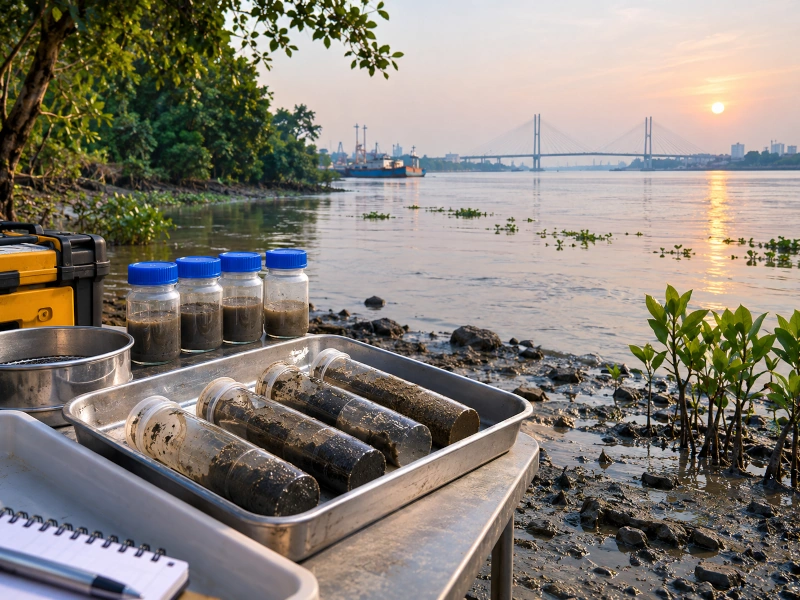
Researchers at the Indian Institute of Technology (IIT) Kharagpur have identified a significant improvement in the environmental condition of the Ganga–Hooghly estuary, reporting a 37.76% reduction in the Pollution Load Index (PLI) of its sediments over the period examined. The findings, announced by the Ministry of Education on November 17, 2026, provide scientific evidence of declining metal contamination in one of India’s most important estuarine ecosystems and highlight the relevance of sustained environmental monitoring and river conservation initiatives.
The research, published in GeoHealth, a peer-reviewed journal of the American Geophysical Union, forms part of an international comparative investigation examining long-term changes in metal contamination across major estuaries in India, China and the United States. The study assessed historical pollution patterns, population pressure and environmental management measures to understand how sediment contamination has changed over time in densely populated and industrially developed river systems.
The investigation was led by Professor Parthasarathi Chakraborty of the Marine Trace Metal Biogeochemistry Laboratory at IIT Kharagpur’s Centre for Ocean, River, Atmosphere and Land Sciences (CORAL). The research team included Soham Chatterjee, Anindya Das, Gunjan Roy, Smrutirekha Mohanta and Sucharita Chakraborty. Their findings contribute to the scientific understanding of how environmental conditions evolve in estuarine systems exposed to industrial activity, urbanisation, wastewater discharge and other human pressures.
Ganga–Hooghly Estuary Records Significant Improvement in Sediment Quality
The Ganga–Hooghly estuary forms an important connection between the Ganga river system and the Bay of Bengal. Flowing through one of India’s most densely populated and economically active regions, the estuary supports maritime transport, fisheries, agriculture and a wide range of commercial and industrial activities.
Its environmental condition is influenced by several factors, including municipal wastewater, industrial discharges, agricultural runoff, port operations and the movement of sediments through the river system. Metals entering the aquatic environment can accumulate in bottom sediments, where they may remain for extended periods and influence the surrounding ecosystem.
The IIT Kharagpur researchers examined changes in sediment contamination using the Pollution Load Index, a scientific indicator that combines information about multiple metals to assess their overall contamination burden.
The study reported a 37.76% reduction in the Pollution Load Index of the Ganga–Hooghly estuary, indicating a substantial improvement in the combined metal contamination indicator across the historical observations examined.
The researchers found that contamination levels had remained elevated during earlier periods, particularly around the beginning of the 2000s. Subsequent assessments showed a gradual decline, with lower contamination indicators reported in the years following 2014.
The findings indicate a positive long-term environmental trend in the estuary, although the reduction relates specifically to the sediment metal pollution indicator rather than every category of water pollution.
Understanding the Pollution Load Index
The Pollution Load Index is used in environmental research to assess the combined contamination burden of multiple metals in sediments. It provides a composite measure that helps scientists compare contamination levels across locations or investigate changes over time.
Sediments are particularly useful for environmental monitoring because they can retain metals introduced into aquatic environments through natural processes and human activities. Unlike some water-quality measurements that may change rapidly with rainfall, tides or river discharge, sediment composition can provide information about longer-term contamination patterns.
Metal contamination is an important environmental concern because certain metals can persist in sediments and, depending on their chemical forms and environmental conditions, become available to aquatic organisms.
The Pollution Load Index helps researchers evaluate the combined contamination burden rather than considering each metal separately. A decline in the index generally indicates an improvement in sediment quality with respect to the metals included in the assessment.
The 37.76% reduction identified by IIT Kharagpur therefore represents a meaningful scientific finding. It does not mean that every individual metal declined by exactly 37.76%, nor does it establish an equivalent percentage improvement in river-water quality or overall ecological health.
By documenting changes in sediment contamination, the study provides information relevant to evaluating long-term environmental conditions and identifying areas where further pollution-control measures may be required.
Research Examines Ten Major Estuaries Across Three Countries
The IIT Kharagpur investigation extended beyond the Ganga–Hooghly estuary to examine metal contamination patterns in ten major estuarine systems across India, China and the United States.
The study included four Indian estuaries, three Chinese estuaries and three American estuaries, allowing researchers to compare environmental conditions across river systems experiencing different levels of population pressure, industrial development and environmental management.
To undertake the assessment, the research team reviewed 1,323 scientific publications and identified approximately 150 studies containing quantitative data suitable for comparative analysis.
The researchers used these datasets to examine historical changes in metal contamination and evaluate differences between estuaries.
The international comparison was particularly relevant because many large estuaries receive pollutants from densely populated river basins and industrial areas. However, the nature and intensity of pollution can vary considerably depending on local geography, economic activities, wastewater management and environmental regulations.
The study found that pollution trajectories differed between the investigated estuaries, with some recording substantial long-term reductions while others continued to experience elevated or fluctuating contamination.
These variations demonstrate the importance of evaluating river systems individually while also examining broader patterns through international scientific comparisons.
India’s Mahanadi Estuary Records 70.46% Reduction
The research also identified a substantial long-term decline in sediment metal contamination in the Mahanadi estuary, another important Indian river system.
According to the comparative findings, the Mahanadi estuary recorded a 70.46% reduction in its Pollution Load Index across the periods examined.
The Mahanadi River flows through central and eastern India before entering the Bay of Bengal through its extensive delta system in Odisha. The river supports agriculture, water supply, industrial activity and important coastal ecosystems.
The reduction in the sediment contamination indicator provides evidence of improving conditions with respect to the metals assessed in the study.
The finding is significant because it shows that declining sediment metal contamination is not confined to the Ganga–Hooghly system. The research identifies improvement in another major Indian estuary, strengthening the case for continued scientific assessment of river and coastal environments.
At the same time, the researchers emphasised that environmental conditions differ between estuaries and that long-term changes must be interpreted in relation to their respective sources of pollution, management measures and natural processes.
Hudson River Estuary in the United States Records 80.68% Decline
The international assessment identified an 80.68% reduction in the Pollution Load Index of the Hudson River estuary in the United States.
The Hudson River system passes through an extensively urbanised and industrialised region of the northeastern United States. Its environmental history includes substantial industrial activity and long-running efforts to address contamination and improve river conditions.
The reported reduction provides an international reference point for understanding how sediment contamination can change over extended periods.
The researchers also examined other estuaries, including Galveston Bay, the Yellow River estuary, the Yangtze estuary, the Pearl River estuary, Chesapeake Bay, the Cochin estuary and the Ulhas estuary.
The study found substantial differences in pollution levels across these environments, demonstrating that estuarine contamination is shaped by a combination of human activities, environmental characteristics and management practices.
These comparisons provide a broader scientific context for evaluating the improvements identified in the Ganga–Hooghly and Mahanadi estuaries.
Researchers Examine Environmental Changes Following Namami Gange
An important aspect of the IIT Kharagpur research is its examination of long-term pollution trends in relation to major environmental management initiatives.
The researchers observed that the decline in sediment metal contamination in the Ganga–Hooghly estuary became evident in assessments conducted after the introduction of the Namami Gange Programme in 2014.
Namami Gange was launched by the Government of India to support the conservation and rejuvenation of the Ganga through pollution abatement, wastewater management and ecosystem restoration.
The programme encompasses activities intended to reduce pollution entering the river system and improve the management of wastewater and other environmental pressures.
According to the Ministry of Education’s announcement, the observed decline in the Ganga–Hooghly estuary is consistent with the objectives of sustained river conservation initiatives, including Namami Gange.
However, the study does not establish that the entire 37.76% reduction was caused by any single programme. Long-term changes in sediment contamination can arise from multiple interacting factors, including industrial practices, regulatory measures, wastewater treatment, changes in pollutant discharge and natural sediment processes.
The researchers also acknowledged earlier conservation initiatives, including the Ganga Action Plan, as part of the broader history of river management efforts.
The findings therefore provide encouraging evidence of environmental improvement while reinforcing the importance of scientific monitoring in assessing the effectiveness of pollution-control measures.
New Population-Normalised Pollution Indicator Developed
Beyond documenting changes in sediment contamination, the IIT Kharagpur researchers introduced an additional analytical tool called the Population Normalised Pollution Load (PNPL).
This indicator is intended to complement the conventional Pollution Load Index by examining sediment metal contamination in relation to population pressure.
Population growth and urban expansion can place increasing demands on river systems through wastewater generation, industrial activity, infrastructure development and changes in land use.
Evaluating pollution levels without considering these pressures may provide an incomplete picture of how environmental conditions are changing.
The Population Normalised Pollution Load introduces a way to examine contamination in relation to the human population associated with an estuarine environment.
By combining the conventional Pollution Load Index with this additional indicator, the researchers developed a framework for investigating whether contamination conditions are improving or deteriorating relative to population-related pressures.
The approach offers an additional perspective for international comparisons, particularly where estuaries differ substantially in population size and levels of urbanisation.
The researchers identified potential applications for this framework in environmental monitoring, coastal management and the assessment of pollution-control strategies.
Sediment Monitoring Provides Important Evidence of Environmental Change
Sediments play a central role in the movement, accumulation and transformation of metals within river and estuarine environments.
When rivers carry suspended particles towards coastal areas, changes in water flow, salinity and other environmental conditions can cause some materials to settle and become incorporated into bottom sediments.
Metals originating from industrial activity, municipal wastewater, agricultural sources and natural geological processes may become associated with these particles.
Over time, sediment deposits can preserve information about environmental conditions and contamination patterns.
However, sediment contamination does not remain entirely static. Changes in water chemistry, oxygen availability, salinity, tidal movement and sediment disturbance can influence the behaviour and mobility of certain metals.
This makes long-term monitoring particularly important in estuarine systems, where river water and seawater interact.
The IIT Kharagpur research demonstrates the value of combining observations from multiple scientific studies to identify broader environmental trends that may be difficult to establish from individual sampling campaigns.
Such assessments can help researchers distinguish longer-term changes from temporary fluctuations and provide a stronger scientific foundation for environmental management.
Implications for Aquatic Ecosystems and Coastal Livelihoods
The environmental condition of the Ganga–Hooghly estuary is important because the river system supports fisheries, aquatic biodiversity, agricultural activities, maritime transportation and communities dependent on coastal and riverine resources.
Sediment quality is an important component of aquatic ecosystem health because numerous organisms live in or interact with bottom sediments.
Certain metals can affect aquatic organisms when they become biologically available, although their environmental effects depend on concentration, chemical form and exposure conditions.
A long-term reduction in the combined sediment metal contamination indicator is therefore an encouraging finding for environmental management.
However, the ecological implications of the reported decline require assessment alongside other indicators, including dissolved oxygen, organic pollution, microbial contamination, nutrient concentrations and biological conditions.
The study does not establish that the estuary is entirely free from pollution or that all ecological pressures have been resolved.
Instead, it documents improvement in one important category of environmental contamination and provides a scientific basis for further investigation.
The findings are relevant to coastal communities because improvements in river and estuarine environments can support the long-term management of ecosystems associated with fisheries, livelihoods and other economic activities.
IIT Kharagpur Strengthens India’s Environmental Research Capabilities
The study highlights the contribution of IIT Kharagpur’s Centre for Ocean, River, Atmosphere and Land Sciences to environmental research addressing major national and international challenges.
CORAL undertakes multidisciplinary investigations involving aquatic environments, atmospheric processes, land systems and their interactions.
The research led by Professor Parthasarathi Chakraborty combines environmental chemistry, sediment analysis, scientific literature assessment and international comparison to examine changes in contamination across major estuarine systems.
The investigation demonstrates the importance of using scientific evidence to evaluate environmental conditions rather than relying exclusively on individual measurements or short-term observations.
By examining ten estuaries across three countries, the researchers have placed India’s river conservation experience within a broader international scientific framework.
The development of the Population Normalised Pollution Load indicator also represents a methodological contribution that could support future investigations of pollution in regions experiencing substantial demographic and industrial pressures.
The research reinforces the role of Indian scientific institutions in producing knowledge relevant to environmental protection, sustainable development and evidence-based policymaking.
Scientific Findings Highlight the Importance of Sustained River Conservation
The findings from IIT Kharagpur provide encouraging evidence that sediment metal contamination in the Ganga–Hooghly estuary has declined over the historical period examined.
The reported 37.76% reduction in the Pollution Load Index represents a measurable improvement in the combined metal contamination indicator, while the 70.46% reduction recorded in the Mahanadi estuary demonstrates that comparable long-term improvements have also been identified in another major Indian river system.
The international comparison, including the 80.68% reduction observed in the Hudson River estuary, illustrates how scientific monitoring can document changes in environmental conditions across different regions.
The research also underlines the importance of understanding the relationship between pollution trends, population pressure and environmental management measures.
While the decline observed after 2014 is consistent with the objectives of initiatives such as Namami Gange, the study recognises that river restoration outcomes are influenced by multiple factors and require sustained assessment.
Continued wastewater treatment, pollution prevention, regulatory enforcement and scientific monitoring remain important for maintaining and extending environmental improvements.
Towards Cleaner Rivers and Healthier Estuarine Ecosystems
The IIT Kharagpur study represents an important contribution to India’s understanding of long-term environmental changes in major river and estuarine systems.
By documenting a 37.76% decline in the sediment Pollution Load Index of the Ganga–Hooghly estuary, the researchers have provided scientific evidence of improving conditions with respect to the metals assessed.
The investigation also demonstrates the value of international comparisons and introduces an additional analytical approach for examining pollution in relation to population pressure.
For India, where rivers support agriculture, livelihoods, industry, biodiversity and cultural traditions, sustained improvements in environmental quality carry considerable significance.
The findings highlight the contribution of rigorous scientific research to understanding environmental progress and identifying priorities for continued conservation.
As India strengthens its river rejuvenation and coastal management efforts, research from institutions such as IIT Kharagpur provides valuable evidence for developing effective environmental policies and monitoring their results.
The documented improvement in the Ganga–Hooghly estuary offers an encouraging example of how long-term scientific assessment can support the objective of cleaner waterways, healthier aquatic ecosystems and sustainable management of India’s river resources.
You may also like
-
IIT Mandi Researchers Advance Next-Generation Memory Materials for Brain-Inspired Computing
-
Archaeological Survey Identifies 21 Prehistoric Sites and Over 580 Stone Artefacts in Madhya Pradesh
-
Former ISRO Chairman S. Somanath Highlights India’s Human Spaceflight and Lunar Exploration Roadmap
-
India Commits Over €7 Million to Italy’s Elettra 2.0 Synchrotron Research Programme
-
Indian Scientists Discover New Deep-Sea Bramble Shark Species off Kerala Coast
