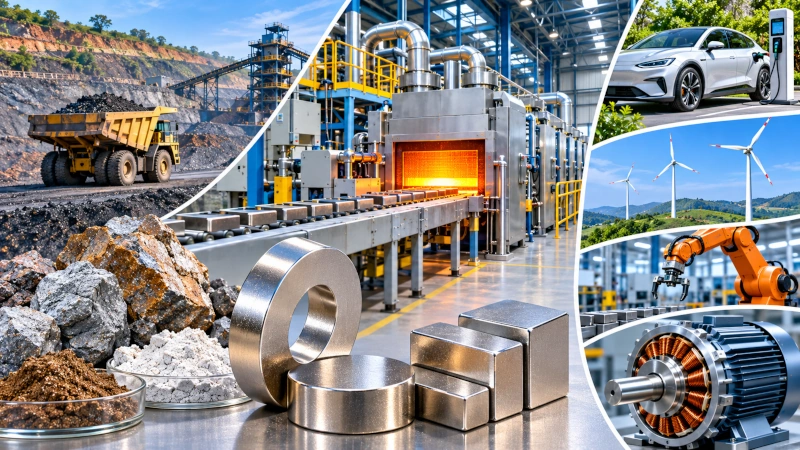
Coal India Limited (CIL), India’s largest coal-producing public sector enterprise, has received a Letter of Intent from the Ministry of Heavy Industries for establishing a manufacturing facility for sintered rare earth permanent magnets with an annual production capacity of 1,200 tonnes. The development represents an important step in the company’s diversification into critical mineral-based advanced manufacturing and India’s efforts to establish domestic production capabilities for materials used in electric vehicles, renewable energy systems, industrial machinery and high-technology equipment.
In a regulatory filing submitted to the Bombay Stock Exchange (BSE) and National Stock Exchange (NSE) on November 19, 2026, Coal India confirmed that it had been declared the L2 bidder as the lead member of a consortium with the Non-Ferrous Materials Technology Development Centre (NFTDC). The Letter of Intent was issued under the Government of India’s Scheme to Promote Manufacturing of Sintered Rare Earth Permanent Magnets.
The proposed facility will manufacture neodymium-iron-boron (NdFeB) permanent magnets through a Special Purpose Vehicle (SPV) established under the scheme. The project forms part of India’s wider initiative to develop an integrated rare earth magnet manufacturing ecosystem and reduce dependence on imported components essential to advanced industries.
Coal India and NFTDC Consortium Selected Under Government Scheme
The Ministry of Heavy Industries issued the Letter of Intent to the Coal India-led consortium on November 19, 2026, following the competitive selection process established under the national rare earth permanent magnet manufacturing scheme. Coal India’s regulatory disclosure identifies the company as the lead member of the consortium with NFTDC and confirms its position as the L2 bidder.
The proposed manufacturing facility will have an annual capacity of 1,200 tonnes of sintered NdFeB permanent magnets. These magnets are manufactured using alloys containing neodymium, iron and boron, with additional elements incorporated where required to achieve specific performance characteristics. Their high magnetic strength and compact size make them particularly important for modern electrical and electromechanical equipment.
The project is envisaged through a Special Purpose Vehicle, which will serve as the entity responsible for establishing and operating the manufacturing facility. Under the government scheme, consortium-based beneficiaries are required to establish an appropriate corporate structure for implementing their allocated manufacturing capacity.
Coal India’s disclosure identifies a seven-year project period, comprising two years of pre-construction activities and five years of operations. This corresponds to the broader scheme structure, which provides an initial establishment period followed by an incentive-supported manufacturing phase.
The Letter of Intent marks an important development in the selection and allocation process. However, Coal India has not announced the commencement of construction, the final location of the proposed facility or a confirmed date for the beginning of commercial production.
₹7,280 Crore National Scheme to Establish Rare Earth Magnet Manufacturing
The Coal India-led project forms part of the Government of India’s ₹7,280 crore scheme to promote domestic manufacturing of sintered rare earth permanent magnets. The Union Cabinet approved the initiative on November 26, 2025, and the Ministry of Heavy Industries issued the scheme notification on December 15, 2025.
The programme aims to establish an integrated manufacturing capacity of 6,000 metric tonnes per annum across five selected beneficiaries. Each beneficiary may receive an allocation of up to 1,200 tonnes of annual manufacturing capacity, creating the foundation for a domestic industry capable of producing high-performance permanent magnets from rare earth materials.
The scheme provides capital subsidies for establishing manufacturing facilities and sales-linked incentives for eligible domestically manufactured magnets. Its seven-year duration includes a two-year period for establishing production facilities and five years of incentive disbursement linked to qualifying magnet sales.
The Ministry of Heavy Industries invited bids through a global competitive tender process beginning in March 2026. The response included 20 bidders, with participation from public sector enterprises, private Indian manufacturers and international industrial companies. Coal India was among the companies that submitted bids under the programme.
The government initiative seeks to address a critical gap in India’s industrial supply chain by encouraging domestic manufacturing of finished rare earth magnets rather than relying predominantly on overseas suppliers.
Understanding Rare Earth Permanent Magnet Technology
Rare earth permanent magnets are among the strongest commercially available permanent magnets and are extensively used in equipment requiring high magnetic performance within relatively compact dimensions. Neodymium-iron-boron magnets are particularly important because they provide high magnetic strength while allowing manufacturers to reduce the size and weight of motors, generators and other electrical components.
The manufacturing process involves several technically demanding stages. Rare earth materials must first be processed and refined into suitable oxides, which are subsequently converted into metals and alloys. These alloys are then processed into magnet materials through specialised powder preparation, alignment, compaction, sintering and finishing operations.
Sintering is a manufacturing process in which compacted material is heated under controlled conditions to form a dense and mechanically stable structure. In NdFeB magnet manufacturing, careful control of material composition, particle characteristics, processing conditions and microstructure is essential for achieving the required magnetic properties.
The technology requires advanced metallurgical capabilities, specialised equipment and strict quality control throughout the manufacturing process. Establishing domestic production therefore involves more than assembling imported components. It requires the development of industrial capabilities across materials processing, alloy production, magnet manufacturing and product testing.
The proposed Coal India-NFTDC facility is intended to contribute to the establishment of these capabilities within India’s manufacturing ecosystem.
Addressing India’s Dependence on Imported Rare Earth Magnets
India possesses significant rare earth mineral resources and has developed capabilities in selected stages of mineral processing and rare earth oxide production. However, the country has faced limitations in establishing industrial-scale manufacturing facilities capable of converting refined rare earth materials into finished high-performance magnets.
According to the Ministry of Heavy Industries, India has domestic capabilities in upstream activities such as rare earth mineral extraction, separation and oxide refining. The principal industrial gap lies in the intermediate stages involving the conversion of rare earth oxides into metals, metals into alloys and alloys into finished magnets.
This gap has contributed to India’s dependence on imported sintered NdFeB permanent magnets for downstream industrial applications. Such dependence creates supply-chain vulnerabilities for industries requiring reliable access to specialised magnetic materials.
Rare earth magnet supply chains involve complex processing technologies and are concentrated in a limited number of countries. Disruptions affecting the availability of processed materials or finished magnets can therefore influence manufacturing activities across multiple industrial sectors.
Developing domestic production capabilities is important for reducing these vulnerabilities and supporting the long-term requirements of India’s manufacturing economy. The government’s rare earth magnet scheme is intended to strengthen industrial capabilities across the complete value chain, beginning with refined rare earth oxides and extending to finished magnets.
The proposed Coal India-led facility represents one component of this larger effort to establish a commercially viable Indian rare earth magnet industry.
Applications in Electric Vehicles and Renewable Energy
Sintered neodymium-iron-boron magnets are important components in several advanced industrial applications, particularly electric mobility and renewable energy generation. Their high magnetic strength and efficiency make them suitable for use in compact, high-performance electric motors and generators.
In electric vehicles, permanent magnet motors are widely employed because they can provide high power density, efficient operation and compact mechanical designs. These characteristics are important for improving vehicle performance and supporting efficient utilisation of electrical energy.
The expansion of India’s electric vehicle manufacturing industry is therefore increasing the strategic importance of reliable access to permanent magnet materials. Domestic manufacturing capabilities could support the development of local supply chains for automotive components, traction motors and related electrical systems.
Rare earth magnets are also used in certain wind turbine generator designs, where their magnetic properties support efficient electricity generation. As India expands renewable energy capacity, the availability of specialised electrical materials and components becomes increasingly important for domestic equipment manufacturing.
Beyond electric vehicles and wind turbines, NdFeB magnets are used in industrial automation, robotics, electronic devices, precision equipment and specialised electrical machinery. Their applications across multiple industries make rare earth magnet manufacturing an important component of advanced industrial development.
The proposed facility could eventually support these sectors by providing an additional domestic source of high-performance magnetic materials, subject to successful commissioning, product qualification and commercial production.
NFTDC Brings Advanced Materials and Metallurgical Expertise
The participation of the Non-Ferrous Materials Technology Development Centre provides a technical dimension to the Coal India-led consortium. NFTDC is a research and technology development institution specialising in non-ferrous materials, advanced metallurgical processes and industrial materials technologies.
The development of rare earth magnets requires expertise in materials chemistry, metallurgy, alloy processing, powder technology and manufacturing process optimisation. These capabilities are important for converting refined raw materials into finished products that satisfy demanding industrial specifications.
NFTDC’s participation provides an opportunity to integrate specialised materials research with the industrial and project implementation capabilities of Coal India. Such cooperation is relevant because establishing an integrated magnet manufacturing facility involves research expertise alongside engineering, procurement, infrastructure development and commercial management.
The proposed partnership also reflects the importance of connecting specialised research institutions with large industrial enterprises in sectors requiring sophisticated manufacturing technologies.
Successful implementation would require the development of production processes, quality assurance systems, technical personnel and reliable raw material supply arrangements. The combined participation of Coal India and NFTDC provides an institutional framework for undertaking these activities under the government’s manufacturing scheme.
IREL’s Role in India’s Rare Earth Material Supply Chain
IREL (India) Limited, a public sector enterprise under the Department of Atomic Energy, occupies an important position in India’s existing rare earth processing ecosystem. The company is involved in mineral processing and the production of rare earth materials used in downstream industrial applications.
The Ministry of Heavy Industries identified IREL as an important potential supplier of neodymium-praseodymium oxide under the national magnet manufacturing scheme. Neodymium and praseodymium are essential constituents of many high-performance NdFeB permanent magnets.
The scheme provides for a limited assured supply of NdPr oxide to selected beneficiaries, subject to the applicable allocation framework. This arrangement is intended to support initial manufacturing activities while domestic production capabilities and supply chains develop.
The government notification provides for raw material allocations to the L1, L2 and L3 beneficiaries. As the Coal India-led consortium has been declared the L2 bidder, its position is relevant to the scheme’s raw material supply arrangements.
However, the company’s November 19 disclosure does not independently confirm the execution of a specific oxide supply agreement or the commencement of material deliveries.
Developing an integrated supply chain involving mineral processing, refined oxide production, metal conversion, alloy manufacturing and finished magnet production will be essential for achieving the broader objectives of the programme.
Coal India’s Diversification Beyond Conventional Coal Mining
The proposed rare earth magnet manufacturing facility represents a notable development in Coal India’s efforts to explore industrial opportunities beyond its established coal mining business.
Coal India has extensive experience in managing large industrial projects, mineral-related operations, infrastructure development and complex supply-chain activities. Participation in advanced materials manufacturing would allow the enterprise to apply elements of this experience to an industrial sector associated with critical minerals and high-technology components.
The proposed venture differs substantially from conventional coal production because rare earth magnet manufacturing requires specialised metallurgical processes, precise material specifications and advanced manufacturing systems. Consequently, the partnership with NFTDC is particularly relevant to the technical requirements of the project.
The development also reflects the changing role of public sector enterprises in India’s industrial economy. Companies traditionally associated with energy and mineral extraction are increasingly examining opportunities connected with critical materials, emerging technologies and new manufacturing value chains.
For Coal India, successful participation in the rare earth magnet sector could provide experience in advanced industrial manufacturing while contributing to national objectives relating to critical mineral security and technological self-reliance.
The Letter of Intent establishes an important initial opportunity for diversification, although the scale of future commercial benefits will depend on project implementation, manufacturing performance and market conditions.
Strengthening India’s Advanced Manufacturing Ecosystem
The proposed Coal India-NFTDC manufacturing facility forms part of a wider national effort to develop domestic capabilities in strategically important industrial materials.
Rare earth permanent magnets are essential components in technologies associated with energy efficiency, automation, electric mobility and advanced electronics. Their availability influences the ability of manufacturers to establish reliable production programmes and maintain continuity in industrial supply chains.
The government’s manufacturing initiative seeks to support an integrated domestic ecosystem involving raw material suppliers, metallurgical technology providers, manufacturing enterprises, component producers and downstream equipment manufacturers.
The development of such an ecosystem could create opportunities for specialised machinery suppliers, materials processing companies, testing laboratories and engineering service providers. It could also encourage further research and development in magnet compositions, manufacturing technologies, recycling and material efficiency.
Establishing domestic magnet manufacturing capacity would not eliminate all import requirements immediately, since industrial production depends on reliable raw material supplies, technical expertise and commercially competitive manufacturing processes. Nevertheless, it would provide an important foundation for progressively increasing India’s participation in the global rare earth materials value chain.
The participation of a major public sector enterprise such as Coal India demonstrates the government’s efforts to mobilise domestic industrial capabilities for manufacturing activities associated with advanced technologies.
A New Opportunity for India’s Critical Minerals Industry
Coal India’s receipt of the Letter of Intent for a 1,200-tonne annual capacity rare earth permanent magnet facility marks an important development in India’s efforts to strengthen domestic manufacturing of critical industrial materials.
The proposed project brings together Coal India’s industrial capabilities and NFTDC’s expertise in advanced materials and metallurgical technologies. It also forms part of the government’s ₹7,280 crore programme to establish 6,000 tonnes of integrated annual rare earth magnet manufacturing capacity.
As the project progresses through the required corporate, engineering and implementation stages, the proposed facility could contribute to the development of domestic supply chains for electric vehicles, renewable energy equipment, industrial automation and other technology-intensive sectors.
The initiative reflects India’s growing emphasis on connecting mineral resources with advanced manufacturing capabilities rather than remaining dependent on imported finished materials.
By expanding indigenous capabilities in rare earth magnet production, India is taking an important step towards strengthening critical mineral security, supporting advanced manufacturing and building a more resilient industrial economy.
You may also like
-
Prime Industries Partners with Wahi Sons to Expand Precision Engineering and Defence Manufacturing Capabilities
-
DRDO and Japan’s ATLA to Advance Joint Research in Advanced Missile and Defence Technologies
-
Bhairav Robotics Begins Rajasthan Desert Trials of Indigenous Vrishabh Combat UGV, Plans Unmanned Combat Testing
-
India’s Mounted PCB Parts Exports Surge to $2.1 Billion as Electronics Manufacturing Diversifies
-
CSIR Transfers Five Indigenous Technologies to Industry for Sustainable Infrastructure and Industrial Development
