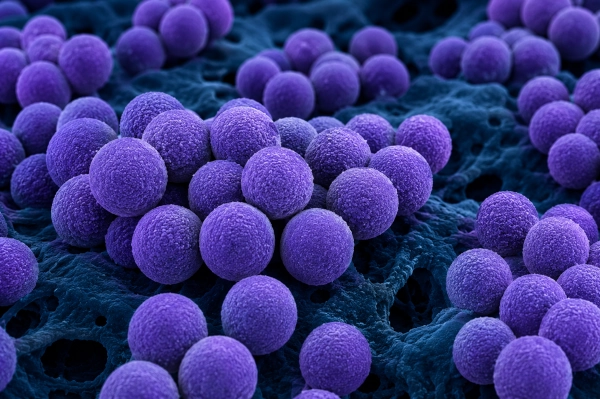
Researchers from IIT Gandhinagar, Jamia Millia Islamia, Jamia Hamdard and partner institutions have identified a promising new way to attack Staphylococcus aureus, one of the bacteria increasingly associated with difficult-to-treat antimicrobial-resistant infections.
Instead of targeting familiar bacterial structures such as the cell wall or protein-making machinery, the researchers focused on a less commonly exploited enzyme called thymidine kinase, or TK, which helps the bacterium obtain the molecular building blocks needed to copy and repair its DNA.
The team designed a series of experimental molecules and identified one compound, DSA3, as the strongest candidate. Laboratory testing showed that DSA3 could bind to the bacterial thymidine kinase enzyme, reduce its activity and inhibit the growth of Staphylococcus aureus.
The result is still at an early research stage, but it provides a proof of concept that thymidine kinase could serve as a fresh molecular target for future antibacterial drugs.
Why Staphylococcus aureus Is an Important Target
Staphylococcus aureus is a common bacterium that can cause infections ranging from relatively minor skin conditions to serious bloodstream, lung, heart and surgical-site infections.
The challenge becomes much greater when strains acquire resistance to widely used antibiotics.
Methicillin-resistant Staphylococcus aureus, better known as MRSA, has become one of the best-known examples of antimicrobial resistance because infections can become resistant to multiple commonly used drugs.
S. aureus also belongs to the ESKAPE group of pathogens, a collection of bacteria known for their ability to “escape” the effects of existing antimicrobial treatments.
That growing resistance is forcing researchers to search for biological targets that current antibiotics have not already exploited extensively.
Targeting the Bacterium’s DNA-Supply System
The IIT Gandhinagar-led research takes such an approach.
Every bacterial cell must continually produce and recycle nucleotides, the chemical building blocks used to construct DNA.
One of the enzymes involved in this process is thymidine kinase.
The enzyme is part of the thymidine salvage pathway, which allows bacteria to recycle thymidine and convert it into forms that can ultimately be used during DNA synthesis.
If thymidine kinase is sufficiently disrupted, the bacterium can struggle to maintain the nucleotide supply required for DNA replication and repair.
This makes TK an attractive target because most conventional antibiotics do not directly attack this pathway.
Earlier research had already suggested that thymidine kinase is important for bacterial survival. The availability of a detailed crystal structure of the S. aureus enzyme gave the researchers another advantage: they could examine its three-dimensional architecture and identify specific pockets where a new molecule might bind.
The structural work was led by Prof. Md. Imtaiyaz Hassan of Jamia Millia Islamia, who is co-corresponding author of the study.
Nine Molecules Designed, DSA3 Emerges as Strongest
Rather than simply reproducing compounds already known to interact with thymidine kinase, the researchers designed a new family of molecules.
The compounds combined two chemical elements frequently associated with antibacterial activity: a thiazole ring and a sulfonamide group.
Nine candidate molecules were synthesised and evaluated.
Among them, an iodo- and trifluoromethyl-substituted compound named DSA3 showed the strongest overall performance.
Computer-based molecular docking was first used to predict how each molecule might fit into the thymidine kinase structure.
DSA3 showed particularly strong predicted binding inside the enzyme’s ATP-binding pocket.
That region is critical because ATP provides chemical energy required for the enzyme to perform its normal function. Blocking the pocket can therefore interfere with the enzymatic process.
Longer molecular-dynamics simulations also indicated that DSA3 remained positioned within the target region while the enzyme retained a stable overall structure.
Laboratory Experiments Confirm Enzyme Inhibition
The researchers then moved beyond computer simulations to laboratory testing.
Experiments showed that DSA3 could physically interact with thymidine kinase and reduce its activity.
A concentration of approximately 6.996 micromolar reduced enzyme activity by half, providing direct evidence that the compound was inhibiting its intended target.
The researchers also used fluorescence measurements to examine changes in the protein after exposure to DSA3.
A second experimental technique, isothermal titration calorimetry, measured the small heat changes produced when the molecule and enzyme interacted.
Together, these results supported the computational prediction that DSA3 forms a stable interaction with bacterial thymidine kinase.
DSA3 Also Inhibits the Bacterium Itself
An enzyme inhibitor becomes medically interesting only if blocking the molecular target also affects the living bacterium.
The researchers therefore tested DSA3 directly against Staphylococcus aureus.
The experimental molecule inhibited bacterial growth in laboratory cultures, and at a higher concentration it was able to kill bacterial cells.
The researchers also observed a substantial fall in the number of viable bacteria at the concentration required to inhibit growth.
These results provide an important proof of concept that disabling thymidine kinase can translate into measurable antibacterial activity.
However, the researchers are careful not to describe DSA3 as a new antibiotic ready for use.
DSA3 Is a Starting Scaffold, Not a Medicine
Dr. Rajesh K. Hadiya, co-first author of the work and a former IIT Gandhinagar PhD scholar, described DSA3 as a proof of concept and starting scaffold rather than a drug.
That distinction is important.
Many molecules that kill bacteria in laboratory experiments never become medicines. A viable antibiotic must demonstrate not only antibacterial activity but also sufficient potency, safety, stability, selectivity and the ability to function effectively inside a living organism.
The researchers say several major steps are still necessary.
DSA3 must first be chemically optimised so that lower concentrations can produce stronger antibacterial effects.
It must also be tested against clinical isolates of resistant bacteria, including strains collected from actual infections rather than laboratory reference strains.
Another critical question is selectivity.
Humans also possess thymidine kinase enzymes. Any future antibacterial compound must therefore preferentially inhibit the bacterial version without significantly disrupting equivalent enzymes in human cells.
Animal studies would subsequently be required before any consideration of human testing.
A New Strategy Against Antimicrobial Resistance
The broader importance of the study lies in the choice of target.
Many traditional antibiotic classes repeatedly attack a relatively small number of bacterial systems.
Beta-lactam antibiotics interfere with cell-wall synthesis. Other drugs affect bacterial ribosomes and protein production, DNA replication or selected metabolic pathways.
Because these mechanisms have been used for decades, bacteria have had enormous evolutionary opportunities to develop countermeasures.
They may alter the antibiotic’s target, pump the drug out of the cell, break it down with specialised enzymes or prevent it from reaching the intended target.
Targeting a biological pathway that has received comparatively little antibiotic pressure may offer a different starting point.
Thymidine kinase therefore represents what researchers describe as an underutilised antibacterial target.
That does not guarantee resistance will never emerge. Bacteria can eventually adapt to almost any sustained antimicrobial pressure. But new targets can expand the number of mechanisms available to drug developers and make it more difficult for resistant pathogens to evade every therapeutic option.
Collaboration Across Indian and International Institutions
The study brought together researchers from several institutions.
IIT Gandhinagar researchers worked with scientists from Jamia Millia Islamia, Jamia Hamdard, Xi’an Jiaotong-Liverpool University and Ahmedabad-based Sushen Medicamentos.
The project was led by corresponding author Prof. Bhaskar Datta, affiliated with IIT Gandhinagar’s Departments of Chemistry and Biological Sciences and Engineering, alongside Prof. Md. Imtaiyaz Hassan of Jamia Millia Islamia.
The research was funded by the Indian Council of Medical Research–Department of Health Research and published in the journal Chemistry & Biodiversity.
The collaboration combined structural biology, medicinal chemistry, computational modelling, microbiology and biophysical analysis — the kind of multidisciplinary approach increasingly required in modern drug discovery.
India Has a Major Stake in New Antibiotic Development
The research is particularly relevant for India because South Asia is expected to bear a disproportionate share of the future burden from antimicrobial resistance.
Drug-resistant infections become more difficult and expensive to treat and can turn routine medical procedures into higher-risk interventions.
Antibiotics are essential not only for treating infections but also for supporting surgery, intensive care, cancer chemotherapy, transplantation and many other areas of modern medicine.
If resistance continues increasing while development of new antibiotics remains slow, the effectiveness of many medical treatments could gradually decline.
This is why discovering new bacterial targets is becoming as important as developing new versions of existing antibiotic classes.
From Molecular Weakness to Potential Drug Platform
DSA3 itself may or may not ultimately become a medicine.
Its greater value at this stage lies in showing that thymidine kinase can potentially be attacked in a way that measurably weakens and kills Staphylococcus aureus.
Medicinal chemists can now modify the DSA3 molecular structure, attempting to increase potency, improve bacterial selectivity and optimise properties required for use inside the body.
Researchers can simultaneously test the compound against increasingly resistant clinical isolates to determine whether the mechanism retains its effectiveness against bacteria that already evade conventional antibiotics.
If those stages prove successful, DSA3 or molecules derived from it could eventually form a new family of antibacterial candidates.
The work therefore does not represent a new antibiotic ready for hospitals. It represents something earlier but scientifically important: a new molecular doorway into one of medicine’s most difficult antimicrobial-resistance problems.
By identifying thymidine kinase as an actionable weakness and demonstrating that DSA3 can interfere with the enzyme and suppress bacterial growth, the IIT Gandhinagar-led team has provided a foundation on which a new antibacterial strategy may eventually be built.
You may also like
-
PGIMER, IIT Ropar and ISRO Plan Microgravity Research Laboratory to Advance India’s Human Spaceflight Medicine
-
New Technology Provides Environment Friendly Route for Treating Dye-Contaminated Wastewater
-
Large- and Small-scale Magnetic Activity Driving Microwave Polar Brightening in the Sun
-
Molecular Geometry Tweak Opens New Way for Smart Biomaterials
-
ISRO’s Indo-French TRISHNA Satellite Enters Advanced Development Stage, Launch Expected in 2027–28
