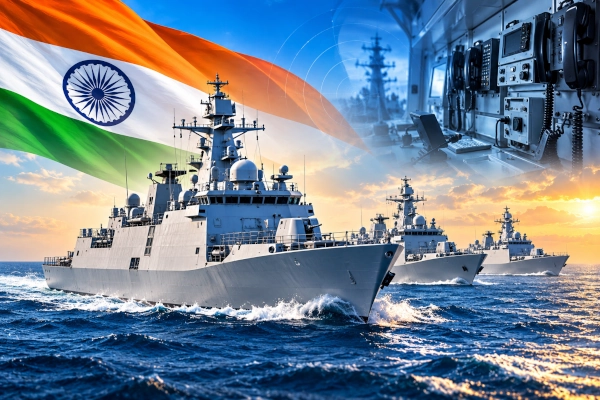
The Indian Navy has initiated the procurement of communication equipment for its indigenously built Kamorta-class anti-submarine warfare (ASW) corvettes under Project 28. The procurement initiative focuses on strengthening onboard communication infrastructure and supporting the operational readiness of these frontline warships, which play an important role in India’s maritime security and underwater surveillance operations.
According to procurement details published through the Government e-Marketplace (GeM), the Ministry of Defence, through the Indian Navy, issued a tender on September 1, 2026, for internal communication systems and associated equipment for Project 28 vessels. The requirement covers communication equipment, onboard spares, base and depot spares, and related testing provisions.
The procurement represents a step towards maintaining and enhancing the communication capabilities of the Kamorta-class corvettes. These vessels form an important component of the Indian Navy’s anti-submarine warfare capabilities and operate with integrated sensors, weapons and communication systems designed for modern naval operations.
Indian Navy Issues Tender for Project 28 Communication Systems
The Indian Navy’s procurement requirement, identified under GeM , concerns the supply of internal communication systems for Project 28-class warships.
The tender carries the request for an aggregate procurement quantity of 14 units across the specified items. The requirement includes the internal communication system, onboard spares, base and depot spares, and provisions for type-testing charges where applicable.
The procurement is associated with the Indian Navy’s establishment at Visakhapatnam, which serves as the headquarters of the Eastern Naval Command and an important operational and maintenance centre for India’s eastern fleet.
The inclusion of onboard and depot-level spares highlights the importance of supporting communication equipment throughout its operational service life. Maintaining adequate spare parts and technical support arrangements helps naval maintenance organisations sustain equipment availability during deployments and scheduled maintenance.
The tender also provides for technical qualification and testing, supporting the Navy’s requirement for communication equipment suitable for demanding maritime environments.
Strengthening Internal Communication Capabilities of Warships
Internal communication systems play a critical role in coordinating activities across different sections of a naval vessel. Warships depend on reliable communication between the bridge, operations room, machinery compartments, damage-control stations and other operational areas.
During anti-submarine warfare operations, effective internal communication allows personnel responsible for navigation, underwater surveillance, combat systems and ship handling to coordinate their activities.
Communication equipment must also support routine shipboard operations, including engineering maintenance, safety procedures, emergency response and damage-control activities.
Modern naval vessels operate in environments where communication equipment must withstand vibration, continuous machinery operation, temperature variations and maritime conditions. Equipment reliability and maintainability therefore remain important considerations in sustaining operational readiness.
The procurement of communication systems and associated spares for the Kamorta class supports the maintenance and improvement of these essential onboard capabilities.
Kamorta-Class Corvettes Form the Backbone of Indigenous ASW Capabilities
The Kamorta-class corvettes were developed under the Indian Navy’s Project 28 programme as specialised anti-submarine warfare vessels.
Designed by the Indian Navy’s Directorate of Naval Design and constructed by Garden Reach Shipbuilders & Engineers Limited (GRSE), Kolkata, the vessels represent an important achievement in India’s indigenous warship development capabilities.
The four ships in the class are INS Kamorta, INS Kadmatt, INS Kiltan and INS Kavaratti. They were commissioned between 2014 and 2020, progressively strengthening the Navy’s ability to undertake anti-submarine warfare and maritime security operations.
According to the Ministry of Defence’s Department of Defence Production, Kamorta-class corvettes incorporate stealth characteristics intended to reduce their detectability during maritime operations.
The vessels also feature design measures that reduce underwater radiated noise, an important consideration for ships conducting anti-submarine warfare missions.
Their specialised design enables them to undertake underwater surveillance, anti-submarine operations and maritime security missions while operating alongside other naval vessels.
Indigenous Warships Equipped with Advanced Sensors and Weapons
The Kamorta-class corvettes incorporate a combination of underwater sensors, surveillance radars, naval weapons and integrated ship management systems.
According to official information published by the Department of Defence Production, these vessels carry torpedo launchers, rocket launchers, naval guns and chaff launchers. Their electronic equipment includes early-warning, navigation and fire-control radars, underwater sensors, integrated communication systems and electronic warfare systems.
The ships also feature facilities for operating a naval helicopter, extending their surveillance and anti-submarine warfare capabilities beyond the immediate vicinity of the vessel.
At approximately 109 metres in length, the corvettes have a maximum speed of around 25 knots and an endurance of approximately 3,450 nautical miles at economical speed, according to the Department of Defence Production’s published specifications.
Their propulsion systems incorporate engineering arrangements designed to minimise underwater noise. This characteristic is particularly valuable during anti-submarine warfare operations, where reducing a ship’s acoustic signature supports its ability to conduct surveillance and detect underwater threats.
The combination of specialised hull design, sensors, weapons and communication equipment makes the Kamorta class an important component of the Indian Navy’s surface-based anti-submarine warfare capability.
Communication Systems Support Anti-Submarine Warfare Operations
Anti-submarine warfare involves the coordinated use of underwater sensors, surveillance equipment, shipboard weapons and, where available, embarked helicopters.
Warships conducting these missions must process information from different systems while maintaining effective communication among personnel responsible for surveillance, navigation and combat operations.
Internal communication equipment provides an essential connection between the teams operating these systems.
For instance, information generated by underwater sensors must reach the appropriate personnel responsible for evaluating contacts and coordinating operational responses. Similarly, the bridge and machinery departments must maintain communication to execute manoeuvres and support ship operations.
Reliable internal communication also contributes to crew safety by allowing instructions and emergency information to reach different compartments quickly.
By procuring communication equipment for the Kamorta class, the Indian Navy is addressing an important element of the shipboard infrastructure that supports these operational requirements.
Eastern Naval Command Plays a Major Role in Maritime Security
The Eastern Naval Command, headquartered at Visakhapatnam, is one of the Indian Navy’s principal operational commands and plays a significant role in safeguarding India’s maritime interests.
Its responsibilities extend across India’s eastern seaboard and the wider maritime areas of strategic importance in the Bay of Bengal and eastern Indian Ocean.
Visakhapatnam also hosts major naval maintenance, logistics and operational support infrastructure, making it an important centre for sustaining the readiness of warships deployed in the region.
The Kamorta-class corvettes have longstanding operational links with the Eastern Naval Command. INS Kamorta, the lead ship of the class, was commissioned at Visakhapatnam on August 23, 2014.
INS Kadmatt followed on January 7, 2016, while INS Kiltan entered service on October 16, 2017. INS Kavaratti, the fourth and final vessel of the class, was commissioned at Visakhapatnam on October 22, 2020.
Together, these four indigenously designed and constructed vessels strengthened the Navy’s ability to conduct specialised anti-submarine warfare operations.
The procurement of communication equipment for Project 28 vessels forms part of the continuing logistical and technical support required to sustain these capabilities.
Project 28 Demonstrates India’s Indigenous Naval Engineering Capabilities
Project 28 occupies an important position in India’s naval indigenisation programme because it brought together domestic ship design, specialised steel manufacturing, propulsion engineering, stealth technologies and combat system integration.
The Ministry of Defence has highlighted the high indigenous content achieved in the Kamorta-class programme. During the commissioning of INS Kavaratti in October 2020, the government stated that the vessel incorporated up to 90% indigenous content.
The programme also demonstrated India’s progress in using domestically developed warship-grade steel, including DMR 249A, and advanced composite materials in naval construction.
The third and fourth ships incorporated composite superstructures, representing an important development in indigenous warship design and manufacturing.
Garden Reach Shipbuilders & Engineers played a central role in constructing these vessels, working with the Indian Navy’s design establishment and domestic equipment manufacturers.
The experience gained through Project 28 has contributed to India’s wider naval shipbuilding capabilities, particularly in constructing specialised warships with advanced engineering and combat systems.
Sustaining these vessels through equipment procurement, maintenance support and technological improvements remains an important part of protecting the investment made in indigenous naval platforms.
Supporting Operational Readiness Through Equipment Modernisation
The continued effectiveness of a warship depends not only on its original design and weapons but also on the reliability of its supporting systems.
Communication equipment, electrical infrastructure, machinery, navigation systems and onboard support arrangements all require periodic maintenance and replacement as part of normal naval operations.
The Indian Navy’s procurement of internal communication systems for Project 28 vessels reflects this continuing requirement to sustain equipment readiness.
The associated provisions for onboard and depot spares also support long-term maintenance planning. Such arrangements help technical personnel undertake repairs and restore equipment availability when necessary.
Strengthening the supporting infrastructure of existing warships allows the Navy to preserve their operational capabilities while new vessels and technologies enter service.
The initiative is particularly relevant to the Kamorta class because these corvettes are specialised platforms designed for demanding anti-submarine warfare missions.
Strengthening India’s Maritime Defence Capabilities
India continues to expand its maritime defence capabilities through indigenous shipbuilding, advanced naval technologies and the maintenance of existing operational platforms.
The Kamorta-class corvettes remain an important example of the country’s progress in designing and constructing sophisticated anti-submarine warfare vessels.
The latest communication equipment procurement supports the continued operational readiness of these warships by addressing an essential element of their onboard infrastructure.
As the Indian Navy develops new surface combatants, submarines and maritime surveillance capabilities, sustaining the effectiveness of established platforms remains equally important.
The procurement initiative for Project 28 vessels reinforces this approach by supporting reliable shipboard communications, maintenance preparedness and the long-term operational effectiveness of India’s indigenous anti-submarine warfare corvettes.
References
1. Government e-Marketplace (GeM), Government of India
Organisation: Ministry of Defence, Department of Military Affairs, Indian Navy
Tender Number: GEM/2026/B/7826091
Tender Date: September 1, 2026
Description: Procurement of N5840-TV00060 Internal Communication System for P28 Class of Ships, Onboard Spares, Base and Depot Spares, and Type-Testing Provisions.
Official Portal: https://bidplus.gem.gov.in/all-bids
2. Department of Defence Production, Ministry of Defence
Title: Anti Submarine Warfare Corvette — Kamorta Class
Details: Official product description, manufacturer, technical specifications, weapons, sensors and integrated communication systems.
https://www.ddpmod.gov.in/hi/node/7492
3. Press Information Bureau, Ministry of Defence
Date: August 23, 2014
Title: First Indigenously Built Stealth Anti-Submarine Warfare Ship — INS Kamorta — Commissioned
https://www.pib.gov.in/newsite/PrintRelease.aspx?relid=109004
4. Press Information Bureau, Ministry of Defence
Date: January 7, 2016
Title: Commissioning of INS Kadmatt Marks Yet Another Milestone in Our Journey Towards Self-Reliance and Make in India
https://www.pib.gov.in/newsite/PrintRelease.aspx?relid=134269
5. Press Information Bureau, Ministry of Defence
Date: October 16, 2017
Title: Raksha Mantri Commissions INS Kiltan ASW Stealth Corvette
https://www.pib.gov.in/newsite/erelcontent.aspx?relid=171743
6. Press Information Bureau, Ministry of Defence
Date: October 22, 2020
Title: General Manoj Mukund Naravane Commissions INS Kavaratti
https://www.pib.gov.in/PressReleasePage.aspx?PRID=1666771
7. Press Information Bureau, Ministry of Defence
Date: May 19, 2015
Title: Kavaratti — Fourth Ship of Project 28 (Anti-Submarine Warfare Corvette) Launched at GRSE, Kolkata
https://www.pib.gov.in/newsite/PrintRelease.aspx?relid=121851
You may also like
-
HAL’s Indigenous Light Utility Helicopter Nears Final Certification, First 12 Deliveries Targeted for FY 2027–28
-
Tata Advanced Systems Reportedly Considering LAMV 4×4 Production in Morocco
-
TDB Backs Panacea Medical Technologies to Develop Indigenous 32-Slice CT Scanner in Karnataka
-
India Reportedly Offers Mine-Protected Vehicles to Kenya to Strengthen Defence Cooperation
-
Sigma Advanced Systems and Munitions India Sign MoU for Indigenous 155mm Course-Correction Fuzes
